Calvin S. Kalman - Böcker
Visar alla böcker från författaren Calvin S. Kalman. Handla med fri frakt och snabb leverans.
7 produkter
7 produkter
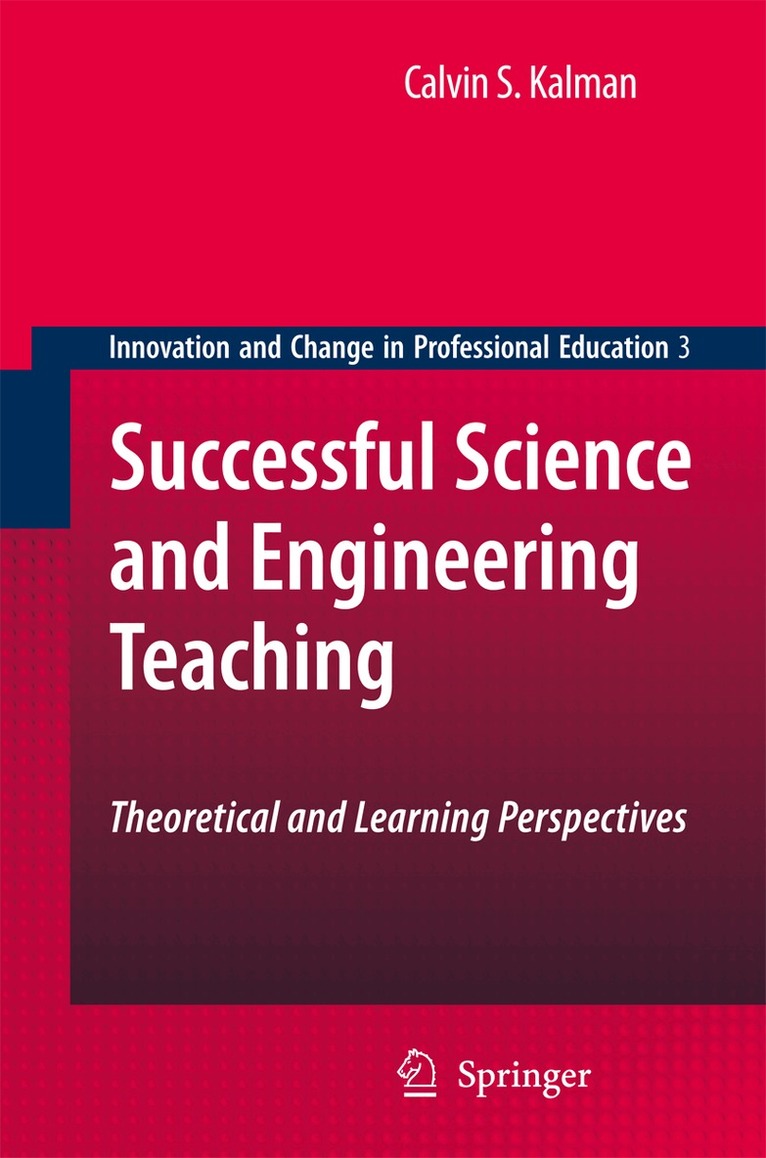
Successful Science and Engineering Teaching
Theoretical and Learning Perspectives
Inbunden, Engelska, 2008
1 369 kr
Skickas inom 5-8 vardagar
The intent of this book is to describe how a professor can provide a learning en vironment that assists students to come to grips with the nature of science and engineering, to understand science and engineering concepts, and to solve problems in science and engineering courses. As such, this book is intended to be useful for any science or engineering professor, who wants to change their course to include more effective teaching methods, to instructors at post-secondary institutions, who are beginning their careers, and as a handbook for TA’s. Since the book is based upon articles that I have had published in Science Educational Research and which are grounded in educational research that I have performed (both quantitative and qualitative) over many years, it will also be of interest to anyone engaged in research into teaching science and engineering at the post-secondary level. I have also tried to include enough background so that the book could be used as a te- book for a course in educational practice in science and engineering. The book has two main axes of development. Firstly, how do we get students to change their epistemology so that their outlook on the course material is not that it consists of a tool kit of assorted practices, classified according to problem type, but rather that the subject comprises a connected structure of concepts. Secondly, he- ing students to have a deeper understanding of science and engineering.
Deep Learning in Introductory Physics
Exploratory Studies of Model Based Reasoning
Häftad, Engelska, 2016
580 kr
Skickas inom 7-10 vardagar
Deep Learning in Introductory Physics: Exploratory Studies of Model-Based Reasoning is concerned with the broad question of how students learn physics in a model-centered classroom. The diverse, creative, and sometimes unexpected ways students construct models, and deal with intellectual conflict, provide valuable insights into student learning and cast a new vision for physics teaching. This book is the first publication in several years to thoroughly address the 'coherence versus fragmentation' debate in science education, and the first to advance and explore the hypothesis that deep science learning is regressive and revolutionary. Deep Learning in Introductory Physics also contributes to a growing literature on the use of history and philosophy of science to confront difficult theoretical and practical issues in science teaching, and addresses current international concern over the state of science education and appropriate standards for science teaching and learning.The book is divided into three parts. Part I introduces the framework, agenda, and educational context of the book. An initial study of student modeling raises a number of questions about the nature and goals of physics education. Part II presents the results of four exploratory case studies. These studies reproduce the results of Part I with a more diverse sample of students; under new conditions (a public debate, peer discussions, and group interviews); and with new research prompts (model-building software, bridging tasks, and elicitation strategies). Part III significantly advances the emergent themes of Parts I and II through historical analysis and a review of physics education research.
Deep Learning in Introductory Physics
Exploratory Studies of Model Based Reasoning
Inbunden, Engelska, 2016
1 025 kr
Skickas inom 7-10 vardagar
Deep Learning in Introductory Physics: Exploratory Studies of Model-Based Reasoning is concerned with the broad question of how students learn physics in a model-centered classroom. The diverse, creative, and sometimes unexpected ways students construct models, and deal with intellectual conflict, provide valuable insights into student learning and cast a new vision for physics teaching. This book is the first publication in several years to thoroughly address the 'coherence versus fragmentation' debate in science education, and the first to advance and explore the hypothesis that deep science learning is regressive and revolutionary. Deep Learning in Introductory Physics also contributes to a growing literature on the use of history and philosophy of science to confront difficult theoretical and practical issues in science teaching, and addresses current international concern over the state of science education and appropriate standards for science teaching and learning.The book is divided into three parts. Part I introduces the framework, agenda, and educational context of the book. An initial study of student modeling raises a number of questions about the nature and goals of physics education. Part II presents the results of four exploratory case studies. These studies reproduce the results of Part I with a more diverse sample of students; under new conditions (a public debate, peer discussions, and group interviews); and with new research prompts (model-building software, bridging tasks, and elicitation strategies). Part III significantly advances the emergent themes of Parts I and II through historical analysis and a review of physics education research.
531 kr
Skickas inom 7-10 vardagar
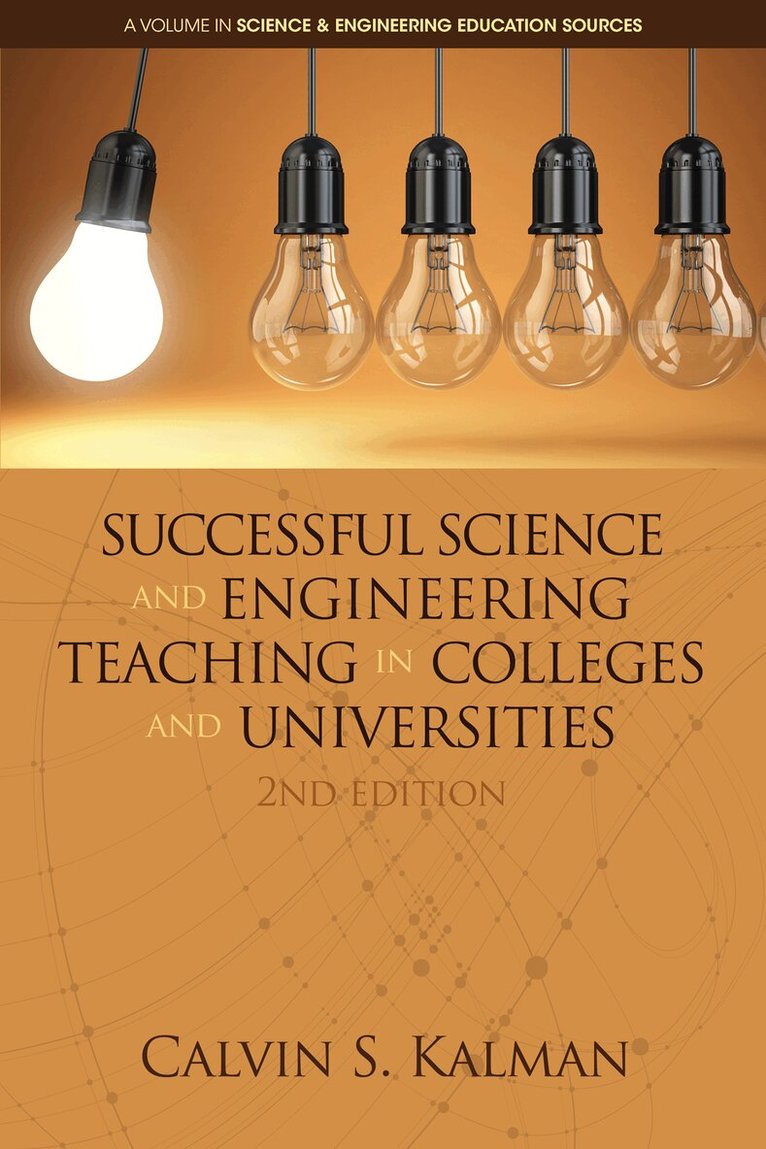
Based on the author's work in science and engineering educational research, this book offers broad, practical strategies for teaching science and engineering courses and describes how faculty can provide a learning environment that helps students comprehend the nature of science, understand science concepts, and solve problems in science courses.This book's student-centered approach focuses on two main themes: writing to learn (especially Reflective Writing) and interactive activities (collaborative groups and labatorials). When faculty incorporate these methods into their courses, students gain a better understanding of science as a connected structure of concepts rather than as a toolkit of assorted practices.
980 kr
Skickas inom 7-10 vardagar
Based on the author's work in science and engineering educational research, this book offers broad, practical strategies for teaching science and engineering courses and describes how faculty can provide a learning environment that helps students comprehend the nature of science, understand science concepts, and solve problems in science courses.This book's student-centered approach focuses on two main themes: writing to learn (especially Reflective Writing) and interactive activities (collaborative groups and labatorials). When faculty incorporate these methods into their courses, students gain a better understanding of science as a connected structure of concepts rather than as a toolkit of assorted practices.
Del 16 - Innovation and Change in Professional Education
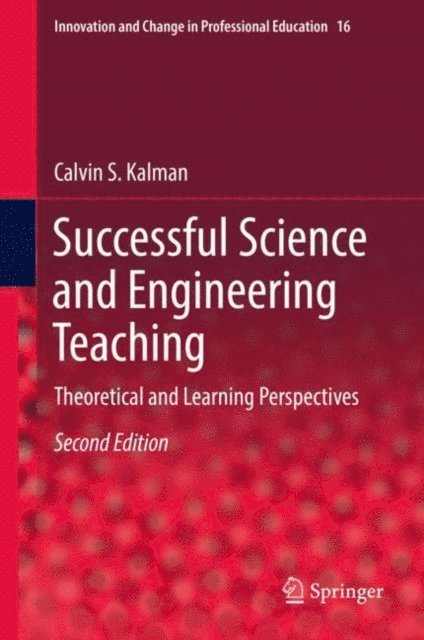
Successful Science and Engineering Teaching
Theoretical and Learning Perspectives
Inbunden, Engelska, 2017
1 061 kr
Skickas inom 10-15 vardagar
This second edition goes beyond the question of whether or not a pedagogical technique is effective, towards more of a focus on answering the question of why a particular technique or class of techniques is effective. In particular it is shown that students’ epistemological beliefs could become more expert-like with a combination of appropriate instructional activities. The debate in the science education community between those who believe that students come in to the classroom with a theory about the subject which is different from that described by the teacher and their textbooks and those who feel that students’ knowledge consists of isolated structures is elaborated especially in the light of the work by M.J. Lattery. Discussion of the stages in epistemic development in students beginning with the Perry model and continuing through later developments is now included. In this edition there is a discussion of how an instructor can enable the student to resolve cognitive dissonance in the difficulties students have in transcending their misconceptions. The second edition includes research comparing Peer Instruction with the Conceptual Conflict Collaborative Group Activity that had been described in the first edition. Much better instructions are available for students on how to use Reflective Writing including a rubric that simplifies the marking of Reflective Writing.
727 kr
Skickas inom 5-8 vardagar
There are a number of unanswered questions which indicate that the Standard Model, successful as it is, cannot be the entire story. One solution to answering these questions is that the Standard Model is an effective low-energy theory of structure hopefully nearby in its energy scale in much the same way that a model of strong interactions among nucleons mediated by pions is an effective theory for the strong interactions of quarks mediated by coloured gluons. This book reviews the Standard Model and then examines the current status of composite models. After developing criteria for judging such models the text discusses two of the major indicators of compositeness, triviality and naturalness. Using this framework as a background the various models are summarized and discussed. This monograph concludes with a chapter describing the constraints imposed on composite models by current measurements of decay rates, magnetic moment measurements, flavour changing processes etc. and describing other ways to look for signatures of compositeness.This monograph attempts to be thorough, covering all aspects of composite models, as found in the literature at the time of completion of the manuscript. As such it should be of interest to any experimental or theoretical physicist having an interest in the subject. The review of the Standard Model in the first chapter is written in such a way that anyone with a basic knowledge of Quantum Field Theory should be able to understand the entire text. As such it could also be used for supplementary reading in graduate courses.