• Fri frakt över 249 kr
  • •
  • Snabba leveranser
  • •
  • Billiga böcker
Kundservice

Du är på sajten för privatpersoner.

Företag, bibliotek eller offentlig verksamhet?

Du handlar på classic.bokus.com, där alla dina funktioner finns intakta.
Till classic.bokus.com
Bokus logotyp. Gå till startsidan.
  • Erbjudanden
  • Nyheter
  • Student
  • Topplistor
  • Barn & ungdom
  • Bokus Play
  • E-böcker
  • Pocketböcker
  • Spel & pussel

10% rabatt på allt med kod: NYSTART10 →

Sidfot

Mina sidor

    Hjälp

    • Kundservice
    • Vanliga frågor och svar
    • Frakt och leverans
    • Retur vid ångerrätt
    • Reklamera vara
    • Betalning
    • Köpvillkor
    • Allmänna villkor
    • Information om webbplatsens tillgänglighet

    Om Bokus

    • Om oss
    • Pressrum
    • För studenter
    • För företag
    • För bibliotek och offentlig verksamhet
    • För leverantörer
    • Hållbarhet

    Populärt

    • Aktuella erbjudanden
    • Presentkort
    • Studentlitteratur
    • Nya böcker
    • Topplistor
    • Signerade böcker
    • Engelska böcker

    Inspiration

    • Boktips
    • BookTok
    • Populära bokserier
    • Barnbokskaraktärer
    • Populära författare
    Logotyp för Bokus
    Följ oss på Facebook (extern länk)Följ oss på Instagram (extern länk)Följ oss på YouTube (extern länk)Följ oss på TikTok (extern länk)
    bokus @ CookiesAnpassa cookiesIntegritetspolicyKöpvillkor
    Till Citymail hemsida (extern länk)Till Budbee hemsida (extern länk)Till Postnord hemsida (extern länk)Till Schenker hemsida (extern länk)Till Early Bird hemsida (extern länk)Till Walleys hemsida (extern länk)
    1. Psykologi och pedagogik
    2. Pedagogik
    3. Undervisning i specifika ämnen

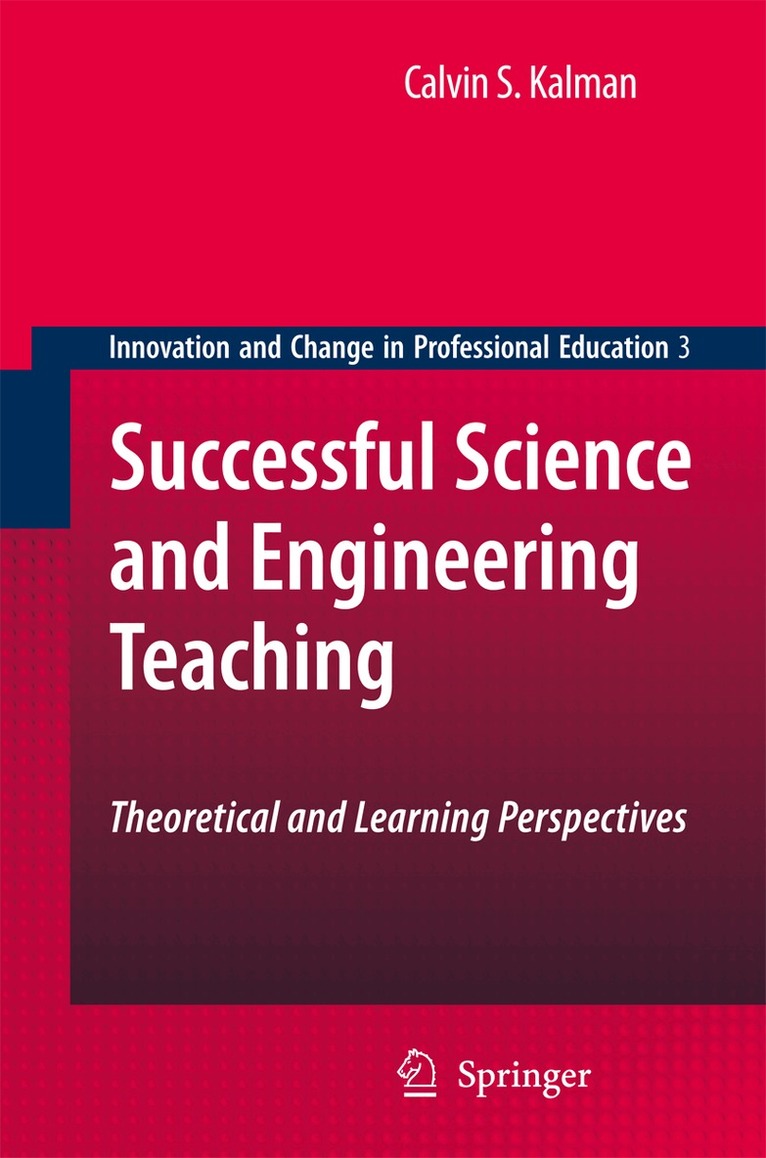
    Successful Science and Engineering Teaching

    Theoretical and Learning Perspectives

    AvCalvin S. Kalman

    Inbunden, Engelska, 2008

    Del i serien Innovation and Change in Professional Education

    1 394 kr

    Beställningsvara. Skickas inom 5-8 vardagar. Fri frakt över 249 kr.

    Fler format och utgåvor

    E-bok

    1 413 kr

    Inbunden

    1 086 kr

    E-bok

    1 373 kr

    Beskrivning

    The intent of this book is to describe how a professor can provide a learning en vironment that assists students to come to grips with the nature of science and engineering, to understand science and engineering concepts, and to solve problems in science and engineering courses. As such, this book is intended to be useful for any science or engineering professor, who wants to change their course to include more effective teaching methods, to instructors at post-secondary institutions, who are beginning their careers, and as a handbook for TA’s. Since the book is based upon articles that I have had published in Science Educational Research and which are grounded in educational research that I have performed (both quantitative and qualitative) over many years, it will also be of interest to anyone engaged in research into teaching science and engineering at the post-secondary level. I have also tried to include enough background so that the book could be used as a te- book for a course in educational practice in science and engineering. The book has two main axes of development. Firstly, how do we get students to change their epistemology so that their outlook on the course material is not that it consists of a tool kit of assorted practices, classified according to problem type, but rather that the subject comprises a connected structure of concepts. Secondly, he- ing students to have a deeper understanding of science and engineering.

    Produktinformation

    • Utgivningsdatum:2008-04-14
    • Mått:155 x 235 x undefined mm
    • Vikt:432 g
    • Format:Inbunden
    • Språk:Engelska
    • Serie:Innovation and Change in Professional Education
    • Antal sidor:192
    • Upplaga:2008
    • Förlag:Springer-Verlag New York Inc.
    • ISBN:9781402069093

    Utforska kategorier

    • Undervisning i specifika ämnen inom Psykologi och pedagogik
    • Högskola och universitet inom Psykologi och pedagogik

    Innehållsförteckning

    • How Students Learn Science.- Intellectual Development and Psychological Types.- Students Alternative Scientific Conceptions.- Writing to Learn: Reflective Writing.- Changing Student's Epistemologies.- Getting Students to Examine Their Epistemology.- Critical Thinking.- Educational Models Based upon Philosophy of Science.- Changing Student's Epistemologies.- Final Thoughts.- Courses for Non-science Students.- Computer Assisted Instruction.- Summing Up.