Carmine Bianchi - Böcker
Visar alla böcker från författaren Carmine Bianchi. Handla med fri frakt och snabb leverans.
9 produkter
9 produkter
Public Service Logic and Public Service Reform
State of the Art, New Perspectives, and Future Directions
Inbunden, Engelska, 2025
2 098 kr
Skickas inom 10-15 vardagar
This book extends and develops the theoretical framework of Public Service Logic (PSL). This framework has become established as one of the major frameworks for the delivery of public services. It draws upon and adapts the service management literature to present an understanding of public services as ‘services’, with significant implication both for public administration and management theory and research and for public policy and public service management practice. It shifts the focus away from a pre- occupation with the production of public services alone and rather explores the way in which they add value to both citizens and society – and what such ‘value’ may comprise. This edited volume challenges the product- dominant assumptions of the New Public Management (NPM) about the nature and management of public service delivery and will bring together the ‘state of the art’ in the development of PSL theory by leading researchers in the field.It will be of interest to researchers and academics in the field of public management, as well as to students studying public management and administration around the world. It will also engage with thoughtful and critical practitioners.
Del 4 - System Dynamics for Performance Management & Governance
Enabling Collaborative Governance through Systems Modeling Methods
Public Policy Design and Implementation
Inbunden, Engelska, 2020
1 069 kr
Skickas inom 10-15 vardagar
This volume constitutes a first approximation for the use of systems approaches and dynamic performance management as tools for collaborative governance. The explicit connection between resources and outcomes promoted by this view helps managers to understand better how to improve policy and to create positive outcomes that create public value.
Del 4 - System Dynamics for Performance Management & Governance
Enabling Collaborative Governance through Systems Modeling Methods
Public Policy Design and Implementation
Häftad, Engelska, 2021
1 069 kr
Skickas inom 10-15 vardagar
This volume constitutes a first approximation for the use of systems approaches and dynamic performance management as tools for collaborative governance. The explicit connection between resources and outcomes promoted by this view helps managers to understand better how to improve policy and to create positive outcomes that create public value.
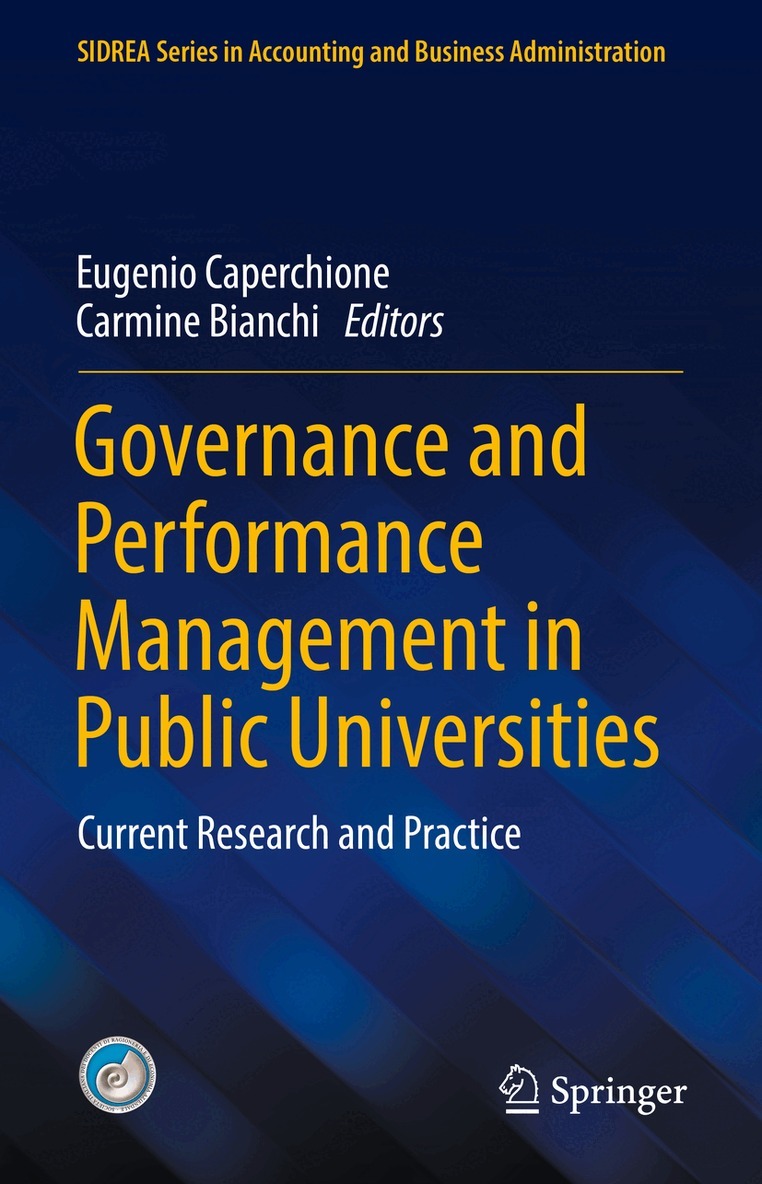
Governance and Performance Management in Public Universities
Current Research and Practice
Inbunden, Engelska, 2022
1 532 kr
Skickas inom 10-15 vardagar
This edited volume contributes to the ongoing research and practice on applying performance management to university governance. A specific focus is also placed on using performance governance applied to higher education institutions' Third Mission, and on enhancing decision makers’ ability to frame dynamic complexity.
Governance and Performance Management in Public Universities
Current Research and Practice
Häftad, Engelska, 2023
1 532 kr
Skickas inom 10-15 vardagar
This edited volume contributes to the ongoing research and practice on applying performance management to university governance. A specific focus is also placed on using performance governance applied to higher education institutions' Third Mission, and on enhancing decision makers’ ability to frame dynamic complexity.
Del 1 - System Dynamics for Performance Management & Governance
Dynamic Performance Management
Inbunden, Engelska, 2016
1 095 kr
Skickas inom 10-15 vardagar
This book explores how to design and implement planning & control (P&C) systems that can help organizations to manage their growth and restructuring processes in a sustainability perspective. The book is not designed to enable the reader to become an experienced system dynamics modeler; rather, it aims to develop the reader’s capabilities to design and implement performance management systems by using a system dynamics approach. More specifically, the book shows how to develop system dynamics models that can better support an understanding of:-What is organizational performance and how to frame and measure it;-How to identify and map the processes underlying performance;-How to design and implement a dynamic performance management system and link it to strategic planning;-How to tie strategic resource dynamics to processes and performance indicators;-How to link strategic resources, and performance indicators to responsibility andincentive systems.Using a dynamic performance management approach can improve an organization’s capability to understand and manage the forces driving performance over time, as well as set goals and objectives that may properly and selectively gauge results and match them to the key responsibility areas in the planning process. The dynamic performance management approaches covered in the book are beneficial to performance management analysts, enabling them to frame their professional field within the broader context of the system. The book also includes numerous case studies and dynamic performance management models for providing examples of how dynamic performance management works in practice. In addition, a literature review is included to provide a guideline for further improvements to those readers who wish to develop relevant, specific, and detailed system dynamics modeling skills and to establish the foundation for teaching system dynamics applied to performance management in organizational and inter-organizational contexts. This is particularly relevant for graduate students who have taken system dynamics courses and need to apply their own skills to business and public management.
2 937 kr
Skickas inom 10-15 vardagar
This book highlights the use of an outcome-oriented view of performance to frame and assess the desirability of the effects produced by adopted policies, so to allow governments not only to consider effects in the short, but also the long run. Furthermore, it does not only focus on policy from the perspective of a single unit or institution, but also under an inter-institutional viewpoint. This book features theoretical and empirical research on how public organizations have evolved their performance management systems toward outcome measures that may allow one to better deal with wicked problems. Today, ‘wicked problems’ characterize most of governmental planning involving social issues. These are complex policy problems, underlying high risk and uncertainty, and a high interdependency among variables affecting them. Such problems cannot be clustered within the boundaries of a single organization, or referred to specific administrative levels or ministries. They are characterized by dynamic complexity, involving multi-level, multi-actor and multi-sectoral challenges. In the last decade, a number of countries have started to develop new approaches that may enable to improve cohesion, to effectively deal with wicked problems. The chapters in this book showcase these approaches, which encourage the adoption of more flexible and pervasive governmental systems to overcome such complex problems. Outcome-Based Performance Management in the Public Sector is divided into five parts. Part 1 aims at shedding light on problems and issues implied in the design and implementation of “outcome-based” performance management systems in the public sector.Then Part 2 illustrates the experiences, problems, and evolving trends in three different countries (Scotland, USA, and Italy) towards the adoption of outcome-based performance management systems in the public sector. Such analyses are conducted at both the national and local government levels. The third part ofthe book frames how outcome-based performance management can enhance public governance and inter-institutional coordination. Part 4 deals with the illustration of challenges and results from different public sector domains. Finally the book concludes in Part 5 as it examines innovative methods and tools that may support decision makers in dealing with the challenges of outcome-based performance management in the public sector. Though the book is specifically focused on a research target, it will also be useful to practitioners and master students in public administration .
Del 1 - System Dynamics for Performance Management & Governance
Dynamic Performance Management
Häftad, Engelska, 2018
1 064 kr
Skickas inom 10-15 vardagar
This book explores how to design and implement planning & control (P&C) systems that can help organizations to manage their growth and restructuring processes in a sustainability perspective. The book is not designed to enable the reader to become an experienced system dynamics modeler; rather, it aims to develop the reader’s capabilities to design and implement performance management systems by using a system dynamics approach. More specifically, the book shows how to develop system dynamics models that can better support an understanding of:-What is organizational performance and how to frame and measure it;-How to identify and map the processes underlying performance;-How to design and implement a dynamic performance management system and link it to strategic planning;-How to tie strategic resource dynamics to processes and performance indicators;-How to link strategic resources, and performance indicators to responsibility andincentive systems.Using a dynamic performance management approach can improve an organization’s capability to understand and manage the forces driving performance over time, as well as set goals and objectives that may properly and selectively gauge results and match them to the key responsibility areas in the planning process. The dynamic performance management approaches covered in the book are beneficial to performance management analysts, enabling them to frame their professional field within the broader context of the system. The book also includes numerous case studies and dynamic performance management models for providing examples of how dynamic performance management works in practice. In addition, a literature review is included to provide a guideline for further improvements to those readers who wish to develop relevant, specific, and detailed system dynamics modeling skills and to establish the foundation for teaching system dynamics applied to performance management in organizational and inter-organizational contexts. This is particularly relevant for graduate students who have taken system dynamics courses and need to apply their own skills to business and public management.
2 937 kr
Skickas inom 10-15 vardagar
This book highlights the use of an outcome-oriented view of performance to frame and assess the desirability of the effects produced by adopted policies, so to allow governments not only to consider effects in the short, but also the long run. Furthermore, it does not only focus on policy from the perspective of a single unit or institution, but also under an inter-institutional viewpoint. This book features theoretical and empirical research on how public organizations have evolved their performance management systems toward outcome measures that may allow one to better deal with wicked problems. Today, ‘wicked problems’ characterize most of governmental planning involving social issues. These are complex policy problems, underlying high risk and uncertainty, and a high interdependency among variables affecting them. Such problems cannot be clustered within the boundaries of a single organization, or referred to specific administrative levels or ministries. They are characterized by dynamic complexity, involving multi-level, multi-actor and multi-sectoral challenges. In the last decade, a number of countries have started to develop new approaches that may enable to improve cohesion, to effectively deal with wicked problems. The chapters in this book showcase these approaches, which encourage the adoption of more flexible and pervasive governmental systems to overcome such complex problems. Outcome-Based Performance Management in the Public Sector is divided into five parts. Part 1 aims at shedding light on problems and issues implied in the design and implementation of “outcome-based” performance management systems in the public sector.Then Part 2 illustrates the experiences, problems, and evolving trends in three different countries (Scotland, USA, and Italy) towards the adoption of outcome-based performance management systems in the public sector. Such analyses are conducted at both the national and local government levels. The third part ofthe book frames how outcome-based performance management can enhance public governance and inter-institutional coordination. Part 4 deals with the illustration of challenges and results from different public sector domains. Finally the book concludes in Part 5 as it examines innovative methods and tools that may support decision makers in dealing with the challenges of outcome-based performance management in the public sector. Though the book is specifically focused on a research target, it will also be useful to practitioners and master students in public administration .