Chaomei Chen - Böcker
Visar alla böcker från författaren Chaomei Chen. Handla med fri frakt och snabb leverans.
13 produkter
13 produkter
779 kr
Skickas inom 7-10 vardagar
Theories and practices to assess critical information in a complex adaptive system Organized for readers to follow along easily, The Fitness of Information: Quantitative Assessments of Critical Evidence provides a structured outline of the key challenges in assessing crucial information in a complex adaptive system. Illustrating a variety of computational and explanatory challenges, the book demonstrates principles and practical implications of exploring and assessing the fitness of information in an extensible framework of adaptive landscapes. The book’s first three chapters introduce fundamental principles and practical examples in connection to the nature of aesthetics, mental models, and the subjectivity of evidence. In particular, the underlying question is how these issues can be addressed quantitatively, not only computationally but also explanatorily. The next chapter illustrates how one can reduce the level of complexity in understanding the structure and dynamics of scientific knowledge through the design and use of the CiteSpace system for visualizing and analyzing emerging trends in scientific literature. The following two chapters explain the concepts of structural variation and the fitness of information in a framework that builds on the idea of fitness landscape originally introduced to study population evolution. The final chapter presents a dual-map overlay technique and demonstrates how it supports a variety of analytic tasks for a new type of portfolio analysis. The Fitness of Information: Quantitative Assessments of Critical Evidence also features: In-depth case studies and examples that characterize far-reaching concepts, illustrate underlying principles, and demonstrate profound challenges and complexities at various levels of analytic reasoningWide-ranging topics that underline the common theme, from the subjectivity of evidence in criminal trials to detecting early signs of critical transitions and mechanisms behind radical patentsAn extensible and unifying framework for visual analytics by transforming analytic reasoning tasks to the assessment of critical evidence The Fitness of Information: Quantitative Assessments of Critical Evidence is a suitable reference for researchers, analysts, and practitioners who are interested in analyzing evidence and making decisions with incomplete, uncertain, and even conflicting information. The book is also an excellent textbook for upper-undergraduate and graduate-level courses on visual analytics, information visualization, and business analytics and decision support systems.
1 101 kr
Skickas inom 10-15 vardagar
This is an examination of the history and the state of the art of the quest for visualizing scientific knowledge and the dynamics of its development. Through an interdisciplinary perspective this book presents profound visions, pivotal advances, and insightful contributions made by generations of researchers and professionals, which portrays a holistic view of the underlying principles and mechanisms of the development of science.This updated and extended second edition:highlights the latest advances in mapping scientific frontiersexamines the foundations of strategies, principles, and design patternsprovides an integrated and holistic account of major developments across disciplinary boundaries“Anyone who tries to follow the exponential growth of the literature on citation analysis and scientometrics knows how difficult it is to keep pace. Chaomei Chen has identified the significant methods and applications in visual graphics and made them clear to the uninitiated. Derek Price would have loved this book which not only pays homage to him but also to the key players in information science and a wide variety of others in the sociology and history of science.”– Eugene Garfield“This is a wide ranging book on information visualization, with a specific focus on science mapping. Science mapping is still in its infancy and many intellectual challenges remain to be investigated and many of which are outlined in the final chapter. In this new edition Chaomei Chen has provided an essential text, useful both as a primer for new entrants and as a comprehensive overview of recent developments for the seasoned practitioner.”– Henry SmallChaomei Chen is a Professor in the College of Information Science and Technology at Drexel University, Philadelphia, USA, and a ChangJiang Scholar at Dalian University of Technology, Dalian,China. He is the Editor-in-Chief of Information Visualization and the author of Turning Points: The Nature of Creativity (Springer, 2012) and Information Visualization: Beyond the Horizon (Springer, 2004, 2006).
1 101 kr
Skickas inom 10-15 vardagar
This is an examination of the history and the state of the art of the quest for visualizing scientific knowledge and the dynamics of its development. Through an interdisciplinary perspective this book presents profound visions, pivotal advances, and insightful contributions made by generations of researchers and professionals, which portrays a holistic view of the underlying principles and mechanisms of the development of science.This updated and extended second edition:highlights the latest advances in mapping scientific frontiersexamines the foundations of strategies, principles, and design patternsprovides an integrated and holistic account of major developments across disciplinary boundaries“Anyone who tries to follow the exponential growth of the literature on citation analysis and scientometrics knows how difficult it is to keep pace. Chaomei Chen has identified the significant methods and applications in visual graphics and made them clear to the uninitiated. Derek Price would have loved this book which not only pays homage to him but also to the key players in information science and a wide variety of others in the sociology and history of science.”– Eugene Garfield“This is a wide ranging book on information visualization, with a specific focus on science mapping. Science mapping is still in its infancy and many intellectual challenges remain to be investigated and many of which are outlined in the final chapter. In this new edition Chaomei Chen has provided an essential text, useful both as a primer for new entrants and as a comprehensive overview of recent developments for the seasoned practitioner.”– Henry SmallChaomei Chen is a Professor in the College of Information Science and Technology at Drexel University, Philadelphia, USA, and a ChangJiang Scholar at Dalian University of Technology, Dalian,China. He is the Editor-in-Chief of Information Visualization and the author of Turning Points: The Nature of Creativity (Springer, 2012) and Information Visualization: Beyond the Horizon (Springer, 2004, 2006).
554 kr
Skickas inom 10-15 vardagar
Information visualization is not only about creating graphical displays of complex and latent information structures; it contributes to a broader range of cognitive, social, and collaborative activities. This is the first book to examine information visualization from this perspective.This 2nd edition continues the unique and ambitious quest for setting information visualization and virtual environments in a unifying framework. Information Visualization: Beyond the Horizon pays special attention to the advances made over the last 5 years and potentially fruitful directions to pursue. It is particularly updated to meet the need for practitioners. The book is a valuable source for researchers and graduate students. This new edition is forwarded by Ben Shneiderman, University of Maryland.
Visualizing Information Using SVG and X3D
XML-based Technologies for the XML-based Web
Häftad, Engelska, 2010
1 632 kr
Skickas inom 10-15 vardagar
This is the first book devoted to both SVG and X3D as a new and universal means of visualizing information. It presents the state-of-the-art research emerging in this novel area and introduces SVG and X3D fundamentals and leading authoring tools. The key topics covered include: - The foundations of SVG and X3D - Data, information, knowledge and network visualization - Advanced and distributed user interfaces - Visualizing metadata and the Semantic Web - Visual interfaces to Web services - New trends and paradigms in publishing and Interactive TV - Displaying geographically referenced data and chemical structures - Advanced use of Adobe Illustrator and X3D-Edit authoring tools This book will be essential reading not only for researchers, Web developers and graduate students but also for undergraduates and everyone who is interested in using the next-generation computer graphics on their websites.
1 101 kr
Skickas inom 10-15 vardagar
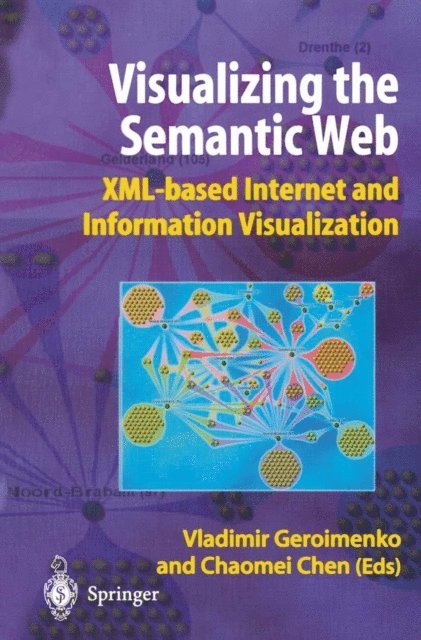
The Semantic Web is a vision that has sparked a wide-ranging enthusiasm for a new generation of the Web. The Semantic Web is happening. The central idea of that vision is to make the Web more understandable to computer programs so that people can make more use of this gigantic asset. The use of metadata (data about data) can clearly indicate the meaning of data on the Web so as to provide computers enough information to handle such data. On the future Web, many additional layers will be required if we want computer programs to handle the semantics (the meaning of data) properly without human - tervention. Such layers should deal with the hierarchical relationships between me- ings, their similarities and differences, logical rules for making new inferences from the existing data and metadata, and so on. Dozens of new technologies have emerged recently to implement these ideas. XML (eXtensible Markup Language) forms the foundation of the future Web, RDF (Resource Description Framework), OWL (Web Ontology Language) and many other technologies help to erect a “multistory” bui- ing of the Semantic Web layer by layer by adding new features and new types of metadata. According to Tim Berners-Lee, the inventor of the current Web and the Semantic Web, it may take up to ten years to complete the building. The new Web will be much more complex than the current one and will contain enormous amounts of metadata as well as data.
554 kr
Skickas inom 10-15 vardagar
Information visualization is not only about creating graphical displays of complex and latent information structures; it contributes to a broader range of cognitive, social, and collaborative activities. This is the first book to examine information visualization from this perspective.This 2nd edition continues the unique and ambitious quest for setting information visualization and virtual environments in a unifying framework. Information Visualization: Beyond the Horizon pays special attention to the advances made over the last 5 years and potentially fruitful directions to pursue. It is particularly updated to meet the need for practitioners. The book is a valuable source for researchers and graduate students. This new edition is forwarded by Ben Shneiderman, University of Maryland.
Visualizing Information Using SVG and X3D
XML-based Technologies for the XML-based Web
Inbunden, Engelska, 2004
1 632 kr
Skickas inom 10-15 vardagar
This is the first book devoted to both SVG and X3D as a new and universal means of visualizing information. It presents the state-of-the-art research emerging in this novel area and introduces SVG and X3D fundamentals and leading authoring tools. The key topics covered include: - The foundations of SVG and X3D - Data, information, knowledge and network visualization - Advanced and distributed user interfaces - Visualizing metadata and the Semantic Web - Visual interfaces to Web services - New trends and paradigms in publishing and Interactive TV - Displaying geographically referenced data and chemical structures - Advanced use of Adobe Illustrator and X3D-Edit authoring tools This book will be essential reading not only for researchers, Web developers and graduate students but also for undergraduates and everyone who is interested in using the next-generation computer graphics on their web sites.
Visualizing the Semantic Web
XML-based Internet and Information Visualization
Inbunden, Engelska, 2005
1 101 kr
Skickas inom 10-15 vardagar
The Semantic Web is a vision that has sparked a wide-ranging enthusiasm for a new generation of the Web. The Semantic Web is happening. The central idea of that vision is to make the Web more understandable to computer programs so that people can make more use of this gigantic asset. The use of metadata (data about data) can clearly indicate the meaning of data on the Web so as to provide computers enough information to handle such data. On the future Web, many additional layers will be required if we want computer programs to handle the semantics (the meaning of data) properly without human - tervention. Such layers should deal with the hierarchical relationships between me- ings, their similarities and differences, logical rules for making new inferences from the existing data and metadata, and so on. Dozens of new technologies have emerged recently to implement these ideas. XML (eXtensible Markup Language) forms the foundation of the future Web, RDF (Resource Description Framework), OWL (Web Ontology Language) and many other technologies help to erect a “multistory” bui- ing of the Semantic Web layer by layer by adding new features and new types of metadata. According to Tim Berners-Lee, the inventor of the current Web and the Semantic Web, it may take up to ten years to complete the building. The new Web will be much more complex than the current one and will contain enormous amounts of metadata as well as data.
718 kr
Skickas inom 10-15 vardagar
This book is written for anyone who is interested in how a field of research evolves and the fundamental role of understanding uncertainties involved in different levels of analysis, ranging from macroscopic views to meso- and microscopic ones. We introduce a series of computational and visual analytic techniques, from research areas such as text mining, deep learning, information visualization and science mapping, such that readers can apply these tools to the study of a subject matter of their choice. In addition, we set the diverse set of methods in an integrative context, that draws upon insights from philosophical, sociological, and evolutionary theories of what drives the advances of science, such that the readers of the book can guide their own research with their enriched theoretical foundations.Scientific knowledge is complex. A subject matter is typically built on its own set of concepts, theories, methodologies and findings, discovered by generations of researchersand practitioners. Scientific knowledge, as known to the scientific community as a whole, experiences constant changes. Some changes are long-lasting, whereas others may be short lived. How can we keep abreast of the state of the art as science advances? How can we effectively and precisely convey the status of the current science to the general public as well as scientists across different disciplines? The study of scientific knowledge in general has been overwhelmingly focused on scientific knowledge per se. In contrast, the status of scientific knowledge at various levels of granularity has been largely overlooked. This book aims to highlight the role of uncertainties, in developing a better understanding of the status of scientific knowledge at a particular time, and how its status evolves over the course of the development of research. Furthermore, we demonstrate how the knowledge of the types of uncertainties associated with scientific claims serves as an integral and critical part of our domain expertise.
740 kr
Skickas inom 10-15 vardagar
How can we effectively and precisely convey the status of the current science to the general public as well as scientists across different disciplines? The study of scientific knowledge in general has been overwhelmingly focused on scientific knowledge per se.
554 kr
Skickas inom 10-15 vardagar
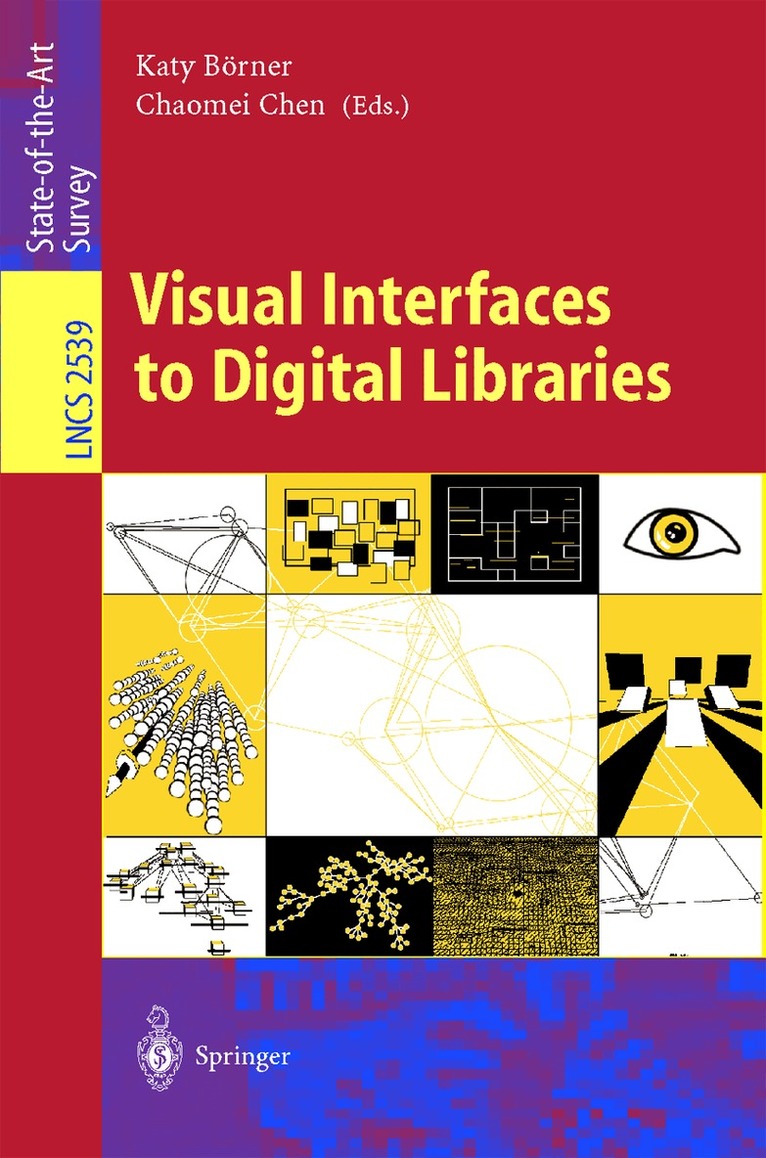
Visual Interfaces to Digital Libraries exploit the power of human vision and spatial cognition to help individuals mentally organize and electronically access and manage large and complex information spaces. They draw on progress in the field of information visualization and seek to shift the users' mental load from slow reading to faster perceptual processes such as visual pattern recognition.Based on two workshops, the book presents an introductory overview as well as a closing listing of the top ten problems in the area by the volume editors. Also included are 16 thoroughly reviewed and revised full papers organized in topical sections on visual interfaces to documents, document parts, document variants, and document usage data; visual interfaces to image and video documents; visualization of knowledge domains; cartographic interfaces to digital libraries; and a general framework.
1 069 kr
Skickas inom 10-15 vardagar
This book focuses on a critical concept of intellectual turning points in the context of critical thinking, scientific discovery, and problem solving. The author presents a novel analytical and experimental system that applies to both past and future data.