Chen Lv – författare
1 278 kr
Skickas inom 10-15 vardagar
Advanced Driver Intention Inference: Theory and Design describes one of the most important function for future ADAS, namely, the driver intention inference. The book contains the state-of-art knowledge on the construction of driver intention inference system, providing a better understanding on how the human driver intention mechanism will contribute to a more naturalistic on-board decision system for automated vehicles.
Features examples of using machine learning/deep learning to build industry products Depicts future trends for driver behavior detection and driver intention inference Discuss traffic context perception techniques that predict driver intentions such as Lidar and GPS1 779 kr
Läs direkt efter köp
2 125 kr
Skickas inom 10-15 vardagar
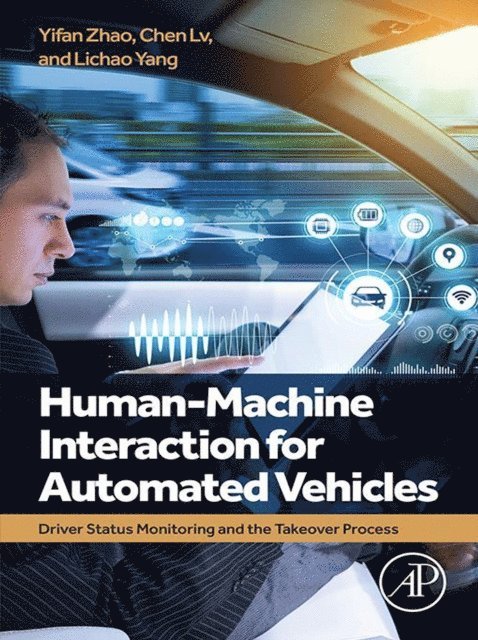
Human-Machine Interaction for Automated Vehicles: Driver Status Monitoring and the Takeover Process explains how to design an intelligent human-machine interface by characterizing driver behavior before and during the takeover process. Multiple solutions are presented to accommodate different sensing technologies, driving environments and driving styles. Depending on the availability and location of the camera, the recognition of driving and non-driving tasks can be based on eye gaze, head movement, hand gesture or a combination. Technical solutions to recognize drivers various behaviors in adaptive automated driving are described with associated implications to the driving quality.
Finally, cutting-edge insights to improve the human-machine-interface design for safety and driving efficiency are also provided, based on the use of this sensing capability to measure drivers' cognition capability.
Covers everything needed to design an effective driver monitoring system, including sensors, areas to monitor, computing devices, and data analysis algorithms Explores aspects of driver behavior that should be considered when designing an intelligent HMI Examines the L3 take-over process in detail3 026 kr
Läs direkt efter köp
706 kr
Läs direkt efter köp
This book details cutting-edge research into human-like driving technology, utilising game theory to better suit a human and machine hybrid driving environment. Covering feature identification and modelling of human driving behaviours, the book explains how to design an algorithm for decision making and control of autonomous vehicles in complex scenarios. Beginning with a review of current research in the field, the book uses this as a springboard from which to present a new theory of human-like driving framework for autonomous vehicles. Chapters cover system models of decision making and control, driving safety, riding comfort and travel efficiency. Throughout the book, game theory is applied to human-like decision making, enabling the autonomous vehicle and the human driver interaction to be modelled using noncooperative game theory approach. It also uses game theory to model collaborative decision making between connected autonomous vehicles. This framework enables human-like decision making and control of autonomous vehicles, which leads to safer and more efficient driving in complicated traffic scenarios.
The book will be of interest to students and professionals alike, in the field of automotive engineering, computer engineering and control engineering.
706 kr
Läs direkt efter köp
This book details cutting-edge research into human-like driving technology, utilising game theory to better suit a human and machine hybrid driving environment. Covering feature identification and modelling of human driving behaviours, the book explains how to design an algorithm for decision making and control of autonomous vehicles in complex scenarios. Beginning with a review of current research in the field, the book uses this as a springboard from which to present a new theory of human-like driving framework for autonomous vehicles. Chapters cover system models of decision making and control, driving safety, riding comfort and travel efficiency. Throughout the book, game theory is applied to human-like decision making, enabling the autonomous vehicle and the human driver interaction to be modelled using noncooperative game theory approach. It also uses game theory to model collaborative decision making between connected autonomous vehicles. This framework enables human-like decision making and control of autonomous vehicles, which leads to safer and more efficient driving in complicated traffic scenarios.
The book will be of interest to students and professionals alike, in the field of automotive engineering, computer engineering and control engineering.
1 477 kr
Skickas inom 10-15 vardagar
728 kr
Skickas inom 10-15 vardagar
362 kr
Skickas inom 10-15 vardagar
443 kr
Läs direkt efter köp
562 kr
Skickas inom 10-15 vardagar
734 kr
Läs direkt efter köp
This book offers a systematic, comprehensive, and timely review on V-HAR, and it covers the related tasks, cutting-edge technologies, and applications of V-HAR, especially the deep learning-based approaches. The field of Human Activity Recognition (HAR) has become one of the trendiest research topics due to the availability of various sensors, live streaming of data and the advancement in computer vision, machine learning, etc. HAR can be extensively used in many scenarios, for example, medical diagnosis, video surveillance, public governance, also in human–machine interaction applications. In HAR, various human activities such as walking, running, sitting, sleeping, standing, showering, cooking, driving, abnormal activities, etc., are recognized. The data can be collected from wearable sensors or accelerometer or through video frames or images; among all the sensors, vision-based sensors are now the most widely used sensors due to their low-cost, high-quality, and unintrusivecharacteristics. Therefore, vision-based human activity recognition (V-HAR) is the most important and commonly used category among all HAR technologies.
The addressed topics include hand gestures, head pose, body activity, eye gaze, attention modeling, etc. The latest advancements and the commonly used benchmark are given. Furthermore, this book also discusses the future directions and recommendations for the new researchers.