Christoph Bussler – författare
Visar alla böcker från författaren Christoph Bussler. Handla med fri frakt och snabb leverans.
28 produkter
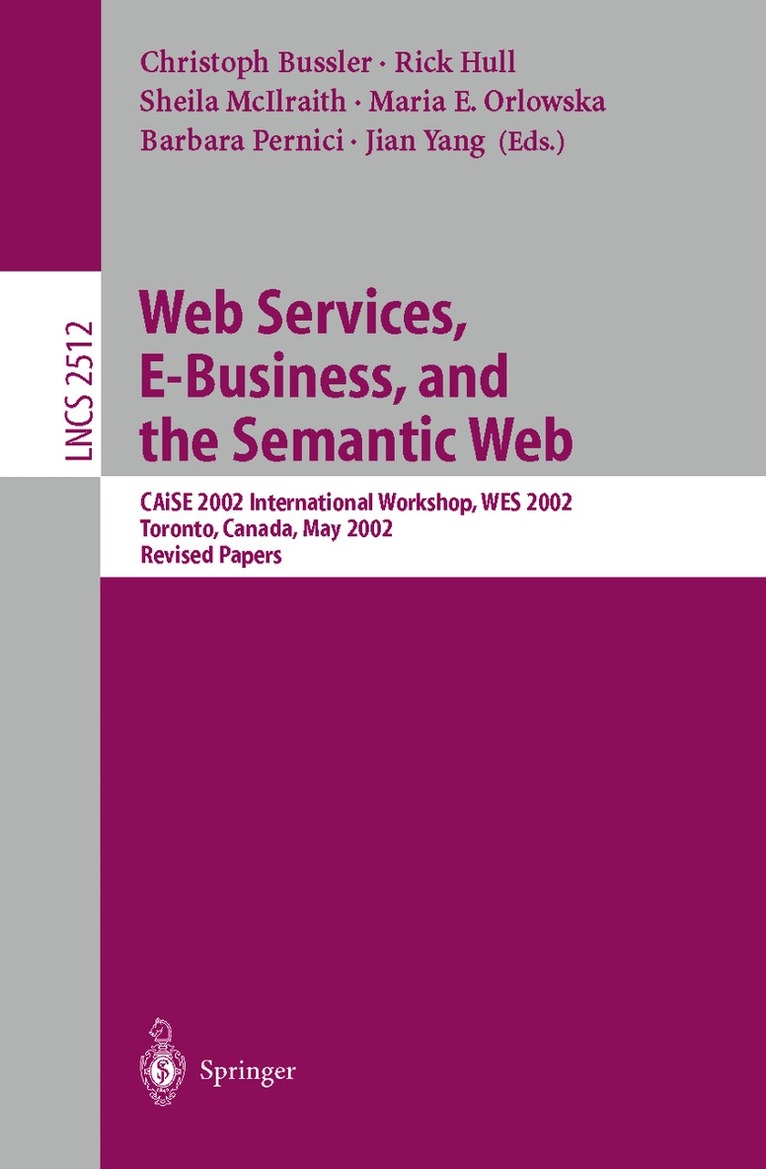
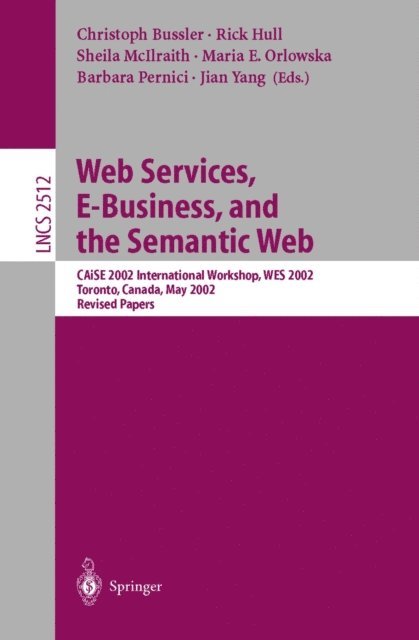
Web Services, E-Business, and the Semantic Web
CAiSE 2002 International Workshop, WES 2002, Toronto, Canada, May 27-28, 2002, Revised Papers
Av Christoph Bussler, Richard Hull m. fl.
Häftad, 2002
569 kr
Lägg i varukorg
The Workshop on Web Services, E-Business, and the Semantic Web (WES) was heldMay27-28,2002inconjunctionwithCAiSE02,the14thInternationalC- ferenceonAdvancedInformationSystemsEngineering.Theworkshopcomprised three tracks: a track on Web services co-chaired by Barbara Pernici (Politecnico di Milano) …
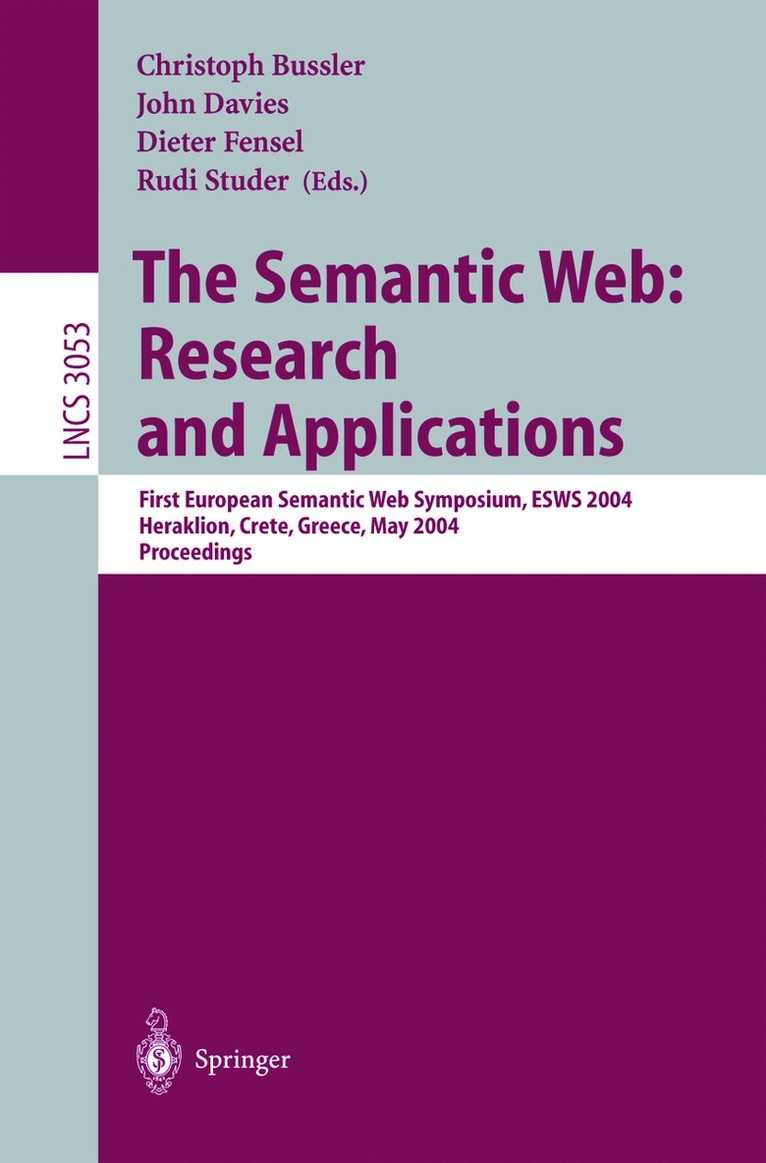
Semantic Web: Research and Applications
First European Semantic Web Symposium, ESWS 2004, Heraklion, Crete, Greece, May 10-12, 2004, Proceedings
Av John Francis Davies, Christoph Bussler m. fl.
Häftad, 2004
1131 kr
Lägg i varukorg
This book constitutes the refereed proceedings of the First European Semantic Web Symposium, ESWS 2004, held in Heraklion, Crete, Greece in May 2004.The 33 revised full papers presented were carefully reviewed and selected from 79 submissions. The papers are organized in topical sections on …
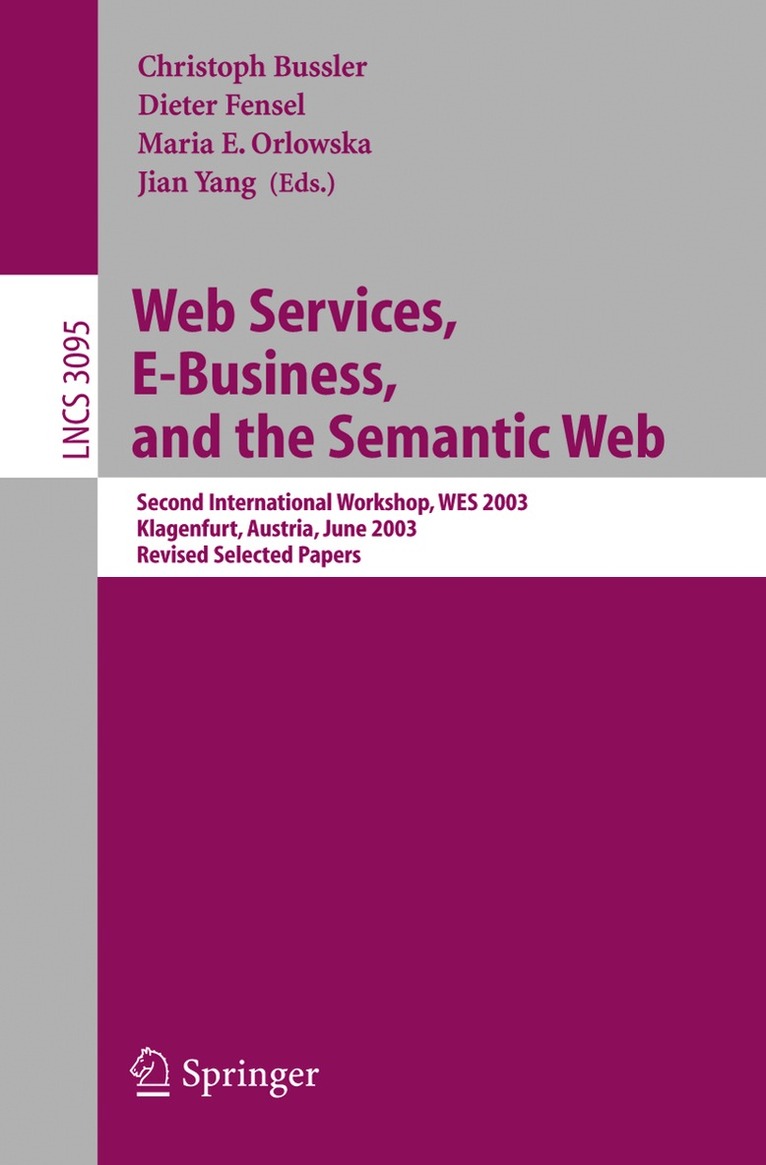
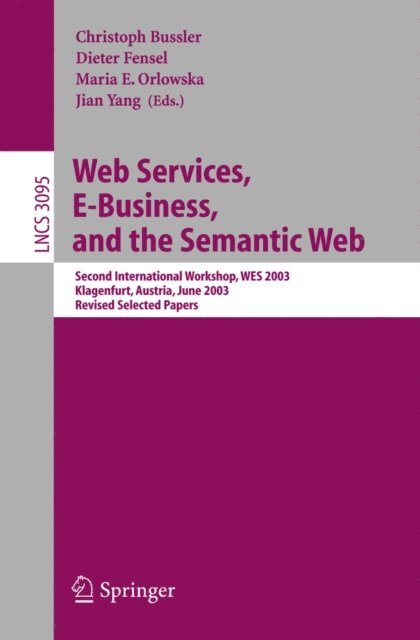
Web Services, E-Business, and the Semantic Web
Second International Workshop, WES 2003, Klagenfurt, Austria, June 16-17, 2003, Revised Selected Papers
Av Christoph Bussler, Maria E. Orlowska m. fl.
Häftad, 2004
569 kr
Lägg i varukorg
The 2nd Workshop on Web Services, E-Business, and the Semantic Web (WES) was held during June 16–17, 2003 in conjunction with CAiSE 2003, the 15th International Conference on Advanced Information Systems Engineering. The Internet is changing the way businesses operate. Organizations are using the …
Artificial Intelligence: Methodology, Systems, and Applications
11th International Conference, AIMSA 2004, Varna, Bulgaria, September 2-4, 2004, Proceedings
Häftad, 2004
569 kr
Lägg i varukorg
The 11th Conference “Artificial Intelligence: Methodology, Systems, Applications – Semantic Web Challenges” (AIMSA 2004) continued successfully pursuing the main aim of the AIMSA series of conferences – to foster the multidisciplinary community of artificial intelligence researchers, embracing both …
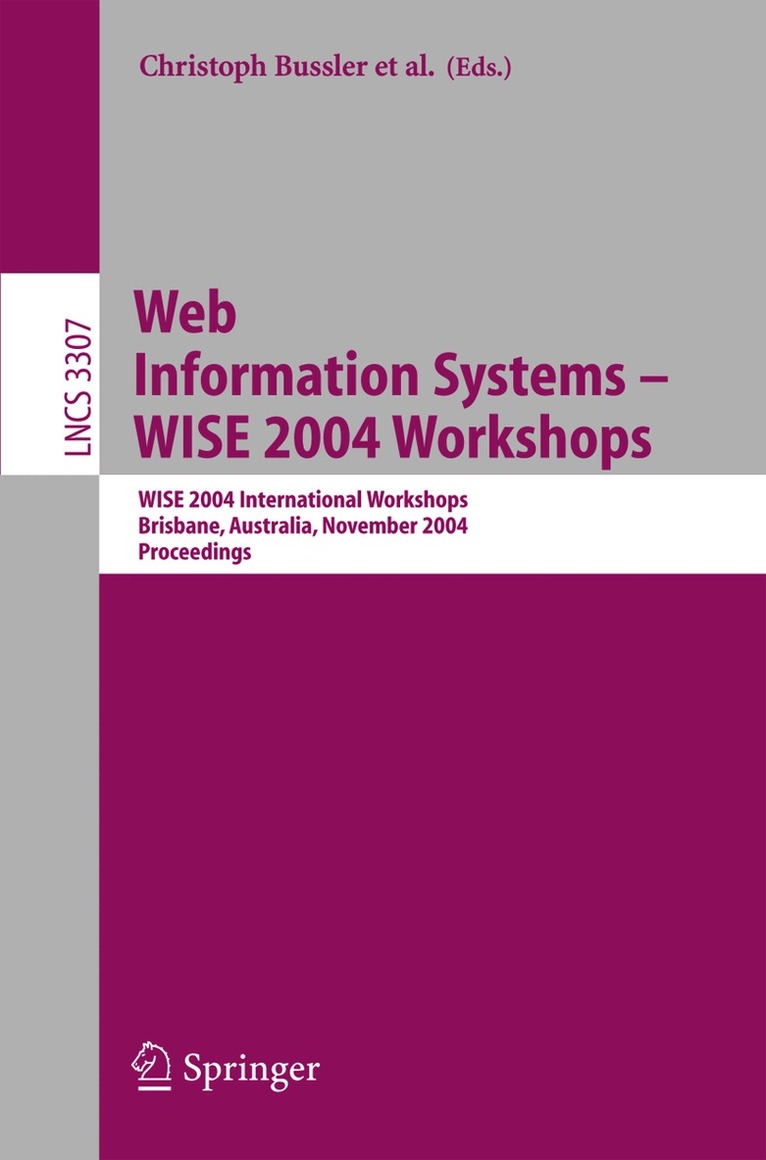
Web Information Systems -- WISE 2004 Workshops
WISE 2004 International Workshops, Brisbane, Australia, November 22-24, 2004, Proceedings
Av Christoph Bussler, Suk-ki Hong m. fl.
Häftad, 2004
569 kr
Lägg i varukorg
The study reported in this paper is an ongoing effort. We reported a preliminary analysis of the data in the paper. The current experiments varied the subjects to c- duct online group learning activities by the communication media such as email and threaded discussion. Although, we could have …
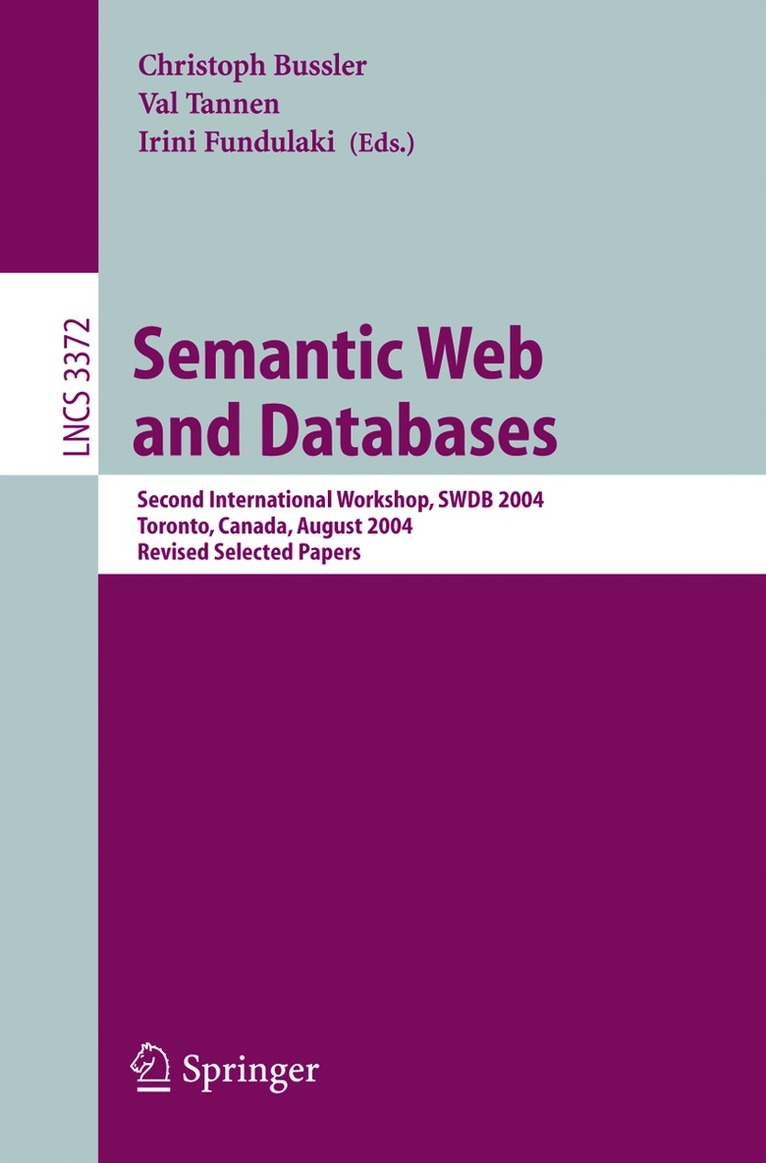
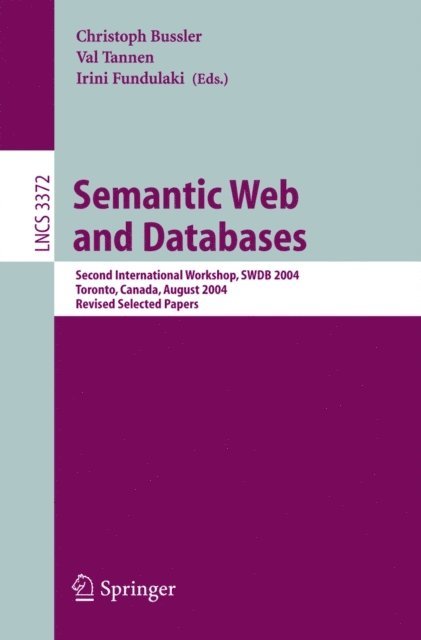
Semantic Web and Databases
Second International Workshop, SWDB 2004, Toronto, Canada, August 29-30, 2004, Revised Selected Papers
Av Christoph Bussler, Val Tannen m. fl.
Häftad, 2005
569 kr
Lägg i varukorg
This book constitutes the thoroughly refereed postproceedings of the Second International Workshop on Semantic Web and Databases, SWDB 2004, held in Toronto, Canada in August 2004 as a satellite workshop of VLDB 2004.The 14 revised full papers presented together with 2 papers by the invited keynote …
Semantic Web: Research and Applications
First European Semantic Web Symposium, ESWS 2004, Heraklion, Crete, Greece, May 10-12, 2004, Proceedings
Av Rudi Studer, Christoph Bussler m. fl.
E-bok, 2004
1502 kr
Lägg i varukorg
This book constitutes the refereed proceedings of the First European Semantic Web Symposium, ESWS 2004, held in Heraklion, Crete, Greece in May 2004. The 33 revised full papers presented were carefully reviewed and selected from 79 submissions. The papers are organized in topical sections on …
Web Services, E-Business, and the Semantic Web
Second International Workshop, WES 2003, Klagenfurt, Austria, June 16-17, 2003, Revised Selected Papers
Av Jian Yang, Maria E. Orlowska m. fl.
E-bok, 2004
755 kr
Lägg i varukorg
The 2nd Workshop on Web Services, E-Business, and the Semantic Web (WES) was held during June 16–17, 2003 in conjunction with CAiSE 2003, the 15th International Conference on Advanced Information Systems Engineering. The Internet is changing the way businesses operate. Organizations are using the …
Artificial Intelligence: Methodology, Systems, and Applications
11th International Conference, AIMSA 2004, Varna, Bulgaria, September 2-4, 2004, Proceedings
E-bok, 2004
734 kr
Lägg i varukorg
The 11th Conference “Artificial Intelligence: Methodology, Systems, Applications – Semantic Web Challenges” (AIMSA 2004) continued successfully pursuing the main aim of the AIMSA series of conferences – to foster the multidisciplinary community of artificial intelligence researchers, embracing both …
Web Information Systems -- WISE 2004 Workshops
WISE 2004 International Workshops, Brisbane, Australia, November 22-24, 2004, Proceedings
Av Bernhard Thalheim, York Sure m. fl.
E-bok, 2004
755 kr
Lägg i varukorg
The study reported in this paper is an ongoing effort. We reported a preliminary analysis of the data in the paper. The current experiments varied the subjects to c- duct online group learning activities by the communication media such as email and threaded discussion. Although, we could have …
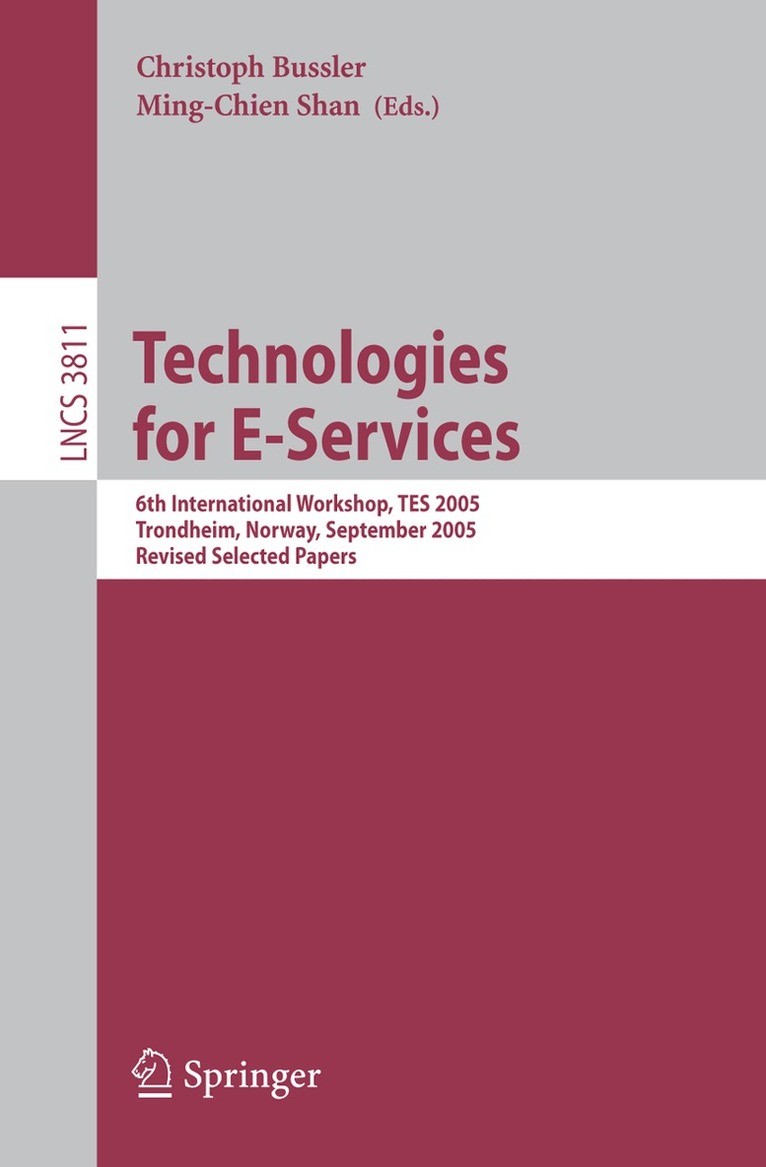
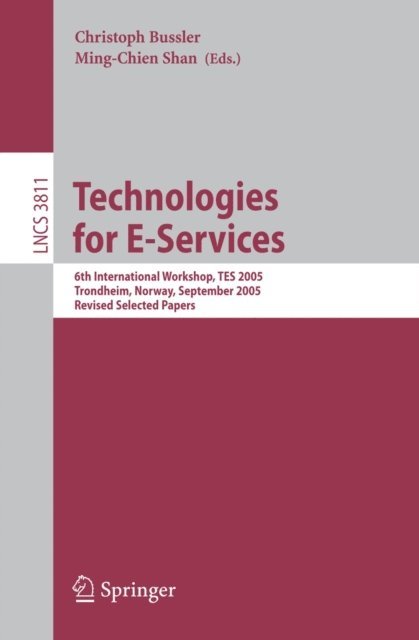
Technologies for E-Services
6th International Workshop, TES 2005, Trondheim, Norway, September 2-3, 2005, Revised Selected Papers
Av Christoph Bussler, Ming-Chien Shan
Häftad, 2006
569 kr
Lägg i varukorg
The 6th Workshop on Technologies for E-Services (TES-05) was held September 2-3, 2005, in conjunction with the 31st International Conference on Very Large Data Bases (VLDB 2005) in Trondheim, Norway. The next generation of applications will be developed in the form of services that are offered over …
Semantic Web and Databases
Second International Workshop, SWDB 2004, Toronto, Canada, August 29-30, 2004, Revised Selected Papers
Av Irini Fundulaki, Val Tannen m. fl.
E-bok, 2005
739 kr
Lägg i varukorg
This book constitutes the thoroughly refereed postproceedings of the Second International Workshop on Semantic Web and Databases, SWDB 2004, held in Toronto, Canada in August 2004 as a satellite workshop of VLDB 2004. The 14 revised full papers presented together with 2 papers by the invited …
Business Process Management Workshops
BPM 2005 International Workshops, BPI, BPD, ENEI, BPRM, WSCOBPM, BPS, Nancy, France, September 5, 2005. Revised Selected Papers
Av Christoph Bussler, Armin Haller
Häftad, 2006
569 kr
Lägg i varukorg
Six parallel Business Process Management workshops were held on September 5th, 2005, in conjunction with the Third International Conference on Business Process Management (BPM 2005) in Nancy, France. This was the first time BPM had asso- ated workshops, and the workshop program was a great success. …
Business Process Management Workshops
BPM 2005 International Workshops, BPI, BPD, ENEI, BPRM, WSCOBPM, BPS, Nancy, France, September 5, 2005. Revised Selected Papers
Av Armin Haller, Christoph Bussler
E-bok, 2006
755 kr
Lägg i varukorg
Six parallel Business Process Management workshops were held on September 5th, 2005, in conjunction with the Third International Conference on Business Process Management (BPM 2005) in Nancy, France. This was the first time BPM had asso- ated workshops, and the workshop program was a great success. …
Technologies for E-Services
6th International Workshop, TES 2005, Trondheim, Norway, September 2-3, 2005, Revised Selected Papers
Av Ming-Chien Shan, Christoph Bussler
E-bok, 2006
732 kr
Lägg i varukorg
The 6th Workshop on Technologies for E-Services (TES-05) was held September 2-3, 2005, in conjunction with the 31st International Conference on Very Large Data Bases (VLDB 2005) in Trondheim, Norway. The next generation of applications will be developed in the form of services that are offered over …
Data Engineering Issues in E-Commerce and Services
Second International Workshop, DEECS 2006, San Francisco, CA, USA, June 26, 2006
Av Juhnyoung Lee, Junho Shim m. fl.
Häftad, 2006
569 kr
Lägg i varukorg
Welcome to the second International Workshop on Data Engineering Issues in E-Commerce and Services (DEECS 2006) in conjunction with the 8th IEEE Conference on E-Commerce Technology and the third IEEE Conference on Enterprise Computing, E-Commerce and E-Services. The purpose of the DEECS workshop is …
Data Engineering Issues in E-Commerce and Services
Second International Workshop, DEECS 2006, San Francisco, CA, USA, June 26, 2006
Av Simon Shim, Christoph Bussler m. fl.
E-bok, 2006
755 kr
Lägg i varukorg
Welcome to the second International Workshop on Data Engineering Issues in E-Commerce and Services (DEECS 2006) in conjunction with the 8th IEEE Conference on E-Commerce Technology and the third IEEE Conference on Enterprise Computing, E-Commerce and E-Services. The purpose of the DEECS workshop is …
Web Services, E-Business, and the Semantic Web
CAiSE 2002 International Workshop, WES 2002, Toronto, Canada, May 27-28, 2002, Revised Papers
Av Jian Yang, Barbara Pernici m. fl.
E-bok, 2003
755 kr
Lägg i varukorg
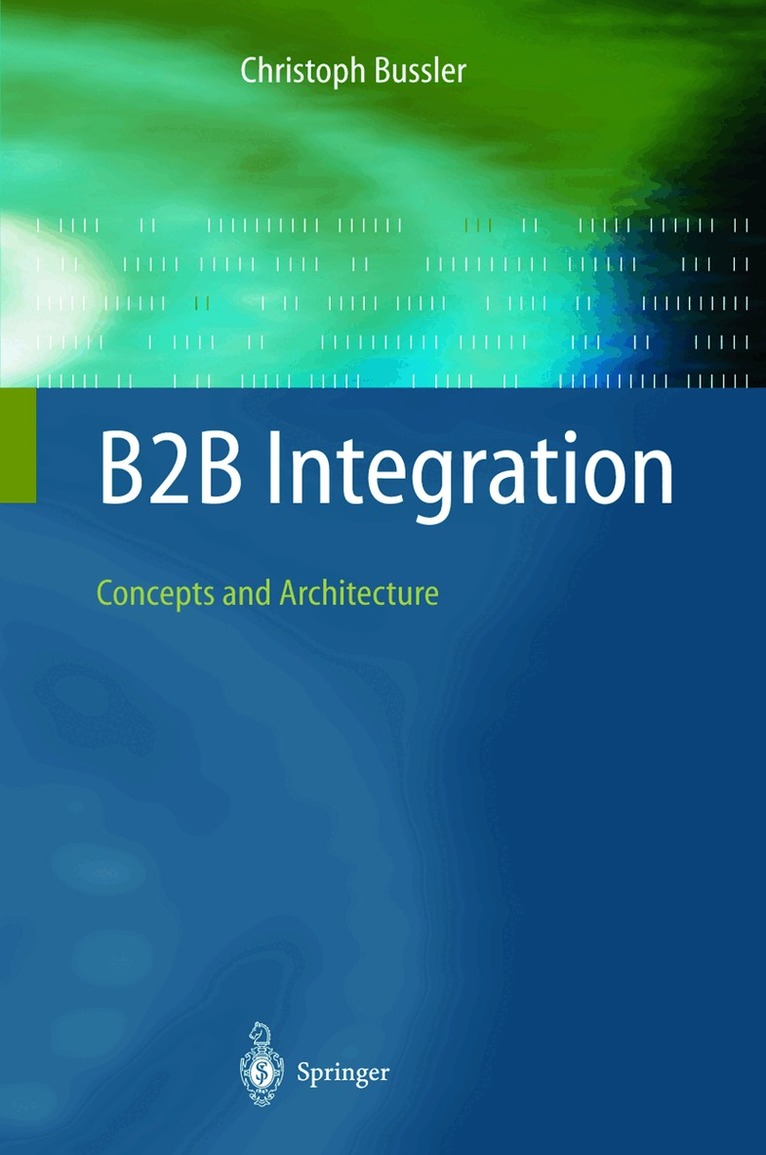
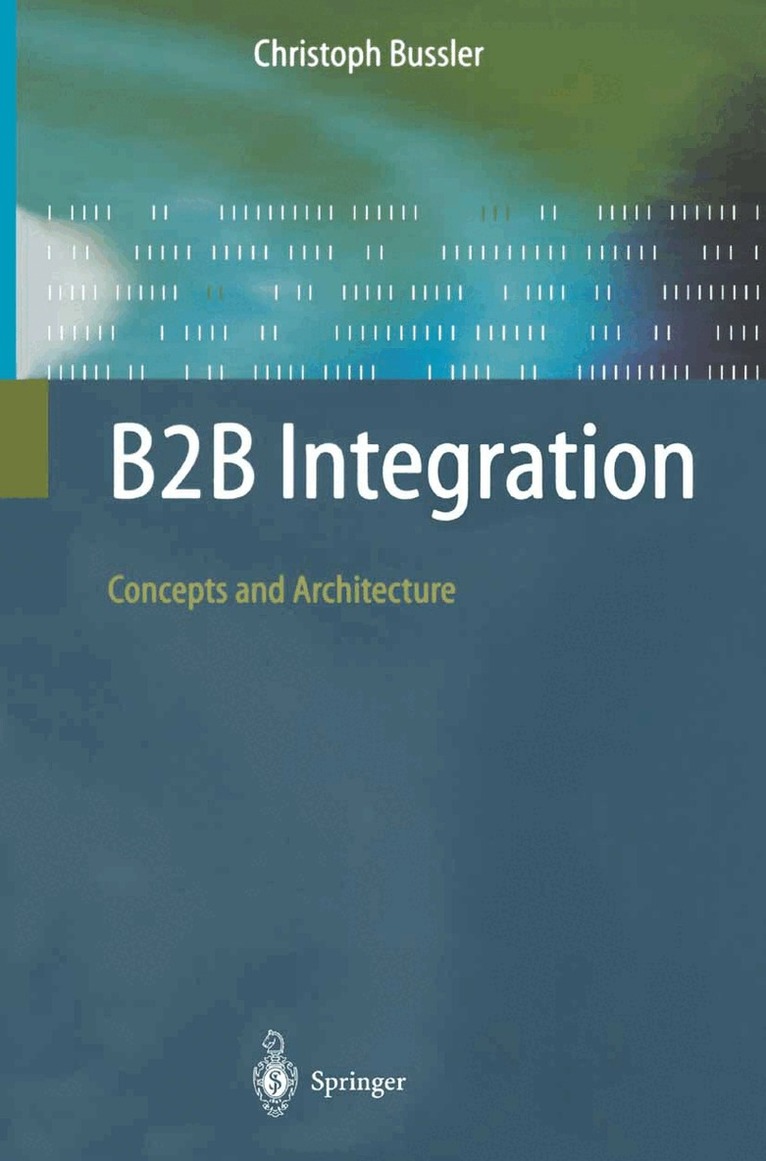
B2B Integration
Concepts and Architecture
Inbunden, 2003
569 kr
Lägg i varukorg
Business-to-business (B2B) integration is a buzzword which has been used a lot in recent years, with a variety of meanings. Starting with a clear technical definition of this term and its relation to topics like A2A (Application-to-Application), ASP (Application Service Provider), A2A, and B2C …
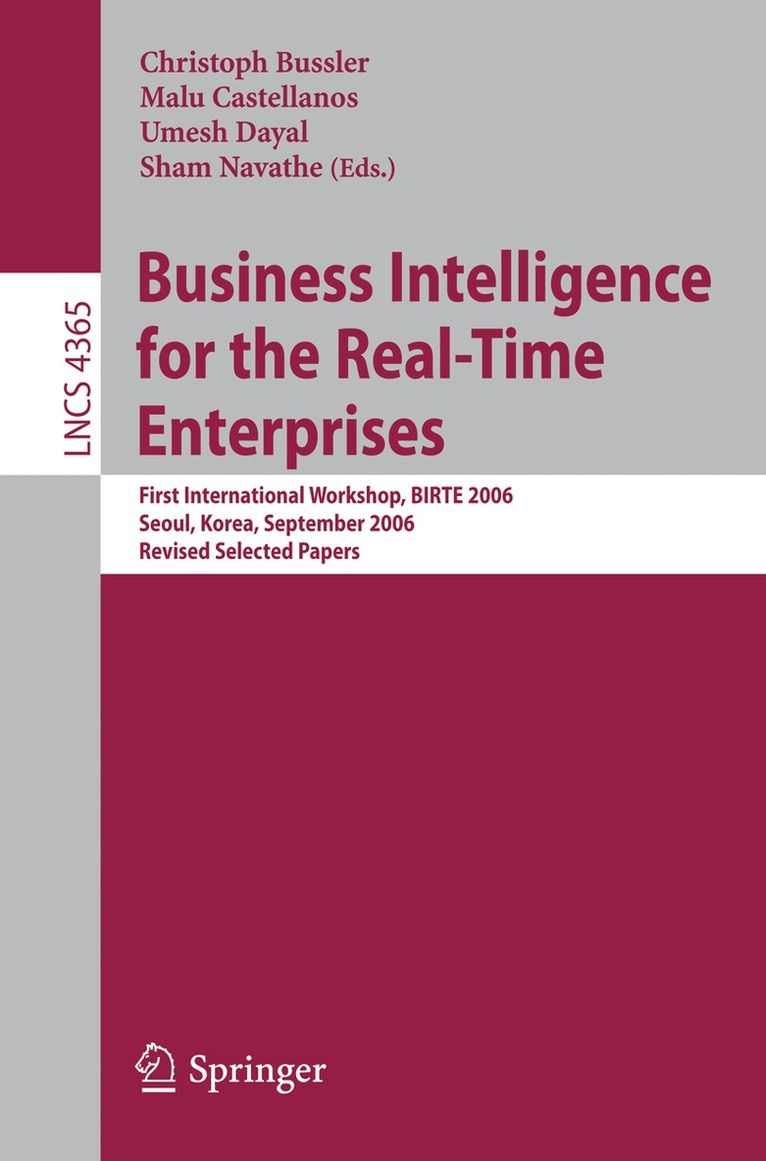
Business Intelligence for the Real-Time Enterprises
First International Workshop, BIRTE 2006, Seoul, Korea, September 11, 2006, Revised Selected Papers
Av Christoph Bussler, Malu Castellanos m. fl.
Häftad, 2007
569 kr
Lägg i varukorg
st The 1 Workshop on Business Intelligence for the Real-Time Enterprise (BIRTE nd 2006) was held on September 11, 2006 in conjunction with the 32 International Conference on Very Large Data Bases (VLDB 2006) in Seoul, Korea. The - location with VLDB is very important as the topic of the workshop …
Business Intelligence for the Real-Time Enterprises
First International Workshop, BIRTE 2006, Seoul, Korea, September 11, 2006, Revised Selected Papers
Av Sham Navathe, Umeshwar Dayal m. fl.
E-bok, 2007
755 kr
Lägg i varukorg
st The 1 Workshop on Business Intelligence for the Real-Time Enterprise (BIRTE nd 2006) was held on September 11, 2006 in conjunction with the 32 International Conference on Very Large Data Bases (VLDB 2006) in Seoul, Korea. The - location with VLDB is very important as the topic of the workshop …
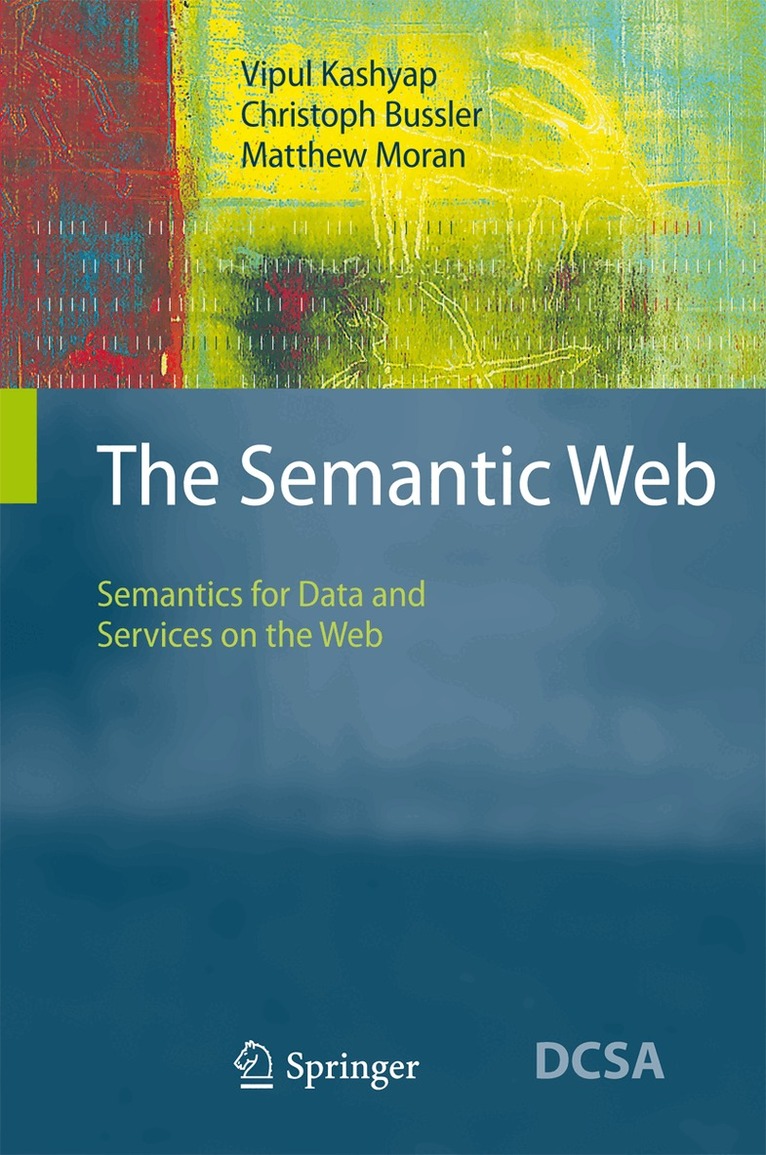
Semantic Web
Semantics for Data and Services on the Web
Av Vipul Kashyap, Christoph Bussler m. fl.
Inbunden, 2008
569 kr
Lägg i varukorg
A decade ago Tim Berners-Lee proposed an extraordinary vision: despite the p- nomenal success of the Web, it would not, and could not, reach its full potential unless it became a place where automated processes could participate as well as people. This meant the publication of documents and data to …
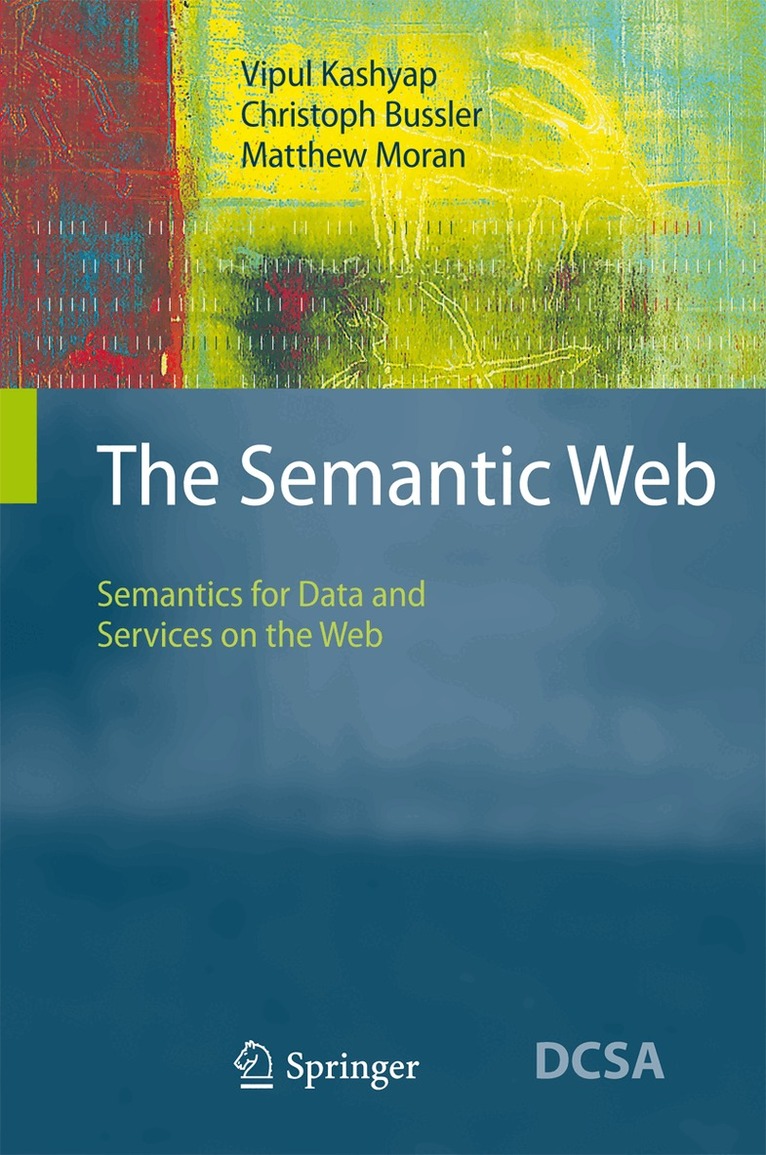
Semantic Web
Semantics for Data and Services on the Web
Av Matthew Moran, Christoph Bussler m. fl.
E-bok, 2008
712 kr
Lägg i varukorg
A decade ago Tim Berners-Lee proposed an extraordinary vision: despite the p- nomenal success of the Web, it would not, and could not, reach its full potential unless it became a place where automated processes could participate as well as people. This meant the publication of documents and data to …
B2B Integration
Concepts and Architecture
Häftad, 2010
552 kr
Lägg i varukorg
Business-to-business (B2B) integration is a buzzword which has been used a lot in recent years, with a variety of meanings. Starting with a clear technical definition of this term and its relation to topics like A2A (Application-to-Application), ASP (Application Service Provider), A2A, and B2C …
Semantic Web
Semantics for Data and Services on the Web
Av Vipul Kashyap, Christoph Bussler m. fl.
Häftad, 2010
552 kr
Lägg i varukorg
A decade ago Tim Berners-Lee proposed an extraordinary vision: despite the p- nomenal success of the Web, it would not, and could not, reach its full potential unless it became a place where automated processes could participate as well as people. This meant the publication of documents and data to …
B2B Integration
Concepts and Architecture
E-bok, 2013
739 kr
Lägg i varukorg
Business-to-business (B2B) integration is a buzzword which has been used a lot in recent years, with a variety of meanings. Starting with a clear technical definition of this term and its relation to topics like A2A (Application-to-Application), ASP (Application Service Provider), A2A, and B2C …
Emerging Web Services Technology
Av Cesare Pautasso, Christoph Bussler
Häftad, 2007
569 kr
Lägg i varukorg
The Workshop on Emerging Web Services Technology (WEWST06) took place in conjunction with the 4th European Conference on Web Services (ECOWS’06) on 4th December 2006, in Zurich, Switzerland. Acting as the natural extension to the main ECOWS conference, the main goal of the WEWST workshop is serving …
Emerging Web Services Technology
Av Christoph Bussler, Cesare Pautasso
E-bok, 2007
755 kr
Lägg i varukorg
The Workshop on Emerging Web Services Technology (WEWST06) took place in conjunction with the 4th European Conference on Web Services (ECOWS’06) on 4th December 2006, in Zurich, Switzerland. Acting as the natural extension to the main ECOWS conference, the main goal of the WEWST workshop is serving …