Clive Agnew - Böcker
Visar alla böcker från författaren Clive Agnew. Handla med fri frakt och snabb leverans.
4 produkter
4 produkter
2 300 kr
Skickas inom 10-15 vardagar
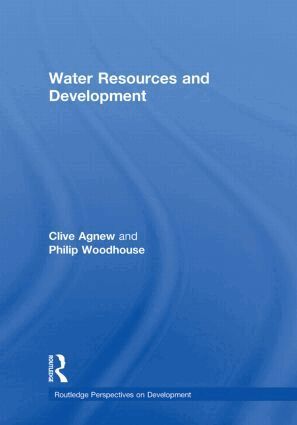
Since the start of the twenty-first century there has been an unprecedented focus upon water as a key factor in the future of both society and environment. Water management lies at the heart of strategies of development as does the added the hazard of climate change.Water Resources and Development provides a stimulating interdisciplinary introduction to the role of water resources in shaping opportunities and constraints for development. The book begins by charting the evolution of approaches to water management. It identifies an emerging polarization in the late twentieth century between ‘technical’ and ‘social’ strategies. In the past decade these two axes of policy debate have been further intersected by discussion of the scale at which management decisions should be made: the relative effectiveness of ‘global’ and ‘local’ governance of water. A variety of case studies elaborate this analytical framework, exemplifying four key development challenges: economic growth, poverty reduction, competition and conflict over water, and adaptation to climate change. Current ‘best practice’ for water management is examined, addressing strategies of water supply augmentation, the ecological implications of intensified use, and strategies of demand management guided by economic or political principles. It is argued defining ‘successful’ water management and best practice requires first the establishment of development goals and the implicit trade-offs between water consumption and conservation.This engaging and insightful text offers a unique interdisciplinary analysis by integrating scientific, engineering, social and political perspectives. This is an essential text for courses on development studies, geography, earth sciences and the environment.
620 kr
Skickas inom 10-15 vardagar
Since the start of the twenty-first century there has been an unprecedented focus upon water as a key factor in the future of both society and environment. Water management lies at the heart of strategies of development as does the added the hazard of climate change.Water Resources and Development provides a stimulating interdisciplinary introduction to the role of water resources in shaping opportunities and constraints for development. The book begins by charting the evolution of approaches to water management. It identifies an emerging polarization in the late twentieth century between ‘technical’ and ‘social’ strategies. In the past decade these two axes of policy debate have been further intersected by discussion of the scale at which management decisions should be made: the relative effectiveness of ‘global’ and ‘local’ governance of water. A variety of case studies elaborate this analytical framework, exemplifying four key development challenges: economic growth, poverty reduction, competition and conflict over water, and adaptation to climate change. Current ‘best practice’ for water management is examined, addressing strategies of water supply augmentation, the ecological implications of intensified use, and strategies of demand management guided by economic or political principles. It is argued defining ‘successful’ water management and best practice requires first the establishment of development goals and the implicit trade-offs between water consumption and conservation.This engaging and insightful text offers a unique interdisciplinary analysis by integrating scientific, engineering, social and political perspectives. This is an essential text for courses on development studies, geography, earth sciences and the environment.
1 273 kr
Skickas inom 10-15 vardagar
Originally published in 1992, this book dispels some of the myths that surround water resource problems of arid lands and the notion that there are simple ‘once and for all’ solutions. Population growth, industrialization, environmental mismanagement and land degradation have led to droughts, poverty and famine with the result that the need for space, food and key natural resources such as water has become the most critical issue in global development. Nowhere is this crisis more apparent than in arid lands, where water resources provide the key to economic and environmental development. The authors argue that as the arid land environment is highly variable the key to success is flexibility. The book is divided into four sections, dealing with the geography of the arid realm; the water resource problems they face: the methods available for enhancing water supplies and finally, management of this resource. The book will be of use to undergraduate and postgraduate student and for those actively engaged in the development of arid land water resources.
415 kr
Skickas inom 10-15 vardagar
Originally published in 1992, this book dispels some of the myths that surround water resource problems of arid lands and the notion that there are simple ‘once and for all’ solutions. Population growth, industrialization, environmental mismanagement and land degradation have led to droughts, poverty and famine with the result that the need for space, food and key natural resources such as water has become the most critical issue in global development. Nowhere is this crisis more apparent than in arid lands, where water resources provide the key to economic and environmental development. The authors argue that as the arid land environment is highly variable the key to success is flexibility. The book is divided into four sections, dealing with the geography of the arid realm; the water resource problems they face: the methods available for enhancing water supplies and finally, management of this resource. The book will be of use to undergraduate and postgraduate student and for those actively engaged in the development of arid land water resources.