Collins Rob Collins – författare
Visar alla böcker från författaren . Handla med fri frakt och snabb leverans.
5 produkter
5 produkter
E-bok
PDF, Engelska, 2014398 kr
Läs direkt efter köp
Lindsay Allason-Jones has been at the forefront of small finds and Roman frontier research for 40 years in a career focussed on, but not exclusive to, the north of Britain, encompassing an enormous range of object types and subject areas. Divided into thematic sections the contributions presented here to celebrate her many achievements all represent at least one aspect of Lindsay’s research interests. These encompass social and industrial aspects of northern frontier forts; new insights into inscribed and sculptural stones specific to military communities; religious, cultural and economic connotations of Roman armour finds; the economic and ideological penetration of romanitas in the frontiers as reflected by individual objects and classes of finds; evidence of trans-frontier interactions and invisible people; the role of John Clayton in the exploration and preservation of Hadrian’s Wall and its material culture; the detailed consideration of individual objects of significant interest; and a discussion of the widespread occurrence of mice in Roman art.
E-bok
PDF, Engelska, 2015382 kr
Läs direkt efter köp
The Roman army was one of the most astounding organizations in the ancient world, and much of the success of the Roman empire can be attributed to its soldiers. Archaeological remains and ancient texts provide detailed testimonies that have allowed scholars to understand and reconstruct the army’s organization and activities. This interest has traditionally worked in tandem with the study of Roman frontiers. Historically, the early imperial period, and in particular the emergence of the frontiers, has been the focus of research. During those investigations, however, the remains of the later Roman army were also frequently encountered, if not always understood. Recent decades have brought a burgeoning interest in not only the later Roman army, but also late antiquity more widely.It is the aim of this volume to demonstrate that while scholars grappling with the late Roman army may want for a rich corpus of inscriptions and easily identifiable military installations, research is revealing a dynamic, less-predictable force that was adapting to a changing world, in terms of both external threats and its own internal structures. The dynamism and ingenuity of the late Roman army provides a breath of fresh air after the suffocating uniformity of its forbears. The late Roman army was a vital and influential element in the late antique empire. Having evolved through the 3rd century and been formally reorganized under Diocletian and Constantine, the limitanei guarded the frontiers, while the comitatenses provided mobile armies that were fielded against external enemies and internal threats. The transformation of the early imperial army to the late antique army is documented in the rich array of texts from the period, supplemented by a perhaps surprisingly rich archaeological record.
443 kr
Läs direkt efter köp
This study focuses on the fabric, construction and preservation of stretches of Hadrian''s Wall in its more remote locations, providing significant insights into the places between the mile castles and important forts and associated settlements.The Hadrian’s Wall Community Archaeology Project (WallCAP) conducted a series of fieldwork projects along the Hadrian’s Wall corridor between 2019 and 2021. The work focused on sites that were poorly understood or under particular threat and aimed to improve understanding of them so they could be better managed in future. At several sites excavation was followed by conservation and consolidation work. This volume brings together the final reports of these excavations, at six Roman sites in the Wall corridor. As the sites were spread along the length of the Wall the character and afterlife of the Wall in very different landscape locations could be compared. An assessment of the Vallum at Heddon on the Wall identified how earthwork archaeology survived in a sloped, heavily ploughed landscape. Three excavations investigated the condition of the stone Wall curtain: at Port Carlisle, Walltown Crags, and Steel Rigg and Cats Stairs. At each site the Wall builders had responded to the demands of the local terrain and made use of local resources. At each site the Wall had a different post-Roman history. Excavations at the bridging point of the Cam Beck revealed for the first time how the Wall was carried over a ‘minor’ watercourse, and discovered traces of the Turf Wall. Small buildings were also identified just south of the Wall as it approached the bridge. At Corbridge Roman town, excavations on the northern periphery of the settlement demonstrated that from early in its history the most northerly town in Europe was of considerable extent. The area investigated showed that, even at the edge of town, shops lined the roads alongside well-appointed houses with bustling yards. Later on in the Roman period the town contracted behind walls and cremation burials were inserted by the road. Each site is reported on independently, presenting the primary data for each investigation. The volume concludes with a synthetic analysis of what the results of these excavations together reveal about Hadrian’s Wall, considering, amongst other things, construction details and the decay and destruction of the monument in the centuries following Roman occupation.
443 kr
Läs direkt efter köp
What is Hadrian’s Wall made of, where did this material come from and how has it been reused in other buildings in the communities that emerged in the centuries after the Roman Empire? By studying the fabric of Hadrian’s Wall using a geological approach combined with archaeological methods, is it possible to refine our answers to these questions? This study describes how the relationship between the geology of the Wall’s landscape and its fabric may be used to further understand the Wall and presents a significant set of new geological and archaeological data on the Wall’s stones from across the length of the Wall. This data set has been collected in two complementary ways. First as a citizen-science project, where volunteers from local communities were trained to visually characterize sandstones and resulting in data collecting on large numbers of the Wall’s stones along the length of the Wall. Secondly, analytical research was used to gather in scientific data for a selected sets of rocks and stones. Geochemical data was captured using an X-ray fluorescence spectrometer, and petrographic observations made using a petrographic microscope and thin sections. The combined methods provide a framework for geological analysis of the Wall supported by robust data. It builds on earlier work on Roman quarrying and stone preparation highlighting not only stone sources, but the criteria for choosing stone, stone preparation methods, and the implied routes to the Wall. At the heart of this study lies the ability to uniquely identify different sandstone types. Geological methods used to achieve this are explored, as are the ways in which the sandstones form. This highlights both the possibilities and limits of this approach.
E-bok
Engelska, 2023123 kr
Läs direkt efter köp
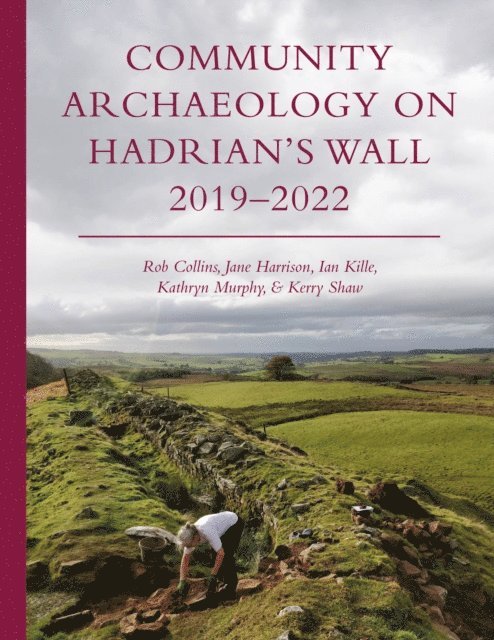
The Hadrian’s Wall Community Archaeology Project (WallCAP) was funded by the National Lottery Heritage Fund to promote the value of heritage – specifically of the Hadrian’s Wall World Heritage Site – to local communities and provide opportunities for volunteers to engage with the archaeology and conservation of the Wall to better ensure the future of the monument.This short book provides a summary of the project, communicating the range of activities undertaken during the project and key results. The structure and aims of the project are communicated, and an overview of the many different people and communities that participated are explored. Archaeological fieldwork resulted in a number of new discoveries and insights into Hadrian’s Wall. Revolutionary new work to explore the stones of Hadrian’s Wall, its source geology and how stones were reused from the monument is also discussed. Each chapter is supported by full color illustrations and contributions from project volunteers also bring the project into a vibrant focus.