Committee on the Human Dimensions of Global Change – författare
Visar alla böcker från författaren Committee on the Human Dimensions of Global Change. Handla med fri frakt och snabb leverans.
37 produkter
New Tools for Environmental Protection
Education, Information, and Voluntary Measures
Av National Research Council, Division of Behavioral and Social Sciences and Education m. fl.
Häftad, 2002
936 kr
Lägg i varukorg
Many people believe that environmental regulation has passed a point of diminishing returns: the quick fixes have been achieved and the main sources of pollution are shifting from large "point sources" to more diffuse sources that are more difficult and expensive to regulate. The political climate …
Research and Networks for Decision Support in the NOAA Sectoral Applications Research Program
Av Panel on Design Issues for the NOAA Sectoral Applications Research Program, Committee on the Human Dimensions of Global Change m. fl.
E-bok, 2007
286 kr
Lägg i varukorg
This study recommends a definition of “decision support” that emphasizes communication rather than translation and a strategy by which the small NOAA Sectoral Applications Research program can advance decision support. The book emphasizes that seasonal climate forecasts provide fundamentally new …
Review of CCSP Draft Synthesis and Assessment Product 5.3
Decision-Support Experiments and Evaluations Using Seasonal to Interannual Forecasts and Observational Data
Av National Research Council, Division of Behavioral and Social Sciences and Education m. fl.
Häftad, 2008
508 kr
Lägg i varukorg
This study offered an independent peer review for a synthetic document being produced for the CCSP. It found the draft document to be in a fairly early stage of development and noted several issues needing attention in the revision. The draft was inconsistent across sections with respect to whether …
Review of CCSP Draft Synthesis and Assessment Product 5.3
Decision-Support Experiments and Evaluations Using Seasonal to Interannual Forecasts and Observational Data
Av Panel to Review CCSP Draft Synthesis and Assessment Product 5.3: Decision-Support Experiments and Evaluations Using Seasonal to Interannual Forecasts and Observational Data, Committee on the Human Dimensions of Global Change m. fl.
E-bok, 2008
286 kr
Lägg i varukorg
This study offered an independent peer review for a synthetic document being produced for the CCSP. It found the draft document to be in a fairly early stage of development and noted several issues needing attention in the revision. The draft was inconsistent across sections with respect to whether …
Public Participation in Environmental Assessment and Decision Making
Av Panel on Public Participation in Environmental Assessment and Decision Making, Committee on the Human Dimensions of Global Change m. fl.
E-bok, 2008
788 kr
Lägg i varukorg
Federal agencies have taken steps to include the public in a wide range of environmental decisions. Although some form of public participation is often required by law, agencies usually have broad discretion about the extent of that involvement. Approaches vary widely, from holding public …
New Directions in Climate Change Vulnerability, Impacts, and Adaptation Assessment
Summary of a Workshop
Av and Adaptation Assessment Subcommittee for a Workshop on New Directions in Vulnerability, Impacts, Committee on the Human Dimensions of Global Change m. fl.
E-bok, 2009
200 kr
Lägg i varukorg
With effective climate change mitigation policies still under development, and with even the most aggressive proposals unable to halt climate change immediately, many decision makers are focusing unprecedented attention on the need for strategies to adapt to climate changes that are now …
Public Participation in Environmental Assessment and Decision Making
Av Panel on Public Participation in Environmental Assessment and Decision Making, Committee on the Human Dimensions of Global Change m. fl.
E-bok, 2008
1126 kr
Lägg i varukorg
Federal agencies have taken steps to include the public in a wide range of environmental decisions. Although some form of public participation is often required by law, agencies usually have broad discretion about the extent of that involvement. Approaches vary widely, from holding public …
Informing Decisions in a Changing Climate
Av Panel on Strategies and Methods for Climate-Related Decision Support, Committee on the Human Dimensions of Global Change m. fl.
E-bok, 2009
505 kr
Lägg i varukorg
Everyone—government agencies, private organizations, and individuals—is facing a changing climate: an environment in which it is no longer prudent to follow routines based on past climatic averages. State and local agencies in particular, as well as the federal government, need to consider what …
Informing Decisions in a Changing Climate
Av Panel on Strategies and Methods for Climate-Related Decision Support, Committee on the Human Dimensions of Global Change m. fl.
E-bok, 2009
745 kr
Lägg i varukorg
Everyone—government agencies, private organizations, and individuals—is facing a changing climate: an environment in which it is no longer prudent to follow routines based on past climatic averages. State and local agencies in particular, as well as the federal government, need to consider what …
Facilitating Climate Change Responses
A Report of Two Workshops on Knowledge from the Social and Behavioral Sciences
Av Panel on Addressing the Challenges of Climate Change Through the Behavioral and Social Sciences, Committee on the Human Dimensions of Global Change m. fl.
E-bok, 2010
494 kr
Lägg i varukorg
The William and Flora Hewlett Foundation, understanding the need for policy makers at the national level to entrain the behavioral and social sciences in addressing the challenges of global climate change, called on the National Research Council to organize two workshops to showcase some of the …
Describing Socioeconomic Futures for Climate Change Research and Assessment
Report of a Workshop
Av Panel on Socioeconomic Scenarios for Climate Change Research and Assessment, Committee on the Human Dimensions of Global Change m. fl.
E-bok, 2011
286 kr
Lägg i varukorg
The implications of climate change for the environment and society depend on the rate and magnitude of climate change, but also on changes in technology, economics, lifestyles, and policy that will affect the capacity both for limiting and adapting to climate change. Describing Socioeconomic …
Population, Land Use, and Environment
Research Directions
Av Panel on New Research on Population and the Environment, Committee on the Human Dimensions of Global Change m. fl.
E-bok, 2005
953 kr
Lägg i varukorg
Population, Land Use, and Environment: Research Directions offers recommendationsfor future research to improve understanding of how changes in human populationsaffect the natural environment by means of changes in land use, such as deforestation,urban development, and development of coastal zones. …
Decision Making for the Environment
Social and Behavioral Science Research Priorities
Av Panel on Social and Behavioral Science Research Priorities for Environmental Decision Making, Committee on the Human Dimensions of Global Change m. fl.
E-bok, 2005
824 kr
Lägg i varukorg
With the growing number, complexity, and importance of environmental problems come demands to include a full range of intellectual disciplines and scholarly traditions to help define and eventually manage such problems more effectively. Decision Making for the Environment: Social and Behavioral …
New Tools for Environmental Protection
Education, Information, and Voluntary Measures
Av Committee on the Human Dimensions of Global Change, Division of Behavioral and Social Sciences and Education m. fl.
E-bok, 2002
1039 kr
Lägg i varukorg
Many people believe that environmental regulation has passed a point of diminishing returns: the quick fixes have been achieved and the main sources of pollution are shifting from large "point sources" to more diffuse sources that are more difficult and expensive to regulate. The political climate …
Human Interactions with the Carbon Cycle
Summary of a Workshop
Av Paul C. Stern, Committee on the Human Dimensions of Global Change m. fl.
E-bok, 2002
303 kr
Lägg i varukorg
The USGCRP''s Carbon Cycle Working Group asked the National Research Council''s Committee on the Human Dimensions of Global Change to hold a workshop on Human Interactions with the Carbon Cycle. The basic purpose of the workshop was to help build bridges between the research communities in the …
Drama of the Commons
Av Committee on the Human Dimensions of Global Change, Division of Behavioral and Social Sciences and Education m. fl.
E-bok, 2002
624 kr
Lägg i varukorg
The "tragedy of the commons" is a central concept in human ecology and the study of the environment. It has had tremendous value for stimulating research, but it only describes the reality of human-environment interactions in special situations. Research over the past thirty years has helped …
People and Pixels
Linking Remote Sensing and Social Science
Av Committee on the Human Dimensions of Global Change, Board on Environmental Change and Society m. fl.
E-bok, 1998
610 kr
Lägg i varukorg
Space-based sensors are giving us an ever-closer and more comprehensive look at the earth''s surface; they also have the potential to tell us about human activity. This volume examines the possibilities for using remote sensing technology to improve understanding of social processes and …
Environmentally Significant Consumption
Research Directions
Av Committee on the Human Dimensions of Global Change, Board on Environmental Change and Society m. fl.
E-bok, 1997
874 kr
Lägg i varukorg
There has been much polemic about affluence, consumption, and the global environment. For some observers, "consumption" is at the root of global environmental threats: wealthy individuals and societies use far too much of the earth''s resource base and should scale back their appetites to preserve …
Review of CCSP Draft Synthesis and Assessment Product 5.3
Decision-Support Experiments and Evaluations Using Seasonal to Interannual Forecasts and Observational Data
Av Panel to Review CCSP Draft Synthesis and Assessment Product 5.3: Decision-Support Experiments and Evaluations Using Seasonal to Interannual Forecasts and Observational Data, Committee on the Human Dimensions of Global Change m. fl.
E-bok, 2008
416 kr
Lägg i varukorg
This study offered an independent peer review for a synthetic document being produced for the CCSP. It found the draft document to be in a fairly early stage of development and noted several issues needing attention in the revision. The draft was inconsistent across sections with respect to whether …
New Directions in Climate Change Vulnerability, Impacts, and Adaptation Assessment
Summary of a Workshop
Av and Adaptation Assessment Subcommittee for a Workshop on New Directions in Vulnerability, Impacts, Committee on the Human Dimensions of Global Change m. fl.
E-bok, 2009
295 kr
Lägg i varukorg
With effective climate change mitigation policies still under development, and with even the most aggressive proposals unable to halt climate change immediately, many decision makers are focusing unprecedented attention on the need for strategies to adapt to climate changes that are now …
Research and Networks for Decision Support in the NOAA Sectoral Applications Research Program
Av Panel on Design Issues for the NOAA Sectoral Applications Research Program, Committee on the Human Dimensions of Global Change m. fl.
E-bok, 2007
416 kr
Lägg i varukorg
This study recommends a definition of “decision support” that emphasizes communication rather than translation and a strategy by which the small NOAA Sectoral Applications Research program can advance decision support. The book emphasizes that seasonal climate forecasts provide fundamentally new …
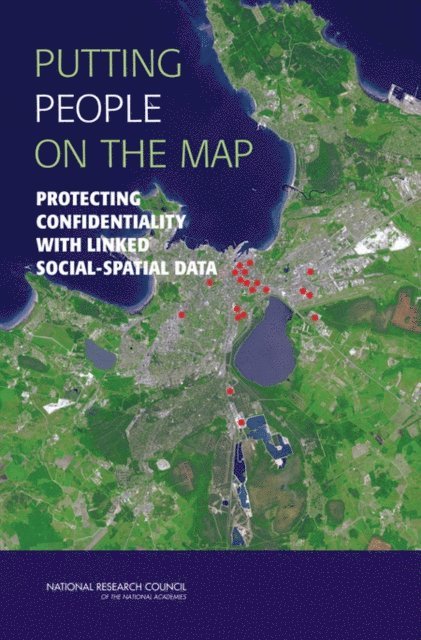
Putting People on the Map
Protecting Confidentiality with Linked Social-Spatial Data
Av Panel on Confidentiality Issues Arising from the Integration of Remotely Sensed and Self-Identifying Data, Committee on the Human Dimensions of Global Change m. fl.
E-bok, 2007
745 kr
Lägg i varukorg
Precise, accurate spatial information linked to social and behavioral data is revolutionizing social science by opening new questions for investigation and improving understanding of human behavior in its environmental context. At the same time, precise spatial data make it more likely that …
Describing Socioeconomic Futures for Climate Change Research and Assessment
Report of a Workshop
Av Panel on Socioeconomic Scenarios for Climate Change Research and Assessment, Committee on the Human Dimensions of Global Change m. fl.
E-bok, 2011
416 kr
Lägg i varukorg
The implications of climate change for the environment and society depend on the rate and magnitude of climate change, but also on changes in technology, economics, lifestyles, and policy that will affect the capacity both for limiting and adapting to climate change. Describing Socioeconomic …
Human Interactions with the Carbon Cycle
Summary of a Workshop
Av Paul C. Stern, Committee on the Human Dimensions of Global Change m. fl.
E-bok, 2002
200 kr
Lägg i varukorg
The USGCRP''s Carbon Cycle Working Group asked the National Research Council''s Committee on the Human Dimensions of Global Change to hold a workshop on Human Interactions with the Carbon Cycle. The basic purpose of the workshop was to help build bridges between the research communities in the …
New Tools for Environmental Protection
Education, Information, and Voluntary Measures
Av Committee on the Human Dimensions of Global Change, Division of Behavioral and Social Sciences and Education m. fl.
E-bok, 2002
736 kr
Lägg i varukorg
Many people believe that environmental regulation has passed a point of diminishing returns: the quick fixes have been achieved and the main sources of pollution are shifting from large "point sources" to more diffuse sources that are more difficult and expensive to regulate. The political climate …
Drama of the Commons
Av Committee on the Human Dimensions of Global Change, Division of Behavioral and Social Sciences and Education m. fl.
E-bok, 2002
458 kr
Lägg i varukorg
The "tragedy of the commons" is a central concept in human ecology and the study of the environment. It has had tremendous value for stimulating research, but it only describes the reality of human-environment interactions in special situations. Research over the past thirty years has helped …
Environmentally Significant Consumption
Research Directions
Av Committee on the Human Dimensions of Global Change, Board on Environmental Change and Society m. fl.
E-bok, 1997
616 kr
Lägg i varukorg
There has been much polemic about affluence, consumption, and the global environment. For some observers, "consumption" is at the root of global environmental threats: wealthy individuals and societies use far too much of the earth''s resource base and should scale back their appetites to preserve …
Decision Making for the Environment
Social and Behavioral Science Research Priorities
Av Panel on Social and Behavioral Science Research Priorities for Environmental Decision Making, Committee on the Human Dimensions of Global Change m. fl.
E-bok, 2005
585 kr
Lägg i varukorg
With the growing number, complexity, and importance of environmental problems come demands to include a full range of intellectual disciplines and scholarly traditions to help define and eventually manage such problems more effectively. Decision Making for the Environment: Social and Behavioral …
Population, Land Use, and Environment
Research Directions
Av Panel on New Research on Population and the Environment, Committee on the Human Dimensions of Global Change m. fl.
E-bok, 2005
627 kr
Lägg i varukorg
Population, Land Use, and Environment: Research Directions offers recommendationsfor future research to improve understanding of how changes in human populationsaffect the natural environment by means of changes in land use, such as deforestation,urban development, and development of coastal zones. …
Global Environmental Change
Understanding the Human Dimensions
Av Committee on the Human Dimensions of Global Change, Board on Environmental Change and Society m. fl.
E-bok, 1991
1133 kr
Lägg i varukorg
Global environmental change often seems to be the most carefully examined issue of our time. Yet understanding the human side—human causes of and responses to environmental change—has not yet received sustained attention. Global Environmental Change offers a strategy for combining the efforts of …