Corey L.M. Keyes - Böcker
Visar alla böcker från författaren Corey L.M. Keyes. Handla med fri frakt och snabb leverans.
6 produkter
6 produkter
786 kr
Skickas inom 10-15 vardagar
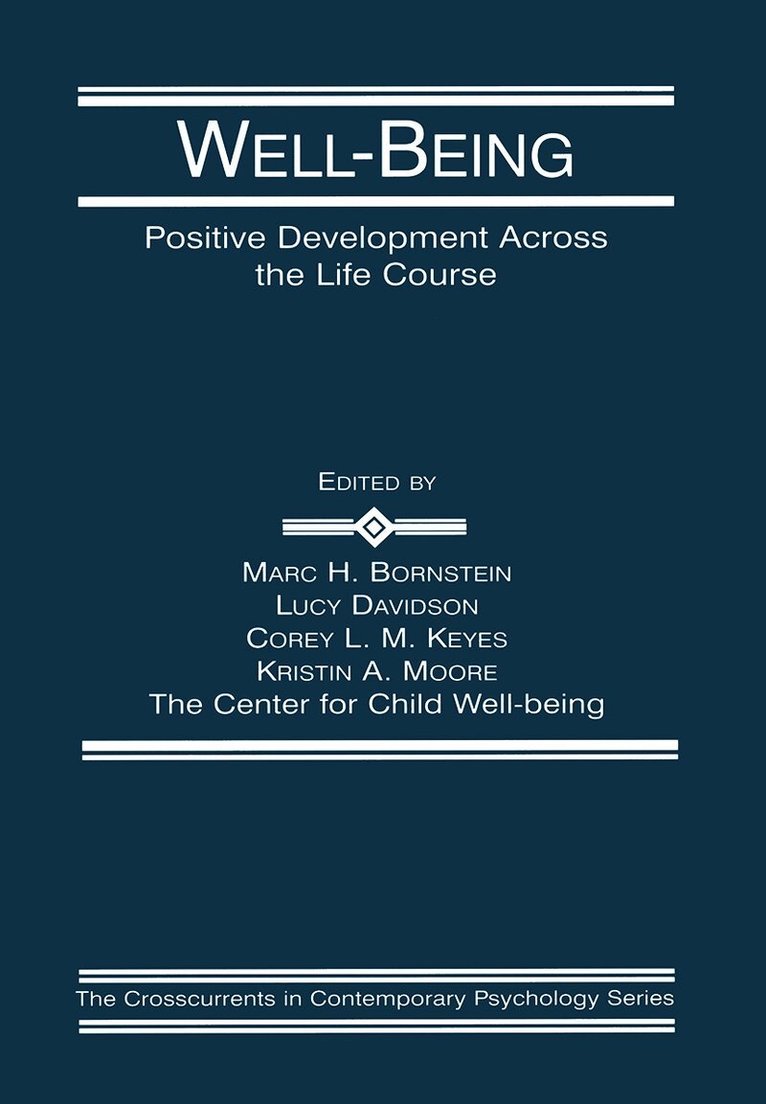
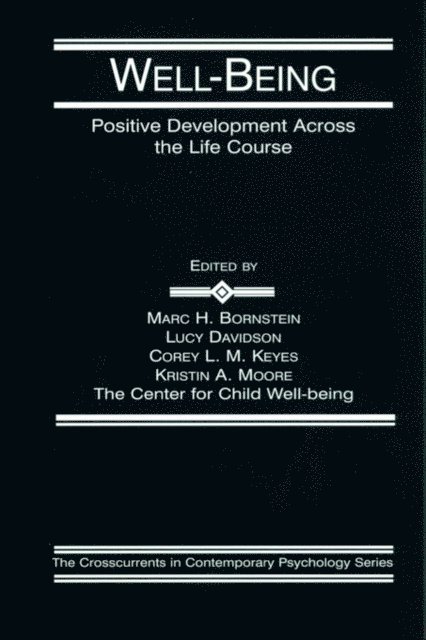
This volume derived from original presentations given at a conference in Atlanta, Georgia, under the auspices of the Center for Child Well-Being. Scholars, practitioners, public health professionals, and principals in the child development community convened to address a science-based framework for elements of well-being and how the elements might be developed across the life course.Integrating physical, cognitive, and social-emotional domains, Well-Being is the first scientific book to consider well-being holistically. Focusing on a set of core strengths grouped within these three domains, the book also includes a fourth section on developmental strengths through adulthood that broadly examines a continuum of health and development, as well as transitions in well-being. This volume takes a developmental perspective across the life course, describing foundational strengths for well-being--the capacities that can be actively developed, supported, or learned. These foundational strengths--problem solving, emotional regulation, and physical safety--are the positive underpinnings of early child health and development, as well as ongoing well-being across the life course. Working together and blending their respective disciplinary perspectives and expertise, 53 experts in psychology, sociology, child development, and medicine have contributed to the book.
1 482 kr
Tillfälligt slut
This volume derived from original presentations given at a conference in Atlanta, Georgia, under the auspices of the Center for Child Well-Being. Scholars, practitioners, public health professionals, and principals in the child development community convened to address a science-based framework for elements of well-being and how the elements might be developed across the life course.Integrating physical, cognitive, and social-emotional domains, Well-Being is the first scientific book to consider well-being holistically. Focusing on a set of core strengths grouped within these three domains, the book also includes a fourth section on developmental strengths through adulthood that broadly examines a continuum of health and development, as well as transitions in well-being. This volume takes a developmental perspective across the life course, describing foundational strengths for well-being--the capacities that can be actively developed, supported, or learned. These foundational strengths--problem solving, emotional regulation, and physical safety--are the positive underpinnings of early child health and development, as well as ongoing well-being across the life course. Working together and blending their respective disciplinary perspectives and expertise, 53 experts in psychology, sociology, child development, and medicine have contributed to the book.
Risk and Resilience in Human Development
A Special Issue of Research in Human Development
Häftad, Engelska, 2004
646 kr
Skickas inom 10-15 vardagar
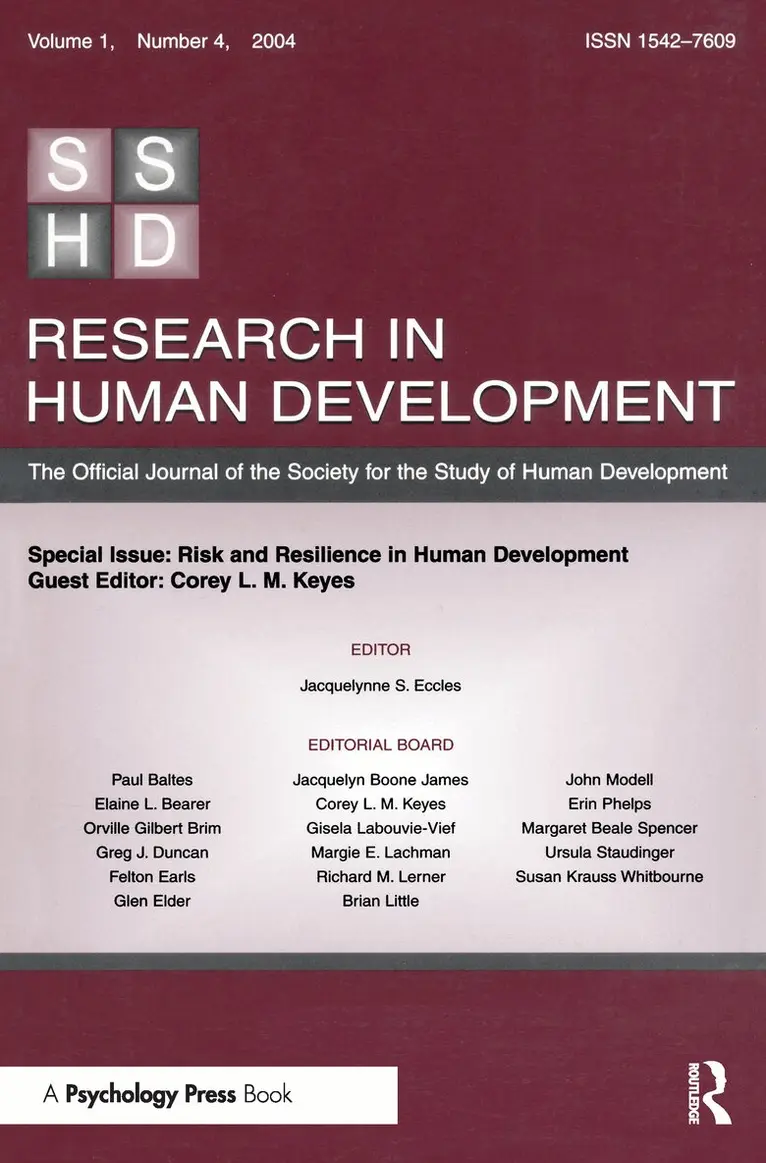
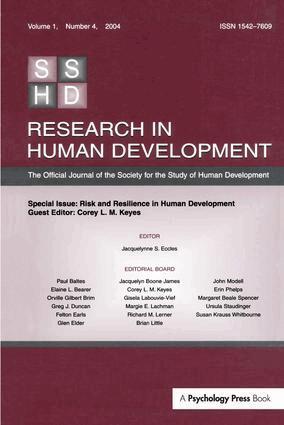
This special issue is devoted to the topic of "risk and resilience" in human development, a topic that epitomizes the complexity of human development as a process of constancy and change throughout life. The three empirical papers in this issue represent strong contributions to the growing corpus of research on risk and resilience in human development. The first one focuses on the uniquely vulnerable population of urban ethnic minority adolescent males. The second paper focuses on the risk and resilience from trauma in a sample of mostly Caucasian individuals from rural Iowa, who were at the last assessment, in the midst of transition into young adulthood. It measures an array of mental disorders outcomes and reveals the theoretical importance of timing of the risk factor. The last paper is a study begun in 1978 of a cohort of individuals with serious adolescent-onset mental disorder. It compares these individuals against the risk and resilience profiles of a matched sample without serious adolescent-onset psychiatric disorder. In sum this issue adds to the corpus of the frontiers of resilience research.
Risk and Resilience in Human Development
A Special Issue of Research in Human Development
Inbunden, Engelska, 2016
2 053 kr
Skickas inom 10-15 vardagar
This special issue is devoted to the topic of "risk and resilience" in human development, a topic that epitomizes the complexity of human development as a process of constancy and change throughout life. The three empirical papers in this issue represent strong contributions to the growing corpus of research on risk and resilience in human development. The first one focuses on the uniquely vulnerable population of urban ethnic minority adolescent males. The second paper focuses on the risk and resilience from trauma in a sample of mostly Caucasian individuals from rural Iowa, who were at the last assessment, in the midst of transition into young adulthood. It measures an array of mental disorders outcomes and reveals the theoretical importance of timing of the risk factor. The last paper is a study begun in 1978 of a cohort of individuals with serious adolescent-onset mental disorder. It compares these individuals against the risk and resilience profiles of a matched sample without serious adolescent-onset psychiatric disorder. In sum this issue adds to the corpus of the frontiers of resilience research.
Mental Well-Being
International Contributions to the Study of Positive Mental Health
Inbunden, Engelska, 2012
1 636 kr
Skickas inom 10-15 vardagar
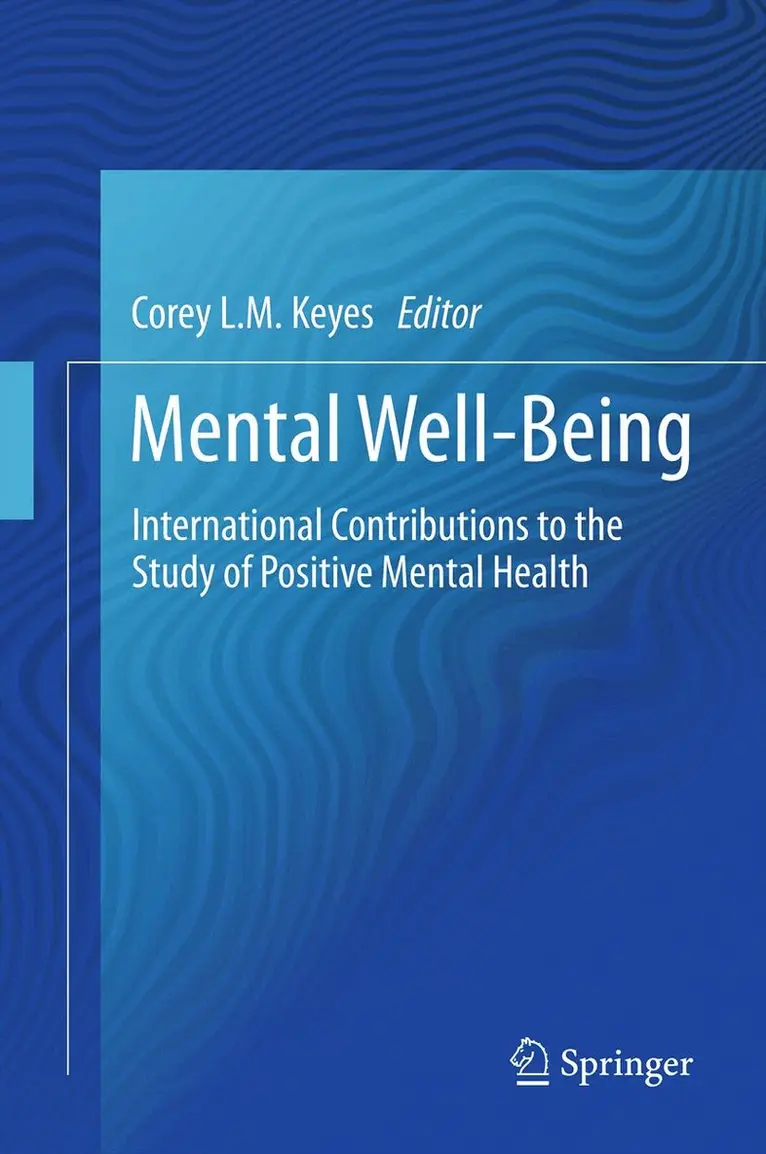
This book provides a new generation of research in which scholars are investigating mental health and human development as not merely the absence of illness or dysfunction, but also the presence of subjective well-being. Subjective well-being is a fundamental facet of the quality of life. The quality of an individual’s life can be assessed externally and objectively or internally and subjectively. From an objective standpoint, other people measure and judge another’s life according to criteria such as wealth or income, educational attainment, occupational prestige, and health status or longevity. Nations, communities, or individuals who are wealthier, have more education, and live longer are considered to have higher quality of life or personal well-being. The subjective standpoint emerged during the 1950s as an important alternative to the objective approach to measuring individual’s well-being. Subjectively, individuals evaluate their own lives as evaluations made, in theory, after reviewing, summing, and weighing the substance of their lives in social context. Research has clearly shown that measures of subjective well-being, which are conceptualized as indicators of mental health (or ‘mental well-being’), are factorially distinct from but correlated with measures of symptoms of common mental disorders such as depression. Despite countless proclamations that health is not merely the absence of illness, there had been little or no empirical research to verify this assumption. Research now supports the hypothesis that health is not merely the absence of illness, it is also the presence of higher levels of subjective well-being.In turn, there is growing recognition of the personal and social utility of subjective well-being, both higher levels of hedonic and eudaimonic wellbeing. Increased subjective well-being has been linked with higher personal and social ‘goods’: higher business profits, more worker productivity, greateremployee retention; increased protection against mortality; increased protection against the onset and increase of physical disability with aging; improved cognitive and immune system functioning; and increased levels of social capital such as civic responsibility, generativity, community involvement and volunteering. This edited volume brings together for the first time the growing scientific literature on positive mental health that is now being conducted in many countries other than the USA and provides students and scholars with an invaluable source for teaching and for generating new ideas for furthering this important line of research.
Mental Well-Being
International Contributions to the Study of Positive Mental Health
Häftad, Engelska, 2014
1 636 kr
Skickas inom 10-15 vardagar
This book provides a new generation of research in which scholars are investigating mental health and human development as not merely the absence of illness or dysfunction, but also the presence of subjective well-being. Subjective well-being is a fundamental facet of the quality of life. The quality of an individual’s life can be assessed externally and objectively or internally and subjectively. From an objective standpoint, other people measure and judge another’s life according to criteria such as wealth or income, educational attainment, occupational prestige, and health status or longevity. Nations, communities, or individuals who are wealthier, have more education, and live longer are considered to have higher quality of life or personal well-being. The subjective standpoint emerged during the 1950s as an important alternative to the objective approach to measuring individual’s well-being. Subjectively, individuals evaluate their own lives as evaluations made, in theory, after reviewing, summing, and weighing the substance of their lives in social context. Research has clearly shown that measures of subjective well-being, which are conceptualized as indicators of mental health (or ‘mental well-being’), are factorially distinct from but correlated with measures of symptoms of common mental disorders such as depression. Despite countless proclamations that health is not merely the absence of illness, there had been little or no empirical research to verify this assumption. Research now supports the hypothesis that health is not merely the absence of illness, it is also the presence of higher levels of subjective well-being.In turn, there is growing recognition of the personal and social utility of subjective well-being, both higher levels of hedonic and eudaimonic wellbeing. Increased subjective well-being has been linked with higher personal and social ‘goods’: higher business profits, more worker productivity, greateremployee retention; increased protection against mortality; increased protection against the onset and increase of physical disability with aging; improved cognitive and immune system functioning; and increased levels of social capital such as civic responsibility, generativity, community involvement and volunteering. This edited volume brings together for the first time the growing scientific literature on positive mental health that is now being conducted in many countries other than the USA and provides students and scholars with an invaluable source for teaching and for generating new ideas for furthering this important line of research.