Cristobal Gnecco - Böcker
Visar alla böcker från författaren Cristobal Gnecco. Handla med fri frakt och snabb leverans.
11 produkter
11 produkter
350 kr
Skickas inom 10-15 vardagar
1 096 kr
Skickas inom 10-15 vardagar
They aim to show that typologies are unavoidable (they are, after all, the way to create networks that give meanings to symbols) but that their tyranny can be overcome if they are used from a critical, heuristic and non-prescriptive stance: critical because the complacent attitude towards their tyranny is replaced by a militant stance against it;
Del 1 - Ethical Archaeologies: The Politics of Social Justice
Ethics and Archaeological Praxis
Inbunden, Engelska, 2014
1 170 kr
Skickas inom 10-15 vardagar
Restoring the historicity and plurality of archaeological ethics is a task to which this book is devoted; its emphasis on praxis mends the historical condition of ethics. In doing so, it shows that nowadays a multicultural (sometimes also called “public”) ethic looms large in the discipline. By engaging communities “differently,” archaeology has explicitly adopted an ethical outlook, purportedly striving to overcome its colonial ontology and metaphysics. In this new scenario, respect for other historical systems/worldviews and social accountability appear to be prominent. Being ethical in archaeological terms in the multicultural context has become mandatory, so much that most professional, international and national archaeological associations have ethical principles as guiding forces behind their openness towards social sectors traditionally ignored or marginalized by their practices. This powerful new ethics—its newness is based, to a large extent, in that it is the first time that archaeological ethics is explicitly stated, as if it didn’t exist before—emanates from metropolitan centers, only to be adopted elsewhere. In this regard, it is worth probing the very nature of the dominant multicultural ethics in disciplinary practices because (a) it is at least suspicious that at the same time archaeology has tuned up with postmodern capitalist/market needs, and (b) the discipline (along with its ethical principles) is contested worldwide by grass-roots organizations and social movements. Can archaeology have socially committed ethical principles at the same time that it strengthens its relationship with the market and capitalism? Is this coincidence just merely haphazard or does it obey more structural rules? The papers in this book try to answer these two questions by examining praxis-based contexts in which archaeological ethics unfolds.
Del 1 - Ethical Archaeologies: The Politics of Social Justice
Ethics and Archaeological Praxis
Häftad, Engelska, 2016
1 170 kr
Skickas inom 10-15 vardagar
Restoring the historicity and plurality of archaeological ethics is a task to which this book is devoted; its emphasis on praxis mends the historical condition of ethics. In doing so, it shows that nowadays a multicultural (sometimes also called “public”) ethic looms large in the discipline. By engaging communities “differently,” archaeology has explicitly adopted an ethical outlook, purportedly striving to overcome its colonial ontology and metaphysics. In this new scenario, respect for other historical systems/worldviews and social accountability appear to be prominent. Being ethical in archaeological terms in the multicultural context has become mandatory, so much that most professional, international and national archaeological associations have ethical principles as guiding forces behind their openness towards social sectors traditionally ignored or marginalized by their practices. This powerful new ethics—its newness is based, to a large extent, in that it is the first time that archaeological ethics is explicitly stated, as if it didn’t exist before—emanates from metropolitan centers, only to be adopted elsewhere. In this regard, it is worth probing the very nature of the dominant multicultural ethics in disciplinary practices because (a) it is at least suspicious that at the same time archaeology has tuned up with postmodern capitalist/market needs, and (b) the discipline (along with its ethical principles) is contested worldwide by grass-roots organizations and social movements. Can archaeology have socially committed ethical principles at the same time that it strengthens its relationship with the market and capitalism? Is this coincidence just merely haphazard or does it obey more structural rules? The papers in this book try to answer these two questions by examining praxis-based contexts in which archaeological ethics unfolds.
1 096 kr
Skickas inom 10-15 vardagar
They aim to show that typologies are unavoidable (they are, after all, the way to create networks that give meanings to symbols) but that their tyranny can be overcome if they are used from a critical, heuristic and non-prescriptive stance: critical because the complacent attitude towards their tyranny is replaced by a militant stance against it;
1 341 kr
Skickas inom 10-15 vardagar
Explores how heritage discourses and local publics interact at Catholic mission sites in the southwestern United States, northern Mexico, and the Southern ConeInterdisciplinary in scope and classed under the name "critical heritage studies," Heritage and Its Missions makes extensive use of ethnographic perspectives to examine heritage not as a collection of inert things upon which a general historical interest is centered, but as a series of active meanings that have consequences in the social, political, and economic arenas. This approach considers the places of interaction between heritage discourses and local publics as constructed spaces where the very materiality of the social and the political unfolds.Heritage and Its Missions brings together researchers from several countries interested in the pre-republican Catholic missions in the Americas as heritage. Each essay discusses the past and current heritage meanings applied to a specific mission by national and multicultural states, local Indigenous and non-Indigenous communities, international heritage institutions, and scholars. They then address how heritage actors produce knowledge from their positioned perspectives; how different actors, collectives, communities, and publics relate to them; how heritage representations are deployed and contested as social facts; and how different conceptions of "heritage" collide, collaborate, and intersperse to produce the meanings around which heritage struggles unfold.
362 kr
Skickas inom 7-10 vardagar
Explores how heritage discourses and local publics interact at Catholic mission sites in the southwestern United States, northern Mexico, and the Southern ConeInterdisciplinary in scope and classed under the name "critical heritage studies," Heritage and Its Missions makes extensive use of ethnographic perspectives to examine heritage not as a collection of inert things upon which a general historical interest is centered, but as a series of active meanings that have consequences in the social, political, and economic arenas. This approach considers the places of interaction between heritage discourses and local publics as constructed spaces where the very materiality of the social and the political unfolds.Heritage and Its Missions brings together researchers from several countries interested in the pre-republican Catholic missions in the Americas as heritage. Each essay discusses the past and current heritage meanings applied to a specific mission by national and multicultural states, local Indigenous and non-Indigenous communities, international heritage institutions, and scholars. They then address how heritage actors produce knowledge from their positioned perspectives; how different actors, collectives, communities, and publics relate to them; how heritage representations are deployed and contested as social facts; and how different conceptions of "heritage" collide, collaborate, and intersperse to produce the meanings around which heritage struggles unfold.
2 288 kr
Skickas inom 10-15 vardagar
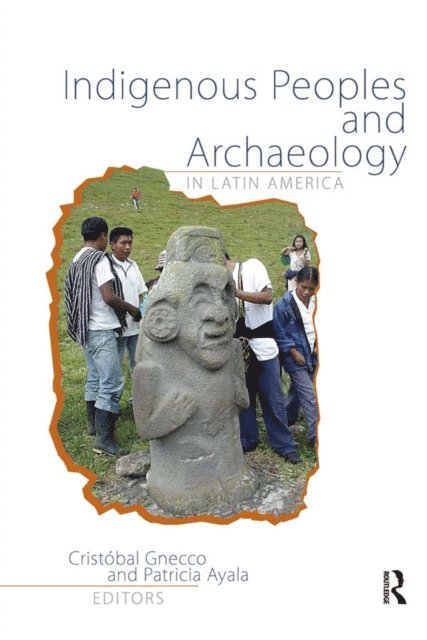
This book is the first to describe indigenous archaeology in Latin America for an English speaking audience. Eighteen chapters primarily by Latin American scholars describe relations between indigenous peoples and archaeology in the frame of national histories and examine the emergence of the native interest in their heritage. Relationships between archaeology and native communities are ambivalent: sometimes an escalating battleground, sometimes a promising site of intercultural encounters. The global trend of indigenous empowerment today has renewed interest in history, making it a tool of cultural meaning and political legitimacy. This book deals with the topic with a raw forthrightness not often demonstrated in writings about archaeology and indigenous peoples. Rather than being ‘politically correct,’ it attempts to transform rather than simply describe.
593 kr
Skickas inom 10-15 vardagar
This book is the first to describe indigenous archaeology in Latin America for an English speaking audience. Eighteen chapters primarily by Latin American scholars describe relations between indigenous peoples and archaeology in the frame of national histories and examine the emergence of the native interest in their heritage. Relationships between archaeology and native communities are ambivalent: sometimes an escalating battleground, sometimes a promising site of intercultural encounters. The global trend of indigenous empowerment today has renewed interest in history, making it a tool of cultural meaning and political legitimacy. This book deals with the topic with a raw forthrightness not often demonstrated in writings about archaeology and indigenous peoples. Rather than being ‘politically correct,’ it attempts to transform rather than simply describe.
296 kr
Skickas
Este libro reúne ensayos que buscan pensar/hacer arqueología desde el trabajo del autor en Colombia. Son arqueológicos en un sentido genealógico y crítico. Proponen una arqueología de la disciplina: un argumento alrededor de lo que hizo y no hizo, de lo que hizo voz y de lo que volvió silencio; en fin, de lo que es capaz de hacer si se desmarca de los mandatos modernos. Ese ejercicio acaso pueda mostrar que la disciplina actual hace eco a la forma como el multiculturalismo controla la diferencia a través de su conveniente promoción de la diversidad. Por eso el libro propone una arqueología de la diferencia radical —una arqueología radical de la diferencia. No otra arqueología sino otros mundos desde ella: otras sociedades, otras temporalidades, otras formas de aglutinación, otras formas de ser. Los abordajes temáticos son amplios: patrimonio, repatriación, modernidad, nacionalismo, ética, alteridad, multiculturalismo, antropología, excavación. Su aparente dispersión obedece al esfuerzo por encender la economía política de la disciplina, los circuitos de producción, circulación y consumo del conocimiento arqueológico y las relaciones de poder inscritas en ellos.
202 kr
Skickas
The texts in this book are autobiographical. Unlike so many academic writings, they do not hide, but rather make visible, everything that happens between the carrying-out and the writing-up of archaeological fieldwork: a space so productive but so contentious that it is usually eliminated, denied, altered.