Cynthia Gordon - Böcker
Visar alla böcker från författaren Cynthia Gordon. Handla med fri frakt och snabb leverans.
10 produkter
10 produkter
2 729 kr
Skickas inom 3-6 vardagar
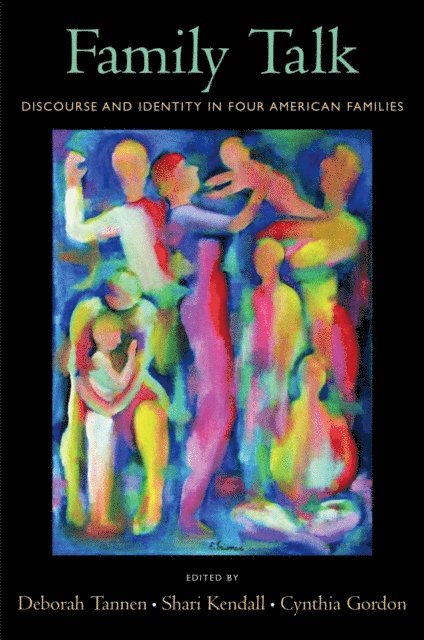
Through everyday talk, individuals forge the ties that can make a family. Family members use language to manage a household, create and maintain relationships, and negotiate and reinforce values and beliefs. The studies gathered in Family Talk are based on a unique research project in which four dual-income American families recorded everything they said for a week. Family Talk extends our understanding of family discourse and of how family membersconstruct, negotiate, and enact their identities as individuals and as families. The volume also contributes to the discourse analysis of naturally-occurring interaction and makes significant contributions to theoriesof framing in interaction.Family Talk addresses issues central to the academic discipline of discourse analysis as well as to families themselves, including decision-making and conflict-talk, the development of gendered family roles, sociability with and socialization of children, the development of social and political beliefs, and the interconnectedness of professional and family life. It provides illuminating insights into the subtleties of familyconversation, and will be of interest to scholars and students in sociolinguistics, discourse studies, communications, anthropological linguistics, cultural studies, psychology, and other fields concerned with thelanguage of everyday interaction or family interaction.
376 kr
Skickas inom 5-8 vardagar
Through everyday talk, individuals forge the ties that can make a family. Family members use language to manage a household, create and maintain relationships, and negotiate and reinforce values and beliefs. The studies gathered in Family Talk are based on a unique research project in which four dual-income American families recorded everything they said for a week. Family Talk extends our understanding of family discourse and of how family members construct, negotiate, and enact their identities as individuals and as families. The volume also contributes to the discourse analysis of naturally-occurring interaction and makes significant contributions to theories of framing in interaction. Family Talk addresses issues central to the academic discipline of discourse analysis as well as to families themselves, including decision-making and conflict-talk, the development of gendered family roles, sociability with and socialization of children, the development of social and political beliefs, and the interconnectedness of professional and family life. It provides illuminating insights into the subtleties of family conversation, and will be of interest to scholars and students in sociolinguistics, discourse studies, communications, anthropological linguistics, cultural studies, psychology, and other fields concerned with the language of everyday interaction or family interaction.
Making Meanings, Creating Family
Intertextuality and Framing in Family Interaction
Inbunden, Engelska, 2009
1 757 kr
Skickas inom 5-8 vardagar
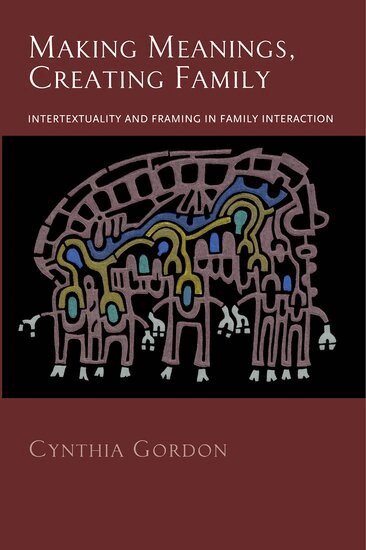
A husband echoes back words that his wife said to him hours before as a way of teasing her. A parent always uses a particular word when instructing her child not to talk during naptime. A mother and family friend repeat each other's instructions as they supervise a child at a shopping mall. Our everyday conversations necessarily are made up of "old" elements of language-words, phrases, paralinguistic features, syntactic structures, speech acts, and stories-that have been used before, which we recontextualize and reshape in new and creative ways. In Making Meanings, Creating Family, Cynthia Gordon integrates theories of intertextuality and framing in order to explore how and why family members repeat one another's words in everyday talk, as well as the interactive effects of those repetitions. Analyzing the discourse of three dual-income American families who recorded their own conversations over the course of one week, Gordon demonstrates how repetition serves as a crucial means of creating the complex, shared meanings that give each family its distinctive identity. Making Meanings, Creating Family takes an interactional sociolinguistic approach, drawing on theories from linguistics, communication, sociology, anthropology, and psychology. Its presentation and analysis of transcribed family encounters will be of interest to scholars and students of communication studies, discourse analysis, sociolinguistics, linguistic anthropology, and psychology-especially those interested in family discourse. Its engagement with intertextuality as theory and methodology will appeal to researchers in media, literary, and cultural studies.
Making Meanings, Creating Family
Intertextuality and Framing in Family Interaction
Häftad, Engelska, 2009
433 kr
Skickas inom 5-8 vardagar
A husband echoes back words that his wife said to him hours before as a way of teasing her. A parent always uses a particular word when instructing her child not to talk during naptime. A mother and family friend repeat each other's instructions as they supervise a child at a shopping mall. Our everyday conversations necessarily are made up of "old" elements of language-words, phrases, paralinguistic features, syntactic structures, speech acts, and stories-that have been used before, which we recontextualize and reshape in new and creative ways. In Making Meanings, Creating Family, Cynthia Gordon integrates theories of intertextuality and framing in order to explore how and why family members repeat one another's words in everyday talk, as well as the interactive effects of those repetitions. Analyzing the discourse of three dual-income American families who recorded their own conversations over the course of one week, Gordon demonstrates how repetition serves as a crucial means of creating the complex, shared meanings that give each family its distinctive identity. Making Meanings, Creating Family takes an interactional sociolinguistic approach, drawing on theories from linguistics, communication, sociology, anthropology, and psychology. Its presentation and analysis of transcribed family encounters will be of interest to scholars and students of communication studies, discourse analysis, sociolinguistics, linguistic anthropology, and psychology-especially those interested in family discourse. Its engagement with intertextuality as theory and methodology will appeal to researchers in media, literary, and cultural studies.
1 438 kr
Skickas inom 7-10 vardagar
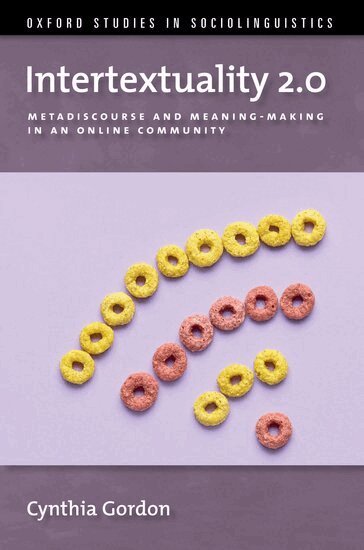
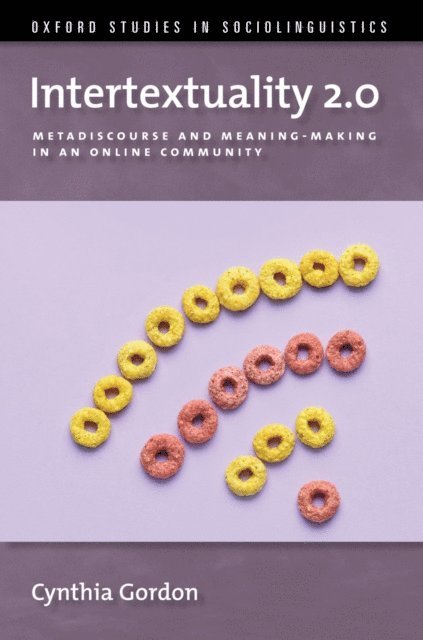
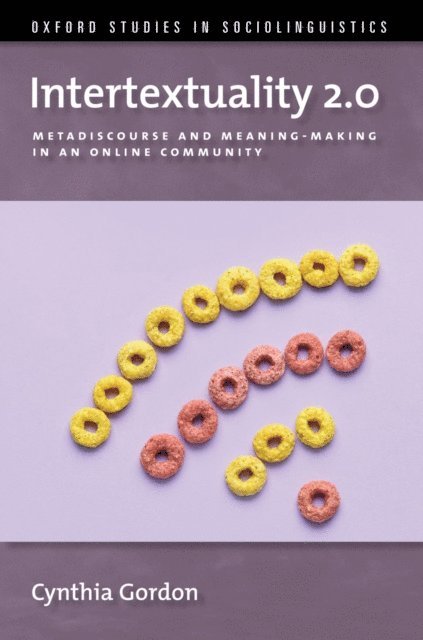
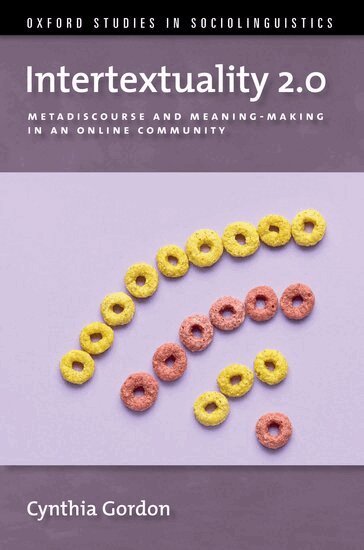
"Intertextuality" is the overarching idea that all texts and conversations are linked to other texts and conversations, and that people create and infer meanings in discourse through making and interpreting these links. Intertextuality is fundamentally connected to metadiscourse; when a person draws on or references one text or conversation in another (intertextuality), they necessarily communicate something about that text or conversation (metadiscourse). While scholars have long recognized the interrelatedness of these two theoretical concepts, existing studies have tended to focus on one or the other, leaving underexplored the specific ways in which these phenomena are intertwined at the micro-interactional level, especially online, and for what purposes.This interactional sociolinguistic study contributes to filling this gap by demonstrating how specific intertextual linking strategies, both linguistic (e.g., word repetition, deictic pronouns) and multimodal (e.g., emojis, symbols, and GIFs), are mobilized by posters participating in online weight loss discussion boards. These strategies serve as a resource to accomplish the metadiscursive activities, targeted at various levels of discourse, through which participants construct shared understandings, negotiate the group's interactional norms, and facilitate engagement in the group's primary shared activity: exchanging information about, and providing support for, weight loss, healthful eating, and related issues. By rigorously applying the perspective of metadiscourse in a study of intertextuality, Intertextuality 2.0 offers important new insights into why intertextuality occurs and what it accomplishes: it helps people manage the challenges of communication.
419 kr
Skickas inom 5-8 vardagar
"Intertextuality" is the overarching idea that all texts and conversations are linked to other texts and conversations, and that people create and infer meanings in discourse through making and interpreting these links. Intertextuality is fundamentally connected to metadiscourse; when a person draws on or references one text or conversation in another (intertextuality), they necessarily communicate something about that text or conversation (metadiscourse). While scholars have long recognized the interrelatedness of these two theoretical concepts, existing studies have tended to focus on one or the other, leaving underexplored the specific ways in which these phenomena are intertwined at the micro-interactional level, especially online, and for what purposes.This interactional sociolinguistic study contributes to filling this gap by demonstrating how specific intertextual linking strategies, both linguistic (e.g., word repetition, deictic pronouns) and multimodal (e.g., emojis, symbols, and GIFs), are mobilized by posters participating in online weight loss discussion boards. These strategies serve as a resource to accomplish the metadiscursive activities, targeted at various levels of discourse, through which participants construct shared understandings, negotiate the group's interactional norms, and facilitate engagement in the group's primary shared activity: exchanging information about, and providing support for, weight loss, healthful eating, and related issues. By rigorously applying the perspective of metadiscourse in a study of intertextuality, Intertextuality 2.0 offers important new insights into why intertextuality occurs and what it accomplishes: it helps people manage the challenges of communication.
Identity and Ideology in Digital Food Discourse
Social Media Interactions Across Cultural Contexts
Inbunden, Engelska, 2020
1 703 kr
Skickas inom 10-15 vardagar
Exploring food-related interactions in various digital and cultural contexts, this book demonstrates how food as a discursive resource can be mobilized to accomplish actions of social, cultural, and political consequence. The chapters reveal how social media users employ language, images, and videos to construct identities and ideologies that both encompass and transcend food.Drawing on various discourse analytic frameworks to digital communication, contributors examine interactions across Facebook, Twitter, YouTube, and Instagram. From the multimodal discourse of a Korean livestreaming online eating show, to food activism in an English blogging community and discussions of a food-related controversy on Omani Twitter, this book shows how language and multimodal resources serve not only to communicate about food, but also as a means of accomplishing key aspects of everyday social life.
Identity and Ideology in Digital Food Discourse
Social Media Interactions Across Cultural Contexts
Häftad, Engelska, 2022
434 kr
Skickas inom 10-15 vardagar
Exploring food-related interactions in various digital and cultural contexts, this book demonstrates how food as a discursive resource can be mobilized to accomplish actions of social, cultural, and political consequence. The chapters reveal how social media users employ language, images, and videos to construct identities and ideologies that both encompass and transcend food.Drawing on various discourse analytic frameworks to digital communication, contributors examine interactions across Facebook, Twitter, YouTube, and Instagram. From the multimodal discourse of a Korean livestreaming online eating show, to food activism in an English blogging community and discussions of a food-related controversy on Omani Twitter, this book shows how language and multimodal resources serve not only to communicate about food, but also as a means of accomplishing key aspects of everyday social life.
2 312 kr
Skickas inom 5-8 vardagar
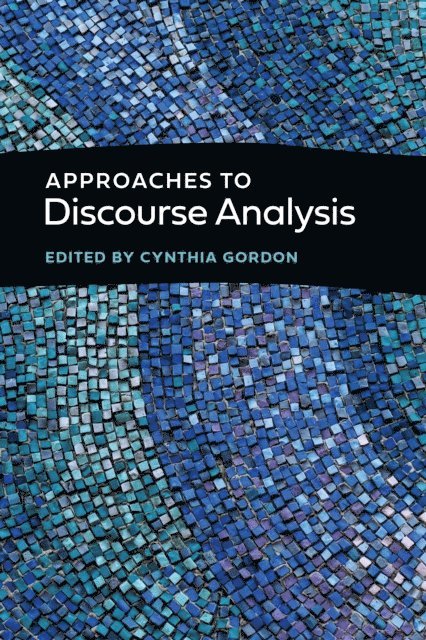
A groundbreaking collection by leading scholars that spans a broad range of social situations, cultural contexts, and analytic perspectivesThe contemporary landscape of discourse analysis—which examines spoken, written, and multimodal communication—is so diverse that, as volume contributor Deborah Tannen observes, “discourse” has become almost synonymous with “language” and, for many scholars, extends well beyond it. The ways in which we communicate grow and change and so do approaches to discourse analysis along with the diversity of topics, analytic contexts, and disciplinary foundations. How do we conceptualize discourse? What are the various approaches to studying it? And how can we put these approaches into dialogue?Scholars within the field of linguistics and beyond contribute to this volume with discourse analyses in multiple languages, contexts, and modes. These snapshots show the different ways language is used in modern social situations—from email messages between professors and students, to Twitter activism, to political trolling on online news articles, to video-chats between US doctors and patients. Collectively, the chapters highlight the diversity and complexity of the field. Across these varied approaches, what emerges is a common understanding of communication as fundamentally connected to human agency and creativity and as embedded in and constitutive of our social and cultural worlds.Approaches to Discourse Analysis demonstrates the importance of the diverse perspectives that various approaches to discourse bring to bear on human communication. Linguists and other readers interested in the interplay of language and culture will gain new insight and understanding from this rich compilation.
755 kr
Skickas inom 5-8 vardagar
A groundbreaking collection by leading scholars that spans a broad range of social situations, cultural contexts, and analytic perspectivesThe contemporary landscape of discourse analysis—which examines spoken, written, and multimodal communication—is so diverse that, as volume contributor Deborah Tannen observes, “discourse” has become almost synonymous with “language” and, for many scholars, extends well beyond it. The ways in which we communicate grow and change and so do approaches to discourse analysis along with the diversity of topics, analytic contexts, and disciplinary foundations. How do we conceptualize discourse? What are the various approaches to studying it? And how can we put these approaches into dialogue?Scholars within the field of linguistics and beyond contribute to this volume with discourse analyses in multiple languages, contexts, and modes. These snapshots show the different ways language is used in modern social situations—from email messages between professors and students, to Twitter activism, to political trolling on online news articles, to video-chats between US doctors and patients. Collectively, the chapters highlight the diversity and complexity of the field. Across these varied approaches, what emerges is a common understanding of communication as fundamentally connected to human agency and creativity and as embedded in and constitutive of our social and cultural worlds.Approaches to Discourse Analysis demonstrates the importance of the diverse perspectives that various approaches to discourse bring to bear on human communication. Linguists and other readers interested in the interplay of language and culture will gain new insight and understanding from this rich compilation.