David N. Rapp – författare
272 kr
Skickas inom 5-8 vardagar
696 kr
Läs direkt efter köp
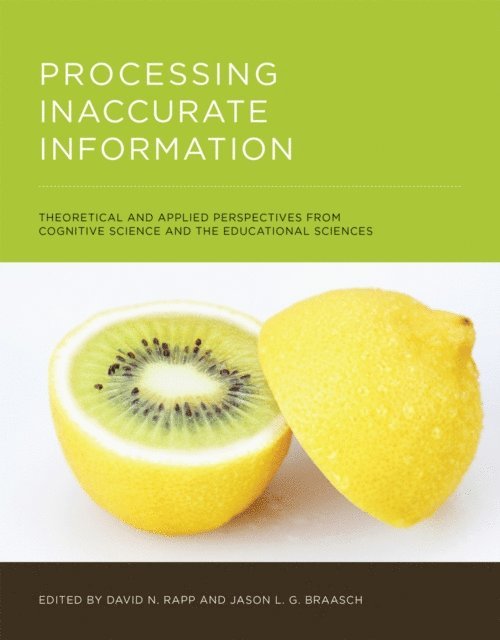
Interdisciplinary approaches to identifying, understanding, and remediating people''s reliance on inaccurate information that they should know to be wrong.
Our lives revolve around the acquisition of information. Sometimes the information we acquire—from other people, from books, or from the media—is wrong. Studies show that people rely on such misinformation, sometimes even when they are aware that the information is inaccurate or invalid. And yet investigations of learning and knowledge acquisition largely ignore encounters with this sort of problematic material. This volume fills the gap, offering theoretical and empirical perspectives on the processing of misinformation and its consequences.
The contributors, from cognitive science and education science, provide analyses that represent a variety of methodologies, theoretical orientations, and fields of expertise. The chapters describe the behavioral consequences of relying on misinformation and outline possible remediations; discuss the cognitive activities that underlie encounters with inaccuracies, investigating why reliance occurs so readily; present theoretical and philosophical considerations of the nature of inaccuracies; and offer formal, empirically driven frameworks that detail when and how inaccuracies will lead to comprehension difficulties.
ContributorsPeter Afflerbach, Patricia A. Alexander, Jessica J. Andrews, Peter Baggetta, Jason L. G. Braasch, Ivar Bråten, M. Anne Britt, Rainer Bromme, Luke A. Buckland, Clark A. Chinn, Byeong-Young Cho, Sidney K. D''Mello, Andrea A. diSessa, Ullrich K. H. Ecker, Arthur C. Graesser, Douglas J. Hacker, Brenda Hannon, Xiangen Hu, Maj-Britt Isberner, Koto Ishiwa, Matthew E. Jacovina, Panayiota Kendeou, Jong-Yun Kim, Stephan Lewandowsky, Elizabeth J. Marsh, Ruth Mayo, Keith K. Millis, Edward J. O''Brien, Herre van Oostendorp, José Otero, David N. Rapp, Tobias Richter, Ronald W. Rinehart, Yaacov Schul, Colleen M. Seifert, Marc Stadtler, Brent Steffens, Helge I. Strømsø, Briony Swire, Sharda Umanath
832 kr
Skickas inom 5-8 vardagar
694 kr
Skickas inom 10-15 vardagar
3 574 kr
Skickas inom 10-15 vardagar
866 kr
Läs direkt efter köp
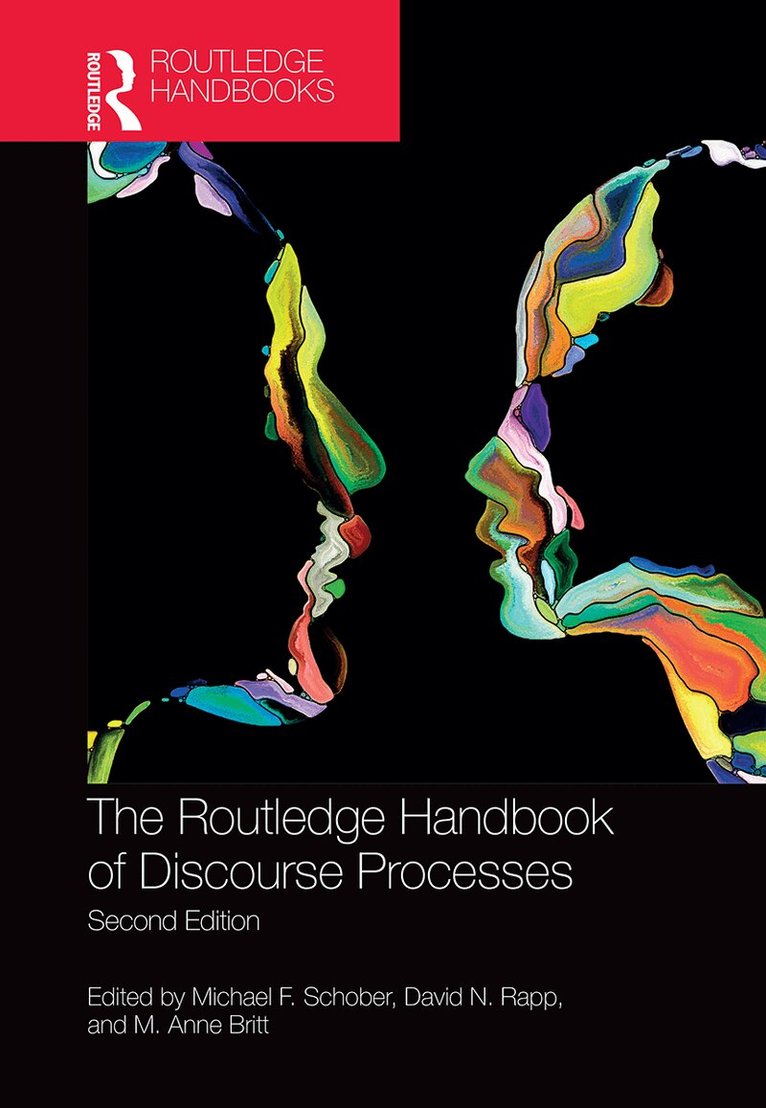
The second edition of The Routledge Handbook of Discourse Processes provides a state-of-the-art overview of the field of discourse processes, highlighting the subject’s interdisciplinary foundations and bringing together established and emergent scholars to provide a dynamic roadmap of the evolution of the field.
This new edition reflects several of the enormous changes in the world since the publication of the first edition—changes in modes of communication and an increased urgency to understand how people comprehend and trust information. The contents of this volume attempt to address fundamental questions about what we should now be thinking about reading, listening, talking, and writing. The chapters collected here represent a wide range of empirical methods currently available: lab or field experiments, with a range of measures, from quantitative to qualitative; observational studies, including classrooms or organizational communication; corpus analyses; conversation analysis; computational modeling; and linguistic analyses. The chapters also draw attention to the explosion of contextually rich and computationally intensive data analysis tools which have changed the research landscape, along with more contemporary measures of people’s discourse use, from eye-tracking to video analysis tools to brain scans. The Routledge Handbook of Discourse Processes, Second edition is the ideal resource for graduate students, researchers, and practitioners in a variety of disciplines, including discourse analysis, conversation analysis, cognitive psychology, and cognitive science.
866 kr
Läs direkt efter köp
The second edition of The Routledge Handbook of Discourse Processes provides a state-of-the-art overview of the field of discourse processes, highlighting the subject’s interdisciplinary foundations and bringing together established and emergent scholars to provide a dynamic roadmap of the evolution of the field.
This new edition reflects several of the enormous changes in the world since the publication of the first edition—changes in modes of communication and an increased urgency to understand how people comprehend and trust information. The contents of this volume attempt to address fundamental questions about what we should now be thinking about reading, listening, talking, and writing. The chapters collected here represent a wide range of empirical methods currently available: lab or field experiments, with a range of measures, from quantitative to qualitative; observational studies, including classrooms or organizational communication; corpus analyses; conversation analysis; computational modeling; and linguistic analyses. The chapters also draw attention to the explosion of contextually rich and computationally intensive data analysis tools which have changed the research landscape, along with more contemporary measures of people’s discourse use, from eye-tracking to video analysis tools to brain scans. The Routledge Handbook of Discourse Processes, Second edition is the ideal resource for graduate students, researchers, and practitioners in a variety of disciplines, including discourse analysis, conversation analysis, cognitive psychology, and cognitive science.