Deborah A. Thomas – författare
Visar alla böcker från författaren Deborah A. Thomas. Handla med fri frakt och snabb leverans.
12 produkter
12 produkter
597 kr
Skickas inom 10-15 vardagar
What does it mean to claim, two decades into the twenty-first century, that citizenship is on the edge? The questions that animate this volume focus attention on the relationships between liberal conceptions of citizenship and democracy on one hand, and sex, race, and gender on the other. Who "counts" as a citizen in today's world, and what are the mechanisms through which the rights, benefits, and protections of liberal citizenship are differentially bestowed upon diverse groups? What are the relationships between global economic processes and political and legal empowerment? What forms of violence emerge in order to defend and define these rights, benefits, and protections, and how do these forms of violence reflect long histories? How might we recognize and account for the various avenues through which people attempt to make themselves as political subjects?Citizenship on the Edge approaches these questions from multiple disciplines, including Africana Studies, anthropology, disability studies, film studies, gender studies, history, law, political science, and sociology. Contributors explore the ways in which compounding social inequalities redound to the conditions and expressions of citizenship in the U.S. and throughout the world. They give a sense of the breathtaking range of the ways that citizenship is controlled, repressed, undercut, and denied at the same time as they outline people's attempts to claim citizenship in ways that are meaningful to them. From university speech policies, to labor and immigration policies, to a rethinking of the security theatre, to women's empowerment in the family and economy and a rethinking of marriage and the family, we see slivers of possibility for a more inclusive and less hostile world, in which citizenship is no longer so in doubt, so on the edge, for so many. As a whole, the volume argues that citizenship cannot be conceptualized as a transcendent good but must instead always be contextualized within specific places and times, and in relation to dynamic struggle.Contributors: Erez Aloni, Ange-Marie Hancock Alfaro, Nancy J. Hirschmann, Samantha Majic, Valentine M. Moghadam, Michael Rembis, Tracy Robinson, Ellen Samuels, Kimberly Theidon, Deborah A. Thomas.
1 180 kr
Skickas inom 10-15 vardagar
At the height of his career, writing short stories provided Dickens with a release from the formal constraints of his novels and gave free reign to his creative imagination. Ranging from "flights of fancy" to literary masterpieces, Dickens's short stories contained artistic experiments that inspired fuller developments in his novels. Yet the short stories have been all but overlooked in critical discussions.Deborah A. Thomas focuses directly on this body of work, tracing three stages of development. In the early stage until 1840, Dickens produced numerous short stories, culminating in his experience with the abortive Master Humphrey's Clock. In the following ten years, he restricted his writing of short stories to the five Christmas Books but refined his theories about the value of the genre in the context of his work. In the third stage, 1850-1868, Dickens again turned actively to the writing of short stories, many of them the "Christmas Stories" appearing in the weeklies Household Words and All the Year Round, which Dickens edited successively from 1850 to 1869 and from 1859 until his death in 1870. The author concentrates primarily upon the more notable stories, drawing for a perspective upon Dickens' own concept of "fancy." In an increasingly factual age, Dickens-attracted to the unusual and the unknown-found the short story a form in which he could indulge his high degree of fantasy and explore the hidden corners of the mind. Dickens' fascination with psychological abnormality and the supernatural-reflected in his novels-reveals itself even more intriguingly in his short stories.In Thomas's analysis, Dickens' short stories appear as an important key to understanding the novels, while proving worthy in themselves of critical attention. Essential to a thorough study of Dickens, her book sheds light upon previously obscure facets of his developing artistry.
677 kr
Skickas inom 5-8 vardagar
Slavery fascinated Thackeray. For him, the essence of slavery consisted of treating people like things. Thomas examines relationships in Thackeray's fiction in which people have been reduced to objects and power is an end. These relationships include not only actual slaves and blacks, but also servants, dependents of all races, upper-class women sold into marriage, and children struggling to escape parental domination.Thomas also clarifies Thackeray's view of black slavery. Many of his remarks about black men and women reflect an attitude that we could today call racist. He regarded blacks of the American South (where he traveled on lecture tours in 1852-53 and 1855-56) as inherently different from whites. At the same time, he viewed slavery as inherently wrong and condemned its exploitive aspects. Nonetheless, in some of his letters from America, he observed that the slaves he had seen appeared better treated, on the whole, than many domestic servants and industrial workers in England. It was characteristic of Thackeray to try to see both sides of a complex issue. However, modern students of Thackeray often seem to be so uncomfortable with his effort to present what he considered a balanced picture that they overlook his basic awareness of the vils of slavery and the way in which the idea of slavery repeatedly occurs in his writing. The prominence of this idea in his fiction has important implications for anyone studying nineteenth-century literature and culture.For Thackeray, as for most of his nineteenth-century British contemporaries, the major form of slavery was that to be found in the New World. However, ideas regarding galley (penal) slavery and Western concepts of "Oriental" slavery also contributed to his thinking about human bondage. Prior to his visits to the United States, the image of slavery had a powerful creative effect on Thackeray's writing. In contrast, after his exposure to the reality of slavery in the American South, this image waned in creative power in his fiction. For Thackeray in this regard, the unseen was imaginatively more stimulating than the seen.Thackeray and Slavery
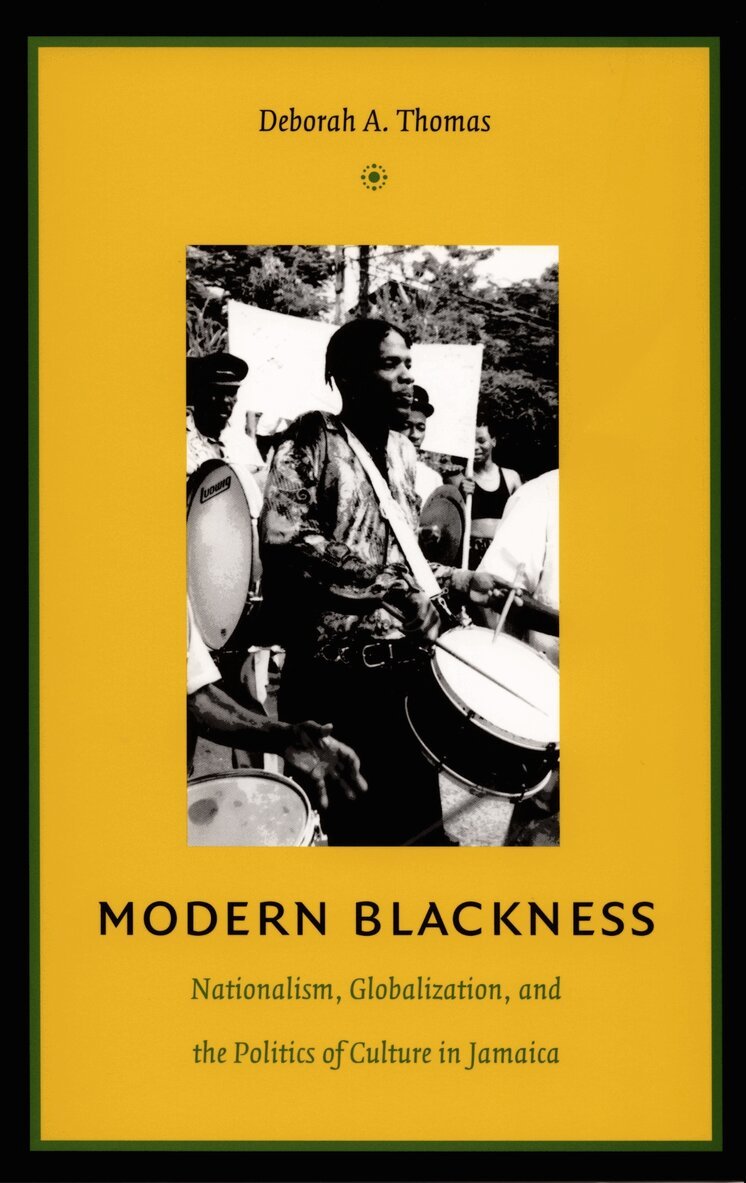
Modern Blackness
Nationalism, Globalization, and the Politics of Culture in Jamaica
Häftad, Engelska, 2004
593 kr
Skickas inom 3-6 vardagar
Modern Blackness is a rich ethnographic exploration of Jamaican identity in the late twentieth century and early twenty-first. Analyzing nationalism, popular culture, and political economy in relation to one another, Deborah A. Thomas illuminates an ongoing struggle in Jamaica between the values associated with the postcolonial state and those generated in and through popular culture. Following independence in 1962, cultural and political policies in Jamaica were geared toward the development of a multiracial creole nationalism reflected in the country’s motto: “Out of many, one people.” As Thomas shows, by the late 1990s, creole nationalism was superseded by “modern blackness”-an urban blackness rooted in youth culture and influenced by African American popular culture. Expressions of blackness that had been marginalized in national cultural policy became paramount in contemporary understandings of what it was to be Jamaican.Thomas combines historical research with fieldwork she conducted in Jamaica between 1993 and 2003. Drawing on her research in a rural hillside community just outside Kingston, she looks at how Jamaicans interpreted and reproduced or transformed on the local level nationalist policies and popular ideologies about progress. With detailed descriptions of daily life in Jamaica set against a backdrop of postcolonial nation-building and neoliberal globalization, Modern Blackness is an important examination of the competing identities that mobilize Jamaicans locally and represent them internationally.
490 kr
Skickas inom 3-6 vardagar
Kamari Maxine Clarke and Deborah A. Thomas argue that a firm grasp of globalization requires an understanding of how race has constituted, and been constituted by, global transformations. Focusing attention on race as an analytic category, this state-of-the-art collection of essays explores the changing meanings of blackness in the context of globalization. It illuminates the connections between contemporary global processes of racialization and transnational circulations set in motion by imperialism and slavery; between popular culture and global conceptions of blackness; and between the work of anthropologists, policymakers, religious revivalists, and activists and the solidification and globalization of racial categories.A number of the essays bring to light the formative but not unproblematic influence of African American identity on other populations within the black diaspora. Among these are an examination of the impact of “black America” on racial identity and politics in mid-twentieth-century Liverpool and an inquiry into the distinctive experiences of blacks in Canada. Contributors investigate concepts of race and space in early-twenty-first century Harlem, the experiences of trafficked Nigerian sex workers in Italy, and the persistence of race in the purportedly non-racial language of the “New South Africa.” They highlight how blackness is consumed and expressed in Cuban timba music, in West Indian adolescent girls’ fascination with Buffy the Vampire Slayer, and in the incorporation of American rap music into black London culture. Connecting race to ethnicity, gender, sexuality, nationality, and religion, these essays reveal how new class economies, ideologies of belonging, and constructions of social difference are emerging from ongoing global transformations.Contributors. Robert L. Adams, Lee D. Baker, Jacqueline Nassy Brown, Tina M. Campt, Kamari Maxine Clarke, Raymond Codrington, Grant Farred, Kesha Fikes, Isar Godreau, Ariana Hernandez-Reguant, Jayne O. Ifekwunigwe, John L. Jackson Jr., Oneka LaBennett, Naomi Pabst, Lena Sawyer, Deborah A. Thomas
364 kr
Skickas inom 5-8 vardagar
Exceptional Violence is a sophisticated examination of postcolonial state formation in the Caribbean, considered across time and space, from the period of imperial New World expansion to the contemporary neoliberal era, and from neighborhood dynamics in Kingston to transnational socioeconomic and political fields. Deborah A. Thomas takes as her immediate focus violence in Jamaica and representations of that violence as they circulate within the country and abroad. Through an analysis encompassing Kingston communities, Jamaica’s national media, works of popular culture, notions of respectability, practices of punishment and discipline during slavery, the effects of intensified migration, and Jamaica’s national cultural policy, Thomas develops several arguments. Violence in Jamaica is the complicated result of a structural history of colonialism and underdevelopment, not a cultural characteristic passed from one generation to the next. Citizenship is embodied; scholars must be attentive to how race, gender, and sexuality have been made to matter over time. Suggesting that anthropologists in the United States should engage more deeply with history and political economy, Thomas mobilizes a concept of reparations as a framework for thinking, a rubric useful in its emphasis on structural and historical lineages.
1 178 kr
Skickas inom 5-8 vardagar
In 2010, Jamaican police and military forces entered the West Kingston community of Tivoli Gardens to apprehend Christopher “Dudus” Coke, who had been ordered for extradition to the United States on gun and drug-running charges. By the time Coke was detained, somewhere between seventy-five and two hundred civilians had been killed. In Political Life in the Wake of the Plantation, Deborah A. Thomas uses the incursion as a point of departure for theorizing the roots of contemporary state violence in Jamaica and in post-plantation societies in general. Drawing on visual, oral historical, and colonial archives, Thomas traces the long-term legacies of the plantation system and how its governing logics continue to shape and replicate forms of violence. She places affect at the center of sovereignty to destabilize disembodied narratives of liberalism and progress and to raise questions about recognition, repair, and accountability. In tying theories of politics, colonialism, race, and affect together with Jamaica's history, Thomas presents a robust framework for understanding what it means to be human in the plantation's wake.
320 kr
Skickas inom 5-8 vardagar
In 2010, Jamaican police and military forces entered the West Kingston community of Tivoli Gardens to apprehend Christopher “Dudus” Coke, who had been ordered for extradition to the United States on gun and drug-running charges. By the time Coke was detained, somewhere between seventy-five and two hundred civilians had been killed. In Political Life in the Wake of the Plantation, Deborah A. Thomas uses the incursion as a point of departure for theorizing the roots of contemporary state violence in Jamaica and in post-plantation societies in general. Drawing on visual, oral historical, and colonial archives, Thomas traces the long-term legacies of the plantation system and how its governing logics continue to shape and replicate forms of violence. She places affect at the center of sovereignty to destabilize disembodied narratives of liberalism and progress and to raise questions about recognition, repair, and accountability. In tying theories of politics, colonialism, race, and affect together with Jamaica's history, Thomas presents a robust framework for understanding what it means to be human in the plantation's wake.
Sovereignty Unhinged
An Illustrated Primer for the Study of Present Intensities, Disavowals, and Temporal Derangements
Inbunden, Engelska, 2023
1 117 kr
Skickas inom 5-8 vardagar
Sovereignty Unhinged theorizes sovereignty beyond the typical understandings of action, control, and the nation-state. Rather than engaging with the geopolitical realities of the present, the contributors consider sovereignty from the perspective of how it is lived and enacted in everyday practice and how it reflects people’s aspirations for new futures. In a series of ethnographic case studies ranging from the Americas to the Middle East to South Asia, they examine the means of avoiding the political and historical capture that make one complicit with sovereign authority rather than creating the conditions of possibility to confront it. The contributors attend to the affective dimensions of these practices of world-building to illuminate the epistemological, ontological, and transnational entanglements that produce a sense of what is possible. They also trace how sovereignty is activated and deactivated over the course of a lifetime within the struggle of the everyday. In so doing, they outline how individuals create and enact forms of sovereignty that allow them to endure fast and slow forms of violence while embracing endless opportunities for building new worlds.Contributors. Alex Blanchette, Yarimar Bonilla, Jessica Cattelino, MarÍa Elena GarcÍa, Akhil Gupta, Lochlann Jain, Purnima Mankekar, Joseph Masco, Michael Ralph, Danilyn Rutherford, Arjun Shankar, Kristen L. Simmons, Deborah A. Thomas, Leniqueca A. Welcome, Kaya Naomi Williams, Jessica Winegar
1 276 kr
Skickas inom 5-8 vardagar
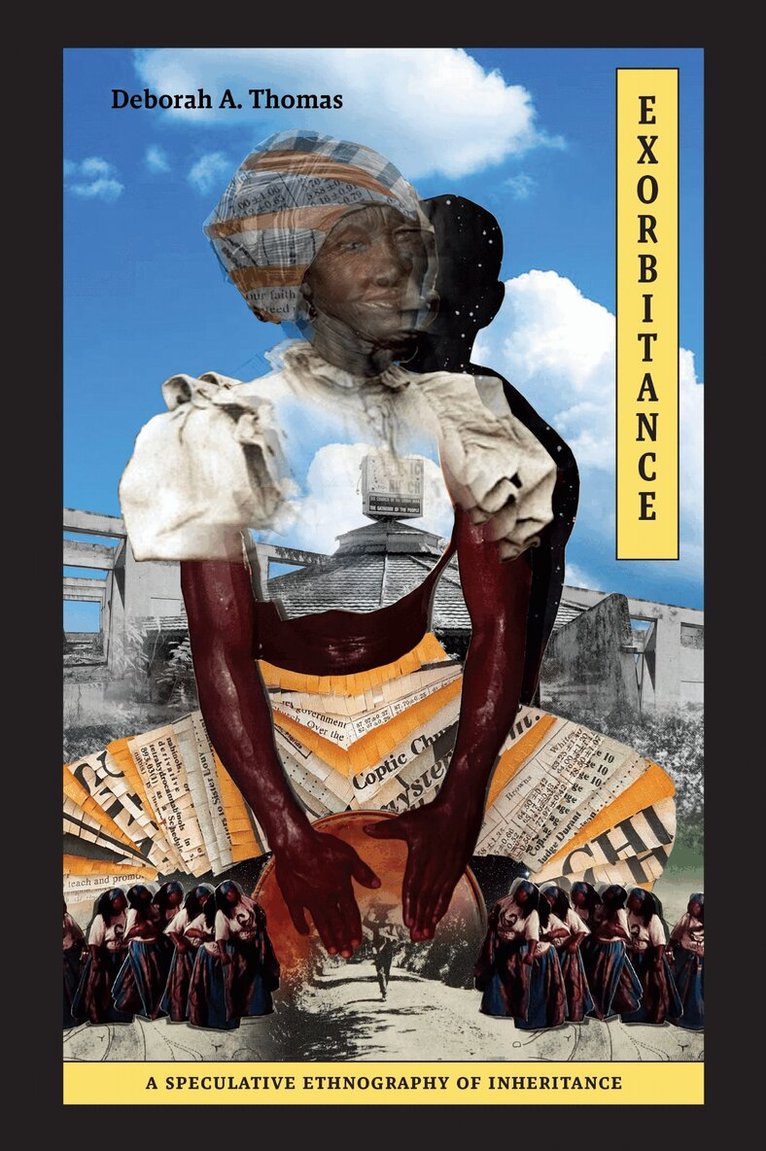
In Exorbitance, Deborah A. Thomas calls for new approaches to political sovereignty grounded in the embodied forms of autonomy and relation created in daily life. Rather than rooting sovereignty in the violence of the state and its institutions, Thomas conceives of sovereignty as the embodied refusal of law and dominion. Drawing on the insights of Caribbeanist thought and studies of Jamaican social, political, and spiritual life, Thomas proposes an exorbitant sovereignty enacted through a phenomenological notion of inheritance. Such a sovereignty emerges from alternative genealogies of governance, community, and ceremony that exceed Enlightenment expectations of political life. Thomas contends that the articulations of exorbitant sovereignty are emergent, ephemeral, and ultimately, relational. By outlining the perils and promises of our inheritance of colonial logics and the tools to refuse them, Thomas models a collaborative and collective anthropology oriented toward improvisational experimentation rather than ethnographic extraction.
298 kr
Skickas inom 5-8 vardagar
In Exorbitance, Deborah A. Thomas calls for new approaches to political sovereignty grounded in the embodied forms of autonomy and relation created in daily life. Rather than rooting sovereignty in the violence of the state and its institutions, Thomas conceives of sovereignty as the embodied refusal of law and dominion. Drawing on the insights of Caribbeanist thought and studies of Jamaican social, political, and spiritual life, Thomas proposes an exorbitant sovereignty enacted through a phenomenological notion of inheritance. Such a sovereignty emerges from alternative genealogies of governance, community, and ceremony that exceed Enlightenment expectations of political life. Thomas contends that the articulations of exorbitant sovereignty are emergent, ephemeral, and ultimately, relational. By outlining the perils and promises of our inheritance of colonial logics and the tools to refuse them, Thomas models a collaborative and collective anthropology oriented toward improvisational experimentation rather than ethnographic extraction.
Changing Continuities and the Scholar-Activist Anthropology of Constance R. Sutton
Häftad, Engelska, 2022
621 kr
Skickas inom 3-6 vardagar