Defense Materials Manufacturing and Infrastructure Standing Committee – författare
552 kr
Läs direkt efter köp
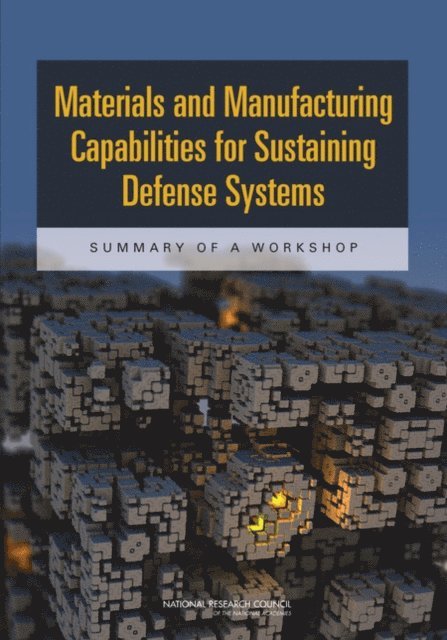
The Standing Committee on Defense Materials Manufacturing and Infrastructure (DMMI) conducted a workshop on July 23-24, 2012, to share information and gather perspectives on issues concerning Materials and Manufacturing Capabilities for Sustaining Defense Systems. This workshop, held at the headquarters building of the National Academies, 2101 Constitution Avenue N.W., Washington D.C., was conducted according to the procedures of the National Research Council (NRC) for a convening activity. That is, all workshop participants—including presenters, members of the DMMI standing committee, Reliance 21, invited guests, and visitors—spoke as individuals, and no overall findings, conclusions, or recommendations were developed during or as a result of the workshop. All statements and views summarized in this publication are attributable only to those individuals who expressed them. It is worth noting that the sponsor, Reliance 21, is a Department of Defense group of professionals that was established to enable the DOD science and technology (S&T) community to work together to enhance Defense S&T programs, eliminate unwarranted duplication, and strengthen cooperation among the military services and other DOD agencies.
The DMMI standing committee named a workshop planning group to develop the workshop agenda and decide on invited guests and presenters, in accordance with the statement of task approved by the Governing Board of the NRC. The planning group also consulted with the Reliance 21 materials and processing community of interest.
The presentations and discussions during the workshop are summarized sequentially in the main part of this report. As an aid to readers, nine themes have been identified by the author that recurred in multiple presentations and discussions. Materials and Manufacturing Capabilities for Sustaining Defense Systems: Summary of a Workshop explains these nine themes and summarizes the two day workshop.
519 kr
Läs direkt efter köp
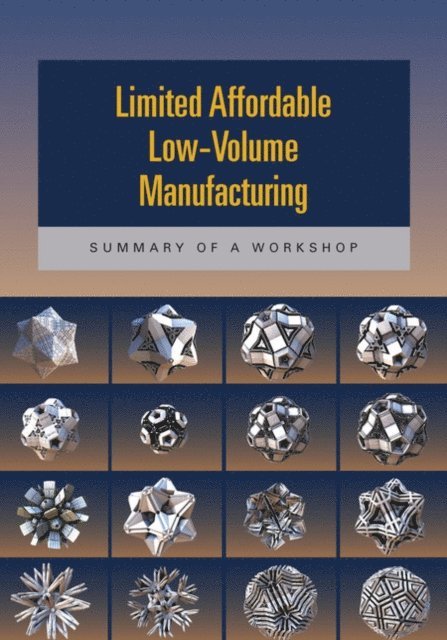
Limited Affordable Low-Volume Manufacturing is the summary of a workshop convened by the National Materials and Manufacturing Board of the National Research Council in August 2013 to discuss affordable, low-volume manufacturing. The workshop focused on four critical issues relevant to manufacturing: low-volume manufacturing; use of commercial off-the-shelf equipment; short production runs; and commercial manufacturing services. The workshop discussion also considered variable-rate manufacturing and high-mix manufacturing, both aspects of low-volume manufacturing. This report examines the characteristics of low-volume manufacturing and considers future advances in limited affordable low-volume manufacturing in the United States.
584 kr
Läs direkt efter köp
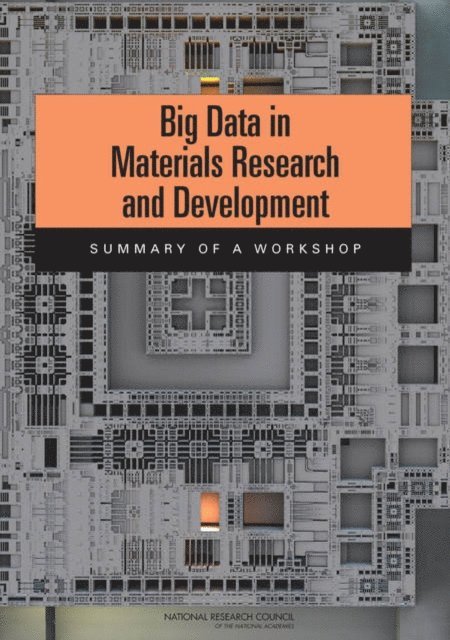
Big Data in Materials Research and Development is the summary of a workshop convened by the National Research Council Standing Committee on Defense Materials Manufacturing and Infrastructure in February 2014 to discuss the impact of big data on materials and manufacturing. The materials science community would benefit from appropriate access to data and metadata for materials development, processing, application development, and application life cycles. Currently, that access does not appear to be sufficiently widespread, and many workshop participants captured the constraints and identified potential improvements to enable broader access to materials and manufacturing data and metadata. This report discusses issues in defense materials, manufacturing and infrastructure, including data ownership and access; collaboration and exploitation of big data''s capabilities; and maintenance of data.
649 kr
Läs direkt efter köp
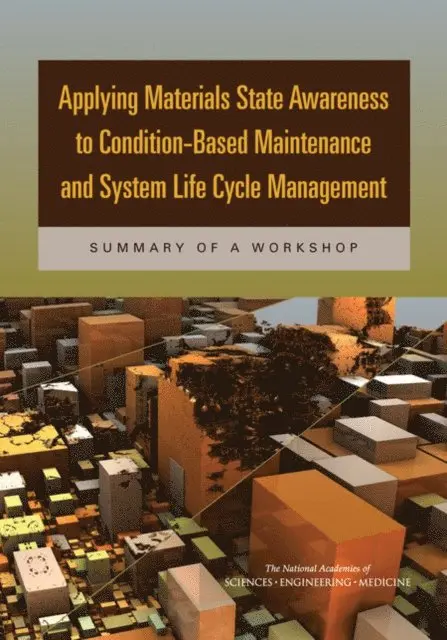
In August 2014, the committee on Defense Materials Manufacturing and Infrastructure convened a workshop to discuss issues related to applying materials state awareness to condition-based maintenance and system life cycle management. The workshop was structured around three focal topics: (1) advances in metrology and experimental methods, (2) advances in physics-based models for assessment, and (3) advances in databases and diagnostic technologies. This report summarizes the discussions and presentations from this workshop.
892 kr
Läs direkt efter köp
Vehicle weight reduction is an effective strategy for reducing fuel consumption in civilian vehicles. For combat vehicles, it presents not only an important opportunity to reduce fuel use and associated logistics, but also important advantages in transport and mobility on the battlefield. Although there have been numerous efforts in the past to reduce the overall weight of combat vehicles, combat vehicle weight has continued to increase over time due to new threats and missions.
On December 8 and 9, 2014, the National Academies of Sciences, Engineering, and Medicine held a workshop to explore opportunities in lightweight materials for armored vehicles. This was the ninth workshop in an ongoing series for the U.S. military on materials and manufacturing issues. The workshop discussed future advances in weight reduction by materials substitution for vehicles, including such topics as armor, structure, automotive parts, and armaments. This publication summarizes the presentations and discussions from the workshop.
795 kr
Läs direkt efter köp
Emerging economies, social and political transitions, and new ways of doing business are changing the world dramatically. To be the leader in this competitive climate, a defense manufacturing enterprise will require up-to-date capabilities, which include improvements in materials processing, among other things. Also, national and international efforts to mitigate environmentally harmful effects of industrial processes and to improve decision making for handling and disposing of industrial contaminants adds additional requirements for any future efforts. The objective of retaining high-value materials-related manufacturing as a key national competitive capability implies a number of factors. The value of specific manufacturing capabilities could be defined not only in terms of criticality to defense systems but also in relation to technology and knowledge content, importance as a supplier to other industries, and importance to U.S. exports.
Requested by Department of Defense (DoD) communities, the National Academies of Sciences, Engineering, and Medicine held a workshop in March 2015 to further explore materials and manufacturing processes. The participants explored changes in the global R&D landscape, technology awareness mechanisms—both DoD''s mechanisms and other models—and collaboration models and issues in R&D. This publication summarizes the presentations and discussions from the workshop.
892 kr
Läs direkt efter köp
In September 2015, the National Academies of Sciences, Engineering, and Medicine convened a two-day workshop on evolving paradigms for design and manufacturing. Participants discussed ways to lower costs and shorten production time in defense systems while bringing materials and manufacturing alternatives into the tradespace. This publication summarizes the presentations and discussions from the workshop.
892 kr
Läs direkt efter köp
High-entropy materials, ultra-strong molecules, and nanoelectronics have become a focus of active research because of their unique potential and applications. Global research is rapidly accelerating and unlocking major recent breakthroughs. It is important to highlight these recent developments and explore possibilities for future research and applications.
The National Academies convened a workshop on February 10-11, 2016 to discuss issues in defense materials, manufacturing, and infrastructure. Key topics of discussion included emerging capabilities and research objectives for ultra-strong molecules, high-entropy materials, and nanoelectronics. This publication summarizes the presentations and discussions from the workshop.
536 kr
Läs direkt efter köp
The Defense Materials Manufacturing and Infrastructure standing and planning committee of the National Academies of Sciences, Engineering, and Medicine convened a workshop on May 19-20, 2016, to discuss the value of collaboration between the materials and civil engineering communities in addressing the following problem: People and equipment are continuously monitored through multiple organizations and instruments, but the physical infrastructure where they live, train, and deploy receives little attention until it fails or is shown to be inadequate. The workshop was organized into three sessions: (1) highway infrastructure, (2) waterways infrastructure, and (3) railways infrastructure. Within these three sessions, individual speakers gave presentations on technical, functional, and economic paradigms and answered questions from workshop participants. Following these sessions, a panel discussion was held to discuss existing gaps as well as ways to overcome challenges. This publication summarizes the presentations and discussion of the workshop.
819 kr
Läs direkt efter köp
Recent advancements in quantum-enabled systems present a variety of new opportunities and challenges. These technologies are important developments for a variety of computing, communications, and sensing applications. However, many materials and components relevant to quantum-enabled systems exist outside of the United States, and it is important to promote the development of assured domestic sources of materials, manufacturing capabilities, and expertise.
The National Academies of Sciences, Engineering, and Medicine convened a 2-day workshop to explore implications and concerns related to the application of quantum-enabled systems in the United States. This workshop focused on quantum-enabled computing systems, quantum communications and networks, and quantum sensing opportunities. Participants explored the path to quantum computing, communications, and networks, opportunities for collaboration, as well as key gaps, supply chain concerns, and security issues. This publication summarizes the presentations and discussions from the workshop.
536 kr
Läs direkt efter köp
Emerging techniques in data analytics, including machine learning and artificial intelligence, offer exciting opportunities for advancing scientific discovery and innovation in materials science. Vast repositories of experimental data and sophisticated simulations are being utilized to predict material properties, design and test new compositions, and accelerate nearly every facet of traditional materials science. How can the materials science community take advantage of these opportunities while avoiding potential pitfalls? What roadblocks may impede progress in the coming years, and how might they be addressed?
To explore these issues, the Workshop on Data Analytics and What It Means to the Materials Community was organized as part of a workshop series on Defense Materials, Manufacturing, and Its Infrastructure. Hosted by the National Academies of Sciences, Engineering, and Medicine, the 2-day workshop was organized around three main topics: materials design, data curation, and emerging applications. Speakers identified promising data analytics tools and their achievements to date, as well as key challenges related to dealing with sparse data and filling data gaps; decisions around data storage, retention, and sharing; and the need to access, combine, and use data from disparate sources. Participants discussed the complementary roles of simulation and experimentation and explored the many opportunities for data informatics to increase the efficiency of materials discovery, design, and testing by reducing the amount of experimentation required. With an eye toward the ultimate goal of enabling applications, attendees considered how to ensure that the benefits of data analytics tools carry through the entire materials development process, from exploration to validation, manufacturing, and use. This publication summarizes the presentations and discussion of the workshop.
374 kr
Tillfälligt slut
351 kr
Tillfälligt slut
385 kr
Tillfälligt slut
442 kr
Tillfälligt slut
614 kr
Tillfälligt slut
534 kr
Tillfälligt slut
568 kr
Tillfälligt slut
573 kr
Tillfälligt slut
351 kr
Tillfälligt slut
550 kr
Tillfälligt slut
351 kr
Tillfälligt slut