Dietrich H. Nies - Böcker
Visar alla böcker från författaren Dietrich H. Nies. Handla med fri frakt och snabb leverans.
3 produkter
3 produkter
910 kr
Tillfälligt slut
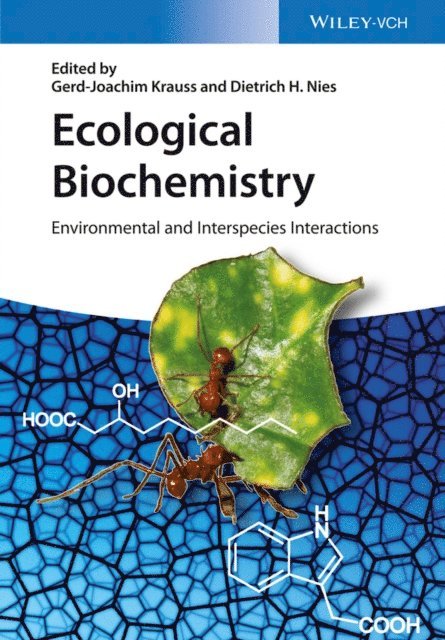
The first stand-alone textbook for at least ten years on this increasingly hot topic in times of global climate change and sustainability in ecosystems.Ecological biochemistry refers to the interaction of organisms with their abiotic environment and other organisms by chemical means. Biotic and abiotic factors determine the biochemical flexibility of organisms, which otherwise easily adapt to environmental changes by altering their metabolism. Sessile plants, in particular, have evolved intricate biochemical response mechanisms to fit into a changing environment. This book covers the chemistry behind these interactions, bottom up from the atomic to the system's level.An introductory part explains the physico-chemical basis and biochemical roots of living cells, leading to secondary metabolites as crucial bridges between organisms and the respective ecosystem. The focus then shifts to the biochemical interactions of plants, fungi and bacteria within terrestrial and aquatic ecosystems with the aim of linking biochemical insights to ecological research, also in human-influenced habitats.A section is devoted to methodology, which allows network-based analyses of molecular processes underlying systems phenomena.A companion website offering an extended version of the introductory chapter on Basic Biochemical Roots is available athttp://www.wiley.com/go/Krauss/Nies/EcologicalBiochemistry
2 111 kr
Skickas inom 10-15 vardagar
All forms of life depend on a variety of heavy metal ions. Nearly one-third of all gene products require a metal ion for proper folding or function. However, even metals generally regarded as non-poisonous are toxic at higher concentrations, including the essential ones. Thus, sensitive regulation of metal uptake, storage, allocation and detoxification is needed to maintain cellular homeostasis of heavy metal ions.Molecular Microbiology of Heavy Metals includes chapters on allocation of metals in cells, metal transporter, storage and metalloregulatory proteins, cellular responses to metal ion stress, transcription of genes involved in metal ion homeostasis, uptake of essential metals, metal efflux and other detoxification mechanisms. Also discussed are metal bioreporters for the nanomolar range of concentration and tools to address the metallome. Chapters in the second part cover specific metals such as Fe, Mn, Cu, Ni, Co, Zn and Mo as key nutrient elements and Ag, As, Cd, Hg and Cr as toxic elements.
2 111 kr
Skickas inom 10-15 vardagar
All forms of life depend on a variety of heavy metal ions. Nearly one-third of all gene products require a metal ion for proper folding or function. However, even metals generally regarded as non-poisonous are toxic at higher concentrations, including the essential ones. Thus, sensitive regulation of metal uptake, storage, allocation and detoxification is needed to maintain cellular homeostasis of heavy metal ions.Molecular Microbiology of Heavy Metals includes chapters on allocation of metals in cells, metal transporter, storage and metalloregulatory proteins, cellular responses to metal ion stress, transcription of genes involved in metal ion homeostasis, uptake of essential metals, metal efflux and other detoxification mechanisms. Also discussed are metal bioreporters for the nanomolar range of concentration and tools to address the metallome. Chapters in the second part cover specific metals such as Fe, Mn, Cu, Ni, Co, Zn and Mo as key nutrient elements and Ag, As, Cd, Hg and Cr as toxic elements.