Dinesh Kumar Srivastava - Böcker
Visar alla böcker från författaren Dinesh Kumar Srivastava. Handla med fri frakt och snabb leverans.
9 produkter
9 produkter
1 618 kr
Skickas inom 10-15 vardagar
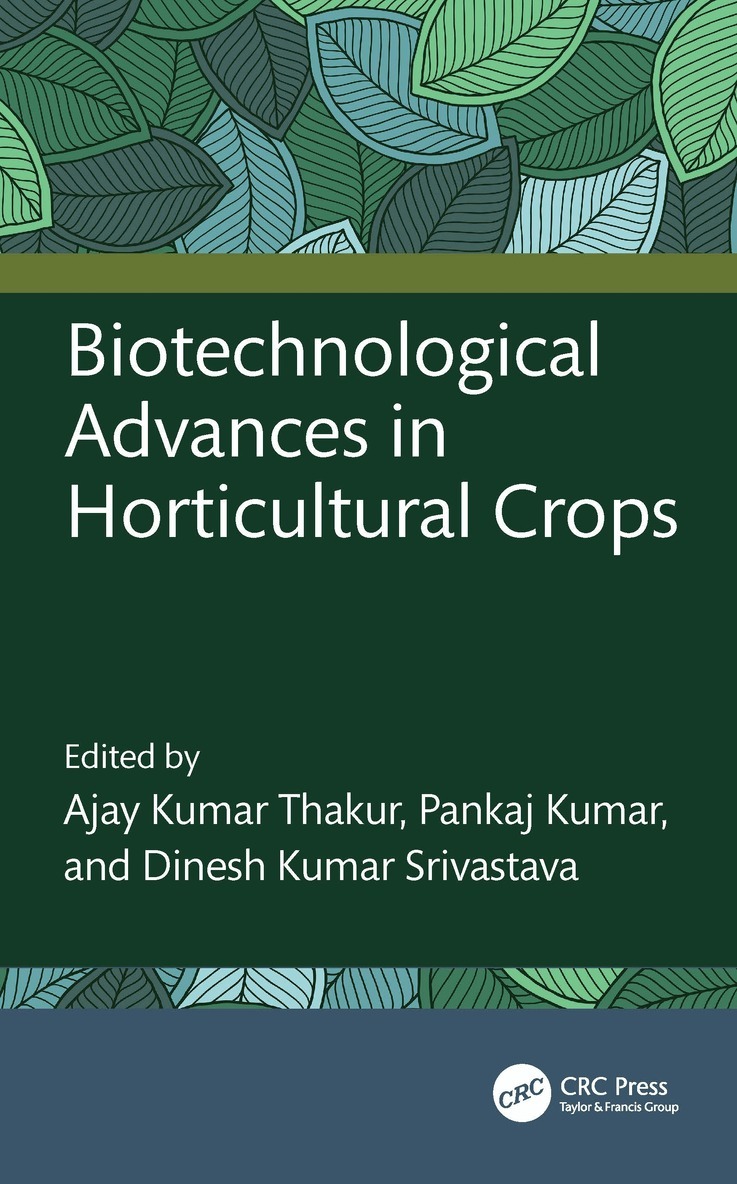
The field of horticultural biotechnology has witnessed remarkable growth in recent years, offering profound insights and innovations that are reshaping agriculture's future. Biotechnological Advances in Horticultural Crops serves as a comprehensive guide to the latest innovations and applications. This meticulously curated volume bridges the gap between fundamental knowledge and cutting-edge advancements. From plant tissue culture to genomic approaches, this book spans a diverse array of topics, catering to a broad audience of students, researchers, and academics.Key Features:In-depth exploration of plant tissue culture and its applications in horticultural crop improvement.Insightful coverage of transgenic approaches in fruit crops, including genetic modifications for enhancing fruit quality, yield, and resistance to pests and diseases.Detailed examination of the application of omics sciences in tropical fruits, opening up new perspectives for crop improvement and sustainable production.Extensive discussion on the potential of in vitro production techniques for underutilized and unconventional horticultural crops.Exploration of sustainable agriculture practices, including the use of beneficial microbes and the scientific validation of natural and organic farming practices.This book is more than just a collection of topics; it’s a gateway to the transformative potential of biotechnology in horticulture. It empowers readers (students, researchers, and academicians) to comprehend and harness these advancements, promoting innovation and sustainability in horticultural crop improvement.
1 618 kr
Skickas inom 10-15 vardagar
Biotechnology has revolutionized horticulture by enhancing the productivity, resilience and nutritional quality of fruit, vegetable and spice crops. This comprehensive volume provides an in-depth exploration of cutting-edge biotechnological advancements that are reshaping horticultural science. From genomics-driven crop improvement to the development of functional foods, this book presents a meticulously curated compilation of research and methodologies addressing key challenges and opportunities in modern horticulture. By integrating molecular techniques, plant–microbe interactions and bioprocess innovations, this book provides a unique perspective on sustainable and precision-driven horticultural practices.Key FeaturesInsights into genomic approaches for understanding abiotic stress tolerance and developing climate-resilient varieties.Advances in tissue culture, marker-assisted selection and genome editing for apple, grapevine and potato breeding.Molecular and biocontrol strategies for tackling major threats, such as root rot disease in apples.Applications of soilless cultivation techniques and plant growth-promoting rhizobacteria (PGPR) to optimize crop yield and quality.Biotechnological tools for developing probiotic-enriched fruits and vegetables and the valorization of non-grape fruit wines.With contributions from leading researchers, this book serves as an essential reference for graduate students, academics and professionals in plant biotechnology, horticulture and food science. It provides a valuable resource for those seeking to harness the power of biotechnology to drive sustainable innovation in horticultural crop production.
1 238 kr
Skickas inom 3-6 vardagar
"This book could not be more timely — published after a year that saw the costliest slew of weather disasters in history along with one of the deadliest pandemic, the emergence and spread of which is linked to climate change ... This book will be a valuable resource for scientists, policy makers but also educators and especially a young generation of readers who want to be informed citizens shaping the right choices for their local communities but also as cosmopolitan citizens of the world."Journal of Indian Physics AssociationThe signs of global warming can be seen everywhere — hotter summers, frequent heavy rains, prolonged droughts, more severe forest fires, fiercer storms (including snow storms) and cyclones, as well as melting polar ice caps. Our indiscriminate actions are raising the spectre of millions of climate refugees who are victims of battles for water, crops, fish, and so on. It is poignant that the poorer countries, that are the least equipped to face these calamities have contributed the least to global warming, but are the worst hit.Only a concerted effort from the entire world by a rapid transition to renewable, clean and green energy sources, while checking wastage, deforestation and pollution, and a genuine adjustment in lifestyles towards moderation can avert the Earth, the only habitable planet we know, from turning into a hothouse.
1 679 kr
Skickas inom 3-6 vardagar
The COVID-19 and the onslaught of Climate Change have exposed the fragility of our lives and ecosystem. Natural disasters like asteroid impact, earthquakes, tsunamis, volcanic eruptions, floods, cyclones, etc., and pandemics like plagues, smallpox, cholera, tuberculosis, malaria, etc., have been man's nemesis from the beginning of time. This list of public risks has now expanded to include pollutions, industrial disasters, and very many new, confusing and emerging technologies.How have governments handled these public risks? How have they convinced people to take precautions under such emergencies? What measures does one take for managing them, and for the rescue, relief, and rehabilitation of the masses? And most importantly, how does one prepare the masses to face the risks without panicking? It is argued that sermons, dictates, and discourses may not work in democratic societies. Rather, one needs a new breed of risk communicators who can enter into a dialogue with the people to prepare them for these challenges and to welcome truly beneficial new technologies.The book takes a panoramic view of the issue of risks and illustrates the challenges and opportunities of the Art and Science of Managing Public Risks. It celebrates the indomitable spirit of man, who has leveraged science to predict — where possible, and provide solutions for managing these risks.
753 kr
Skickas
The COVID-19 and the onslaught of Climate Change have exposed the fragility of our lives and ecosystem. Natural disasters like asteroid impact, earthquakes, tsunamis, volcanic eruptions, floods, cyclones, etc., and pandemics like plagues, smallpox, cholera, tuberculosis, malaria, etc., have been man's nemesis from the beginning of time. This list of public risks has now expanded to include pollutions, industrial disasters, and very many new, confusing and emerging technologies.How have governments handled these public risks? How have they convinced people to take precautions under such emergencies? What measures does one take for managing them, and for the rescue, relief, and rehabilitation of the masses? And most importantly, how does one prepare the masses to face the risks without panicking? It is argued that sermons, dictates, and discourses may not work in democratic societies. Rather, one needs a new breed of risk communicators who can enter into a dialogue with the people to prepare them for these challenges and to welcome truly beneficial new technologies.The book takes a panoramic view of the issue of risks and illustrates the challenges and opportunities of the Art and Science of Managing Public Risks. It celebrates the indomitable spirit of man, who has leveraged science to predict — where possible, and provide solutions for managing these risks.
2 939 kr
Skickas inom 10-15 vardagar
This book caters to the need of researchers working in the ever-evolving field of agricultural biotechnology. The book discusses evolution of plant tissue culture techniques, development of doubled haploids technology, role of recombinant-DNA technology in crop improvement.
2 939 kr
Skickas inom 10-15 vardagar
This book caters to the need of researchers working in the ever-evolving field of agricultural biotechnology. The book discusses evolution of plant tissue culture techniques, development of doubled haploids technology, role of recombinant-DNA technology in crop improvement.
2 160 kr
Skickas inom 3-6 vardagar
International collaboration in basic sciences allows researchers from different countries to pool their expertise, knowledge, and resources. This combined effort tackles complex scientific challenges that might be beyond the intellectual, technical, and financial capabilities of a single nation. It fosters the sharing of data and ideas, accelerates scientific progress and leads to breakthroughs that benefit all of humanity.This was established in tackling COVID-19; establishment of CERN; building of LHC, ITER, FAIR, LIGO, SKA, TMT, scores of terrestrial and space telescopes, International Space Station; Space Missions; discovery of Higgs boson; discovery of gravitational waves; green revolution; understanding of weather and monsoon in a rapidly warming world; and spread of modern technology and education across the world, etc.The most challenging problem facing the world now is climate change, which can only be solved if every nation cooperates and contributes to mitigation measures and research outlined by scientists from across the world. This presents us with a huge existential challenge, which can only be met when each one of us contributes to the spirit of the entire world being one family, and with the conviction of futility of conflict.If we fail to rise to the occasion, our very survival on this planet would become extremely difficult and near impossible. This book will be of interest to science policymakers in industry or government, as well as laypersons interested in the history of science, cosmology, particle physics or scientific collaborations.
1 370 kr
Skickas inom 3-6 vardagar
Dr Raja Ramanna (1925-2004) was a visionary nuclear physicist and key figure in Indian nuclear and defence research. During his first term as director of the Bhabha Atomic Research Centre (BARC), India successfully tested its first nuclear device. Subsequently, Dr Ramanna served his nation in various roles, including as Secretary for Defence Research, Chairman of the Atomic Energy Commission, and the Minister of State for Defence as well as Member of Parliament. He also contributed tremendously to academic positions in IIT Bombay and the Indian Institute of Science, eventually becoming founder director of the National Institute of Advanced Studies (NIAS) in Bangalore. He was known to be a multifaceted person, with accomplishments in science, technology, policy and the arts. NIAS celebrated the centenary of his birth in January 2025.Edited by two eminent scholars from NIAS, this volume gathers contributions from various people who have worked with or associated with Dr Raja Ramanna. The chapter authors reflect on their encounters with Dr Ramanna and the institutions he led, while expanding on topics ranging from nuclear fission, defence science, technology policy, governance, philosophy and music, the last being a well-known lifetime interest of Dr Ramanna.Through the writings of the people Dr Ramanna influenced, readers gain a glimpse of his personality and actions, with many lessons to learn from his long life of service and research. This book is a suitable reading for students and researchers in nuclear physics and particle physics, as well as policymakers and officials in science and technology.