Domine Leenaerts – författare
Visar alla böcker från författaren Domine Leenaerts. Handla med fri frakt och snabb leverans.
12 produkter
12 produkter
E-bok
PDF, Engelska, 20073 157 kr
Läs direkt efter köp
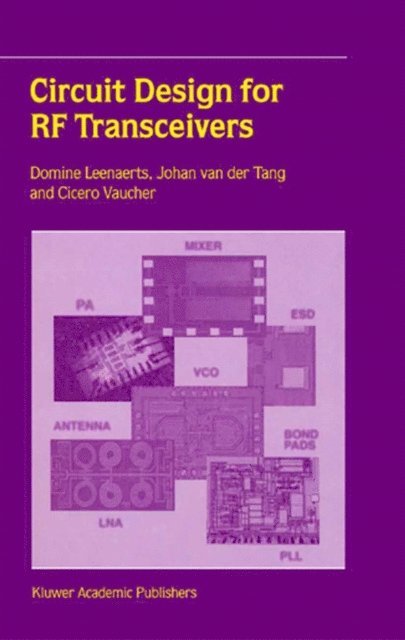
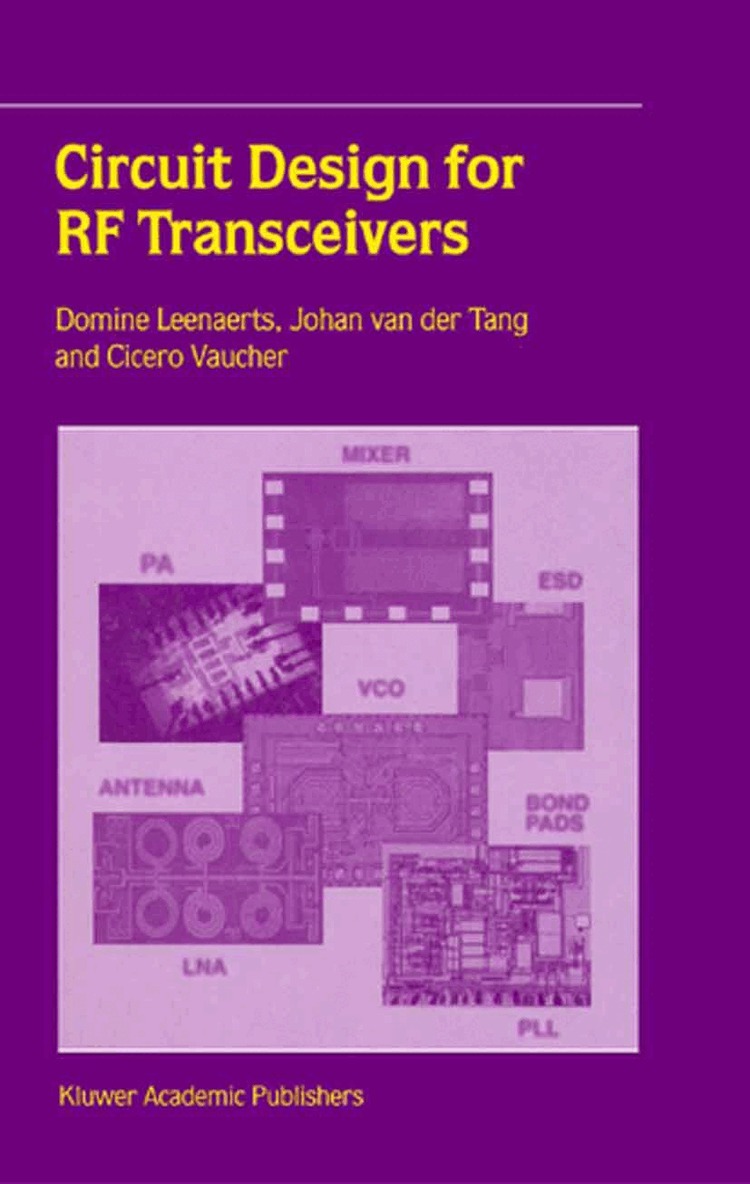
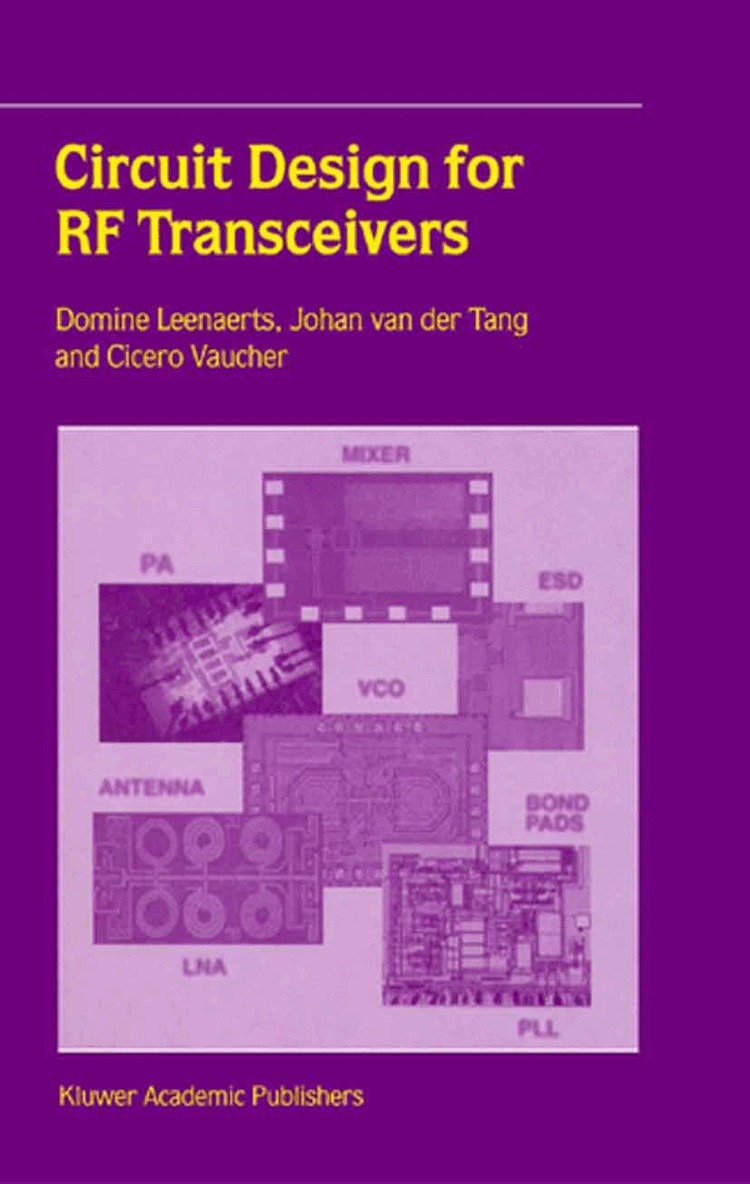
Circuit Design for RF Transceivers covers key building blocks which are needed to make an integrated transceiver for wireless and cellular applications, that is low-noise amplifiers, mixers, voltage controlled oscillators, RF power amplifiers and phase-locked loop systems. Starting from detailed RF concepts and specifications, the authors discuss the circuits in detail and provide solutions to many design problems. The circuits are implemented in a wide range of modern technology processes. Production requirements are taken into account, and measurement results are presented and discussed. Several of the presented circuits are used in IC products. The text also includes several RF technologies (for example double-poly, Silicon-on-Anything, SiGe-bipolar, RF-CMOS, etc.) and microwave design techniques, such as transmission line concepts. In addition, the problem of connecting the RF signals on-chip to the PCB and to the antenna will be discussed, including the influence of the package, ESD and bond pads. The contents of Circuit Design for RF Transceivers 2nd edition are based on research activities carried out at Philips Research. Many internal and external publications contributed to make the presented material state-of-the-art. The book is written for people who have a basic knowledge of analogue IC design. The second edition of this successful 2001 RF Circuit Design book has been updated, latest technology reviews have been added as well as several actual case studies. Due to the authors being active in industry as well as academia, this should prove to be an essential guide on RF Transceiver Design for students and engineers.
E-bok
PDF, Engelska, 20051 416 kr
Läs direkt efter köp
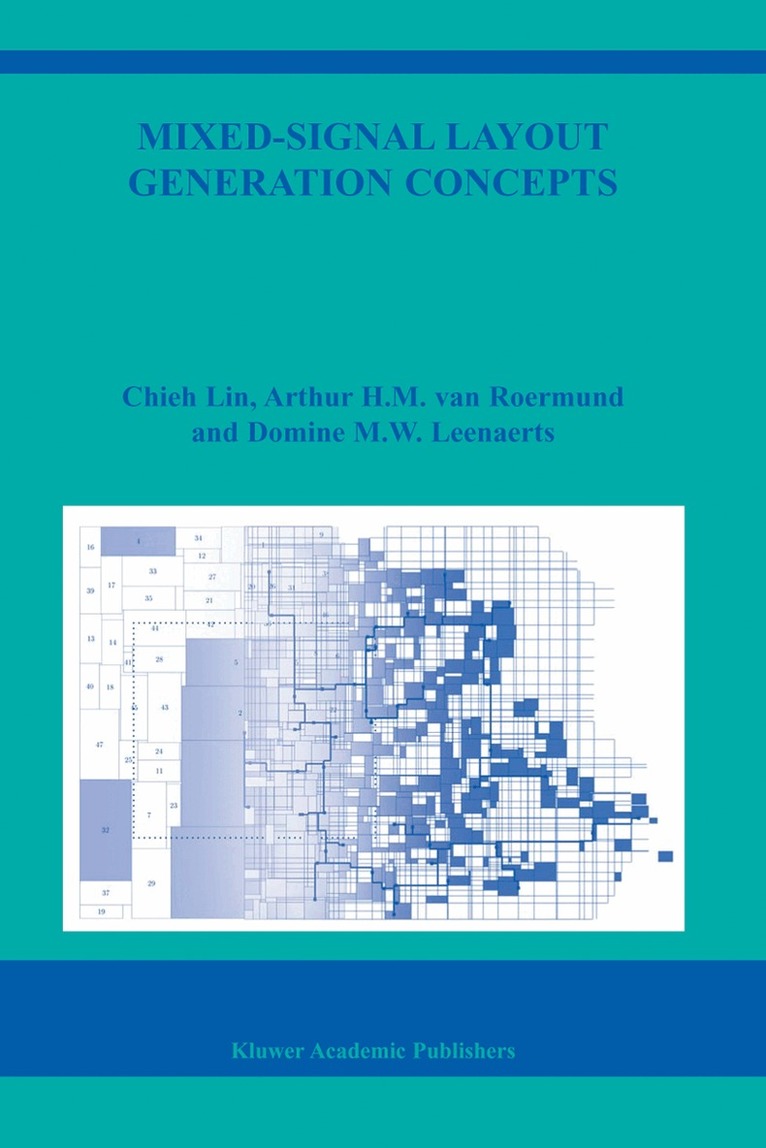
Mixed-Signal Layout Generation Concepts covers important physical-design issues that exist in contemporary analog and mixed-signal design flows. Due to the increasing pressure on time-to-market, the steep increase in chip fabrication costs, and the increasing design complexity, it becomes even more challenging to produce a first-time right IC layout. The fundamental issues in creating a layout are placement and routing. Although these coupled problems have been investigated for many decades, no satisfactory automated solution has emerged yet. Fortunately, supported by modern computing power and results of new research that further improve computation efficiency, significant steps forward have been taken.
Inbunden, Engelska, 2006
1 616 kr
Skickas inom 10-15 vardagar
IGH-SPEED Digital to Analog (D/A) converters are essential components in digi- Htal communication systems providing the necessary conversion of signals encoding information in bits to signals encoding information in their amplitude vs. time domain characteristics. In general, they are parts of a larger system, the interface, which c- sists of several signal conditioning circuits. Dependent on where the converter is located within the chain of circuits in the interface, signal processing operations are partitioned in those realized with digital techniques, and those with analog. The rapid evolution of CMOS technology has established implicit and explicite trends related to the interface, and in particular to the D/A converter. The implicit relationship comes via the growth of digital systems. First, it is a global trend with respect to all interface circuits that increasing operating frequencies of digital systems place a similar demand for the interface circuits. The second trend takes place locally within the int- face. Initially, the D/A converter was placed at the beginning of the interface chain, and all signal conditioning was implemented in the analog domain after the D/A conversion. The increasing ?exibility and robustness of digital signal processing shifted the D/A converter closer to the end point of the chain where the demands for high quality high frequency operation are very high.
E-bok
PDF, Engelska, 20062 049 kr
Läs direkt efter köp
IGH-SPEED Digital to Analog (D/A) converters are essential components in digi- Htal communication systems providing the necessary conversion of signals encoding information in bits to signals encoding information in their amplitude vs. time domain characteristics. In general, they are parts of a larger system, the interface, which c- sists of several signal conditioning circuits. Dependent on where the converter is located within the chain of circuits in the interface, signal processing operations are partitioned in those realized with digital techniques, and those with analog. The rapid evolution of CMOS technology has established implicit and explicite trends related to the interface, and in particular to the D/A converter. The implicit relationship comes via the growth of digital systems. First, it is a global trend with respect to all interface circuits that increasing operating frequencies of digital systems place a similar demand for the interface circuits. The second trend takes place locally within the int- face. Initially, the D/A converter was placed at the beginning of the interface chain, and all signal conditioning was implemented in the analog domain after the D/A conversion. The increasing ?exibility and robustness of digital signal processing shifted the D/A converter closer to the end point of the chain where the demands for high quality high frequency operation are very high.
Inbunden, Engelska, 2001
2 476 kr
Skickas inom 10-15 vardagar
Circuit Design for RF Transceivers covers key building blocks which are needed to make an integrated transceiver for wireless and cellular applications, that is low-noise amplifiers, mixers, voltage controlled oscillators, RF power amplifiers and phase-locked loop systems. Starting from detailed RF concepts and specifications, the authors discuss the circuits in detail and provide solutions to many design problems. The circuits are implemented in a wide range of modern technology processes. Production requirements are taken into account, and measurement results are presented and discussed. Several of the presented circuits are used in IC products. The text also includes several RF technologies (for example double-poly, Silicon-on-Anything, SiGe-bipolar, RF-CMOS, etc.) and microwave design techniques, such as transmission line concepts. In addition, the problem of connecting the RF signals on-chip to the PCB and to the antenna will be discussed, including the influence of the package, ESD and bond pads. The contents of Circuit Design for RF Transceivers 2nd edition are based on research activities carried out at Philips Research. Many internal and external publications contributed to make the presented material state-of-the-art. The book is written for people who have a basic knowledge of analogue IC design. The second edition of this successful 2001 RF Circuit Design book has been updated, latest technology reviews have been added as well as several actual case studies. Due to the authors being active in industry as well as academia, this should prove to be an essential guide on RF Transceiver Design for students and engineers.
Inbunden, Engelska, 1998
1 618 kr
Skickas inom 10-15 vardagar
Piecewise Linear (PL) approximation of non-linear behaviour is a well-known technique in synthesis and analysis of electrical networks. However, the PL description should be efficient in data storage and the description should allow simple retrieval of the stored information. Furthermore, it would be useful if the model description could handle a large class of piecewise linear mappings. Piecewise Linear Modeling and Analysis explains in detail all possible model descriptions for efficiently storing piecewise linear functions, starting with the Chua descriptions. Detailed explanation on how the model parameter can be obtained for a given mapping is provided and demonstrated by examples. The models are ranked to compare them and to show which model can handle the largest class of PL mappings. All model descriptions are implicitly related to the Linear Complementarity Problem and most solution techniques for this problem, like Katzenelson and Lemke, are discussed according to examples that are explained in detail. To analyse PL electrical networks a simulator is mandatory. Piecewise Linear Modeling and Analysis provides a detailed outline of a possible PL simulator, including pseudo-programming code. Several simulation domains like transient, AC and distortion are discussed. The book explains the attractive features of PL simulators with respect to mixed-level and mixed-signal simulation while paying due regard also to hierarchical simulation. Piecewise Linear Modeling and Analysis shows in detail how many existing components in electrical networks can be modeled. These range from digital logic and analog basic elements such as transistors to complex systems like Phase-Locked Loops and detection systems. Simulation results are also provided. The book concludes with a discussion on how to find multiple solutions for PL functions or networks. Again, the most common techniques areoutlined using clear examples. Piecewise Linear Modeling and Analysis is an indispensable guide for researchers and designers interested in network theory, network synthesis and network analysis.
Inbunden, Engelska, 2003
1 113 kr
Skickas inom 10-15 vardagar
Mixed-Signal Layout Generation Concepts covers important physical-design issues that exist in contemporary analog and mixed-signal design flows. Due to the increasing pressure on time-to-market, the steep increase in chip fabrication costs, and the increasing design complexity, it becomes even more challenging to produce a first-time right IC layout. The fundamental issues in creating a layout are placement and routing. Although these coupled problems have been investigated for many decades, no satisfactory automated solution has emerged yet. Fortunately, supported by modern computing power and results of new research that further improve computation efficiency, significant steps forward have been taken.
Del 871 - Springer International Series in Engineering and Computer Science
Wide-Bandwidth High Dynamic Range D/A Converters
Häftad, Engelska, 2010
1 618 kr
Skickas inom 10-15 vardagar
IGH-SPEED Digital to Analog (D/A) converters are essential components in digi- Htal communication systems providing the necessary conversion of signals encoding information in bits to signals encoding information in their amplitude vs. time domain characteristics. In general, they are parts of a larger system, the interface, which c- sists of several signal conditioning circuits. Dependent on where the converter is located within the chain of circuits in the interface, signal processing operations are partitioned in those realized with digital techniques, and those with analog. The rapid evolution of CMOS technology has established implicit and explicite trends related to the interface, and in particular to the D/A converter. The implicit relationship comes via the growth of digital systems. First, it is a global trend with respect to all interface circuits that increasing operating frequencies of digital systems place a similar demand for the interface circuits. The second trend takes place locally within the int- face. Initially, the D/A converter was placed at the beginning of the interface chain, and all signal conditioning was implemented in the analog domain after the D/A conversion. The increasing ?exibility and robustness of digital signal processing shifted the D/A converter closer to the end point of the chain where the demands for high quality high frequency operation are very high.
Häftad, Engelska, 2011
2 476 kr
Skickas inom 10-15 vardagar
Circuit Design for RF Transceivers covers key building blocks which are needed to make an integrated transceiver for wireless and cellular applications, that is low-noise amplifiers, mixers, voltage controlled oscillators, RF power amplifiers and phase-locked loop systems. Starting from detailed RF concepts and specifications, the authors discuss the circuits in detail and provide solutions to many design problems. The circuits are implemented in a wide range of modern technology processes. Production requirements are taken into account, and measurement results are presented and discussed. Several of the presented circuits are used in IC products. The text also includes several RF technologies (for example double-poly, Silicon-on-Anything, SiGe-bipolar, RF-CMOS, etc.) and microwave design techniques, such as transmission line concepts. In addition, the problem of connecting the RF signals on-chip to the PCB and to the antenna will be discussed, including the influence of the package, ESD and bond pads. The contents of Circuit Design for RF Transceivers 2nd edition are based on research activities carried out at Philips Research. Many internal and external publications contributed to make the presented material state-of-the-art. The book is written for people who have a basic knowledge of analogue IC design. The second edition of this successful 2001 RF Circuit Design book has been updated, latest technology reviews have been added as well as several actual case studies. Due to the authors being active in industry as well as academia, this should prove to be an essential guide on RF Transceiver Design for students and engineers.
Häftad, Engelska, 2010
1 618 kr
Skickas inom 10-15 vardagar
Piecewise Linear (PL) approximation of non-linear behaviour is a well-known technique in synthesis and analysis of electrical networks. However, the PL description should be efficient in data storage and the description should allow simple retrieval of the stored information. Furthermore, it would be useful if the model description could handle a large class of piecewise linear mappings. Piecewise Linear Modeling and Analysis explains in detail all possible model descriptions for efficiently storing piecewise linear functions, starting with the Chua descriptions. Detailed explanation on how the model parameter can be obtained for a given mapping is provided and demonstrated by examples. The models are ranked to compare them and to show which model can handle the largest class of PL mappings. All model descriptions are implicitly related to the Linear Complementarity Problem and most solution techniques for this problem, like Katzenelson and Lemke, are discussed according to examples that are explained in detail. To analyse PL electrical networks a simulator is mandatory. Piecewise Linear Modeling and Analysis provides a detailed outline of a possible PL simulator, including pseudo-programming code. Several simulation domains like transient, AC and distortion are discussed. The book explains the attractive features of PL simulators with respect to mixed-level and mixed-signal simulation while paying due regard also to hierarchical simulation. Piecewise Linear Modeling and Analysis shows in detail how many existing components in electrical networks can be modeled. These range from digital logic and analog basic elements such as transistors to complex systems like Phase-Locked Loops and detection systems. Simulation results are also provided. The book concludes with a discussion on how to find multiple solutions for PL functions or networks. Again, the most common techniques areoutlined using clear examples. Piecewise Linear Modeling and Analysis is an indispensable guide for researchers and designers interested in network theory, network synthesis and network analysis.
Del 751 - Springer International Series in Engineering and Computer Science
Mixed-Signal Layout Generation Concepts
Häftad, Engelska, 2011
1 081 kr
Skickas inom 10-15 vardagar
Mixed-Signal Layout Generation Concepts covers important physical-design issues that exist in contemporary analog and mixed-signal design flows. Due to the increasing pressure on time-to-market, the steep increase in chip fabrication costs, and the increasing design complexity, it becomes even more challenging to produce a first-time right IC layout. The fundamental issues in creating a layout are placement and routing. Although these coupled problems have been investigated for many decades, no satisfactory automated solution has emerged yet. Fortunately, supported by modern computing power and results of new research that further improve computation efficiency, significant steps forward have been taken.
E-bok
PDF, Engelska, 20132 049 kr
Läs direkt efter köp
Piecewise Linear (PL) approximation of non-linear behaviour is a well-known technique in synthesis and analysis of electrical networks. However, the PL description should be efficient in data storage and the description should allow simple retrieval of the stored information. Furthermore, it would be useful if the model description could handle a large class of piecewise linear mappings. Piecewise Linear Modeling and Analysis explains in detail all possible model descriptions for efficiently storing piecewise linear functions, starting with the Chua descriptions. Detailed explanation on how the model parameter can be obtained for a given mapping is provided and demonstrated by examples. The models are ranked to compare them and to show which model can handle the largest class of PL mappings. All model descriptions are implicitly related to the Linear Complementarity Problem and most solution techniques for this problem, like Katzenelson and Lemke, are discussed according to examples that are explained in detail. To analyse PL electrical networks a simulator is mandatory. Piecewise Linear Modeling and Analysis provides a detailed outline of a possible PL simulator, including pseudo-programming code. Several simulation domains like transient, AC and distortion are discussed. The book explains the attractive features of PL simulators with respect to mixed-level and mixed-signal simulation while paying due regard also to hierarchical simulation. Piecewise Linear Modeling and Analysis shows in detail how many existing components in electrical networks can be modeled. These range from digital logic and analog basic elements such as transistors to complex systems like Phase-Locked Loops and detection systems. Simulation results are also provided. The book concludes with a discussion on how to find multiple solutions for PL functions or networks. Again, the most common techniques areoutlined using clear examples. Piecewise Linear Modeling and Analysis is an indispensable guide for researchers and designers interested in network theory, network synthesis and network analysis.