J. van der Tang - Böcker
Visar alla böcker från författaren J. van der Tang. Handla med fri frakt och snabb leverans.
6 produkter
6 produkter
2 416 kr
Skickas inom 10-15 vardagar
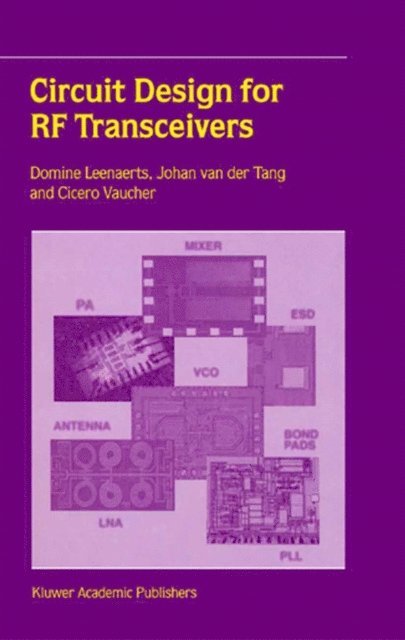
Circuit Design for RF Transceivers covers key building blocks which are needed to make an integrated transceiver for wireless and cellular applications, that is low-noise amplifiers, mixers, voltage controlled oscillators, RF power amplifiers and phase-locked loop systems. Starting from detailed RF concepts and specifications, the authors discuss the circuits in detail and provide solutions to many design problems. The circuits are implemented in a wide range of modern technology processes. Production requirements are taken into account, and measurement results are presented and discussed. Several of the presented circuits are used in IC products. The text also includes several RF technologies (for example double-poly, Silicon-on-Anything, SiGe-bipolar, RF-CMOS, etc.) and microwave design techniques, such as transmission line concepts. In addition, the problem of connecting the RF signals on-chip to the PCB and to the antenna will be discussed, including the influence of the package, ESD and bond pads. The contents of Circuit Design for RF Transceivers is based on research activities carried out at Philips Research.Many internal and external publications contributed to make the presented material state-of-the-art. The book is written for people who already have a basic knowledge of analogue IC design.
1 064 kr
Skickas inom 10-15 vardagar
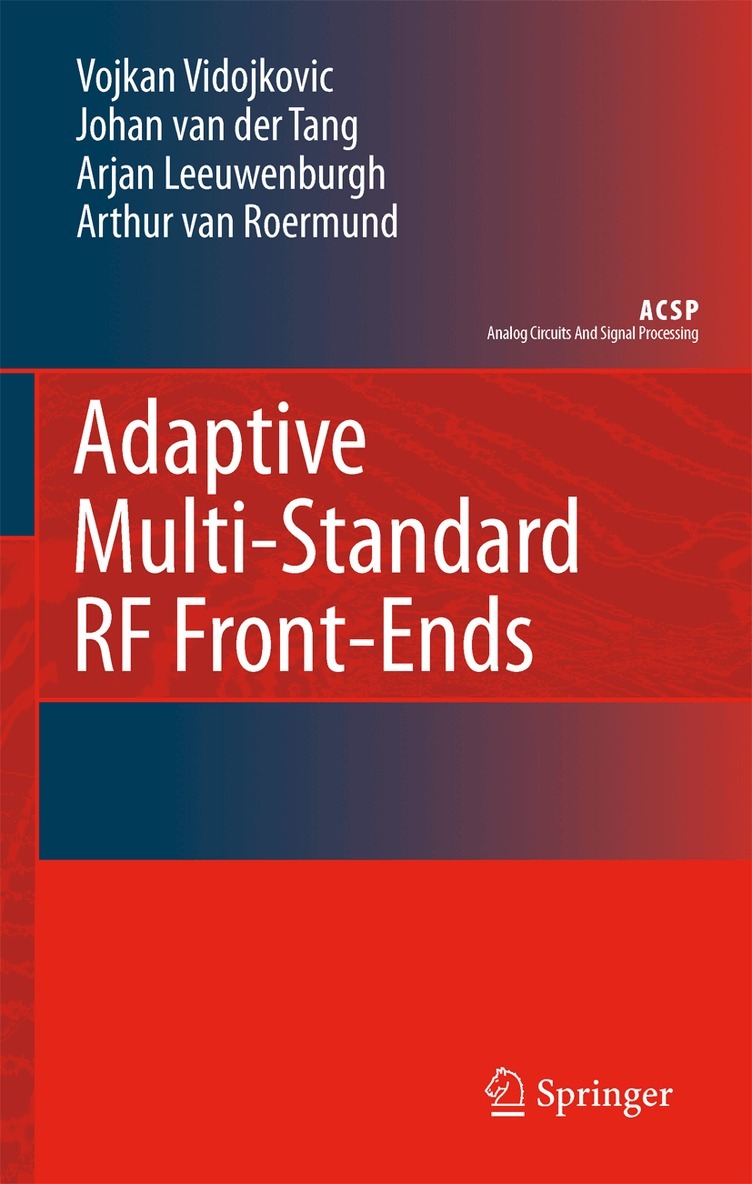
N this information era people are living in a society in which processing, ?ow and Iexchange of information are vital for their existence. Two major issues in such so- ety, which are related to ?ow and exchange of information, are connectivity and mobility. On one hand, computers and Internet provide connectivity and allow communication as well as fast access to large amounts of information. On the other hand, wireless techno- gies bring mobility. People can move and still be able to communicate and have access to various kind of information. Therefore, the functioning of an information society is unthinkable without the use of computers, Internet and wireless technologies. The exp- tations are that in the future they will merge into a unique system for communication, access to information as well as their exchange and processing. The era of wireless communications started in 1901, when Guglielmo Marconi s- cessfully transmitted radio signals across the Atlantic Ocean. From that moment up to now wireless communications experienced explosive growth and became the fastest growing ?eld in the engineering world. Pushed by customer requirements, new wireless techno- gies have been emerging very fast. Each new generation of wireless technologies have brought new features and more complexity. Pushed by market forces to reduce costs, the semiconductor industry has provided new technologies for solid-state circuits implem- tation. Fortunately at the same time with the cost reduction, performance of new te- nologies has been improving.
1 578 kr
Skickas inom 10-15 vardagar
This text covers the analysis and design of all high-frequency oscillators required to realize integrated transceivers for wireless and wired applications. This includes the design of oscillator types as single-phase LC oscillators, I/Q LC oscillators, multi-phase LC oscillators, and ring oscillators in various IC technologies such as bipolar, BiCMOS, CMOS, and SOI (silicon on insulator). Starting from an in depth review of basic oscillator theory, the authors discuss key oscillator specifications, numerous oscillator circuit topologies, and introduce the concepts of design figures of merit (FOMs) and benchmark FOMs, which assist the oscillator designer during the overall design cycle. Taking advantage of behavioural modelling, the elementary properties of LC oscillators and ring oscillators are analyzed first. A detailed analysis of oscillator properties at circuit level follows taking parasitic elements and other practical aspects of integrated oscillator design into account.Special attention is given to advantages and limitations of linear time invariant (LTI) phase noise modeling, leading to the concept of optimum coupling in I/Q LC oscillators and a simulation method for fast and efficient phase noise optimization in oscillators. In addition, all modern linear time variant (LTV) phase noise theories are covered. As not only phase noise is of high importance to the designer, but optimization of other oscillator properties as well, additional subjects such as various tuning methods of LC oscillators are analyzed, too. Design examples of integrated LC and ring oscillators in the frequency range of 100 MHz up to 11 GHz are thoroughly discussed throughout the book.
2 416 kr
Skickas inom 10-15 vardagar
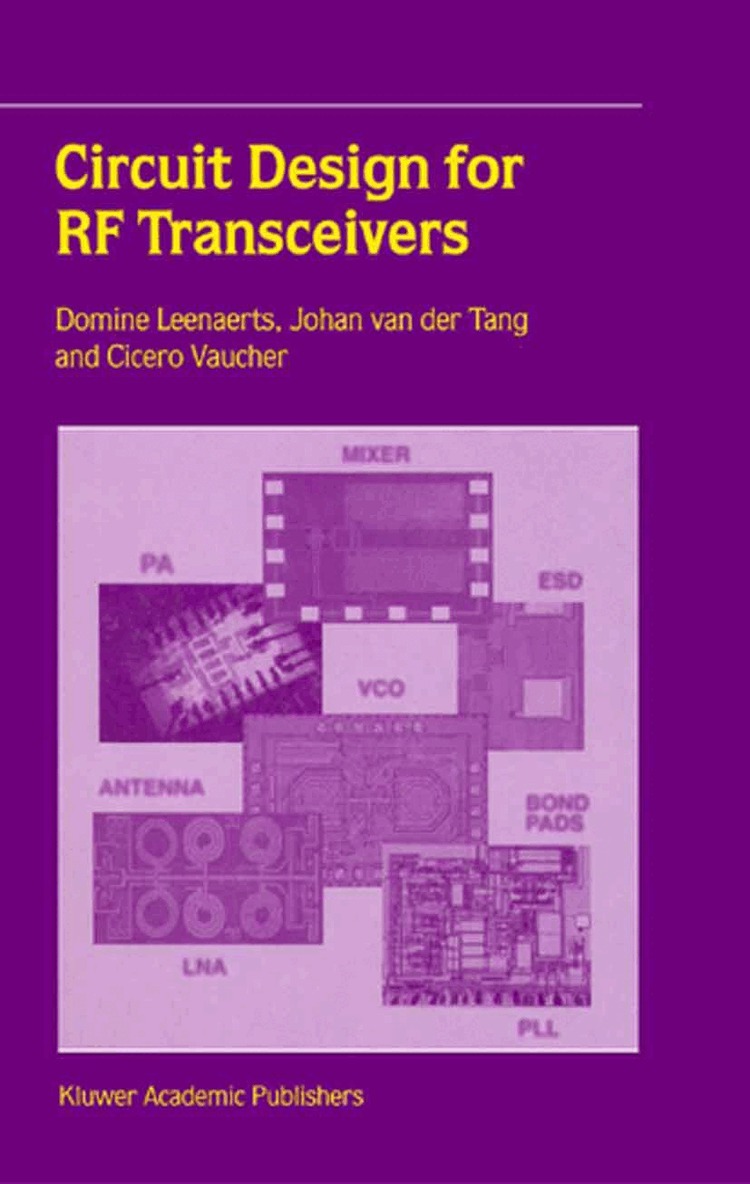
Circuit Design for RF Transceivers covers key building blocks which are needed to make an integrated transceiver for wireless and cellular applications, that is low-noise amplifiers, mixers, voltage controlled oscillators, RF power amplifiers and phase-locked loop systems. Starting from detailed RF concepts and specifications, the authors discuss the circuits in detail and provide solutions to many design problems. The circuits are implemented in a wide range of modern technology processes. Production requirements are taken into account, and measurement results are presented and discussed. Several of the presented circuits are used in IC products. The text also includes several RF technologies (for example double-poly, Silicon-on-Anything, SiGe-bipolar, RF-CMOS, etc.) and microwave design techniques, such as transmission line concepts. In addition, the problem of connecting the RF signals on-chip to the PCB and to the antenna will be discussed, including the influence of the package, ESD and bond pads. The contents of Circuit Design for RF Transceivers 2nd edition are based on research activities carried out at Philips Research. Many internal and external publications contributed to make the presented material state-of-the-art. The book is written for people who have a basic knowledge of analogue IC design. The second edition of this successful 2001 RF Circuit Design book has been updated, latest technology reviews have been added as well as several actual case studies. Due to the authors being active in industry as well as academia, this should prove to be an essential guide on RF Transceiver Design for students and engineers.
1 578 kr
Skickas inom 10-15 vardagar
High-Frequency Oscillator Design for Integrated Transceivers covers the analysis and design of all high-frequency oscillators required to realize integrated transceivers for wireless and wired applications. This includes the design of oscillator types as single-phase LC oscillators, I/Q LC oscillators, multi-phase LC oscillators, and ring oscillators in various IC technologies such as bipolar, BiCMOS, CMOS, and SOI (silicon on insulator). Starting from an in depth review of basic oscillator theory, the authors discuss key oscillator specifications, numerous oscillator circuit topologies, and introduce the concepts of design figures of merit (FOMs) and benchmark FOMs, which assist the oscillator designer during the overall design cycle. Taking advantage of behavioral modeling, the elementary properties of LC oscillators and ring oscillators are analyzed first. A detailed analysis of oscillator properties at circuit level follows taking parasitic elements and other practical aspects of integrated oscillator design into account. Special attention is given to advantages and limitations of linear time invariant (LTI) phase noise modeling, leading to the concept of optimum coupling in I/Q LC oscillators and a simulation method for fast and efficient phase noise optimization in oscillators. In addition, all modern linear time variant (LTV) phase noise theories are covered. As not only phase noise is of high importance to the designer, but optimization of other oscillator properties as well, additional subjects such as various tuning methods of LC oscillators are analyzed, too. Design examples of integrated LC and ring oscillators in the frequency range of 100 MHz up to 11 GHz are thoroughly discussed throughout the book.The clear and structured discussion of basic oscillator properties make High-Frequency Oscillator Design for Integrated Transceivers an excellent starting point for the inexperienced oscillator designer. The detailed analysis of many oscillator types and circuit topologies, the discussion of numerous practical design issues together with fast optimization methods, and more than 200 carefully selected literature references on oscillator literature, LC oscillator and ring oscillator designs make this book a very valuable resource for the experienced IC designer as well.
1 064 kr
Skickas inom 10-15 vardagar
N this information era people are living in a society in which processing, ?ow and Iexchange of information are vital for their existence. Two major issues in such so- ety, which are related to ?ow and exchange of information, are connectivity and mobility. On one hand, computers and Internet provide connectivity and allow communication as well as fast access to large amounts of information. On the other hand, wireless techno- gies bring mobility. People can move and still be able to communicate and have access to various kind of information. Therefore, the functioning of an information society is unthinkable without the use of computers, Internet and wireless technologies. The exp- tations are that in the future they will merge into a unique system for communication, access to information as well as their exchange and processing. The era of wireless communications started in 1901, when Guglielmo Marconi s- cessfully transmitted radio signals across the Atlantic Ocean. From that moment up to now wireless communications experienced explosive growth and became the fastest growing ?eld in the engineering world. Pushed by customer requirements, new wireless techno- gies have been emerging very fast. Each new generation of wireless technologies have brought new features and more complexity. Pushed by market forces to reduce costs, the semiconductor industry has provided new technologies for solid-state circuits implem- tation. Fortunately at the same time with the cost reduction, performance of new te- nologies has been improving.