Don Rahtz - Böcker
Visar alla böcker från författaren Don Rahtz. Handla med fri frakt och snabb leverans.
16 produkter
16 produkter
1 064 kr
Skickas inom 10-15 vardagar
This volume is concerned with quality of life and focuses on subjective well-being (people's own evaluations of their lives in terms of happiness and satisfaction). The first section focuses on theories of subjective well-being, and on testing these theories. The second section concentrates on how work, unemployment and income influence subjective well-being. The third section concerns two important institutions that have an impact on people's well-being - the health care and political systems. Authors from diverse disciplines present their views and research concerning quality of life, and focus on subjective well-being. The chapters cover topics ranging from theories of happiness and data bearing on these theories, to the organization of the political system. Income, work, health care and leisure are considered as they influence well-being. The effects of temperament, people's values and goals and life events are also treated. There is an international dimension to the volume, with authors from several nations and data gathered from diverse societies.The findings of the volume are relevant to academic researchers as well as to those working in applied areas who want to improve quality of life.
1 625 kr
Skickas inom 10-15 vardagar
Advances in Quality-of-Life Theory and Research is relevant to quality-of-life researchers working in the areas of Social Medicine, Sustainable Development, Social Indicators Research and Health Psychology/Behavioral Medicine. This volume contains 14 chapters that represent a culmination of programmatic research in the science of quality of life (QOL). Each chapter offers interesting findings in different areas of QOL research and, together, the chapters reflect the very basic premise that QOL research is a broad interdisciplinary topic explored in a multidisciplinary manner. The research methods and conceptual models used by the different authors are exemplary and can induce QOL researchers to conduct future research in QOL in other cultures, geographic areas, and different socio-economic and demographic groups as well as in different QOL domains.
1 578 kr
Skickas inom 10-15 vardagar
This book is a compilation of cases of best work in community indicators research. The cases describe communities that have launched their own community indicators programs. Elements that are included in the descriptions are the history of the community indicators work within the target region, the planning of community indicators, the actual indicators that were selected, the data collection process, the reporting of the results, and the use of the indicators to guide community development decisions and public policy. Community planners, community indicators researchers and urban planning specialists will find this book very helpful in learning from communities that have done community indicators work and have done it well.
1 578 kr
Skickas inom 10-15 vardagar
This book is the second in a series covering best practices in community quality-of-life (QOL) indicators. The first was published in 2004. The editors are M. Joseph Sirgy, Don Rahtz and Dong-Jin Lee. Volume 1 is a compilation of cases of best work in community indicators research. The cases describe communities that have launched their own community indicators programs. Elements that are included in the descr- tions are the history of the community indicators work within the target region, the planning of community indicators, the actual indicators that were selected, the data collection process, the reporting of the results and the use of the indicators to guide community development decisions and public policy. The chapters in Volume 1 are: Chapter 1: Vital Signs: Quality-of-Life Indicators for Virginia’s Technology Corridor by Terri Lynn Cornwell Chapter 2: The Sustainable Community Model Approach to the Development and Use of Multi-Dimensional Quality-of-Life Indicators by William T. Grunkemeyer and Myra L.
1 096 kr
Skickas inom 10-15 vardagar
Community indicators projects are plentiful. These projects capture the quality of life in towns, cities, counties, metropolitan regions, and larger geographic regions. Community quality-of-life (QOL) indicators are increasingly being integrated into overallplanningandotherpublicpolicyactivities.Thecommunityindicatorsproject reports are used not only in monitoring and evaluation applications but also in the context of increasing citizen participation in guiding communities towards achieving desired goals. This is the fourth book in a series covering best practices in community QOL indicators. Each volume presents individual cases (chapters) of communities at the local or regional levels that have designed and implemented community indi- tors programs. In Volume IV, we present nine chapters from a variety of contexts: cities such as the City of Phoenix (Arizona, USA), Jacksonville (Florida, USA), and Bristol (UK), suburban communities areas such as Long Island (New York, USA) and Sydney (Australia), larger regions such as Vancouver (Canada), and townships such as Sobantu (South Africa).
1 096 kr
Skickas inom 10-15 vardagar
Community quality-of-life (QOL) indicators continue to gain attention and interest in their use as many communities and regions design and apply them. Evolving from early use as data systems, indicators are increasingly being integrated into overall planning and other public policy activities. Their use is found not only in monitoring and evaluation applications, but also in the context of increasing citizen partici- tion in guiding communities towards achieving desired goals. Indeed, the emphasis in many indicator applications now includes linking actions to outcomes – making sure that the indicators are integrated, useful and effective in helping communities address QOL issues. The use of QOL indicators to consider a full spectrum of c- munity and regional well-being is exciting and the focus on integration is certain to bring new and innovative applications to the forefront. This is the third book in a series covering best practices in community QOL indicators. Each volume presents individual cases (chapters) of communities at the local or regional levels that have designed and implemented community indicators programs. In Volume I, we present eight chapters from a variety of contexts – from the county level in the U. S. , to the large megalopolis of Sao Paulo, to looking at a cross section of communities throughout Europe. Also included are three chapters from Canada, a leader in applying community indicator systems.
1 625 kr
Skickas inom 10-15 vardagar
Advances in Quality-of-Life Theory and Research is relevant to quality-of-life researchers working in the areas of Social Medicine, Sustainable Development, Social Indicators Research and Health Psychology/Behavioral Medicine. This volume contains 14 chapters that represent a culmination of programmatic research in the science of quality of life (QOL). Each chapter offers interesting findings in different areas of QOL research and, together, the chapters reflect the very basic premise that QOL research is a broad interdisciplinary topic explored in a multidisciplinary manner. The research methods and conceptual models used by the different authors are exemplary and can induce QOL researchers to conduct future research in QOL in other cultures, geographic areas, and different socio-economic and demographic groups as well as in different QOL domains.
1 625 kr
Skickas inom 10-15 vardagar
This book is a compilation of cases of best work in community indicators research. The cases describe communities that have launched their own community indicators programs. Elements that are included in the descriptions are the history of the community indicators work within the target region, the planning of community indicators, the actual indicators that were selected, the data collection process, the reporting of the results, and the use of the indicators to guide community development decisions and public policy. Community planners, community indicators researchers and urban planning specialists will find this book very helpful in learning from communities that have done community indicators work and have done it well.
1 625 kr
Skickas inom 10-15 vardagar
This book is the second in a series covering best practices in community quality-of-life (QOL) indicators. The first was published in 2004. The editors are M. Joseph Sirgy, Don Rahtz and Dong-Jin Lee. Volume 1 is a compilation of cases of best work in community indicators research. The cases describe communities that have launched their own community indicators programs. Elements that are included in the descr- tions are the history of the community indicators work within the target region, the planning of community indicators, the actual indicators that were selected, the data collection process, the reporting of the results and the use of the indicators to guide community development decisions and public policy. The chapters in Volume 1 are: Chapter 1: Vital Signs: Quality-of-Life Indicators for Virginia’s Technology Corridor by Terri Lynn Cornwell Chapter 2: The Sustainable Community Model Approach to the Development and Use of Multi-Dimensional Quality-of-Life Indicators by William T. Grunkemeyer and Myra L.
1 096 kr
Skickas inom 10-15 vardagar
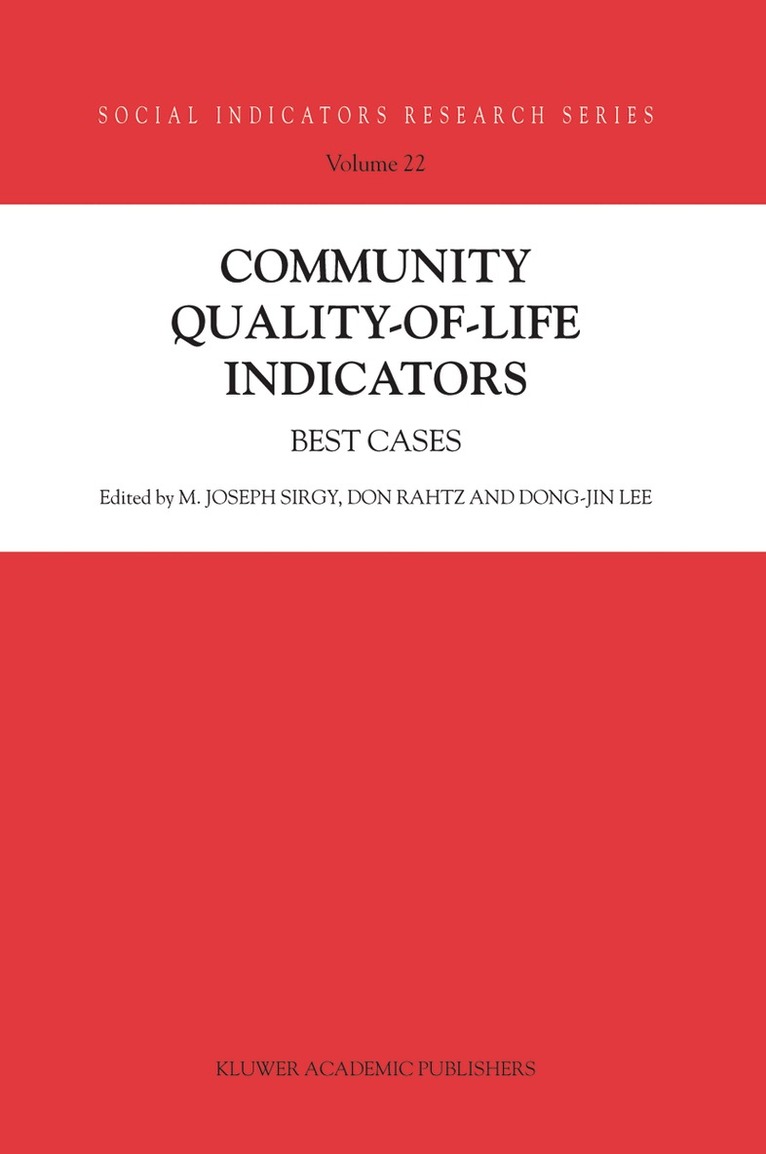
The proposed book is a sequel to volume 1-4 of Community Quality-of-Life Indicators: Best Cases. The first volume, Community Quality-of-Life Indicators: Best Cases was edited by M. Joseph Sirgy, Don Rahtz, and Dong-Jin Lee and published in 2004 by Kluwer Academic Publishers in the Social Indicators Research Book Series (volume 22). The second volume, Community Quality-of-Life Indicators: Best Cases II was edited by M. Joseph Sirgy, Don Rahtz, and David Swain and published in published in 2006 by Springer in the Social Indicators Research Book Series (volume 28). The third and fourth volumes, Community Quality-of-Life Indicators: Best Cases III and Community Quality-of-Life Indicators: Best Cases IV, were edited also by M. Joseph Sirgy, Rhonda Phillips, and Don Rahtz and published in 2009 by Springer in the ISQOLS Community Quality-of-Life Indicators Best Cases Book Series (volumes 1 and 2).
Del 3 - Community Quality-of-Life Indicators
Community Quality-of-Life Indicators: Best Cases V
Häftad, Engelska, 2013
1 096 kr
Skickas inom 10-15 vardagar
The proposed book is a sequel to volume 1-4 of Community Quality-of-Life Indicators: Best Cases. The first volume, Community Quality-of-Life Indicators: Best Cases was edited by M. Joseph Sirgy, Don Rahtz, and Dong-Jin Lee and published in 2004 by Kluwer Academic Publishers in the Social Indicators Research Book Series (volume 22). The second volume, Community Quality-of-Life Indicators: Best Cases II was edited by M. Joseph Sirgy, Don Rahtz, and David Swain and published in published in 2006 by Springer in the Social Indicators Research Book Series (volume 28). The third and fourth volumes, Community Quality-of-Life Indicators: Best Cases III and Community Quality-of-Life Indicators: Best Cases IV, were edited also by M. Joseph Sirgy, Rhonda Phillips, and Don Rahtz and published in 2009 by Springer in the ISQOLS Community Quality-of-Life Indicators Best Cases Book Series (volumes 1 and 2).
Del 1 - Community Quality-of-Life Indicators
Community Quality-of-Life Indicators: Best Cases III
Häftad, Engelska, 2012
1 096 kr
Skickas inom 10-15 vardagar
Community quality-of-life (QOL) indicators continue to gain attention and interest in their use as many communities and regions design and apply them. Evolving from early use as data systems, indicators are increasingly being integrated into overall planning and other public policy activities. Their use is found not only in monitoring and evaluation applications, but also in the context of increasing citizen partici- tion in guiding communities towards achieving desired goals. Indeed, the emphasis in many indicator applications now includes linking actions to outcomes – making sure that the indicators are integrated, useful and effective in helping communities address QOL issues. The use of QOL indicators to consider a full spectrum of c- munity and regional well-being is exciting and the focus on integration is certain to bring new and innovative applications to the forefront. This is the third book in a series covering best practices in community QOL indicators. Each volume presents individual cases (chapters) of communities at the local or regional levels that have designed and implemented community indicators programs. In Volume I, we present eight chapters from a variety of contexts – from the county level in the U. S. , to the large megalopolis of Sao Paulo, to looking at a cross section of communities throughout Europe. Also included are three chapters from Canada, a leader in applying community indicator systems.
Del 2 - Community Quality-of-Life Indicators
Community Quality-of-Life Indicators: Best Cases IV
Häftad, Engelska, 2012
1 096 kr
Skickas inom 10-15 vardagar
Community indicators projects are plentiful. These projects capture the quality of life in towns, cities, counties, metropolitan regions, and larger geographic regions. Community quality-of-life (QOL) indicators are increasingly being integrated into overallplanningandotherpublicpolicyactivities.Thecommunityindicatorsproject reports are used not only in monitoring and evaluation applications but also in the context of increasing citizen participation in guiding communities towards achieving desired goals. This is the fourth book in a series covering best practices in community QOL indicators. Each volume presents individual cases (chapters) of communities at the local or regional levels that have designed and implemented community indi- tors programs. In Volume IV, we present nine chapters from a variety of contexts: cities such as the City of Phoenix (Arizona, USA), Jacksonville (Florida, USA), and Bristol (UK), suburban communities areas such as Long Island (New York, USA) and Sydney (Australia), larger regions such as Vancouver (Canada), and townships such as Sobantu (South Africa).
Del 4 - Community Quality-of-Life Indicators
Community Quality-of-Life Indicators: Best Cases VI
Inbunden, Engelska, 2013
1 064 kr
Skickas inom 10-15 vardagar
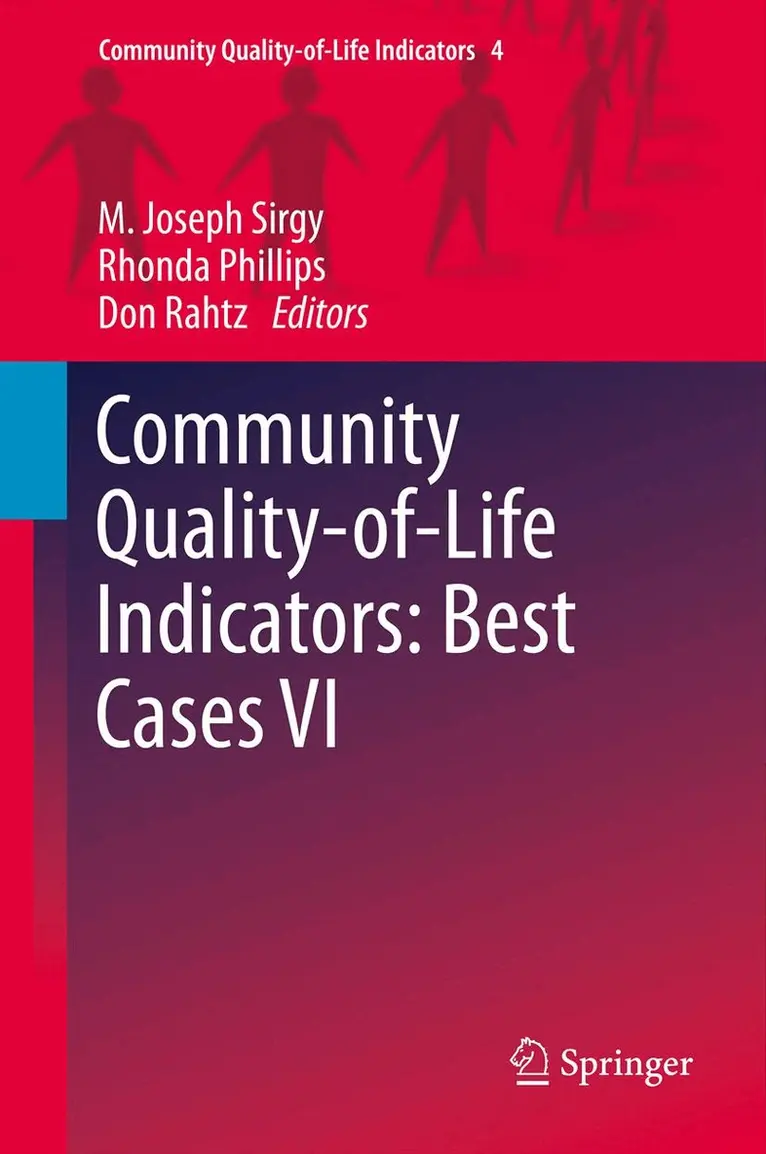
This book is the sixth in a series covering bet practices in community quality-of-life (QOL) indicators. The cases in this volume describe communities that have launched their own community indicators programs. Elements that are included in the descriptions are the history of the community indicators work within the target region, the planning of community indicators, the actual indicators that were selected, the data collection process, the reporting of the results, and the use of the indicators to guide community development decisions and public policy.
1 096 kr
Skickas inom 10-15 vardagar
The International Society for Quality of Life Studies held its first conference in Charlotte, North Carolina in 1997. Participants at the conference were allowed to submit their papers for the present volume. The submitted manuscripts went through a review and revision process, and the papers in this book represent the best articles from that process. Because the society sponsoring this volume is international in character, it is not sur prising that the 11 contributions are from 4 different countries: Canada (3), India (1), Netherlands (3), and the United States (4). Thus, the volume is cross-national in authorship, although we hope that future works can include more papers from additional nations. Ten of the eleven papers consider quality of life in terms of some aspect of subjective well-being. The book is broken into three sections: the first section presenting material on broad theories of subjective well being, the second section covering how work and income are related to subjective well-being, and the third section containing one chapter on health and one on political representation. I am proud to present these broad-ranging chapters on quality of life.
Del 4 - Community Quality-of-Life Indicators
Community Quality-of-Life Indicators: Best Cases VI
Häftad, Engelska, 2015
1 064 kr
Skickas inom 10-15 vardagar
This book is the sixth in a series covering bet practices in community quality-of-life (QOL) indicators. The cases in this volume describe communities that have launched their own community indicators programs. Elements that are included in the descriptions are the history of the community indicators work within the target region, the planning of community indicators, the actual indicators that were selected, the data collection process, the reporting of the results, and the use of the indicators to guide community development decisions and public policy.