Donal O'Shea – författare
Visar alla böcker från författaren Donal O'Shea. Handla med fri frakt och snabb leverans.
13 produkter
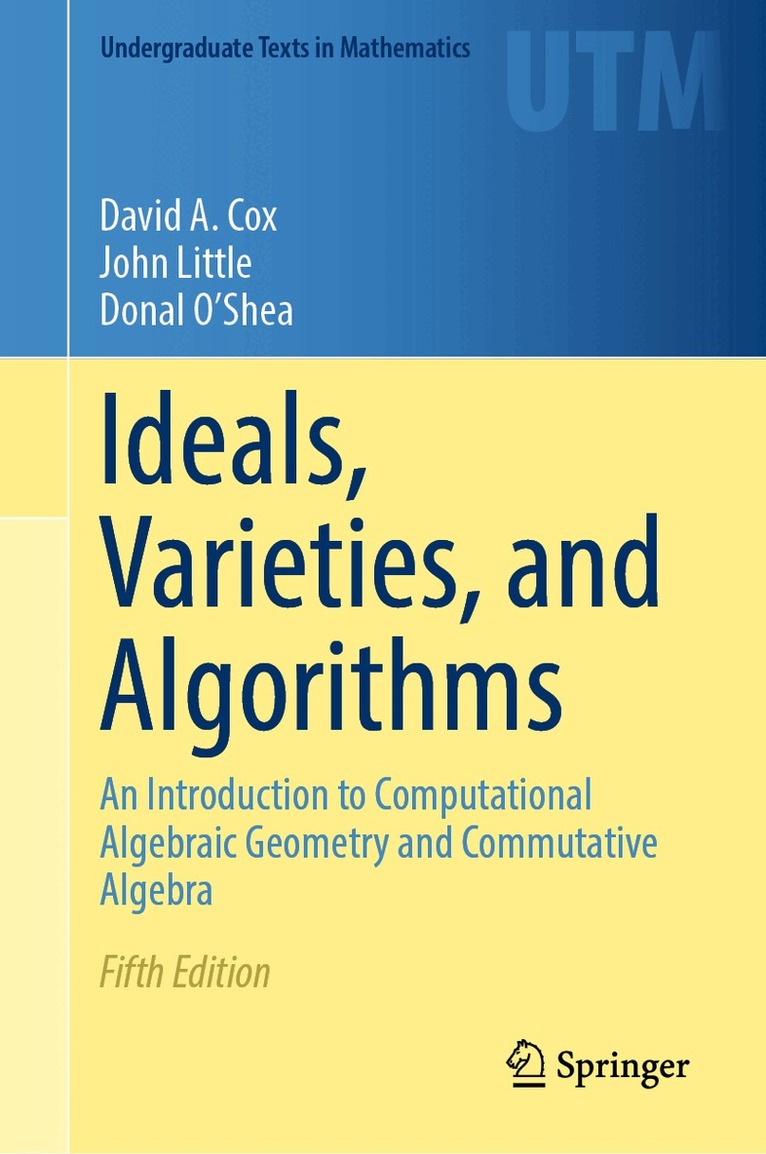
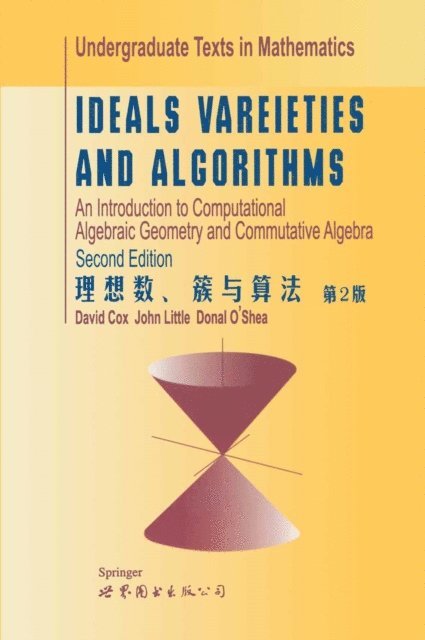
Ideals, Varieties, and Algorithms
An Introduction to Computational Algebraic Geometry and Commutative Algebra
Av David A. Cox, John Little m. fl.
Inbunden, 2025
876 kr
Lägg i varukorg
This text covers topics in algebraic geometry and commutative algebra with careful attention to their practical and computational aspects. The first four chapters form the core of the book. A comprehensive chart in the Preface illustrates a variety of ways to proceed with the material once these …
Ideals, Varieties, and Algorithms
An Introduction to Computational Algebraic Geometry and Commutative Algebra
Av Donal O'Shea, John Little m. fl.
E-bok, 2025
1141 kr
Lägg i varukorg
This text covers topics in algebraic geometry and commutative algebra with careful attention to their practical and computational aspects. The first four chapters form the core of the book. A comprehensive chart in the Preface illustrates a variety of ways to proceed with the material once these …
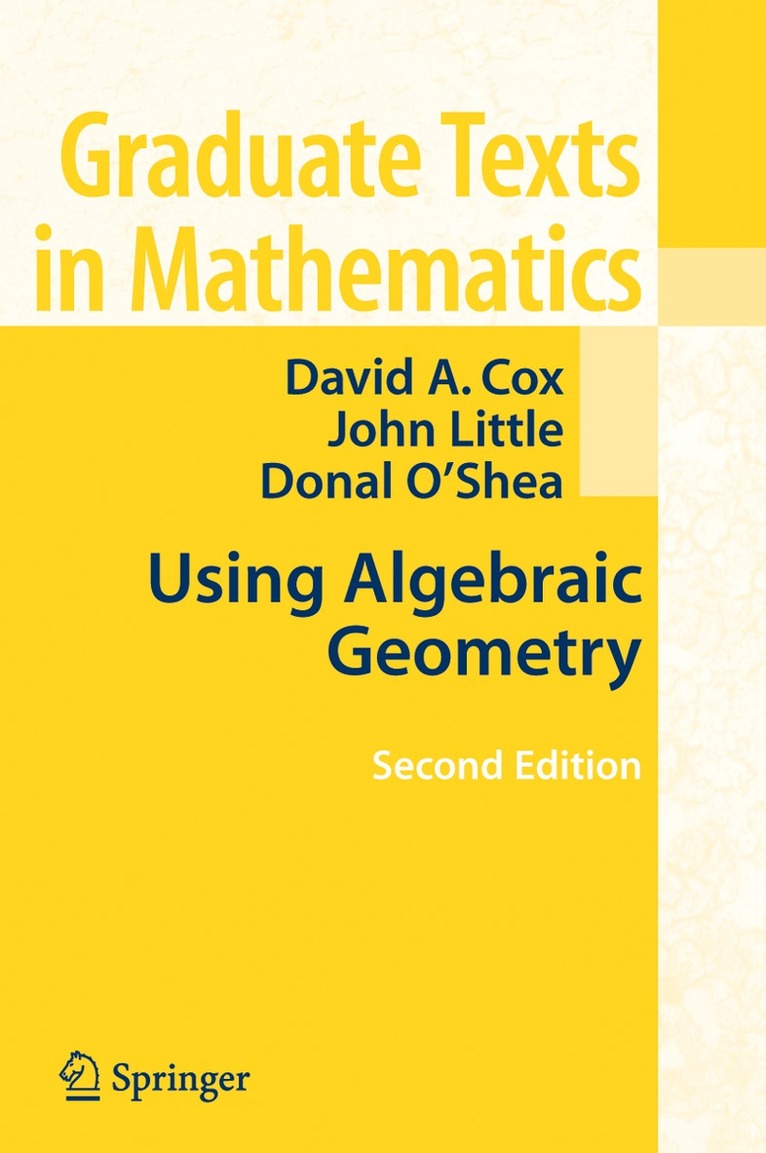
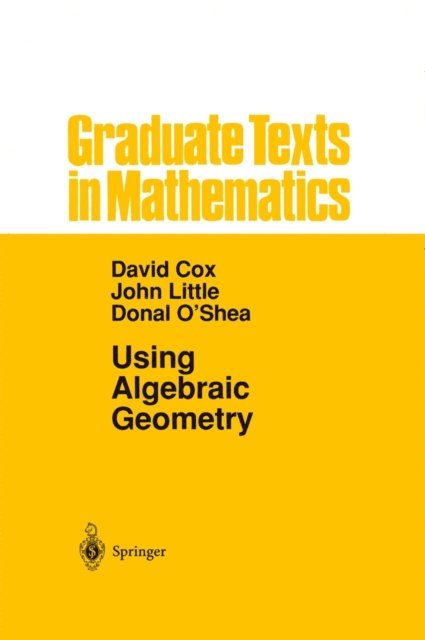
Using Algebraic Geometry
Av David A. Cox, John Little m. fl.
Häftad, 2005
857 kr
Lägg i varukorg
In recent years, the discovery of new algorithms for dealing with polynomial equations, coupled with their implementation on fast inexpensive computers, has sparked a minor revolution in the study and practice of algebraic geometry. These algorithmic methods have also given rise to some exciting …
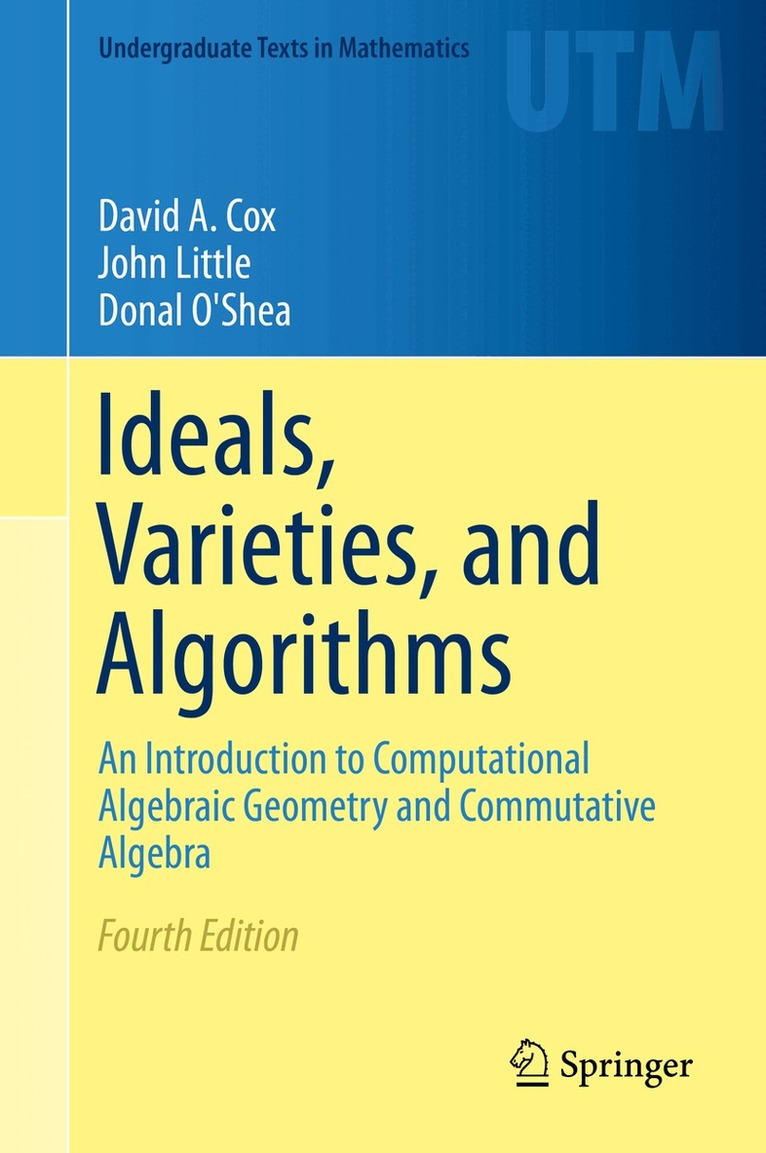
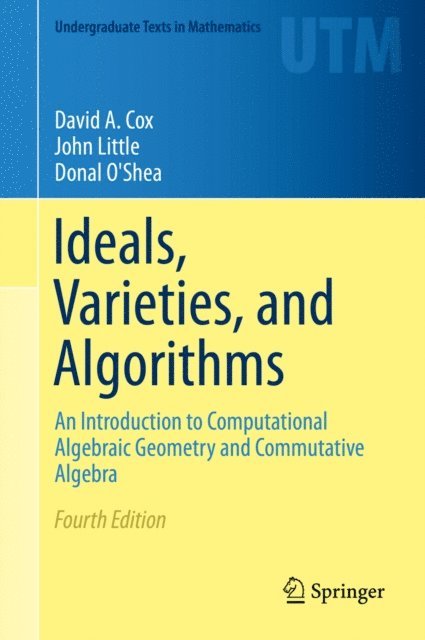
Ideals, Varieties, and Algorithms
An Introduction to Computational Algebraic Geometry and Commutative Algebra
Av David A. Cox, John Little m. fl.
Inbunden, 2015
496 kr
Lägg i varukorg
This text covers topics in algebraic geometry and commutative algebra with a strong perspective toward practical and computational aspects. The first four chapters form the core of the book. A comprehensive chart in the Preface illustrates a variety of ways to proceed with the material once these …
Poincaré Conjecture
In Search of the Shape of the Universe
Av Donal O'Shea
Häftad, 2008
167 kr
Lägg i varukorg
The Poincaré Conjecture tells the story behind one of the world’s most confounding mathematical theories. Formulated in 1904 by Henri Poincaré, his Conjecture promised to describe the very shape of the universe, but remained unproved until a huge prize was offered for its solution in 2000. Six …
Poincaré Conjecture
In Search of the Shape of the Universe
Av Donal O'Shea
E-bok, 2008
108 kr
Lägg i varukorg
The Poincaré Conjecture tells the story behind one of the world’s most confounding mathematical theories. Formulated in 1904 by Henri Poincaré, his Conjecture promised to describe the very shape of the universe, but remained unproved until a huge prize was offered for its solution in 2000. Six …
Using Algebraic Geometry
Av David A. Cox, John Little m. fl.
Inbunden, 2005
1093 kr
Lägg i varukorg
In recent years, the discovery of new algorithms for dealing with polynomial equations, coupled with their implementation on fast inexpensive computers, has sparked a minor revolution in the study and practice of algebraic geometry. These algorithmic methods have also given rise to some exciting …
Using Algebraic Geometry
Av Donal O'Shea, John Little m. fl.
E-bok, 2005
1037 kr
Lägg i varukorg
In recent years, the discovery of new algorithms for dealing with polynomial equations, coupled with their implementation on fast inexpensive computers, has sparked a minor revolution in the study and practice of algebraic geometry. These algorithmic methods have also given rise to some exciting …
Ideals, Varieties, and Algorithms
An Introduction to Computational Algebraic Geometry and Commutative Algebra
Av DONAL OSHEA, John Little m. fl.
E-bok, 2007
668 kr
Lägg i varukorg
Algebraic Geometry is the study of systems of polynomial equations in one or more variables, asking such questions as: Does the system have finitely many solutions, and if so how can one find them? And if there are infinitely many solutions, how can they be described and manipulated? The solutions …
Ideals, Varieties, and Algorithms
An Introduction to Computational Algebraic Geometry and Commutative Algebra
Av DONAL OSHEA, John Little m. fl.
E-bok, 2013
1140 kr
Lägg i varukorg
We wrote this book to introduce undergraduates to some interesting ideas in algebraic geometry and commutative algebra. Until recently, these topics involved a lot of abstract mathematics and were only taught in graduate school. But in the 1960''s, Buchberger and Hironaka discovered new algorithms …
Ideals, Varieties, and Algorithms
An Introduction to Computational Algebraic Geometry and Commutative Algebra
Av DONAL OSHEA, John Little m. fl.
E-bok, 2013
1174 kr
Lägg i varukorg
Algebraic Geometry is the study of systems of polynomial equations in one or more variables, asking such questions as: Does the system have finitely many solutions, and if so how can one find them? And if there are infinitely many solutions, how can they be described and manipulated? The solutions …
Using Algebraic Geometry
Av DONAL OSHEA, John Little m. fl.
E-bok, 2013
848 kr
Lägg i varukorg
In recent years, the discovery of new algorithms for dealing with polynomial equations, coupled with their implementation on fast inexpensive computers, has sparked a minor revolution in the study and practice of algebraic geometry. These algorithmic methods have also given rise to some exciting …
Ideals, Varieties, and Algorithms
An Introduction to Computational Algebraic Geometry and Commutative Algebra
Av Donal O'Shea, John Little m. fl.
E-bok, 2015
652 kr
Lägg i varukorg
This text covers topics in algebraic geometry and commutative algebra with a strong perspective toward practical and computational aspects. The first four chapters form the core of the book. A comprehensive chart in the Preface illustrates a variety of ways to proceed with the material once these …