Eric Marlier - Böcker
Visar alla böcker från författaren Eric Marlier. Handla med fri frakt och snabb leverans.
5 produkter
5 produkter
2 106 kr
Skickas inom 5-8 vardagar
Social indicators are an important tool for evaluating a country's level of social development and for assessing the impact of policy. Such indicators are already in use in investigating poverty and social exclusion in several European countries and have begun to play a significant role in advancing the social dimension of the European Union as a whole. The purpose of this book is to make a scientific contribution to the development of social indicators for the purposes of European policy-making. It considers the principles underlying the construction of policy-relevant indicators, the definition of indicators, and the issues that arise in their implementation, including that of the statistical data required. It seeks to bring together theoretical and methodological methods in the measurement of poverty/social exclusion with the empirical practice of social policy. The experience of Member States is reviewed, including an assessment of the National Action Plans on Social Inclusion submitted for the first time in June 2001 by the fifteen EU governments. The key areas covered by the book are poverty, including its intensity and persistence, income inequality, non-monetary deprivation, low educational attainment, unemployment, joblessness, poor health, poor housing and homelessness, functional illiteracy and innumeracy, and restricted social participation. In each case, the book assesses the strengths and weaknesses of different indicators relevant to social inclusion in the European Union, and makes recommendations for the indicators to be employed.Indicators for Social Inclusion in the European Union is being published at a critical stage in the evolution of the social agenda of the European Union. It is hoped that the report will play a role in widening public debate about the social dimension of Europe and that it will be of value to the social partners, to non-governmental and grass roots organizations, and to those living in poverty and social exclusion. It seeks to provide both a constructive background document at a crucial juncture in the evolution of the social dimension of the European Union and a reference work of continuing value.
1 043 kr
Skickas inom 5-8 vardagar
Social indicators are an important tool for evaluating a country's level of social development and for assessing the impact of policy. Such indicators are already in use in investigating poverty and social exclusion in several European countries and have begun to play a significant role in advancing the social dimension of the European Union as a whole. The purpose of this book is to make a scientific contribution to the development of social indicators for the purposes of European policy-making. It considers the principles underlying the construction of policy-relevant indicators, the definition of indicators, and the issues that arise in their implementation, including that of the statistical data required. It seeks to bring together theoretical and methodological methods in the measurement of poverty/social exclusion with the empirical practice of social policy. The experience of Member States is reviewed, including an assessment of the National Action Plans on Social Inclusion submitted for the first time in June 2001 by the fifteen EU governments. The key areas covered by the book are poverty, including its intensity and persistence, income inequality, non-monetary deprivation, low educational attainment, unemployment, joblessness, poor health, poor housing and homelessness, functional illiteracy and innumeracy, and restricted social participation. In each case, the book assesses the strengths and weaknesses of different indicators relevant to social inclusion in the European Union, and makes recommendations for the indicators to be employed.Social Indicators is being published at a critical stage in the evolution of the social agenda of the European Union. It will play a role in widening public debate about the social dimension of Europe and it will be of value to the social partners, to non-governmental and grass roots organizations, and to those living in poverty and social exclusion. It seeks to provide both a constructive background document at a crucial juncture in the evolution of the social dimension of the European Union and a reference work of continuing value.
583 kr
Skickas inom 7-10 vardagar
ePDF and ePUB available Open Access under CC-BY-NC-ND license. The perpetuation of poverty across generations damages lives. It weakens social cohesion and the economy and undermines environmental sustainability. This book examines why poverty is carried on from one generation to the next and what needs to be done to eradicate it.This book draws on a wide variety of sources and academic disciplines (social sciences, economics, law, community development, neuroscience and developmental psychology) along with the lived experience of people in poverty. Challenging the myths and prejudices about poverty that hinder progress, it calls for a comprehensive approach based on ensuring real equality of opportunity for all. It stresses the need to intervene early to combat child poverty and break the vicious cycles that perpetuate poverty and disadvantage.
442 kr
Skickas inom 7-10 vardagar
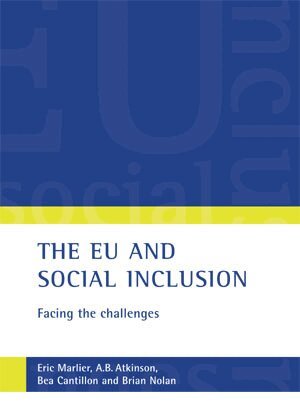
Social cohesion is one of the declared objectives of the European Union and, with some 16% of EU citizens at risk of poverty, the need to fight poverty and social exclusion continues as a major challenge. This book provides an in-depth analysis of the EU Social Inclusion Process, the means by which it hopes to meet this objective, and explores the challenges ahead at local, regional, national and EU levels. It sets out concrete proposals for taking the Process forward.The book provides a unique analysis of policy formulation and assessment. Setting out the evolution and current state of EU cooperation in social policy, it examines what can be learned about poverty and social exclusion from the EU commonly agreed indicators. Taking the position of outside, but informed, observers, the authors explore the further development of the common indicators, including the implications of Enlargement, and consider the challenges of advancing the Social Inclusion Process - strengthening policy analysis, embedding the Process in domestic policies and making it more effective. Proposing the setting of targets and restructuring of National Action Plans and their implementation, they emphasise the need for widespread "ownership" of the Process at domestic and EU level and for it to demonstrate significant progress in reducing poverty and social exclusion.The book will be invaluable to academics, students and policy-makers at sub-national, national and EU levels as well as to social partners, and NGOs working towards a more inclusive society.
1 192 kr
Skickas inom 7-10 vardagar
Social cohesion is one of the declared objectives of the European Union and, with some 16% of EU citizens at risk of poverty, the need to fight poverty and social exclusion continues as a major challenge. This book provides an in-depth analysis of the EU Social Inclusion Process, the means by which it hopes to meet this objective, and explores the challenges ahead at local, regional, national and EU levels. It sets out concrete proposals for taking the Process forward.The book provides a unique analysis of policy formulation and assessment. Setting out the evolution and current state of EU cooperation in social policy, it examines what can be learned about poverty and social exclusion from the EU commonly agreed indicators. Taking the position of outside, but informed, observers, the authors explore the further development of the common indicators, including the implications of Enlargement, and consider the challenges of advancing the Social Inclusion Process - strengthening policy analysis, embedding the Process in domestic policies and making it more effective. Proposing the setting of targets and restructuring of National Action Plans and their implementation, they emphasise the need for widespread "ownership" of the Process at domestic and EU level and for it to demonstrate significant progress in reducing poverty and social exclusion.The book will be invaluable to academics, students and policy-makers at sub-national, national and EU levels as well as to social partners, and NGOs working towards a more inclusive society.