Gambier Yves Gambier – författare
Visar alla böcker från författaren Gambier Yves Gambier. Handla med fri frakt och snabb leverans.
19 produkter
19 produkter
Inbunden, Engelska, 1997
395 kr
Skickas
Inbunden, Engelska, 2001
656 kr
Skickas
E-bok
PDF, Engelska, 20141 065 kr
Läs direkt efter köp
1 065 kr
Läs direkt efter köp
E-bok
Engelska, 20211 171 kr
Läs direkt efter köp
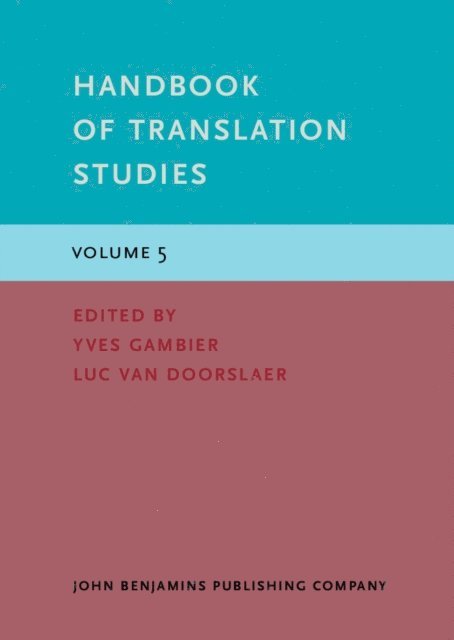
Up to now, the Handbook of Translation Studies (HTS) consisted of four volumes, all published between 2010 and 2013. Since research in TS continues to grow and expand, this fifth volume was added in 2021. The HTS aims at disseminating knowledge about translation, interpreting, localization, adaptation, etc. and providing easy access to a large range of topics, traditions, and methods to a relatively broad audience: not only students who prefer such user-friendliness, but also researchers and lecturers in Translation Studies, Translation & Interpreting professionals, as well as scholars and experts from other adjacent disciplines. All articles in HTS are written by specialists in the different subfields and are peer-reviewed.
E-bok
Engelska, 20191 305 kr
Läs direkt efter köp
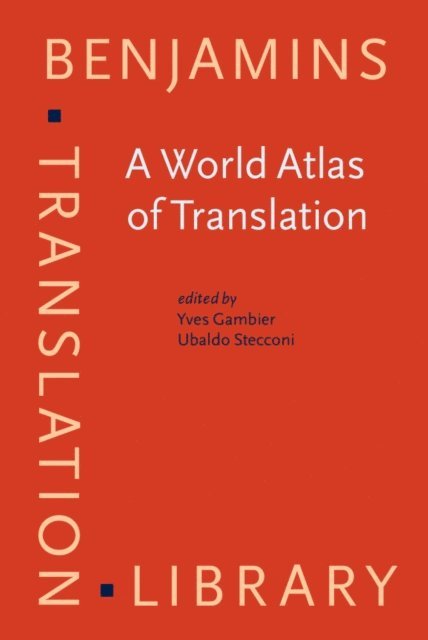
What do people think of translation in the different historical, cultural and linguistic traditions of the world? How many uses has translation been put to? How distant from one another are the concepts of translation found in the different traditions? These are some of the questions A World Atlas of Translation addresses. Its twenty-one reports give us pictures taken from the inside, both from traditions that are well represented in the literature and from the many that (for now) are not.But the Atlas is not content with documenting - no map is this innocent. In fact, the wealth of information collected and made accessible by its reporters can be useful to gauge the dispersion of translation concepts across traditions. As you read its reports, the Atlas will keep asking "e;How far apart do these concepts look to you?"e; Finally and more ambitiously, the reports can help us test the hypothesis that a cross-cultural notion of translation exists. In this respect, the Atlas is mostly a proof of concept. It hopes to encourage further fact-based research in quest of a robust and compelling unifying notion of translation.
E-bok
PDF, Engelska, 20181 054 kr
Läs direkt efter köp
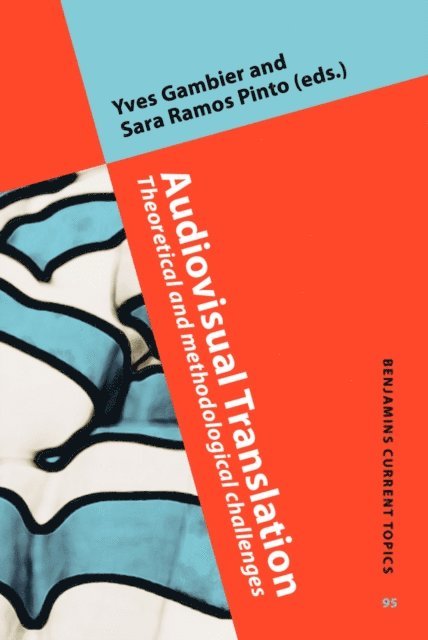
The exponential growth of Audiovisual Translation (AVT) in the last three decades has consolidated its place as an area of study within Translation Studies (TS). However, AVT is still a young domain currently exploring a number of different lines of inquiry without a specific methodological and theoretical framework.This volume discusses the advantages and drawbacks of ten approaches to AVT and highlights the potential avenues opened up by new methods. Our aim is to jumpstart the discussion on the (in)adequacy of the methodologies imported from other disciplines and the need (or not) for a conceptual apparatus and framework of analysis specific to AVT.This collective work relates to recent edited volumes that seek to take stock on research in AVT, but it distinguishes itself from those publications by promoting links in what is now a very fragmented field. Originally published as a special issue of Target 28:2 (2016).
E-bok
Engelska, 20181 305 kr
Läs direkt efter köp
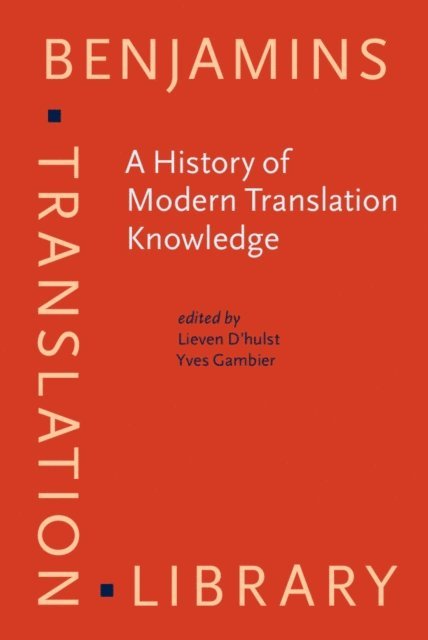
A History of Modern Translation Knowledge is the first attempt to map the coming into being of modern thinking about translation. It breaks with the well-established tradition of viewing history through the reductive lens of schools, theories, turns or interdisciplinary exchanges. It also challenges the artificial distinction between past and present and it sustains that the latter's historical roots go back far beyond the 1970s. Translation Studies is but part of a broader set of discourses on translation we propose to label "e;translation knowledge"e;. This book concentrates on seven processes that make up the history of modern translation knowledge: generating, mapping, internationalising, historicising, analysing, disseminating and applying knowledge. All processes are covered by 58 domain experts and allocated over 55 chapters, with cross-references. This book is indispensable reading for advanced Master- and PhD-students in Translation Studies who need background information on the history of their field, with relevance for Europe, the Americas and large parts of Asia. It will also interest students and scholars working in cultural and social history.
E-bok
Engelska, 20181 258 kr
Läs direkt efter köp
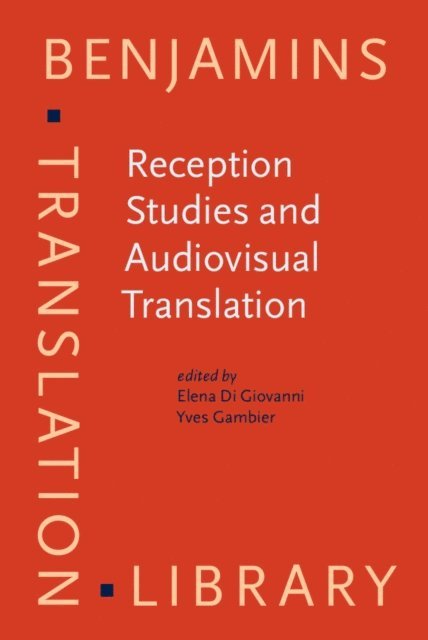
The coming of age of audiovisual translation studies has brought about a much-needed surge of studies focusing on the audience, their comprehension, appreciation or rejection of what reaches them through the medium of translation. Although complex to perform, studies on the reception of translated audiovisual texts offer a uniquely thorough picture of the life and afterlife of these texts. This volume provides a detailed and comprehensive overview of reception studies related to audiovisual translation and accessibility, from a diachronic and synchronic perspective. Focusing on all audiovisual translation techniques and encompassing theoretical and methodological approaches from translation, media and film studies, it aims to become a reference for students and scholars across these fields.
E-bok
PDF, Engelska, 20161 258 kr
Läs direkt efter köp
For decades, Translation Studies has been perceived not merely as a discipline but rather as an interdiscipline, a trans-disciplinary field operating across a number of boundaries. This has implied and still implies a considerable amount of interaction with other disciplines. There is often much more awareness of and attention to translation and Translation Studies than many translation scholars are aware of. This volume crosses the boundaries to other disciplines and explicitly sets up dialogic formats: every chapter is co-authored both by a specialist from Translation Studies and a scholar from another discipline with a special interest in translation. Sixteen disciplinary dialogues about and around translation are the result, sometimes with expected partners, such as scholars from Computational Linguistics, History and Comparative Literature, but sometimes also with less expected interlocutors, such as scholars from Biosemiotics, Game Localization Research and Gender Studies. The volume not only challenges the boundaries of Translation Studies but also raises issues such as the institutional division of disciplines, the cross-fertilization of a given field, the trends and turns within an interdiscipline.
E-bok
PDF, Engelska, 20131 195 kr
Läs direkt efter köp
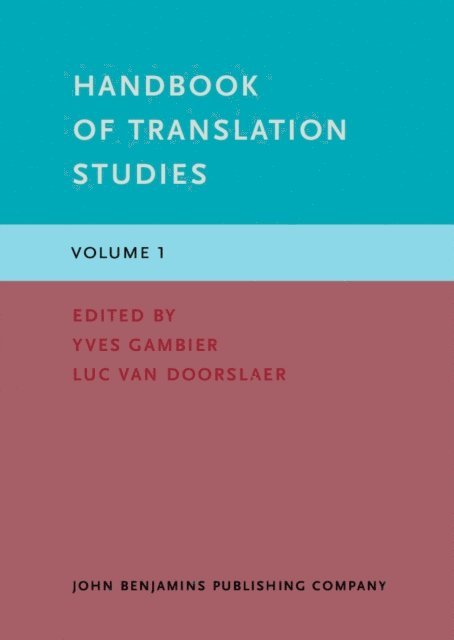
As a meaningful manifestation of how institutionalized the discipline has become, the new Handbook of Translation Studies is most welcome. It joins the other signs of maturation such as Summer Schools, the development of academic curricula, historical surveys, journals, book series, textbooks, terminologies, bibliographies and encyclopedias.The HTS aims at disseminating knowledge about translation and interpreting and providing easy access to a large range of topics, traditions, and methods to a relatively broad audience: not only students who often adamantly prefer such user-friendliness, researchers and lecturers in Translation Studies, Translation & Interpreting professionals; but also scholars and experts from other disciplines (among which linguistics, sociology, history, psychology). In addition the HTS addresses any of those with a professional or personal interest in the problems of translation, interpreting, localization, editing, etc., such as communication specialists, journalists, literary critics, editors, public servants, business managers, (intercultural) organization specialists, media specialists, marketing professionals.The usability, accessibility and flexibility of the HTS depend on the commitment of people who agree that Translation Studies does matter. All users are therefore invited to share their feedback. Any questions, remarks and suggestions for improvement can be sent to the editorial team at hts@kuleuven.be.Next to the book edition (in printed and electronic, PDF, format), HTS is also available as an online resource, connected with the Translation Studies Bibliography. For access to the Handbook of Translation Studies Online, please visit http://www.benjamins.com/online/hts/
E-bok
PDF, Engelska, 20121 195 kr
Läs direkt efter köp
As a meaningful manifestation of how institutionalized the discipline has become, the new Handbook of Translation Studies is most welcome. It joins the other signs of maturation such as Summer Schools, the development of academic curricula, historical surveys, journals, book series, textbooks, terminologies, bibliographies and encyclopedias.The HTS aims at disseminating knowledge about translation and interpreting and providing easy access to a large range of topics, traditions, and methods to a relatively broad audience: not only students who often adamantly prefer such user-friendliness, researchers and lecturers in Translation Studies, Translation & Interpreting professionals; but also scholars and experts from other disciplines (among which linguistics, sociology, history, psychology). In addition the HTS addresses any of those with a professional or personal interest in the problems of translation, interpreting, localization, editing, etc., such as communication specialists, journalists, literary critics, editors, public servants, business managers, (intercultural) organization specialists, media specialists, marketing professionals.The usability, accessibility and flexibility of the HTS depend on the commitment of people who agree that Translation Studies does matter. All users are therefore invited to share their feedback. Any questions, remarks and suggestions for improvement can be sent to the editorial team at hts@kuleuven.be.Next to the book edition (in printed and electronic, PDF, format), HTS is also available as an online resource, connected with the Translation Studies Bibliography. For access to the Handbook of Translation Studies Online, please visit http://www.benjamins.com/online/hts/
E-bok
PDF, Engelska, 20111 195 kr
Läs direkt efter köp
As a meaningful manifestation of how institutionalized the discipline has become, the new Handbook of Translation Studies is most welcome. It joins the other signs of maturation such as Summer Schools, the development of academic curricula, historical surveys, journals, book series, textbooks, terminologies, bibliographies and encyclopedias.The HTS aims at disseminating knowledge about translation and interpreting and providing easy access to a large range of topics, traditions, and methods to a relatively broad audience: not only students who often adamantly prefer such user-friendliness, researchers and lecturers in Translation Studies, Translation & Interpreting professionals; but also scholars and experts from other disciplines (among which linguistics, sociology, history, psychology). In addition the HTS addresses any of those with a professional or personal interest in the problems of translation, interpreting, localization, editing, etc., such as communication specialists, journalists, literary critics, editors, public servants, business managers, (intercultural) organization specialists, media specialists, marketing professionals.The usability, accessibility and flexibility of the HTS depend on the commitment of people who agree that Translation Studies does matter. All users are therefore invited to share their feedback. Any questions, remarks and suggestions for improvement can be sent to the editorial team at hts@kuleuven.be.Next to the book edition (in printed and electronic, PDF, format), HTS is also available as an online resource, connected with the Translation Studies Bibliography. For access to the Handbook of Translation Studies Online, please visit http://www.benjamins.com/online/hts/
E-bok
PDF, Engelska, 20101 384 kr
Läs direkt efter köp
As a meaningful manifestation of how institutionalized the discipline has become, the new Handbook of Translation Studies is most welcome. It joins the other signs of maturation such as Summer Schools, the development of academic curricula, historical surveys, journals, book series, textbooks, terminologies, bibliographies and encyclopedias.The HTS aims at disseminating knowledge about translation and interpreting and providing easy access to a large range of topics, traditions, and methods to a relatively broad audience: not only students who often adamantly prefer such user-friendliness, researchers and lecturers in Translation Studies, Translation & Interpreting professionals; but also scholars and experts from other disciplines (among which linguistics, sociology, history, psychology). In addition the HTS addresses any of those with a professional or personal interest in the problems of translation, interpreting, localization, editing, etc., such as communication specialists, journalists, literary critics, editors, public servants, business managers, (intercultural) organization specialists, media specialists, marketing professionals.The usability, accessibility and flexibility of the HTS depend on the commitment of people who agree that Translation Studies does matter. All users are therefore invited to share their feedback. Any questions, remarks and suggestions for improvement can be sent to the editorial team at hts@kuleuven.be.Next to the book edition (in printed and electronic, PDF, format), HTS is also available as an online resource, connected with the Translation Studies Bibliography. For access to the Handbook of Translation Studies Online, please visit http://www.benjamins.com/online/hts/ .
E-bok
PDF, Engelska, 20001 714 kr
Läs direkt efter köp
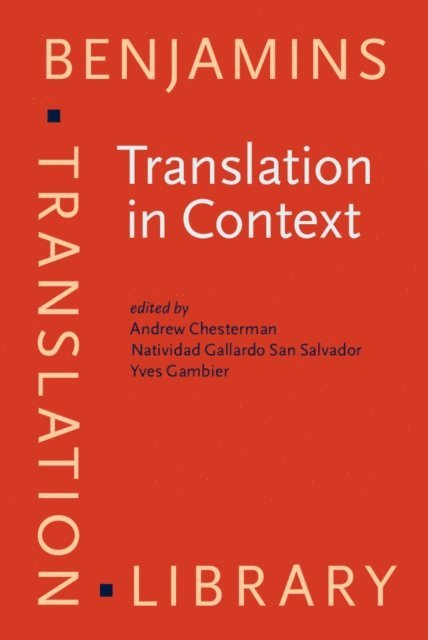
Translation in Context is a collection of contributions from the 1998 Congress arranged by EST, the European Society for Translation Studies, in Granada, Spain. It illustrates some of the latest research interests and achievements in Translation Studies at the turn of the millennium. The contributions show how the context of Translation Studies has expanded to cover new documentation techniques, cultural and psychological factors, the latest computer tools, ideological issues, media translation, and new methodologies. A total of 32 papers deal with: (I) Conceptual analysis in Translation Studies, (II) Situational, sociological and political factors, (III) Psychological and cognitive aspects, (IV) Translation effects, (V) Computer aids, (VI) Text-type studies, (VII) Culture-bound concepts, and (VIII) Translation history. The languages of the papers and abstracts are English, French, German and Spanish.
E-bok
PDF, Engelska, 19971 384 kr
Läs direkt efter köp
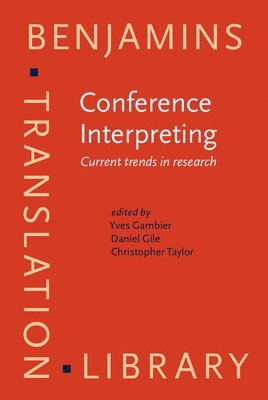
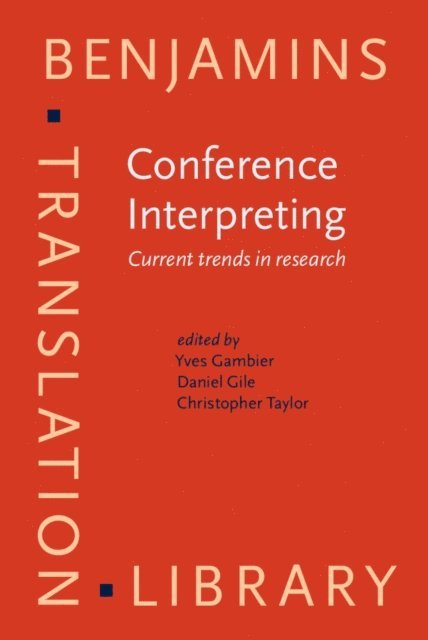
''Conference Interpreting: What do we know and how?'' is the title of a round-table conference (Turku 1994) organised to assess the state of the art in conference interpreting research. The result is collected in this volume with fully coordinated reports on the round tables. The book presents an exciting coverage of the field, touching on methodology, communication, discourse, culture, neurolinguistic and cognitive aspects, quality assessment, training and developing skills.
E-bok
PDF, Engelska, 20091 117 kr
Läs direkt efter köp
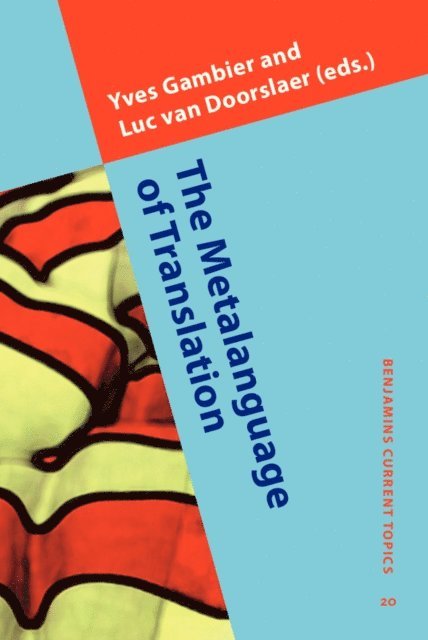
“Let the meta-discussion begin,” James Holmes urged in 1972. Coming almost forty years later – years filled with fascinating and often unexpected developments in the interdiscipline of Translation Studies – this volume offers the reader a multiplicity of meta-perspectives, while also moving the discussion forward. Indeed, the (re)production and (re)use of metalinguistic metaphors frame and partly determine our views on research, so such a discussion is vital as it is in any scholarly discipline. Among other questions, the eleven contributors draw the reader’s attention to the often puzzling variations of usage and conceptualization in both the theory and the practice of translation.First published as a special issue of Target 19:2 (2007), the volume runs the gamut of metalinguistic topics, ranging from terminology, localization and epistemological questions, through the Chinese perspective, to the conceptual mapping of the online Translation Studies Bibliography.
E-bok
PDF, Engelska, 20071 447 kr
Läs direkt efter köp
Like previous collections based on congresses of the European Society of Translation Studies (EST), this volume presents the latest insights and findings in an ever-changing, ever-challenging domain. The twenty-six papers, carefully chosen from about 140 presented at the 4th EST Congress, offer a bird''s eye view of the most pressing concerns and most exciting vistas in Translation Studies today. The editors'' final choices reflect a focus on quality of approach, originality of topic, and clarity of presentation, and aim at capturing the most salient developments in the contemporary theory, methodology and technology of TS. As always in EST, the themes covered relate to translation as well as interpreting. They include discussion of a broad range of text-types and skopoi, and a diversity of themes, such as translation universals, translation strategies, translation and ideology, perception of translated humor, translation tools, etc. Many of the papers force us to take a fresh look at seemingly well established paradigms and familiar notions, while also making recourse to work being done in other disciplines (Semiotics, Linguistics, Discourse Analysis, Contrastive Studies).
E-bok
PDF, Engelska, 20011 405 kr
Läs direkt efter köp
The globalisation of communication networks has increased the domains of translation and is challenging ever more the translator’s role. This volume is a collection of contributions from two different conferences (Misano, 1997 and Berlin, 1998). (Multi)Media translation, especially screen translation (TV, cinema, video), has made more explicit the complexities of any communication and has led us to take a fresh look at the translator’s strategies and behaviours.Several papers ponder the concepts of media and multimedia, the necessity of interdisciplinarity, the polysemiotic dimension of audiovisual media. Quite a few discuss the current transformations in audiovisual media policy. A great many deal with practices, mainly in subtitling but also in interpreting for TV and surtitling: what are the quality parameters and the conditions to meet audience’s expectations?Finally some show the cultural and linguistic implications of screen translation. Digitalisation is changing production and broadcasting and speeding up convergence between media, telecommunications and information and communication technology.Is (multi)media translation a new field of study or an umbrella framework for scholars from various disciplines? Is it a trick to overcome the absence of prestige in Translation Studies? Or is it just a buzz word which gives rise to confusion? These questions remain open: the 26 contributions are partial answers.