Garrow Duncan Garrow – författare
Visar alla böcker från författaren . Handla med fri frakt och snabb leverans.
6 produkter
6 produkter
E-bok
PDF, Engelska, 2015328 kr
Läs direkt efter köp
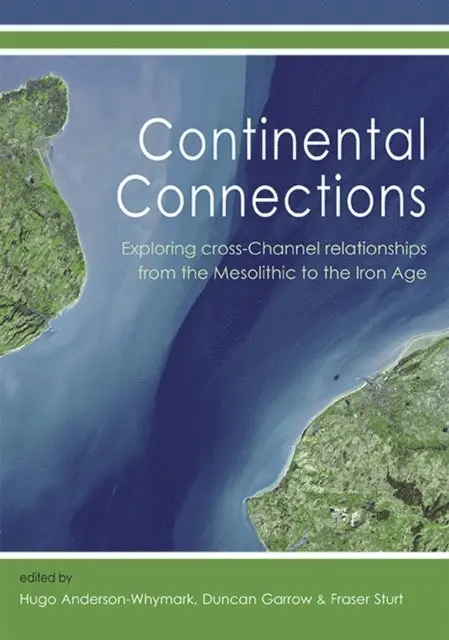
The prehistories of Britain and Ireland are inescapably entwined with continental European narratives. The central aim here is to explore ‘cross-channel’ relationships throughout later prehistory, investigating the archaeological links (material, social, cultural) between the areas we now call Britain and Ireland, and continental Europe, from the Mesolithic through to the end of the Iron Age. Since the separation from the European mainland of Ireland (c. 16,000 BC) and Britain (c. 6000 BC), their island nature has been seen as central to many aspects of life within them, helping to define their senses of identity, and forming a crucial part of their neighbourly relationship with continental Europe and with each other. However, it is important to remember that the surrounding seaways have often served to connect as well as to separate these islands from the continent. In approaching the subject of ‘continental connections’ in the long-term, and by bringing a variety of different archaeological perspectives (associated with different periods) to bear on it, this volume provides a new a new synthesis of the ebbs and flows of the cross-channel relationship over the course of 15,000 years of later prehistory, enabling fresh understandings and new insights to emerge about the intimately linked trajectories of change in both regions.
E-bok
PDF, Engelska, 2008321 kr
Läs direkt efter köp
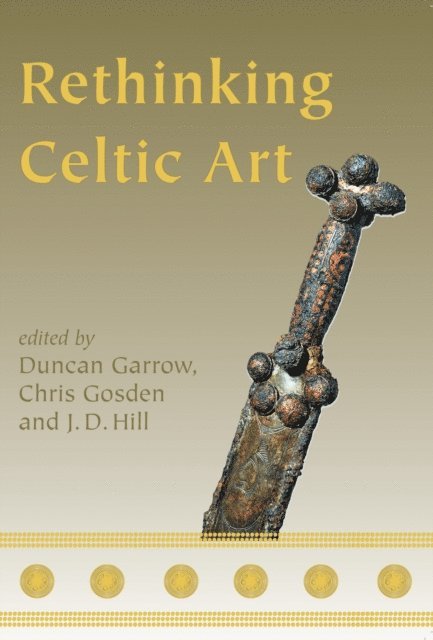
''Early Celtic art'' - typified by the iconic shields, swords, torcs and chariot gear we can see in places such as the British Museum - has been studied in isolation from the rest of the evidence from the Iron Age. This book reintegrates the art with the archaeology, placing the finds in the context of our latest ideas about Iron Age and Romano-British society. The contributions move beyond the traditional concerns with artistic styles and continental links, to consider the material nature of objects, their social effects and their role in practices such as exchange and burial. The aesthetic impact of decorated metalwork, metal composition and manufacturing, dating and regional differences within Britain all receive coverage. The book gives us a new understanding of some of the most ornate and complex objects ever found in Britain, artefacts that condense and embody many histories.
E-bok
Engelska, 2017352 kr
Läs direkt efter köp
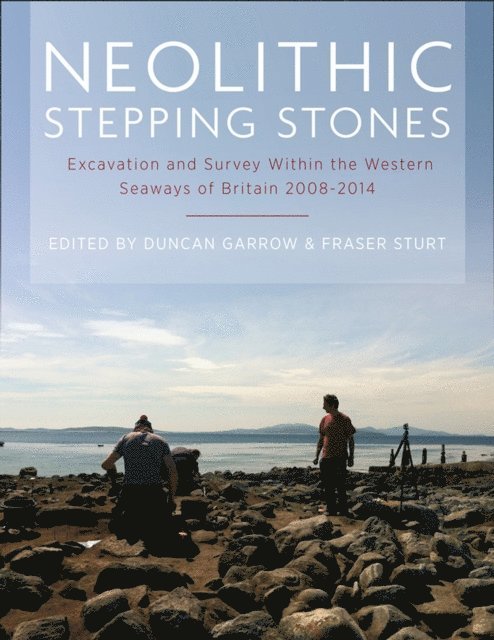
The ‘western seaways’ are an arc of sea extending from the Channel Islands in the south, through the Isles of Scilly around to Orkney in the north. This maritime zone has long been seen as a crucial corridor of interaction during later prehistory. Connections across it potentially led, for example, to the eventual arrival of the Neolithic in Britain, almost 1000 years after it arrived on the near continent. This book’s primary focus is Early Neolithic settlement on islands within the ‘western seaways’ – sites that offer significant insight into the character of the Mesolithic–Neolithic transition in this particular maritime zone. It also explores a series of directly related, wider themes: the nature and effects of ‘island-ness’ in later prehistory; the visibility of material connections across the sea; the extent of Neolithic settlement variability across Britain; and the consequences of geographical biases in research for our understanding of the prehistoric past. At the heart of the book lie the results of three substantial excavations at L’Erée, Guernsey; Old Quay, St Martin’s (Isles of Scilly); and An Doirlinn, South Uist. Key findings include: the first major Mesolithic flint assemblage recovered from Scilly; one of the most extensively excavated and long-lasting Neolithic/Bronze Age occupation sites in the Channel Islands; the first substantial Neolithic settlement on Scilly; and the longest sequence of Neolithic/Early Bronze Age occupation on a single site from the Outer Hebrides. In order to contextualise the significance of these findings, we also present an extended discussion and broad synthesis of Mesolithic, Neolithic and Bronze Age archaeology on each island group.
E-bok
PDF, Engelska, 2017351 kr
Läs direkt efter köp
The ‘western seaways’ are an arc of sea extending from the Channel Islands in the south, through the Isles of Scilly around to Orkney in the north. This maritime zone has long been seen as a crucial corridor of interaction during later prehistory. Connections across it potentially led, for example, to the eventual arrival of the Neolithic in Britain, almost 1000 years after it arrived on the near continent. This book’s primary focus is Early Neolithic settlement on islands within the ‘western seaways’ – sites that offer significant insight into the character of the Mesolithic–Neolithic transition in this particular maritime zone. It also explores a series of directly related, wider themes: the nature and effects of ‘island-ness’ in later prehistory; the visibility of material connections across the sea; the extent of Neolithic settlement variability across Britain; and the consequences of geographical biases in research for our understanding of the prehistoric past. At the heart of the book lie the results of three substantial excavations at L’Erée, Guernsey; Old Quay, St Martin’s (Isles of Scilly); and An Doirlinn, South Uist. Key findings include: the first major Mesolithic flint assemblage recovered from Scilly; one of the most extensively excavated and long-lasting Neolithic/Bronze Age occupation sites in the Channel Islands; the first substantial Neolithic settlement on Scilly; and the longest sequence of Neolithic/Early Bronze Age occupation on a single site from the Outer Hebrides. In order to contextualise the significance of these findings, we also present an extended discussion and broad synthesis of Mesolithic, Neolithic and Bronze Age archaeology on each island group.
E-bok
Engelska, 2021457 kr
Läs direkt efter köp
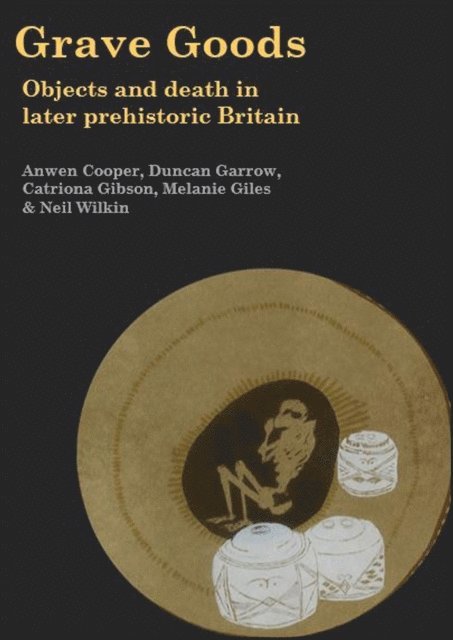
Britain is internationally renowned for the high quality and exquisite crafting of its later prehistoric grave goods (c. 4000 BC to AD 43). Many of prehistoric Britain''s most impressive artefacts have come from graves. Interred with both inhumations and cremations, they provide some of the most durable and well-preserved insights into personal identity and the prehistoric life-course, yet they also speak of the care shown to the dead by the living, and of people’s relationships with ''things''. Objects matter.This book''s title is an intentional play on words. These are objects in burials; but they are also goods, material culture, that must be taken seriously. Within it, we outline the results of the first long-term, large-scale investigation into grave goods during this period, which enables a new level of understanding of mortuary practice and material culture throughout this major period of technological innovation and social transformation. Analysis is structured at a series of different scales, ranging from macro-scale patterning across Britain, to regional explorations of continuity and change, to site-specific histories of practice, to micro-scale analysis of specific graves and the individual objects (and people) within them. We bring these different scales of analysis together in the first ever book focusing specifically on objects and death in later prehistoric Britain.Focusing on six key case study regions, the book innovatively synthesises antiquarian reports, research projects and developer funded excavations. At the same time, it also engages with, and develops, a number of recent theoretical trends within archaeology, including personhood, object biography and materiality, ensuring that it will be of relevance right across the discipline. Its subject matter will also resonate with those working in anthropology, sociology, museology and other areas where death, burial and the role of material culture in people’s lives are key contemporary issues.
E-bok
PDF, Engelska, 2010321 kr
Läs direkt efter köp
This book focuses on the relationship between the disciplines of archaeology and anthropology. Both disciplines arose from a common project: a desire to understand human social and cultural diversity. However, in recent years, archaeologys interest in anthropology has remained largely unreciprocated. To date, the causes and consequences of this imbalance have received little attention, particularly within anthropology. Including papers by eminent thinkers within both disciplines, this book sheds new light on issues of disciplinary identity. The contributors show how a lack of collaboration has resulted in a narrowing of horizons within both disciplines and explore the grounds upon which these might be opened up. The papers draw on a range of theoretical perspectives and empirical case-studies, but are unified in their concern to explore the ideological, practical and methodological commitments that mark each discipline as distinct. Ultimately, the volume arrives at the startling conclusion that archaeologys apparent absence of data may actually be a positive attribute, leading to a distinctive approach from which anthropology can learn.