Gérard Ligozat – författare
Visar alla böcker från författaren Gérard Ligozat. Handla med fri frakt och snabb leverans.
5 produkter
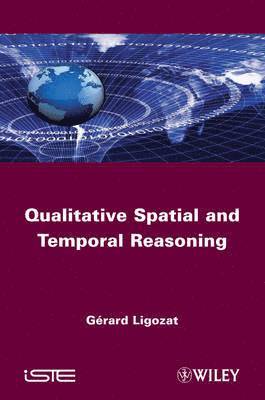
Qualitative Spatial and Temporal Reasoning
Inbunden, 2011
2736 kr
Lägg i varukorg
Starting with an updated description of Allen's calculus, the book proceeds with a description of the main qualitative calculi which have been developed over the last two decades. It describes the connection of complexity issues to geometric properties. Models of the formalisms are described using …
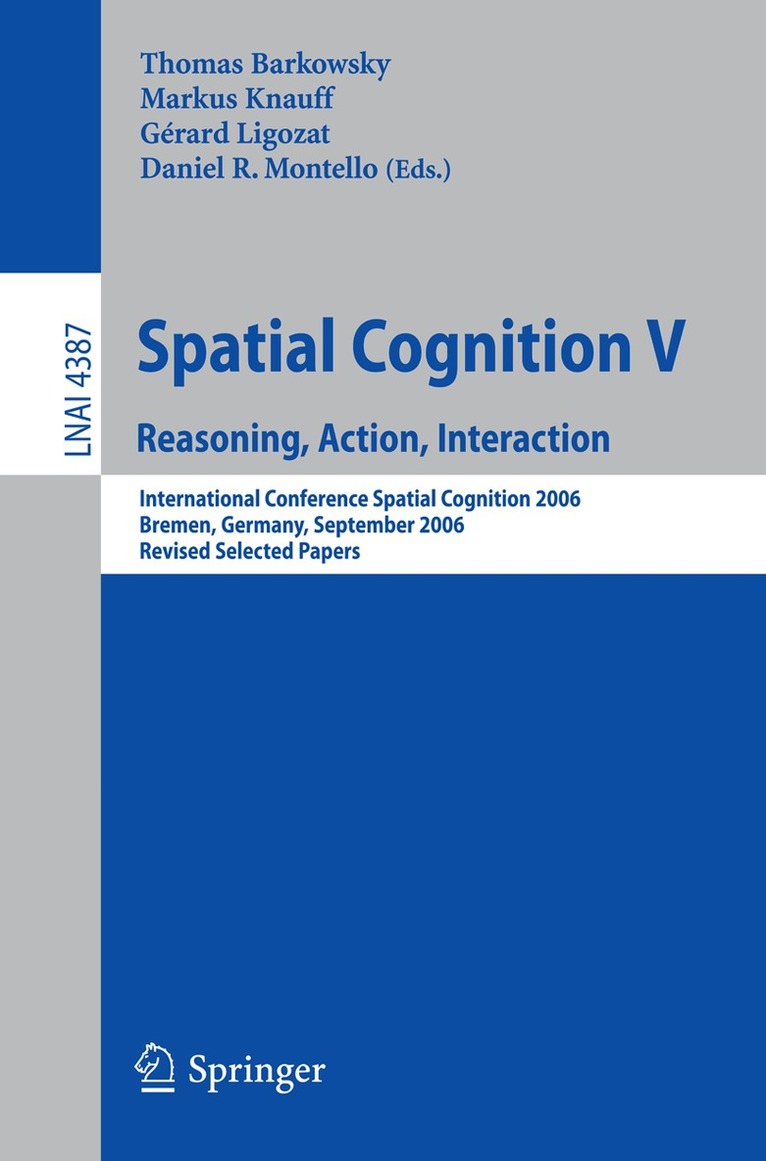
Spatial Cognition V
Reasoning, Action, Interaction
Av Thomas Barkowsky, Markus Knauff m. fl.
Häftad, 2007
569 kr
Lägg i varukorg
This is the fifth volume in a series of book publications featuring basic interdisciplinary research in spatial cognition. The study of spatial cognition is the study of knowledge about spatial properties of objects and events in the world. Spatial properties include location, size, distance, …
Spatial Cognition V
Reasoning, Action, Interaction
Av Daniel R. Montello, Gerard Ligozat m. fl.
E-bok, 2007
734 kr
Lägg i varukorg
This is the fifth volume in a series of book publications featuring basic interdisciplinary research in spatial cognition. The study of spatial cognition is the study of knowledge about spatial properties of objects and events in the world. Spatial properties include location, size, distance, …
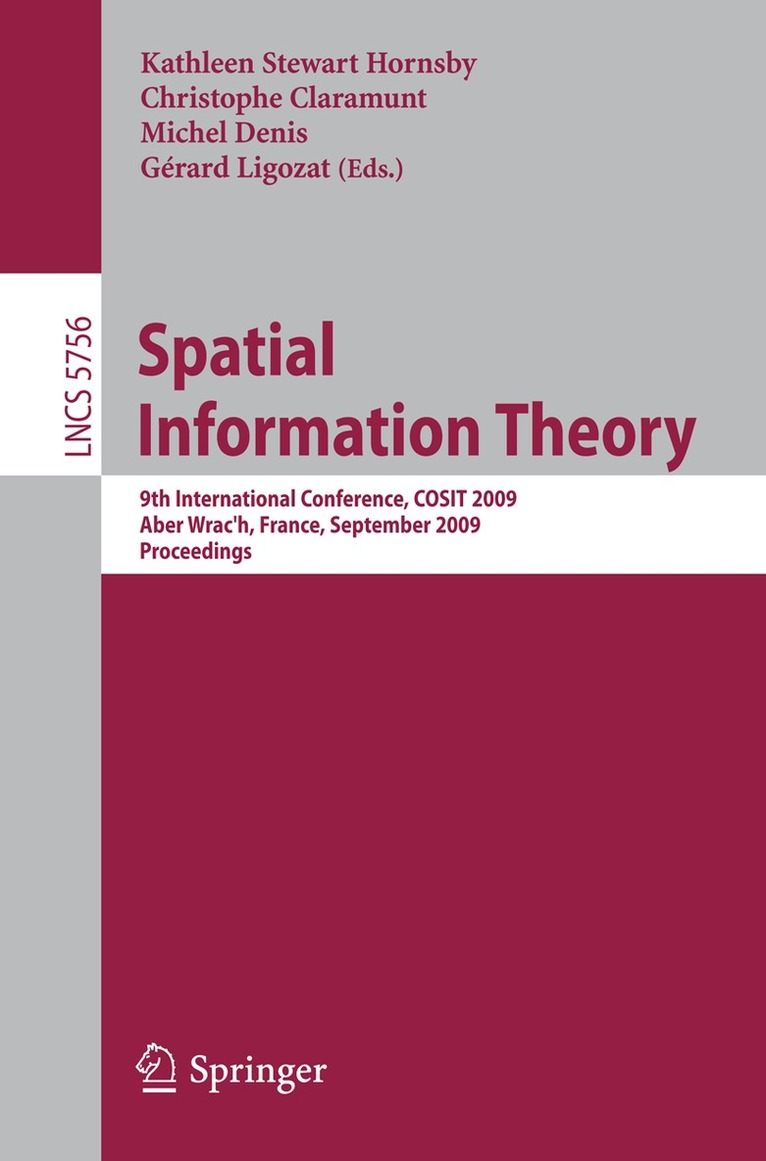
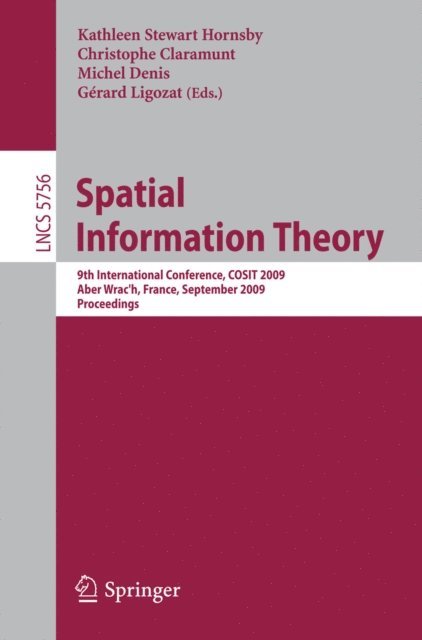
Spatial Information Theory
9th International Conference, COSIT 2009, Aber Wrac'h, France, September 21-25, 2009, Proceedings
Av Kathleen Stewart Hornsby, Christophe Claramunt m. fl.
Häftad, 2009
552 kr
Lägg i varukorg
First established in 1993 with a conference in Elba, Italy, COSIT (the International C- ference on Spatial Information Theory) is widely acknowledged as one of the most - portant conferences for the field of spatial information theory. This conference series brings together researchers from a wide …
Spatial Information Theory
9th International Conference, COSIT 2009, Aber Wrac''h, France, September 21-25, 2009, Proceedings
Av Gerard Ligozat, Michel Denis m. fl.
E-bok, 2009
739 kr
Lägg i varukorg
First established in 1993 with a conference in Elba, Italy, COSIT (the International C- ference on Spatial Information Theory) is widely acknowledged as one of the most - portant conferences for the field of spatial information theory. This conference series brings together researchers from a wide …