Giosuè Lo Bosco - Böcker
Visar alla böcker från författaren Giosuè Lo Bosco. Handla med fri frakt och snabb leverans.
3 produkter
3 produkter
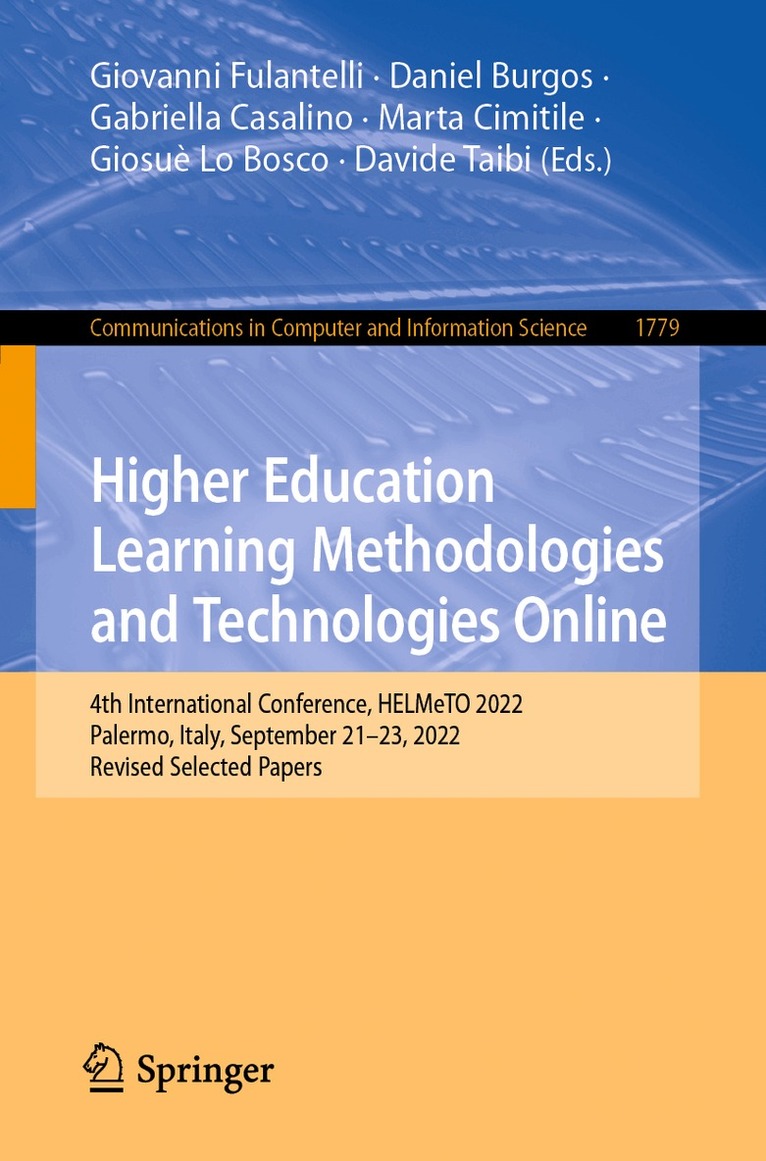
Higher Education Learning Methodologies and Technologies Online
4th International Conference, HELMeTO 2022, Palermo, Italy, September 21–23, 2022, Revised Selected Papers
Häftad, Engelska, 2023
1 034 kr
Skickas inom 10-15 vardagar
The papers present recent research on challenges of implementing emerging technology solution for online, online learning pedagogical frameworks, online learning technologies in practice, online learning strategies and resources, etc.
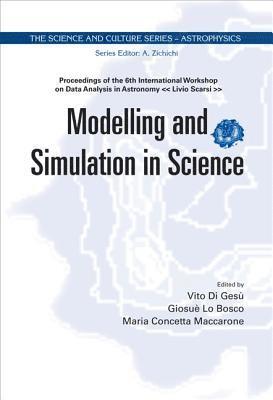
Modelling And Simulation In Science - Proceedings Of The 6th International Workshop On Data Analysis In Astronomy "Livio Scarsi"
Inbunden, Engelska, 2007
2 180 kr
Tillfälligt slut
This proceedings volume contains results presented at the Sixth International Workshop on Data Analysis in Astronomy — “Modeling and Simulation in Science” held on April 15-22, 2007, at the Ettore Majorana Foundation and Center for Scientific Culture, Erice, Italy. Recent progress and new trends in the field of simulation and modeling in three branches of science — astrophysics, biology, and climatology — are described in papers presented by outstanding scientists. The impact of new technologies on the design of novel data analysis systems and the interrelation among different fields are foremost in scientists' minds in the modern era. This book therefore focuses primarily on data analysis methodologies and techniques.
Science: Image In Action - Proceedings Of The 7th International Workshop On Data Analysis In Astronomy "Livio Scarsi And Vito Digesu"
Inbunden, Engelska, 2011
2 044 kr
Skickas inom 5-8 vardagar
The book gathers articles that were exposed during the seventh edition of the Workshop “Data Analysis in Astronomy”. It illustrates a current trend to search for common expressions or models transcending usual disciplines, possibly associated with some lack in the Mathematics required to model complex systems. In that, data analysis would be at the epicentre and a key facilitator of some current integrative phase of Science.It is all devoted to the question of “representation in Science”, whence its name, IMAGe IN AcTION, and main thrustsSuch a classification makes concepts as “complexity” or “dynamics” appear like transverse notions: a measure among others or a dimensional feature among others.Part A broadly discusses a dialogue between experiments and information, be information extracted-from or brought-to experiments. The concept is fundamental in statistics and tailors to the emergence of collective behaviours. Communication then asks for uncertainty considerations — noise, indeterminacy or approximation — and its wider impact on the couple perception-action. Clustering being all about uncertainty handling, data set representation appears not to be the only solution: Introducing hierarchies with adapted metrics, a priori pre-improving the data resolution are other methods in need of evaluation. The technology together with increasing semantics enables to involve synthetic data as simulation results for the multiplication of sources.Part B plays with another couple important for complex systems: state vs. transition. State-first descriptions would characterize physics, while transition-first would fit biology. That could stem from life producing dynamical systems in essence. Uncertainty joining causality here, geometry can bring answers: stable patterns in the state space involve constraints from some dynamics consistency. Stable patterns of activity characterize biological systems too. In the living world, the complexity — i.e. a global measure on both states and transitions — increases with consciousness: this might be a principle of evolution. Beside geometry or measures, operators and topology have supporters for reporting on dynamical systems. Eventually targeting universality, the category theory of topological thermodynamics is proposed as a foundation of dynamical system understanding.Part C details examples of actual data-system relations in regards to explicit applications and experiments. It shows how pure computer display and animation techniques link models and representations to “reality” in some “concrete” virtual, manner. Such techniques are inspired from artificial life, with no connection to physical, biological or physiological phenomena! The Virtual Observatory is the second illustration of the evidence that simulation helps Science not only in giving access to more flexible parameter variability, but also due to the associated data and method storing-capabilities. It fosters interoperability, statistics on bulky corpuses, efficient data mining possibly through the web etc. in short a reuse of resources in general, including novel ideas and competencies. Other examples deal more classically with inverse modelling and reconstruction, involving Bayesian techniques or chaos but also fractal and symmetry.