Gudela Grote – författare
Visar alla böcker från författaren Gudela Grote. Handla med fri frakt och snabb leverans.
4 produkter
4 produkter
Inbunden, Engelska, 2027
1 810 kr
Kommande
Uncertainty is a defining feature of organizational and human experience. The COVID-19 pandemic generated uncertainty on a global scale, while a decade earlier the global financial crisis increased uncertainty for people and markets across the world. In The Oxford Handbook of Uncertainty Management in Work Organizations, leading researchers in their respective research domains, ranging from creativity to strategy management, provide a comprehensive overview of the role of uncertainty in work organizations and examine how organizations, teams, and individuals approach and manage uncertainty. To date, uncertainty has primarily been studied as a powerful external force, driving organizational actors to adapt. The handbook extends this view by highlighting a more generative role of uncertainty, where organizational actors may even deliberately create uncertainty to spur learning and innovation. The chapters present new insights on the role of uncertainty in organizations and discusses topics such as the neuroscience of decision-making, workplace uncertainty and employee proactivity, the implications of uncertainty for fairness, uncertainty in human-AI interaction, and uncertainty in safety management. This handbook will help to answer pressing questions on how individuals, decision makers in organizations, and policy makers can confront and even take advantage of uncertainty.
Häftad, Engelska, 2012
1 083 kr
Skickas inom 10-15 vardagar
As I write, the financial systems of the world are collapsing with still no clear indication of what the consequences will be and which measures should be taken to avoid such a crisis in the future. There seems to be agreement though, that the financial instruments introduced in the past few decades entailed far too much complexity and uncertainty and that there was too little regulatory control over the use of these instruments. Management of uncertainty with the aim of achieving self-control is the core concern of this book. It was not written with a focus on financial systems, but many concepts developed in this book are applicable to this field as well. The - neric principles of reducing, maintaining or increasing uncertainties in view of the different contingencies an organization is faced with, the fundamental issue of how much control is possible and who should be in control, and the question of how much and what kind of regulation is necessary with the overall aim of finding an appropriate balance between system stability and flexibility are at the centre of heated debates on the future of finance.
Inbunden, Engelska, 2009
1 108 kr
Skickas inom 10-15 vardagar
As I write, the financial systems of the world are collapsing with still no clear indication of what the consequences will be and which measures should be taken to avoid such a crisis in the future. There seems to be agreement though, that the financial instruments introduced in the past few decades entailed far too much complexity and uncertainty and that there was too little regulatory control over the use of these instruments. Management of uncertainty with the aim of achieving self-control is the core concern of this book. It was not written with a focus on financial systems, but many concepts developed in this book are applicable to this field as well. The - neric principles of reducing, maintaining or increasing uncertainties in view of the different contingencies an organization is faced with, the fundamental issue of how much control is possible and who should be in control, and the question of how much and what kind of regulation is necessary with the overall aim of finding an appropriate balance between system stability and flexibility are at the centre of heated debates on the future of finance.
Häftad, Engelska, 2024
435 kr
Skickas inom 10-15 vardagar
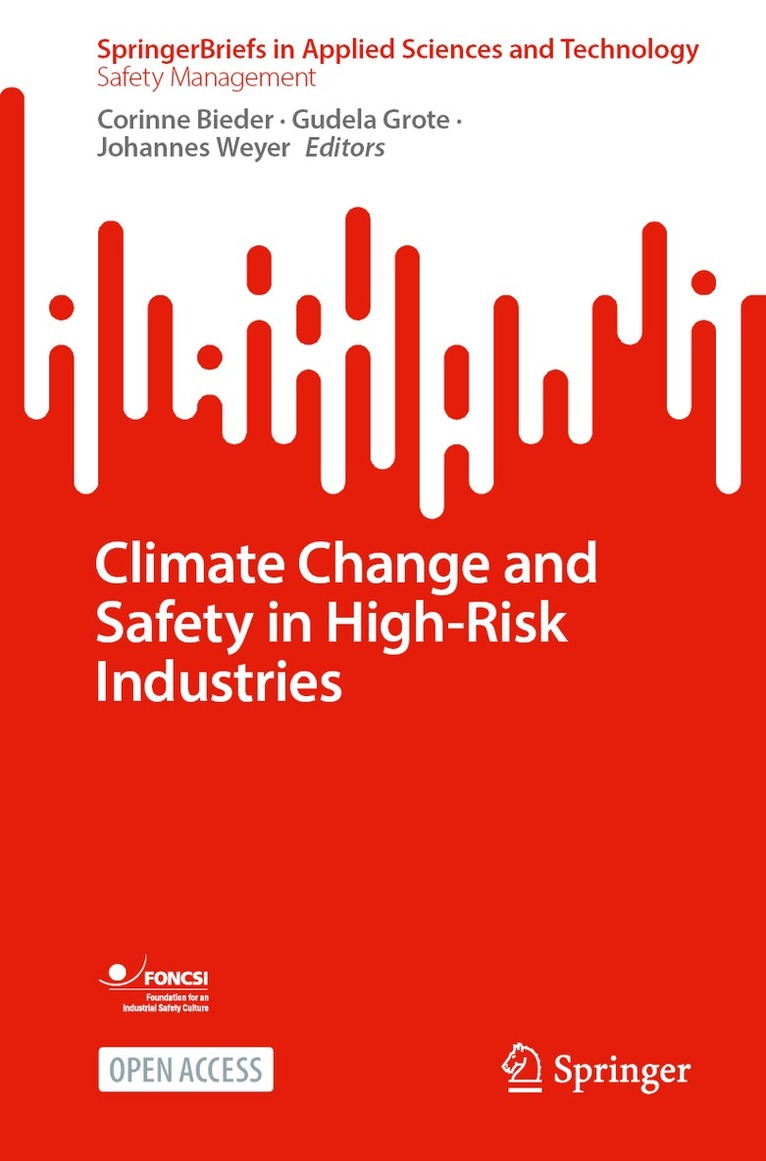
This open access book directs attention to the safety implications of disruptive, sustainability-driven changes in sociotechnical systems resulting from climate-change considerations in high-risk industries.