Guido Gainotti - Böcker
Visar alla böcker från författaren Guido Gainotti. Handla med fri frakt och snabb leverans.
4 produkter
4 produkter
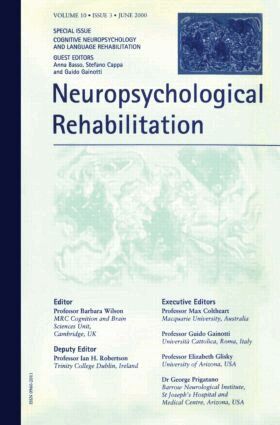
Cognitive Neuropsychology and Language Rehabilitation
A Special Issue of Neuropsychological Rehabilitation
Häftad, Engelska, 2002
635 kr
Skickas inom 10-15 vardagar
Even if, in recent years, the study of language disorders in brain-damaged patients has been strongly influenced by models and experimental paradigms of cognitive neuropsychology, much less relevant has been the impact of this new approach to language rehabilitation. Contrasting opinions exist on this subject among clinicians and researchers. Some authors maintain that cognitive neuropsychology has not changed and will not change the treatment of aphasia. Other authors adopt a less pessimistic attitude, either reporting empirical data that support this viewpoint, or trying to define more precisely theoretical models, patient's characteristics and treatment paradigms that should improve the efficacy of cognitively oriented treatments.The main scope of the present volume, which is mainly based upon contributions presented at a workshop on the relationships between cognitive neuropsychology and aphasia rehabilitation, is to make the point on this controversial issue. The volume includes several theoretical papers discussing the role of the cognitive approach in the development of language rehabilitation (Shallice; Basso & Marangolo; Best & Nickels), as well as specific examples of the application of cognitive models to the treatment of disorders of written language (Luzzatti, Colombo, Frustaci & Vitolo) and of sentence-level impairments (Springer & Huber; Mitchum, Berndt & Greenwald). Two review papers, dealing with the pragmatic approach to aphasia rehabilitation (Carlomagno, Santoro, Labruna & Blasi) and with neuroimaging studies of recovery (Cappa) complete the issue.The papers incorporate elements of the lively discussion, which took place among the restricted number of participants at the workshop, on a number of controversial issues. Leading among them were the fundamental questions: has cognitive neuropsychology given up to now a significant contribution to aphasia rehabilitation, and what can be expected in the future. We hope that the moderately optimistic view that emerged from the workshop will be shared by readers of this special issue.
551 kr
Skickas inom 10-15 vardagar
This book focuses on asymmetries in brain structure and their role in emotional functions (such as amygdala in emotional comprehension, the ventro-medial prefrontal cortex in the integration between cognition and emotion and in the control of emotional reactions, and the anterior insula in the experience of emotions).The idea of hemispheric asymmetries in emotional comprehension and expression was first proposed about a century after the first studies showing that the left hemisphere is dominant for language, but it quickly became very popular. Initial investigations considered the right and left hemispheres as single functional units, but in the last few years several researchers have focused attention on asymmetries in brain structures playing a critical role in specific components of emotional functions.Furthermore, interesting data have been obtained by studying emotional and behavioural disorders of patients with asymmetrical forms of frontal or temporal variants of fronto-temporal degeneration.Elaborating on these subjects requires, on the one hand, a consolidated understanding of how models concerning the relationships between emotions and hemispheric asymmetries evolved in time and, on the other hand, a sound interdisciplinary knowledge of psychology (nature, components and hierarchical organization of emotions) and neuroscience (neuroanatomy). This volume – intended for neurologists, neuroscientists and psychologists – pursues an organic and consistent approach to provide an overview of these complex and fascinating issues.
551 kr
Skickas inom 10-15 vardagar
This book focuses on asymmetries in brain structure and their role in emotional functions (such as amygdala in emotional comprehension, the ventro-medial prefrontal cortex in the integration between cognition and emotion and in the control of emotional reactions, and the anterior insula in the experience of emotions).The idea of hemispheric asymmetries in emotional comprehension and expression was first proposed about a century after the first studies showing that the left hemisphere is dominant for language, but it quickly became very popular. Initial investigations considered the right and left hemispheres as single functional units, but in the last few years several researchers have focused attention on asymmetries in brain structures playing a critical role in specific components of emotional functions.Furthermore, interesting data have been obtained by studying emotional and behavioural disorders of patients with asymmetrical forms of frontal or temporal variants of fronto-temporal degeneration.Elaborating on these subjects requires, on the one hand, a consolidated understanding of how models concerning the relationships between emotions and hemispheric asymmetries evolved in time and, on the other hand, a sound interdisciplinary knowledge of psychology (nature, components and hierarchical organization of emotions) and neuroscience (neuroanatomy). This volume – intended for neurologists, neuroscientists and psychologists – pursues an organic and consistent approach to provide an overview of these complex and fascinating issues.
1 577 kr
Skickas inom 10-15 vardagar
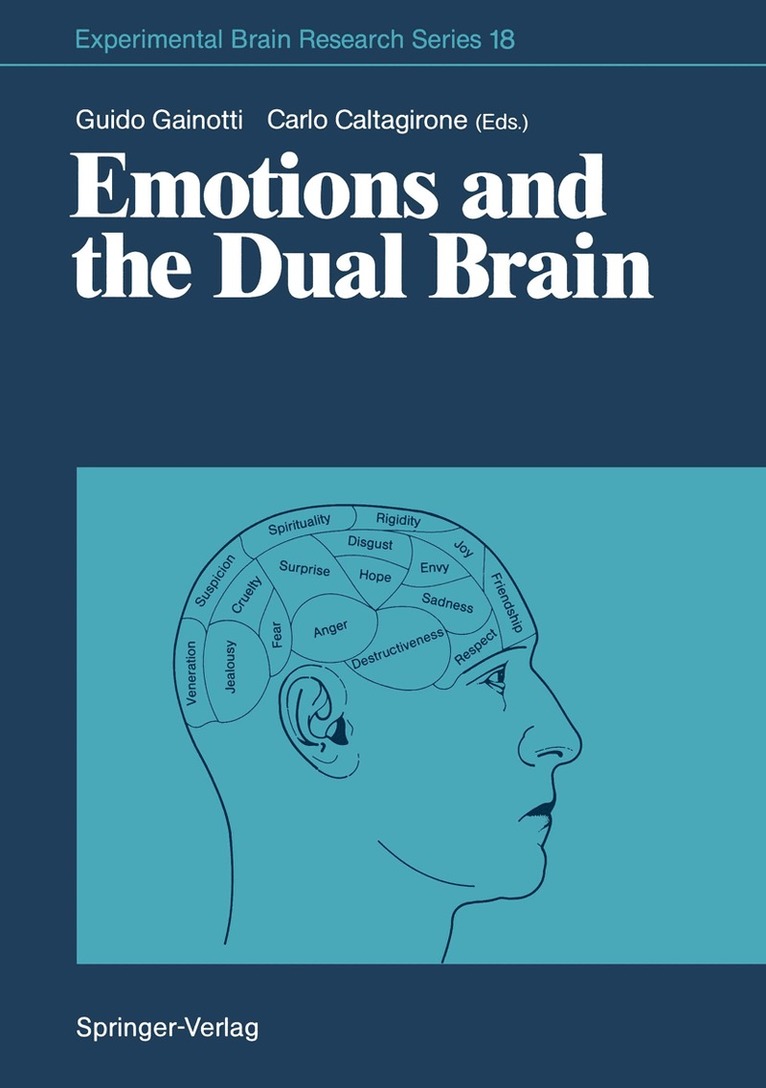
This book attempts to clarify a relatively new problem in the area of brain-behavior relationships, namely the link between emotions and hemispheric specialization. The contributions by leading specialists integrate theoretical models of emotions in normal subjects with results of experimental investigations conducted in patients with unilateral brain lesions. The communicative aspects of emotions and the inner experience of emotions as well as the concomitant autonomous changes are separately investigated and discussed.