Gulf Research Program – författare
Visar alla böcker från författaren Gulf Research Program. Handla med fri frakt och snabb leverans.
12 produkter
12 produkter
Häftad, Engelska, 2021
605 kr
Skickas inom 3-6 vardagar
More than a decade after the Deepwater Horizon disaster, the Gulf Research Program convened a diverse group of 60 experts in a virtual event to inform its efforts to enhance resilience to future offshore oil disasters in the Gulf of Mexico region. The event, Offshore Situation Room, took place over three half-days during June 15-17, 2021, and had four main objectives: 1) develop a concise, prioritized list of questions that need to be addressed to support successful prevention, response, and recovery that would minimize the impacts of an offshore oil disaster; 2) provide a collaborative atmosphere where participants can share ideas, capabilities, and information, and build a community dedicated to the successful prevention of, response to, and recovery from an offshore oil spill disaster; 3) explore capabilities for and impediments to prevention, response, recovery, and understanding impacts of an offshore oil disaster in the Gulf of Mexico; and 4) highlight how changes in policy, response, resilience, and restoration efforts may affect outcomes of a major offshore incident. This publication summarizes the presentations and discussion of the event.
Häftad, Engelska, 2015
694 kr
Skickas inom 3-6 vardagar
There are many connections between human communities and their surrounding environments that influence community resilience and health in the Gulf of Mexico. The impacts of the Deepwater Horizon oil spill on Gulf communities and ecosystems - coupled with the region's preexisting health challenges and environmental stressors - illustrate the need to better understand these connections. In the future, natural and man-made disasters, climate change impacts, and other environmental stressors will present complex challenges to the physical, mental, and social well-being of communities in the Gulf. Understanding the interrelationships among health, ecological, and economic impacts of disasters and other environmental stressors will be crucial to addressing these challenges. Opportunities for the Gulf Research Program: Community Resilience and Health summarizes a Gulf Research Program workshop held on September 22-23, 2014, in New Orleans, Louisiana. The workshop examined opportunities to improve the health, well-being, and resilience of communities in the Gulf region through discussions with about 50 participants with diverse expertise and experience.These discussions identified perceived needs, challenges, and opportunities that align with the Gulf Research Program's mission and goals - particularly its goal to improve understanding of the connections between human health and the environment to support the development of health and resilient Gulf communities. This workshop is expected to lead to the development of additional Program activities and opportunities for the research community.
Häftad, Engelska, 2024
305 kr
Skickas
Experiencing a single disaster - a hurricane, tornado, flood, severe winter storm, or a global pandemic - can wreak havoc on the lives and livelihoods of individuals, families, communities and entire regions. For many people who live in communities in the U.S. Gulf of Mexico region, the reality of disaster is starker. Endemic socioeconomic and health disparities have made many living in Gulf of Mexico communities particularly vulnerable to the effects of weather-climate hazards. Prolonged disaster recovery and increasing disaster risk is an enduring reality for many living in Gulf of Mexico communities. Between 2020 and 2021, seven major hurricanes and a severe winter storm affected communities across the region. As a backdrop to these acute weather events, the global COVID-19 pandemic was unfolding, producing a complex and unprecedented public health and socioeconomic crisis.Traditionally, the impacts of disasters are quantified individually and often in economic terms of property damage and loss. In this case, each of these major events occurring in the Gulf of Mexico during this time period subsequently earned the moniker of "billion-dollar" disaster. However, this characterization does not reflect the non-financial human toll and disparate effects caused by multiple disruptive events that increase underlying physical and social vulnerabilities, reduce adaptive capacities and ultimately make communities more sensitive to the effects of future disruptive events. This report explores the interconnections, impacts, and lessons learned of compounding disasters that impair resilience, response, and recovery efforts. While Compounding Disasters in Gulf Coast Communities, 2020-2021 focuses on the Gulf of Mexico region, its findings apply to any region that has similar vulnerabilities and that is frequently at risk for disasters.
Häftad, Engelska, 2022
374 kr
Tillfälligt slut
Valued for its ecological richness and economic value, the U.S. Gulf of Mexico is under substantial pressure from human activities. The Deepwater Horizon platform explosion and oil spill significantly damaged Gulf ecosystems and led to the largest ecological restoration investment in history. The unprecedented number and diversity of restoration activities provide valuable information for future restoration efforts, but assessment efforts are hampered by many factors, including the need to evaluate the interaction of multiple stressors and consider long-term environmental trends such as sea level rise, increasing hurricane intensity, and rising water temperatures.This report offers a comprehensive approach to assess restoration activities beyond the project scale in the face of a changing environment. A main component of this approach is using different types of scientific evidence to develop "multiple lines of evidence" to evaluate restoration efforts at regional scales and beyond, especially for projects that may be mutually reinforcing (synergistic) or in conflict (antagonistic). Because Gulf of Mexico ecosystems cross political boundaries, increased coordination and collaboration is needed, especially to develop standardized data collection, analysis, synthesis, and reporting. With these improvements, program-level adaptive management approaches can be used more effectively to assess restoration strategies against the backdrop of long-term environmental trends.
Häftad, Engelska, 2014
180 kr
Tillfälligt slut
In 2010 the Deepwater Horizon explosion and fire in the Gulf of Mexico caused the largest offshore oil spill in U.S. history, resulting in significant impacts on the region\'s environment and residents. Legal settlements with the companies held responsible led the federal government to ask the National Academy of Sciences to form and administer a 30-year program to enhance oil system safety, human health, and environmental resources in the Gulf of Mexico and other U.S. continental shelf areas where offshore oil and gas exploration and production occur or are under consideration. The new Gulf Research Program will receive $500 million to support activities using three broad approaches: research and development, education and training, and environmental monitoring. The Gulf Research Program: A Strategic Vision establishes the Program\'s foundation and introduces its mission, goals, and objectives. It describes some initial activities and sets out the Program\'s vision for contributing lasting benefit to the Gulf region and the nation. The Program is an extraordinary opportunity to foster science on a regional scale and over the long term.The document will be of interest to scientists, health professionals, engineers, and educators who wish to learn about, collaborate with, and submit proposals to the Program, and to all those who share the goal of enhancing resilience in areas where offshore energy production, vibrant communities, and dynamic ecosystems coexist.
Häftad, Engelska, 2014
248 kr
Tillfälligt slut
During the period 1990 to 2010, U.S. job growth occurred primarily in the high-skilled and low-skilled sectors. Yet, one-third of projected job growth for the period 2010-2020 will require middle-skilled workers -- who will earn strong middle-class wages and salaries -- important to both the production and consumption components of our economy. These jobs typically require significant training, often requiring more than a high school diploma but less than a baccalaureate degree. In the Gulf of Mexico, middle skilled workers play key roles in maintaining oil system safety, completing the numerous environmental restoration projects needed along the Gulf coast, and as workers in an integrated and resilient public health system. Educational pathways that lead to middle skilled jobs in these areas include: apprenticeship programs offered by schools, unions, and employers; high school career and technical education programs; community college courses, certificates, and associate degrees; and employer provided training. Opportunities for the Gulf Research Program: Middle-Skilled Workforce Needs is the summary of a workshop held on June 9-10, 2014 in Tampa, Florida.This workshop convened 40 thought leaders from the Gulf region's education, employer, and policymaking communities to facilitate a discussion of the current state of education and training pathways for preparing the region\'s middle-skilled workforce in both the short- and long-term and to identify perceived needs and potential opportunities that might be addressed by the GRP. Workshop participants discussed a variety of opportunities around building capacity in the region's middle-skilled workforce, including the need for competency-based education and training approaches and stronger partnerships among the region's employers and institutions of higher education.
Häftad, Engelska, 2015
351 kr
Tillfälligt slut
Environmental monitoring in the Gulf of Mexico poses extensive challenges and significant opportunities. Multiple jurisdictions manage this biogeographically and culturally diverse region, whose monitoring programs tend to be project-specific by design and funding. As a result, these programs form more of a monitoring patchwork then a network. At the same time, the Gulf monitoring community faces a unique opportunity to organize and think differently about monitoring - including how best to allocate and manage the resources for this large marine ecosystem and its communities - as a result of the infusion of resources for environmental restoration and related activities after the Deepwater Horizon oil spill. Opportunities for the Gulf Research Program: Monitoring Ecosystem Restoration and Deep Water Environments summarizes a Gulf Research Program workshop held on September 3-4, 2014 in New Orleans, Louisiana.The workshop gathered about 40 participants from the energy industry, state and federal government, academia, and nongovernmental organizations to examine two broad issues that were seen as time-sensitive opportunities in light of significant investments in the Gulf for restoration and accelerating development of energy resources in the deep Gulf: monitoring ecosystem restoration and deep water environments. As participants explored potential opportunities for the Program to consider, they noted the essential role that communication and outreach play in successful monitoring, and the importance of applying an ecosystem service approach to monitoring, forging partnerships among stakeholders, and supporting efforts to organize and manage monitoring data.
Häftad, Engelska, 2018
534 kr
Tillfälligt slut
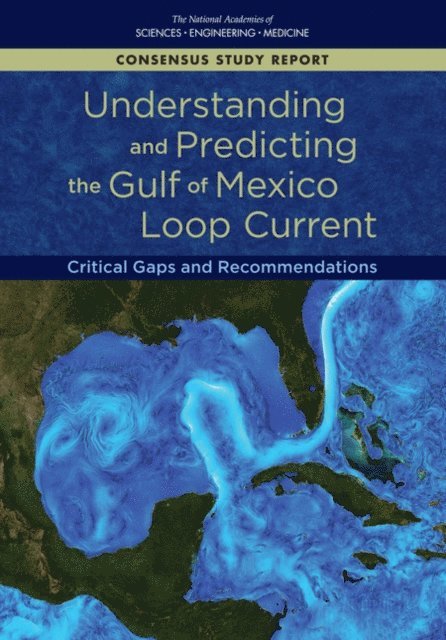
One of the most significant, energetic, yet not well understood, oceanographic features in the Americas is the Gulf of Mexico Loop Current System (LCS), consisting of the Loop Current (LC) and the Loop Current Eddies (LCEs) it sheds. Understanding the dynamics of the LCS is fundamental to understanding the Gulf of Mexico's full oceanographic system, and vice versa. Hurricane intensity, offshore safety, harmful algal blooms, oil spill response, the entire Gulf food chain, shallow water nutrient supply, the fishing industry, tourism, and the Gulf Coast economy are all affected by the position, strength, and structure of the LC and associated eddies. This report recommends a strategy for addressing the key gaps in general understanding of LCS processes, in order to instigate a significant improvement in predicting LC/LCE position, evolving structure, extent, and speed, which will increase overall understanding of Gulf of Mexico circulation and to promote safe oil and gas operations and disaster response in the Gulf of Mexico. This strategy includes advice on how to design a long-term observational campaign and complementary data assimilation and numerical modeling efforts.
Häftad, Engelska, 2023
225 kr
Tillfälligt slut
Most of the offshore oil and gas industry in the Gulf of Mexico has shown considerable improvement in systemic risk management, which is now approaching a middle stage of maturity across most risk elements. Advancing Understanding of Offshore Oil and Gas Systemic Risk in the U.S. Gulf of Mexico: Current State and Safety Reforms Since the Macondo Well–Deepwater Horizon Blowout assesses both industry and regulatory progress against the reforms that were recommended following the Deepwater Horizon disaster in 2010. The report also states that progress has been uneven, and critical gaps remain in comprehensively addressing the management of systemic risk offshore.
Häftad, Engelska, 2023
220 kr
Tillfälligt slut
Consequences of natural disasters and the COVID-19 pandemic have taken a cumulative toll on the health and well-being of people in the Gulf of Mexico region. Long-standing societal challenges related to racism, poverty, education, housing, and underemployment are compounding the trauma, leading to chronic stress for many Gulf residents. The Committee on Progress Toward Human Health and Community Resilience in the Gulf of Mexico Region new report, Advancing Health and Community Resilience in the Gulf of Mexico Region: A Roadmap for Progress, explores key challenges and priorities in Gulf states, including Alabama, Florida, Louisiana, Mississippi, and Texas and evaluates recent progress. The report also makes recommendations for closing critical gaps and implementing transformative approaches that focus on the diverse needs and experiences of people who live and work in the Gulf region.
Häftad, Engelska, 2023
208 kr
Tillfälligt slut
Today, with a changing climate putting pressure on communities and ecosystems worldwide, goals for a carbon-neutral economy mean that renewable and low-carbon energy sources are being presented as solutions. While these cleaner energy sources have the potential to reduce risk to the environment and bring energy security closer to a reality, questions remain about the stability of the energy supply chain, the ability to meet energy demand reliably, and the best ways to produce fair and equitable outcomes in an energy transition.To serve as a catalyst for developing new insights and coordination around the energy transition, the Gulf Research Program at the National Academies of Sciences, Engineering, and Medicine convened a 2-day workshop in Washington, DC, called Navigating the Energy Transition in the Gulf of Mexico. Based around two scenarios in the year 2050 - one in which a carbon neutral economy is achieved and another in which robust dependence on fossil fuels remains - this serious gaming event stimulated the sharing of ideas, concerns, and cascading impacts from participants across academia, industry, government, and Gulf communities. This publication summarizes the activities, presentations, and discussion of the workshop.
Häftad, Engelska, 2025
259 kr
Tillfälligt slut
The Gulf of Alaska and the Southern Gulf Coast have been the sites of the two worst oil spills in U.S. history, Exxon Valdez (1989) and Deepwater Horizon (2010), respectively. These spills had devastating impacts on the environment, human health, the local economy, the seafood industry, and local communities' way of life. While the incidents differed in many ways, the response and recovery efforts both worked to restore the environment and help communities move on from their losses.To explore best practices and lessons learned from these oil spills, the National Academies of Sciences, Engineering, and Medicine's Gulf Research Program launched a three-part workshop series to bring together people with connections to the Exxon Valdez and Deepwater Horizon oil spills to discuss the challenges, successes, and areas where improvements could be made. The first workshop was held in Anchorage, Alaska in October 2024; the second workshop was held in Thibodaux, Louisiana in December 2024; and the final workshop was held in Washington, D.C. in March of 2025. This publication summarizes the presentations and discussions of the workshops.