Guy Pujolle – författare
1 084 kr
Skickas inom 10-15 vardagar
1 367 kr
Läs direkt efter köp
Mobile and Wireless Communication Networks
IFIP 19th World Computer Congress, TC-6, 8th IFIP/IEEE Conference on Mobile and Wireless Communications Networks, August 20-25, 2006, Santiago, Chile
1 116 kr
Skickas inom 10-15 vardagar
1 459 kr
Läs direkt efter köp
This volume presents proceedings from the 19th IFIP World Computer Congress in Santiago, Chile. The proceedings of the World Computer Congress are a product of the gathering of 2,000 delegates from more than 70 countries to discuss a myriad of topics in the ICT domain. Of particular note, this marks the first time that a World Computer Congress has been held in a Latin American country.
Topics in this series include:
- The 4th International Conference on Theoretical Computer Science
- Education for the 21st Century- Impact of ICT and Digital Resources
- Mobile and Wireless Communication Networks
- Ad-Hoc Networking
- Network Control and Engineering for QoS, Security, and Mobility
- The Past and Future of Information Systems: 1976-2006 and Beyond
- History of Computing and Education
- Biologically Inspired Cooperative Computing
- Artificial Intelligence in Theory and Practice
- Applications in Artificial Intelligence
- Advanced Software Engineering: Expanding the Frontiers of Software
2 741 kr
Läs direkt efter köp
1 416 kr
Läs direkt efter köp
Service and network providers must be able to satisfy the demands for new services, improve the quality of service, reduce the cost of network service operations and maintenance, control performance and adapt to user demands. These challenges are so important for the future of our communication environment that it is essential to investigate different approaches for controlling and optimizing network resources.
Network Control and Engineering for QoS, Security and Mobility II addresses the problem of network control and engineering with a focus on control of quality of service, management of security, and supervision of mobility. New trends in these different fields are also investigated.
This volume contains the proceedings of the Second International Conference on NETwork CONtrol and Engineering (NETCON) for Quality of Service, Security and Mobility, which convened in Oman in October 2003. The conference was sponsored by the International Federation for Information Processing (IFIP) and organized by IFIP''s Working Groups 6.2 on Network and Internetwork Architecture, 6.6 on Network Management, and 6.7 on Smart Networks.
1 116 kr
Skickas inom 10-15 vardagar
1 459 kr
Läs direkt efter köp
The Home Networking Conference 2007 provided an international technical forum for experts from industry and academia globally to exchange ideas and present results of ongoing research in home networking.
The IFIP series publishes state-of-the-art results in the sciences and technologies of information and communication. The scope of the series includes: foundations of computer science; software theory and practice; education; computer applications in technology; communication systems; systems modeling and optimization; information systems; computers and society; computer systems technology; security and protection in information processing systems; artificial intelligence; and human-computer interaction. Proceedings and post-proceedings of refereed international conferences in computer science and interdisciplinary fields are featured. These results often precede journal publication and represent the most current research.
2 161 kr
Skickas inom 10-15 vardagar
4 983 kr
Läs direkt efter köp
2 199 kr
Läs direkt efter köp
The first chapter of this title concerns virtualization techniques that allow sharing computational resources basically, slicing a real computational environment into virtual computational environments that are isolated from one another. The Xen and OpenFlow virtualization platforms are then presented in Chapter 2 and a performance analysis of both is provided. This chapter also defines the primitives that the network virtualization infrastructure must provide for allowing the piloting plane to manage virtual network elements. Following this, interfaces for system management of the two platforms are proposed in Chapter 3. To control and manage virtual network elements, five primitives that the network virtualization infrastructure must provide are defined: instantiate, delete, migrate, monitor and set. The book then moves on to survey existing control algorithms for virtual networking. It also describes the main challenges for packet forwarding using Xen as a virtualization tool and describes, in more detail, a proposal for local control of virtual networks. Within each physical node, this proposal guarantees the service level acquired by each virtual network, even in the presence of misbehaving virtual networks.
Contents
1. Virtualization, Luís Henrique M.K. Costa. 2. Virtual Network Interfaces, Miguel Elias M. Campista. 3. Performance Improvement and Control of Virtual Network Elements, Igor M. Moraes. 4. State of the Art in Context-Aware Technologies, Edmundo R.M. Madeira and Guy Pujolle. 5. Providing Isolation and Quality-of-Service to Virtual Networks, Miguel Elias M. Campista. 6. Piloting System, Edmundo R.M. Madeira and Nelson Luis S. Da Fonseca. 7. Management and Control: The Situated View, Otto Carlos M.B. Duarte. 8. System Architecture Design, Otto Carlos M.B. Duarte.
About the Authors
Otto Carlos M.B. Duarte is Full Professor at Universidade Federal do Rio de Janeiro in Brazil, where he has worked since 1978. His research interests include mobile communications, security, multicast, and QoS guarantees. Guy Pujolle is currently Professor at University Pierre and Marie Curie (Paris VI) in France and a member of the Scientific Advisory Board of Orange/France Telecom Group. He has published widely in the area of computer systems modeling and performance, queuing theory, high-speed networks, intelligence in networking, wireless networks, and Post-IP networks, including 19 influential texts and monographs in these areas.
2 199 kr
Läs direkt efter köp
The first chapter of this title concerns virtualization techniques that allow sharing computational resources basically, slicing a real computational environment into virtual computational environments that are isolated from one another. The Xen and OpenFlow virtualization platforms are then presented in Chapter 2 and a performance analysis of both is provided. This chapter also defines the primitives that the network virtualization infrastructure must provide for allowing the piloting plane to manage virtual network elements. Following this, interfaces for system management of the two platforms are proposed in Chapter 3. To control and manage virtual network elements, five primitives that the network virtualization infrastructure must provide are defined: instantiate, delete, migrate, monitor and set. The book then moves on to survey existing control algorithms for virtual networking. It also describes the main challenges for packet forwarding using Xen as a virtualization tool and describes, in more detail, a proposal for local control of virtual networks. Within each physical node, this proposal guarantees the service level acquired by each virtual network, even in the presence of misbehaving virtual networks.
Contents
1. Virtualization, Luís Henrique M.K. Costa. 2. Virtual Network Interfaces, Miguel Elias M. Campista. 3. Performance Improvement and Control of Virtual Network Elements, Igor M. Moraes. 4. State of the Art in Context-Aware Technologies, Edmundo R.M. Madeira and Guy Pujolle. 5. Providing Isolation and Quality-of-Service to Virtual Networks, Miguel Elias M. Campista. 6. Piloting System, Edmundo R.M. Madeira and Nelson Luis S. Da Fonseca. 7. Management and Control: The Situated View, Otto Carlos M.B. Duarte. 8. System Architecture Design, Otto Carlos M.B. Duarte.
About the Authors
Otto Carlos M.B. Duarte is Full Professor at Universidade Federal do Rio de Janeiro in Brazil, where he has worked since 1978. His research interests include mobile communications, security, multicast, and QoS guarantees. Guy Pujolle is currently Professor at University Pierre and Marie Curie (Paris VI) in France and a member of the Scientific Advisory Board of Orange/France Telecom Group. He has published widely in the area of computer systems modeling and performance, queuing theory, high-speed networks, intelligence in networking, wireless networks, and Post-IP networks, including 19 influential texts and monographs in these areas.
4 983 kr
Läs direkt efter köp
2 325 kr
Läs direkt efter köp
This book presents the state of the art in the field of mobile and wireless networks, and anticipates the arrival of new standards and architectures. It focuses on wireless networks, starting with small personal area networks and progressing onto the very large cells of wireless regional area networks, via local area networks dominated by WiFi technology, and finally metropolitan networks. After a description of the existing 2G and 3G standards, with LTE being the latest release, LTE-A is addressed, which is the first 4G release, and a first indication of 5G is provided as seen through the standardizing bodies. 4G technology is described in detail along with the different LTE extensions related to the massive arrival of femtocells, the increase to a 1 Gbps capacity, and relay techniques. 5G is also discussed in order to show what can be expected in the near future.
The Internet of Things is explained in a specific chapter due to its omnipresence in the literature, ad hoc and mesh networks form another important chapter as they have made a comeback after a long period of near hibernation, and the final chapter discusses a particularly recent topic: Mobile-Edge Computing (MEC) servers.
2 325 kr
Läs direkt efter köp
This book presents the state of the art in the field of mobile and wireless networks, and anticipates the arrival of new standards and architectures. It focuses on wireless networks, starting with small personal area networks and progressing onto the very large cells of wireless regional area networks, via local area networks dominated by WiFi technology, and finally metropolitan networks. After a description of the existing 2G and 3G standards, with LTE being the latest release, LTE-A is addressed, which is the first 4G release, and a first indication of 5G is provided as seen through the standardizing bodies. 4G technology is described in detail along with the different LTE extensions related to the massive arrival of femtocells, the increase to a 1 Gbps capacity, and relay techniques. 5G is also discussed in order to show what can be expected in the near future.
The Internet of Things is explained in a specific chapter due to its omnipresence in the literature, ad hoc and mesh networks form another important chapter as they have made a comeback after a long period of near hibernation, and the final chapter discusses a particularly recent topic: Mobile-Edge Computing (MEC) servers.
2 199 kr
Läs direkt efter köp
The goal of this book is to describe new concepts for Internet next generation. This architecture is based on virtual networking using Cloud and datacenters facilities. Main problems concern 1) the placement of virtual resources for opening a new network on the fly, and 2) the urbanisation of virtual resource implemented on physical network equipment. This architecture deals with mechanisms capable of controlling automatically the placement of all virtual resources within the physical network.
In this book, we describe how to create and delete virtual networks on the fly. Indeed, the system is able to create any new network with any kind of resource (e.g., virtual switch, virtual routers, virtual LSRs, virtual optical path, virtual firewall, virtual SIP-based servers, virtual devices, virtual servers, virtual access points, and so on). We will show how this architecture is compatible with new advances in SDN (Software Defined Networking), new high-speed transport protocol like TRILL (Transparent Interconnection of Lots of Links) and LISP (Locator/Identifier Separation Protocol), NGN, IMS, Wi-Fi new generation, and 4G/5G networks. Finally, we introduce the Cloud of security and the virtualisation of secure elements (smartcard) that should definitely transform how to secure the Internet.
2 199 kr
Läs direkt efter köp
The goal of this book is to describe new concepts for Internet next generation. This architecture is based on virtual networking using Cloud and datacenters facilities. Main problems concern 1) the placement of virtual resources for opening a new network on the fly, and 2) the urbanisation of virtual resource implemented on physical network equipment. This architecture deals with mechanisms capable of controlling automatically the placement of all virtual resources within the physical network.
In this book, we describe how to create and delete virtual networks on the fly. Indeed, the system is able to create any new network with any kind of resource (e.g., virtual switch, virtual routers, virtual LSRs, virtual optical path, virtual firewall, virtual SIP-based servers, virtual devices, virtual servers, virtual access points, and so on). We will show how this architecture is compatible with new advances in SDN (Software Defined Networking), new high-speed transport protocol like TRILL (Transparent Interconnection of Lots of Links) and LISP (Locator/Identifier Separation Protocol), NGN, IMS, Wi-Fi new generation, and 4G/5G networks. Finally, we introduce the Cloud of security and the virtualisation of secure elements (smartcard) that should definitely transform how to secure the Internet.
2 199 kr
Läs direkt efter köp
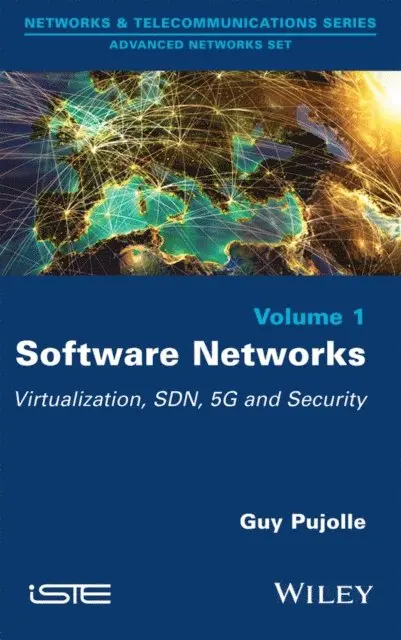
Software Networks describe new concepts for the Internet�s next generation. This architecture is based on virtual networking using Cloud and datacenter facilities. The main problems to be dealt with are the placement of virtual resources for opening a new network on the fly, and the urbanization of virtual resources implemented on physical network equipment. The digital architecture also deals with mechanisms capable of automatically controlling the placement of all virtual resources within the physical network.
This book describes how to create and delete virtual networks on the fly. Indeed, the system is able to create any new network with any kind of virtual resource (e.g. switches, routers, LSRs, optical paths, firewalls, SIP-based servers, devices, servers, access points, etc.). Software Networks shows how this architecture is compatible with new advances in SDN (Software Defined Networking), new high-speed transport protocols such as TRILL (Transparent Interconnection of Lots of Links) and LISP (Locator/Identifier Separation Protocol), NGN, IMS, new generation Wi-Fi, and 4G/5G networks. Finally, the author introduces Clouds of security and the virtualization of secure elements (smartcards) that could certainly transform how to secure the Internet.
For this second edition, the author addresses in five new chapters the importance of open source software for networks, mobile edge computing, fog networking, tactile internet a network environment allowing remote access, and security the use of Cloud of security, secure elements and the emergence of the blockchain.
2 199 kr
Läs direkt efter köp
Software Networks describe new concepts for the Internet�s next generation. This architecture is based on virtual networking using Cloud and datacenter facilities. The main problems to be dealt with are the placement of virtual resources for opening a new network on the fly, and the urbanization of virtual resources implemented on physical network equipment. The digital architecture also deals with mechanisms capable of automatically controlling the placement of all virtual resources within the physical network.
This book describes how to create and delete virtual networks on the fly. Indeed, the system is able to create any new network with any kind of virtual resource (e.g. switches, routers, LSRs, optical paths, firewalls, SIP-based servers, devices, servers, access points, etc.). Software Networks shows how this architecture is compatible with new advances in SDN (Software Defined Networking), new high-speed transport protocols such as TRILL (Transparent Interconnection of Lots of Links) and LISP (Locator/Identifier Separation Protocol), NGN, IMS, new generation Wi-Fi, and 4G/5G networks. Finally, the author introduces Clouds of security and the virtualization of secure elements (smartcards) that could certainly transform how to secure the Internet.
For this second edition, the author addresses in five new chapters the importance of open source software for networks, mobile edge computing, fog networking, tactile internet a network environment allowing remote access, and security the use of Cloud of security, secure elements and the emergence of the blockchain.
2 053 kr
Läs direkt efter köp
The Internet of Edges is a new paradigm whose objective is to keep data and processing close to the user. This book presents three different levels of Edge networking: MEC (Multi-access Edge Computing), Fog and Far Edge (sometimes called Mist or Skin). It also reviews participatory networks, in which user equipment provides the resources for the Edge network.
Edge networks can be disconnected from the core Internet, and the interconnection of autonomous edge networks can then form the Internet of Edges.
This book analyzes the characteristics of Edge networks in detail, showing their capacity to replace the imposing Clouds of core networks due to their superior server response time, data security and energy saving.
2 053 kr
Läs direkt efter köp
The Internet of Edges is a new paradigm whose objective is to keep data and processing close to the user. This book presents three different levels of Edge networking: MEC (Multi-access Edge Computing), Fog and Far Edge (sometimes called Mist or Skin). It also reviews participatory networks, in which user equipment provides the resources for the Edge network.
Edge networks can be disconnected from the core Internet, and the interconnection of autonomous edge networks can then form the Internet of Edges.
This book analyzes the characteristics of Edge networks in detail, showing their capacity to replace the imposing Clouds of core networks due to their superior server response time, data security and energy saving.
1 924 kr
Läs direkt efter köp
A major transformation in the world of networks is underway, as the focus shifts from physical technology to software-based solutions.
In this book, the authors present this new generation of networks that are based in the Cloud by detailing the transition from a complex environment to a simple digital infrastructure. This infrastructure brings together connected devices, the antennas that collect radio waves, the optical fibers that carry signals and the data center that handles all of the different processes.
From this perspective, the data center becomes the brain, managing network services, controls, automation, intelligence, security and other applications. This architecture is relevant to carrier networks, the Internet of Things, enterprise networks and the global networks of the major Internet companies.
Cloud and Edge Networking further discusses developments at the border of networks, the Edge, where data is processed as near as possible to the source. Over the next ten years, the Edge will become a major strategic factor.
1 994 kr
Läs direkt efter köp
A major transformation in the world of networks is underway, as the focus shifts from physical technology to software-based solutions.
In this book, the authors present this new generation of networks that are based in the Cloud by detailing the transition from a complex environment to a simple digital infrastructure. This infrastructure brings together connected devices, the antennas that collect radio waves, the optical fibers that carry signals and the data center that handles all of the different processes.
From this perspective, the data center becomes the brain, managing network services, controls, automation, intelligence, security and other applications. This architecture is relevant to carrier networks, the Internet of Things, enterprise networks and the global networks of the major Internet companies.
Cloud and Edge Networking further discusses developments at the border of networks, the Edge, where data is processed as near as possible to the source. Over the next ten years, the Edge will become a major strategic factor.
1 116 kr
Skickas inom 10-15 vardagar
Mobile and Wireless Communications Networks
IFIP TC6 / WG6.8 Conference on Mobile and Wireless Communication Networks (MWCN 2004) October 25-27, 2004 Paris, France
1 084 kr
Skickas inom 10-15 vardagar
Mobile and Wireless Communication Networks
IFIP 19th World Computer Congress, TC-6, 8th IFIP/IEEE Conference on Mobile and Wireless Communications Networks, August 20-25, 2006, Santiago, Chile
1 116 kr
Skickas inom 10-15 vardagar
Home Networking
First IFIP WG 6.2 Home Networking Conference (IHN'2007), Paris, France, December 10-12, 2007
1 116 kr
Skickas inom 10-15 vardagar
2 226 kr
Skickas inom 10-15 vardagar
648 kr
Skickas inom 5-8 vardagar
Network Control and Engineering for QoS, Security and Mobility II
IFIP TC6 / WG6.2 & WG6.7 Second International Conference on Network Control and Engineering for QoS, Security and Mobility (Net-Con 2003) October 13–15, 2003, Muscat, Oman
1 084 kr
Skickas inom 10-15 vardagar