Heiko Vogler - Böcker
Visar alla böcker från författaren Heiko Vogler. Handla med fri frakt och snabb leverans.
4 produkter
4 produkter
452 kr
Skickas inom 10-15 vardagar
Das Buch bietet eine grundlegende Einfuhrung in die Technik der Attributgrammatiken. Im Compilerbau haben sich Attributgrammatiken als nutzliches Werkzeug zur Spezifikation kontextsensitiver Nebenbedingungen und der Ubersetzung von Programmiersprachen erwiesen. Im Mittelpunkt des Buches stehen die Algorithmen zur Attributauswertung und die Beziehungen zu anderen Programmierparadigmen. Das Buch zeichnet sich durch seine formale Darstellung aus und kann sehr gut als Grundlage fur Lehrveranstaltungen in Informatik, Mathematik und ingenieurwissenschaftlichen Fachern benutzt werden. Durch die vielen begleitenden Beispiele und Ubungsaufgaben ist es auch zum Selbststudium geeignet. Nicht nur Dozenten und Studenten, sondern auch der erfahrene Compilerdesigner und der Entwickler von Programmierumgebungen werden intensiven Nutzen aus diesem Buch ziehen konnen.
2 416 kr
Skickas inom 10-15 vardagar
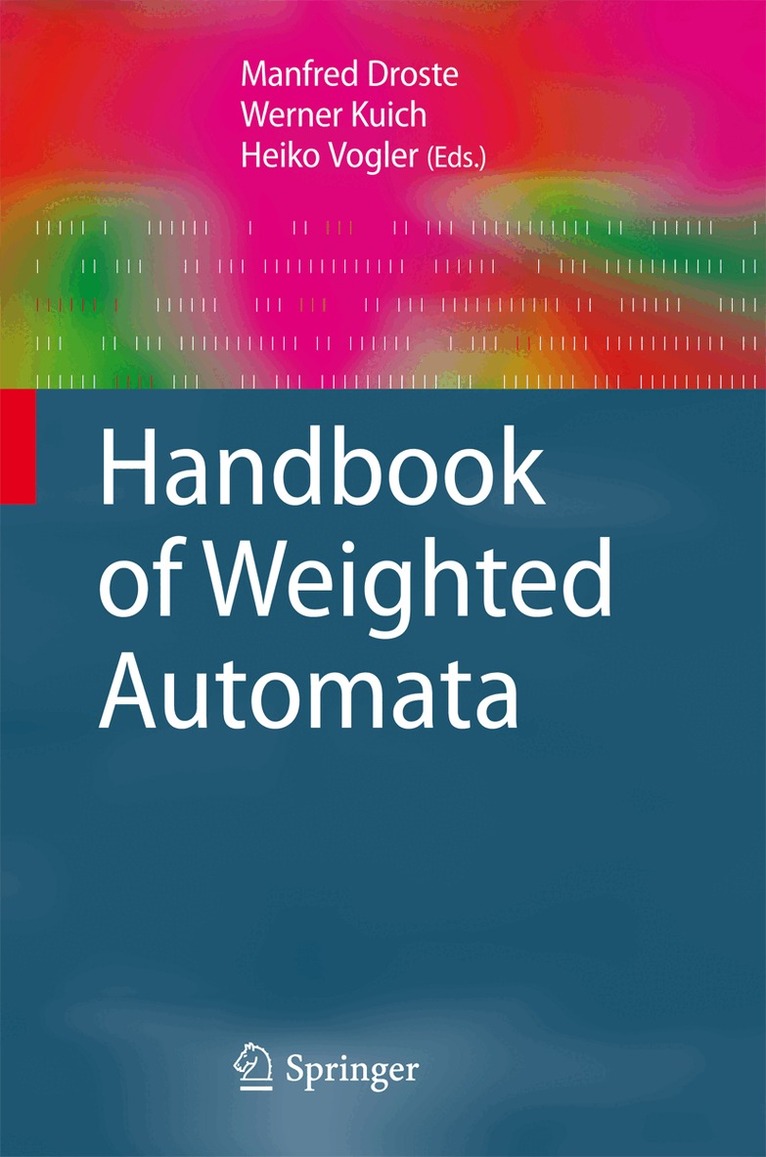
The purpose of this Handbook is to highlight both theory and applications of weighted automata. Weighted finite automata are classical nondeterministic finite automata in which the transitions carry weights. These weights may model, e. g. , the cost involved when executing a transition, the amount of resources or time needed for this,or the probability or reliability of its successful execution. The behavior of weighted finite automata can then be considered as the function (suitably defined) associating with each word the weight of its execution. Clearly, weights can also be added to classical automata with infinite state sets like pushdown automata; this extension constitutes the general concept of weighted automata. To illustrate the diversity of weighted automata, let us consider the following scenarios. Assume that a quantitative system is modeled by a classical automaton in which the transitions carry as weights the amount of resources needed for their execution. Then the amount of resources needed for a path in this weighted automaton is obtained simply as the sum of the weights of its transitions. Given a word, we might be interested in the minimal amount of resources needed for its execution, i. e. , for the successful paths realizing the given word. In this example, we could also replace the “resources” by “profit” and then be interested in the maximal profit realized, correspondingly, by a given word.
2 183 kr
Skickas inom 5-8 vardagar
The purpose of this Handbook is to highlight both theory and applications of weighted automata. Weighted finite automata are classical nondeterministic finite automata in which the transitions carry weights. These weights may model, e. g. , the cost involved when executing a transition, the amount of resources or time needed for this,or the probability or reliability of its successful execution. The behavior of weighted finite automata can then be considered as the function (suitably defined) associating with each word the weight of its execution. Clearly, weights can also be added to classical automata with infinite state sets like pushdown automata; this extension constitutes the general concept of weighted automata. To illustrate the diversity of weighted automata, let us consider the following scenarios. Assume that a quantitative system is modeled by a classical automaton in which the transitions carry as weights the amount of resources needed for their execution. Then the amount of resources needed for a path in this weighted automaton is obtained simply as the sum of the weights of its transitions. Given a word, we might be interested in the minimal amount of resources needed for its execution, i. e. , for the successful paths realizing the given word. In this example, we could also replace the “resources” by “profit” and then be interested in the maximal profit realized, correspondingly, by a given word.
1 064 kr
Skickas inom 10-15 vardagar
The subject of this book is the investigation of tree transducers. Tree trans ducers were introduced in theoretical computer science in order to study the general properties of formal models which give semantics to context-free languages in a syntax-directed way. Such formal models include attribute grammars with synthesized attributes only, denotational semantics, and at tribute grammars (with synthesized and inherited attributes). However, these formal models share certain constituents which are irrelevant in the investi gation of the general properties considered in this book. In particular, we can abstract (a) from derivation trees of the context-free grammar and take trees over some ranked alphabet, (b) from the semantic domain of the model and use the initial term algebra instead, and finally (c) from the machine oriented computation paradigm, which maintains the incarnation information of recursive function calls, and take a term rewriting semantics instead. Ap plying these three abstraction steps to attribute grammars with synthesized attributes only, to denotational semantics, and to attribute grammars we obtain the concepts of top-down tree transducer, macro tree transducer, and attributed tree transducer, respectively. The macro attributed tree transducer combines the concepts of the macro tree transducer and the attributed tree transducer. This book explores the general properties of these four types of tree transducers.