J. Timmons Roberts – författare
339 kr
Skickas inom 5-8 vardagar
507 kr
Läs direkt efter köp
489 kr
Läs direkt efter köp
1 267 kr
Skickas inom 7-10 vardagar
2 295 kr
Skickas inom 3-6 vardagar
578 kr
Skickas inom 3-6 vardagar
342 kr
Läs direkt efter köp
342 kr
Läs direkt efter köp
664 kr
Skickas inom 5-8 vardagar
399 kr
Läs direkt efter köp
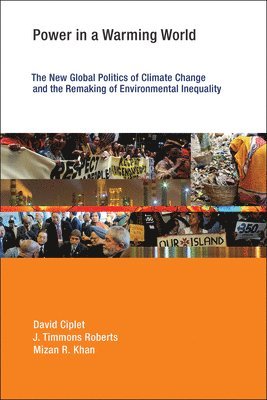
An examination of shifting global power dynamics in climate change politics, and how this affects our ability to achieve equitable and sustainable climate outcomes.
After nearly a quarter century of international negotiations on climate change, we stand at a crossroads. A new set of agreements is likely to fail to prevent the global climate''s destabilization. Islands and coastlines face inundation, and widespread drought, flooding, and famine are expected to worsen in the poorest and most vulnerable countries. How did we arrive at an entirely inequitable and scientifically inadequate international response to climate change?
In Power in a Warming World, David Ciplet, J. Timmons Roberts, and Mizan Khan, bring decades of combined experience as negotiators, researchers, and activists to bear on this urgent question. Combining rich empirical description with a political economic view of power relations, they document the struggles of states and social groups most vulnerable to a changing climate and describe the emergence of new political coalitions that take climate politics beyond a simple North-South divide. They offer six future scenarios in which power relations continue to shift as the world warms. A focus on incremental market-based reform, they argue, has proven insufficient for challenging the enduring power of fossil fuel interests, and will continue to be inadequate without a bolder, more inclusive and aggressive response.
399 kr
Läs direkt efter köp
How Latin American countries became leading voices and innovators on addressing climate change—and what threatens their leadership.
Latin American countries have increased their influence at the United Nations climate change negotiations and offered potential solutions on coping with global warming. But in the face of competing priorities, sometimes these climate policies are jettisoned, undermined, or simply ignored.
A Fragmented Continent focuses on Latin America''s three major blocs at the U.N. climate negotiations and how they attempt to balance climate action with building prosperity. Brazil has reduced its deforestation but continues its drive for economic growth and global recognition. A leftist group led by Venezuela, Bolivia, and Ecuador decries the injustice of climate change but is highly dependent on the export of fossil fuels. A new group, including Chile, Costa Rica, and Peru and supported by Mexico, offers sharp reductions in their carbon emissions in return for greater action by others; these countries now have to deliver on their promises. Weaving together issues of politics and economy, trade, foreign policy, civil society, and environmental protection, A Fragmented Continent offers a long-missing perspective on one of this century''s greatest challenges and neglected regions.
492 kr
Skickas inom 3-6 vardagar
617 kr
Skickas inom 10-15 vardagar
2 830 kr
Skickas inom 10-15 vardagar
755 kr
Skickas inom 10-15 vardagar
1 175 kr
Skickas inom 7-10 vardagar
464 kr
Skickas inom 7-10 vardagar
513 kr
Skickas inom 5-8 vardagar
472 kr
Skickas inom 5-8 vardagar
538 kr
Läs direkt efter köp
This revised and updated second edition of The Globalization and Development Reader builds on the considerable success of a first edition that has been used around the world. It combines selected readings and editorial material to provide a coherent text with global coverage, reflecting new theoretical and empirical developments.
Main text and core reference for students and professionals studying the processes of social change and development in “third world” countries. Carefully excerpted materials facilitate the understanding of classic and contemporary writings Second edition includes 33 essential readings, including 21 new selections New pieces cover the impact of the recession in the global North, global inequality and uneven development, gender, international migration, the role of cities, agriculture and on the governance of pharmaceuticals and climate change politics Increased coverage of China and India help to provide genuinely global coverage, and for a student readership the materials have been subject to a higher degree of editing in the new edition Includes a general introduction to the field, and short, insightful section introductions to each reading New readings include selections by Alexander Gershenkron, Alice Amsden, Amartya Sen, Anne-Marie Slaughter, Cecile Jackson, Dani Rodrik, David Harvey, Greta Krippner, Kathryn Sikkink, Leslie Sklair, Margaret E. Keck, Michael Burawoy, Nitsan Chorev, Oscar Lewis, Patrick Bond, Peter Evans, Philip McMichael, Pranab Bardhan, Ruth Pearson, Sarah Babb, Saskia Sassen, and Steve Radelet538 kr
Läs direkt efter köp
This revised and updated second edition of The Globalization and Development Reader builds on the considerable success of a first edition that has been used around the world. It combines selected readings and editorial material to provide a coherent text with global coverage, reflecting new theoretical and empirical developments.
Main text and core reference for students and professionals studying the processes of social change and development in “third world” countries. Carefully excerpted materials facilitate the understanding of classic and contemporary writings Second edition includes 33 essential readings, including 21 new selections New pieces cover the impact of the recession in the global North, global inequality and uneven development, gender, international migration, the role of cities, agriculture and on the governance of pharmaceuticals and climate change politics Increased coverage of China and India help to provide genuinely global coverage, and for a student readership the materials have been subject to a higher degree of editing in the new edition Includes a general introduction to the field, and short, insightful section introductions to each reading New readings include selections by Alexander Gershenkron, Alice Amsden, Amartya Sen, Anne-Marie Slaughter, Cecile Jackson, Dani Rodrik, David Harvey, Greta Krippner, Kathryn Sikkink, Leslie Sklair, Margaret E. Keck, Michael Burawoy, Nitsan Chorev, Oscar Lewis, Patrick Bond, Peter Evans, Philip McMichael, Pranab Bardhan, Ruth Pearson, Sarah Babb, Saskia Sassen, and Steve Radelet1 170 kr
Läs direkt efter köp
The Globalization and Environment Reader features a collection of classic and cutting-edge readings that explore whether and how globalization can be made compatible with sustainable development.
Offers a comprehensive collection of nearly 30 classic and cutting-edge readings spanning a broad range of perspectives within this increasingly important field Addresses the question of whether economic globalization is the prime cause of the destruction of the global environment – or if some forms of globalization could help to address global environmental problems Features carefully edited extracts selected both for their importance and their accessibility Covers a variety of topics such as the ‘marketization’ of nature, debates about managing and governing the relationship between globalization and the environment, and discussions about whether or not globalization should be ‘greened’ Systematically captures the breadth and diversity of the field without assuming prior knowledge Offers a timely and necessary insight into the future of our fragile planet in the 21st century490 kr
Läs direkt efter köp
The Globalization and Environment Reader features a collection of classic and cutting-edge readings that explore whether and how globalization can be made compatible with sustainable development.
Offers a comprehensive collection of nearly 30 classic and cutting-edge readings spanning a broad range of perspectives within this increasingly important field Addresses the question of whether economic globalization is the prime cause of the destruction of the global environment – or if some forms of globalization could help to address global environmental problems Features carefully edited extracts selected both for their importance and their accessibility Covers a variety of topics such as the ‘marketization’ of nature, debates about managing and governing the relationship between globalization and the environment, and discussions about whether or not globalization should be ‘greened’ Systematically captures the breadth and diversity of the field without assuming prior knowledge Offers a timely and necessary insight into the future of our fragile planet in the 21st century431 kr
Skickas inom 5-8 vardagar
2 084 kr
Skickas inom 10-15 vardagar
702 kr
Läs direkt efter köp
The Paris Framework for Climate Change Capacity Building pioneers a new era of climate change governance, performing the foundational job of clarifying what is meant by the often ad-hoc, one-off, uncoordinated, ineffective and unsustainable practices of the past decade described as ''capacity building'' to address climate change. As an alternative, this book presents a framework on how to build effective and sustainable capacity systems to meaningfully tackle this long-term problem. Such a reframing of capacity building itself requires means of implementation. The authors combine their decades-long experiences in climate negotiations, developing climate solutions, climate activism and peer-reviewed research to chart a realistic roadmap for the implementation of this alternative framework for capacity building. As a result, this book convincingly makes the case that universities, as the highest and sustainable seats of learning and research in the developing countries, should be the central hub of capacity building there.
This will be a valuable resource for students, researchers and policy-makers in the areas of climate change and environmental studies.
727 kr
Läs direkt efter köp
The Paris Framework for Climate Change Capacity Building pioneers a new era of climate change governance, performing the foundational job of clarifying what is meant by the often ad-hoc, one-off, uncoordinated, ineffective and unsustainable practices of the past decade described as ''capacity building'' to address climate change. As an alternative, this book presents a framework on how to build effective and sustainable capacity systems to meaningfully tackle this long-term problem. Such a reframing of capacity building itself requires means of implementation. The authors combine their decades-long experiences in climate negotiations, developing climate solutions, climate activism and peer-reviewed research to chart a realistic roadmap for the implementation of this alternative framework for capacity building. As a result, this book convincingly makes the case that universities, as the highest and sustainable seats of learning and research in the developing countries, should be the central hub of capacity building there.
This will be a valuable resource for students, researchers and policy-makers in the areas of climate change and environmental studies.
187 kr
Tillfälligt slut
303 kr
Tillfälligt slut