Jan K. Labanowski - Böcker
Visar alla böcker från författaren Jan K. Labanowski. Handla med fri frakt och snabb leverans.
3 produkter
3 produkter
1 589 kr
Skickas inom 10-15 vardagar
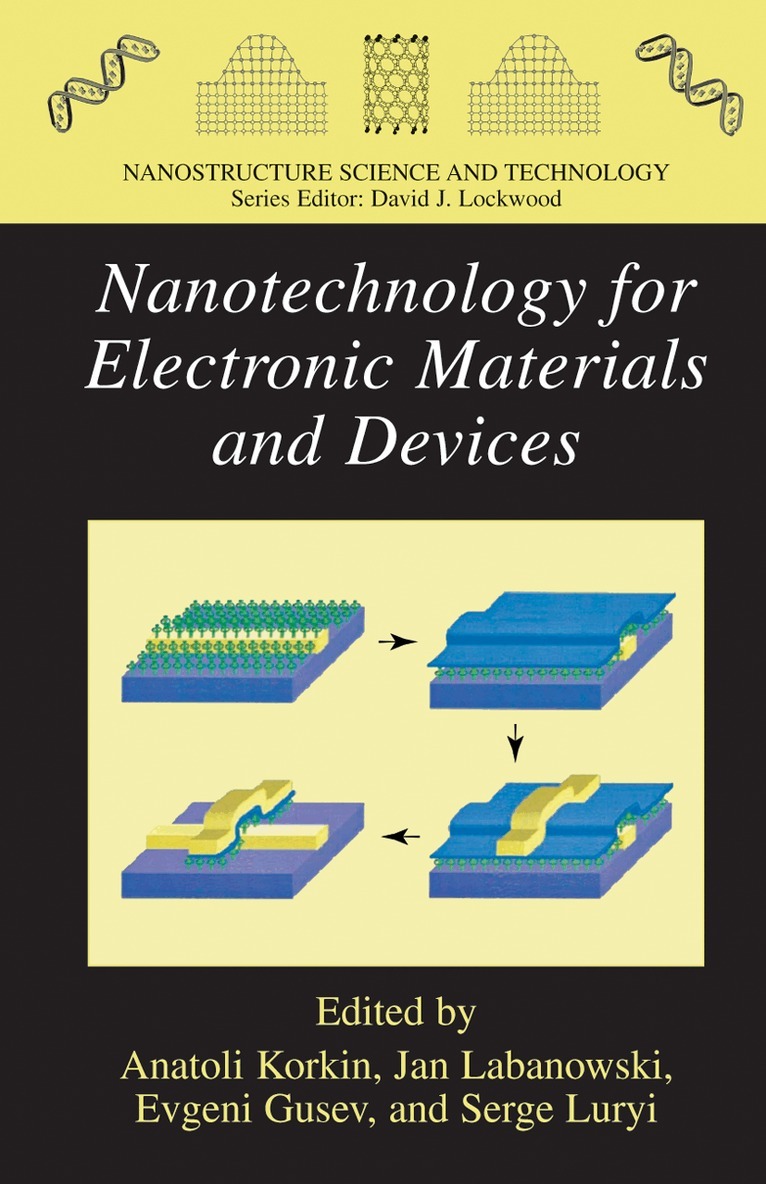
The high level of attention and interest of the global community to NANO science and technology to a large extent is linked to the GIGAntic challenges for the c- tinuing growth of information technology, which sparked an unprecedented level of interdisciplinary and international cooperation among industrial and academic researchers, companies, IT market rivals, and countries, including former political and military rivals . Microelectronics technologies have reached a new stage in their development: The latest miniaturization of electronic devices is approaching atomic dimensions, interconnect bottlenecks are limiting circuit speeds, new ma- rials are being introduced into microelectronics manufacture at an unprecedented rate , and alternative technologies to mainstream complementary metal-oxide sem- conductors (CMOSs) are being considered . The very dynamic stage of science and technology related to the advanced and future electronics and photonics creates a growing gap between the large number of rapid publications and nanotechnology highlights in media on one side and fundamental understanding of underlying phenomena and an adequate evaluation of scientific discoveries and technological innovations on the other side. Writing a tutorial book on fundamentals of science and technology for electronics at this time is almost the same level of challenge as writing a history book during a revolution.
1 589 kr
Skickas inom 10-15 vardagar
The high level of attention and interest of the global community to NANO science and technology to a large extent is linked to the GIGAntic challenges for the c- tinuing growth of information technology, which sparked an unprecedented level of interdisciplinary and international cooperation among industrial and academic researchers, companies, IT market rivals, and countries, including former political and military rivals . Microelectronics technologies have reached a new stage in their development: The latest miniaturization of electronic devices is approaching atomic dimensions, interconnect bottlenecks are limiting circuit speeds, new ma- rials are being introduced into microelectronics manufacture at an unprecedented rate , and alternative technologies to mainstream complementary metal-oxide sem- conductors (CMOSs) are being considered . The very dynamic stage of science and technology related to the advanced and future electronics and photonics creates a growing gap between the large number of rapid publications and nanotechnology highlights in media on one side and fundamental understanding of underlying phenomena and an adequate evaluation of scientific discoveries and technological innovations on the other side. Writing a tutorial book on fundamentals of science and technology for electronics at this time is almost the same level of challenge as writing a history book during a revolution.
534 kr
Skickas inom 10-15 vardagar
Predicting molecular structure and energy and explaining the nature of bonding are central goals in quantum chemistry. With this book, the editors assert that the density functional (DF) method satisfies these goals and has come into its own as an advanced method of computational chemistry. The wealth of applications presented in the book, ranging from solid state sys tems and polymers to organic and organo-metallic molecules, metallic clus ters, and biological complexes, prove that DF is becoming a widely used computational tool in chemistry. Progress in the methodology and its imple mentation documented by the contributions in this book demonstrate that DF calculations are both accurate and efficient. In fact, the results of DF calculations may pleasantly surprise many chem ists. Even the simplest approximation of DF, the local spin density method (LSD), yields molecular structures typical of ab initio correlated methods. The next level of theory, the nonlocal spin density method, predicts the energies of molecular processes within a few kcallmol or less. Like the Hartree-Fock (HF) and configuration interaction (CI) methods, the DF method is based only on fundamental physical constants. Therefore, it does not require semiempirical parameters and can be applied to any molecular system and to metallic phases. However, DF's greatest advantage is that it can be applied to much larger systems than those approachable by tradition al ab initio methods, especially when compared with correlated ab initio methods.