Jana Kosecká – författare
Visar alla böcker från författaren . Handla med fri frakt och snabb leverans.
3 produkter
3 produkter
Inbunden, Engelska, 2003
1 188 kr
Skickas inom 10-15 vardagar
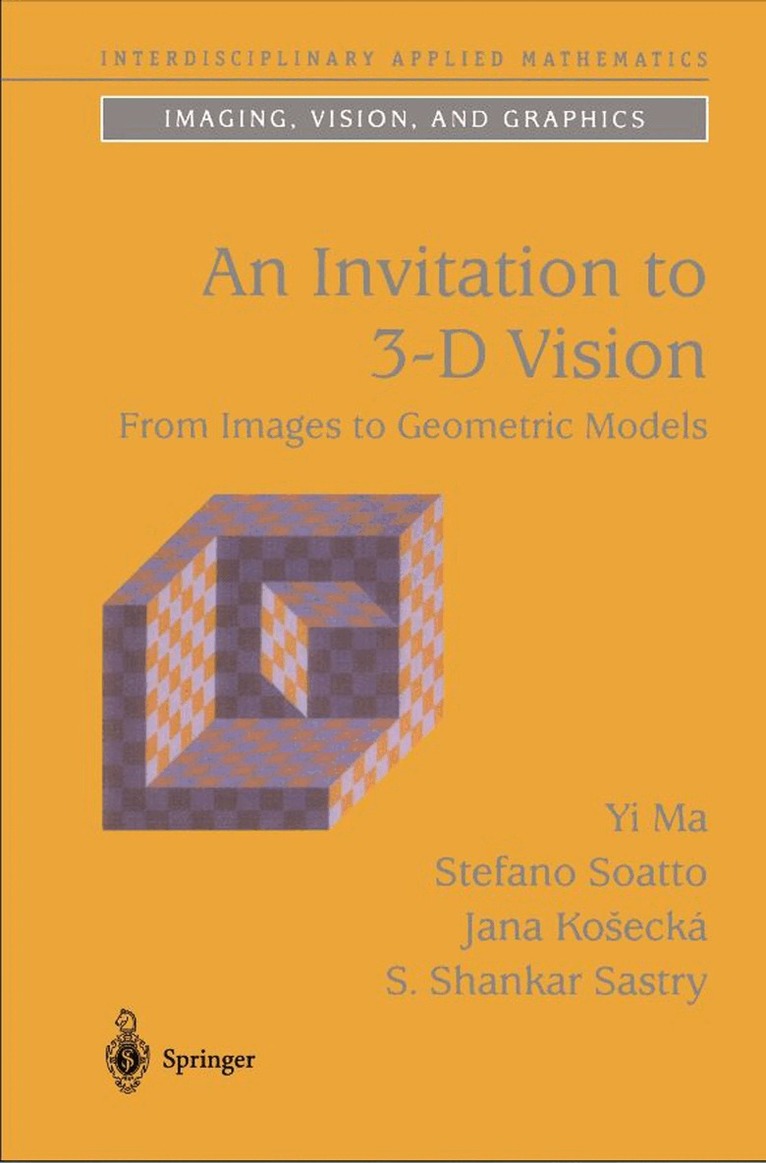
This book is intended to give students at the advanced undergraduate or introduc tory graduate level, and researchers in computer vision, robotics and computer graphics, a self-contained introduction to the geometry of three-dimensional (3- D) vision. This is the study of the reconstruction of 3-D models of objects from a collection of 2-D images. An essential prerequisite for this book is a course in linear algebra at the advanced undergraduate level. Background knowledge in rigid-body motion, estimation and optimization will certainly improve the reader's appreciation of the material but is not critical since the first few chapters and the appendices provide a review and summary of basic notions and results on these topics. Our motivation Research monographs and books on geometric approaches to computer vision have been published recently in two batches: The first was in the mid 1990s with books on the geometry of two views, see e. g. [Faugeras, 1993, Kanatani, 1993b, Maybank, 1993, Weng et aI. , 1993b]. The second was more recent with books fo cusing on the geometry of multiple views, see e. g. [Hartley and Zisserman, 2000] and [Faugeras and Luong, 2001] as well as a more comprehensive book on computer vision [Forsyth and Ponce, 2002]. We felt that the time was ripe for synthesizing the material in a unified framework so as to provide a self-contained exposition of this subject, which can be used both for pedagogical purposes and by practitioners interested in this field.
E-bok
PDF, Engelska, 20121 116 kr
Läs direkt efter köp
This book is intended to give students at the advanced undergraduate or introduc tory graduate level, and researchers in computer vision, robotics and computer graphics, a self-contained introduction to the geometry of three-dimensional (3- D) vision. This is the study of the reconstruction of 3-D models of objects from a collection of 2-D images. An essential prerequisite for this book is a course in linear algebra at the advanced undergraduate level. Background knowledge in rigid-body motion, estimation and optimization will certainly improve the reader''s appreciation of the material but is not critical since the first few chapters and the appendices provide a review and summary of basic notions and results on these topics. Our motivation Research monographs and books on geometric approaches to computer vision have been published recently in two batches: The first was in the mid 1990s with books on the geometry of two views, see e. g. [Faugeras, 1993, Kanatani, 1993b, Maybank, 1993, Weng et aI. , 1993b]. The second was more recent with books fo cusing on the geometry of multiple views, see e. g. [Hartley and Zisserman, 2000] and [Faugeras and Luong, 2001] as well as a more comprehensive book on computer vision [Forsyth and Ponce, 2002]. We felt that the time was ripe for synthesizing the material in a unified framework so as to provide a self-contained exposition of this subject, which can be used both for pedagogical purposes and by practitioners interested in this field.
Del 26 - Interdisciplinary Applied Mathematics
Invitation to 3-D Vision
From Images to Geometric Models
Häftad, Engelska, 2010
866 kr
Skickas inom 10-15 vardagar
This book is intended to give students at the advanced undergraduate or introduc tory graduate level, and researchers in computer vision, robotics and computer graphics, a self-contained introduction to the geometry of three-dimensional (3- D) vision. This is the study of the reconstruction of 3-D models of objects from a collection of 2-D images. An essential prerequisite for this book is a course in linear algebra at the advanced undergraduate level. Background knowledge in rigid-body motion, estimation and optimization will certainly improve the reader's appreciation of the material but is not critical since the first few chapters and the appendices provide a review and summary of basic notions and results on these topics. Our motivation Research monographs and books on geometric approaches to computer vision have been published recently in two batches: The first was in the mid 1990s with books on the geometry of two views, see e. g. [Faugeras, 1993, Kanatani, 1993b, Maybank, 1993, Weng et aI. , 1993b]. The second was more recent with books fo cusing on the geometry of multiple views, see e. g. [Hartley and Zisserman, 2000] and [Faugeras and Luong, 2001] as well as a more comprehensive book on computer vision [Forsyth and Ponce, 2002]. We felt that the time was ripe for synthesizing the material in a unified framework so as to provide a self-contained exposition of this subject, which can be used both for pedagogical purposes and by practitioners interested in this field.