Jennifer Fletcher - Böcker
Visar alla böcker från författaren Jennifer Fletcher. Handla med fri frakt och snabb leverans.
5 produkter
5 produkter
401 kr
Skickas inom 10-15 vardagar
No matter wherestudents' lives lead after graduation, one of the most essential tools we can teach them is how to comprehend, analyze, and respond to arguments. Students need to know how writers' and speakers' choices are shaped by elements of the rhetorical situation, including audience, occasion, and purpose. In Teaching Arguments: Rhetorical Comprehension, Critique, and Response, Jennifer Fletcher provides teachers with engaging classroom activities, writing prompts, graphic organizers, and student samples to help students at all levels read, write, listen, speak, and think rhetorically.Fletcher believes that, with appropriate scaffolding and encouragement, all students can learn a rhetorical approach to argument and gain access to rigorous academic content. Teaching Arguments opens the door and helps them pay closer attention to the acts of meaning around them, to notice persuasive strategies that might not be apparent at first glance. When we analyze and develop arguments, we have to consider more than just the printed words on the page. We have to evaluate multiple perspectives; the tension between belief and doubt; the interplay of reason, character, and emotion; the dynamics of occasion, audience, and purpose; and how our own identities shape what we read and write. Rhetoric teaches us how to do these things.Teaching Arguments will help students learn to move beyond a superficial response to texts so they can analyze and craft sophisticated, persuasive arguments - a major cornerstone for being not just college-and career-ready but ready for the challenges of the world.
Fostering Habits of Mind in Today's Students
A New Approach to Developmental Education
Inbunden, Engelska, 2015
2 044 kr
Skickas inom 10-15 vardagar
Co-published with and Students need more than just academic skills for success in college and career, and the lack of an explicit instructional focus on the “soft skills” critical to postsecondary success poses a challenge for many students who enter college, especially the underprepared. Based upon a multi-campus, cross-disciplinary collaboration, this book presents the resulting set of habits-of-mind-based strategies that demonstrably help not only low-income, ESL, and first-generation college students overcome obstacles on the path to degree completion; these strategies equally benefit all students. They promote life-long, integrative learning and foster intellectual qualities such as curiosity, openness, flexibility, engagement, and persistence that are the key to developing internalized and transferrable competencies that are seldom given direct attention in college classrooms. This contributed volume, written with full-time and adjunct faculty in mind, provides the rationale for this pedagogical approach and presents the sequential instructional cycle that begins by identifying students’ assets and progressively focusing on specific habits to develop their capacity to transfer their learning to new tasks and situations.Faculty from both two-year and four-year colleges provide examples of how they implement these practices in English, math, and General Education courses, and demonstrate the applicability of these practices across course types and disciplines.Chapters address key factors of college success, including:* The link between habits of mind and student retention and achievement* Using an assets-based approach to teaching and learning* Supporting and engaging students* Creating inclusive learning communities* Building confidence and self-efficacy* Promoting transfer of learning* Teacher networks and cross-disciplinary collaborationBy foregrounding habits of mind as an instructional lens, this book makes a unique contribution to teaching in developmental and general education settings.
Fostering Habits of Mind in Today's Students
A New Approach to Developmental Education
Häftad, Engelska, 2015
454 kr
Skickas inom 10-15 vardagar
Co-published with and Students need more than just academic skills for success in college and career, and the lack of an explicit instructional focus on the “soft skills” critical to postsecondary success poses a challenge for many students who enter college, especially the underprepared. Based upon a multi-campus, cross-disciplinary collaboration, this book presents the resulting set of habits-of-mind-based strategies that demonstrably help not only low-income, ESL, and first-generation college students overcome obstacles on the path to degree completion; these strategies equally benefit all students. They promote life-long, integrative learning and foster intellectual qualities such as curiosity, openness, flexibility, engagement, and persistence that are the key to developing internalized and transferrable competencies that are seldom given direct attention in college classrooms. This contributed volume, written with full-time and adjunct faculty in mind, provides the rationale for this pedagogical approach and presents the sequential instructional cycle that begins by identifying students’ assets and progressively focusing on specific habits to develop their capacity to transfer their learning to new tasks and situations.Faculty from both two-year and four-year colleges provide examples of how they implement these practices in English, math, and General Education courses, and demonstrate the applicability of these practices across course types and disciplines.Chapters address key factors of college success, including:* The link between habits of mind and student retention and achievement* Using an assets-based approach to teaching and learning* Supporting and engaging students* Creating inclusive learning communities* Building confidence and self-efficacy* Promoting transfer of learning* Teacher networks and cross-disciplinary collaborationBy foregrounding habits of mind as an instructional lens, this book makes a unique contribution to teaching in developmental and general education settings.
Teaching Literature Rhetorically
Transferable Literacy Skills for 21st Century Students
Häftad, Engelska, 2018
401 kr
Skickas inom 10-15 vardagar
English language arts teachers often find themselves defending their discipline and the practical values it has. When will I read this again? is an all too common question heard in classrooms. Author Jennifer Fletcher faced the same questions and more. In Teaching Literature Rhetorically: Transferable Literacy Skills for 21st Century Students she shows you how to help your students develop transferable literacy skills that allow them to succeed not just in their English language arts classes, but in their future lives and careers. The book is built around eight high-utility literacy skills and practices that will help students communicate effectively and with confidence as they navigate important transitions in their lives:Integrating skills and knowledge from texts Reading closely and critically Assessing rhetorical situations Negotiating different perspectives Developing and supporting a line of reasoning Analyzing genres Communicating with self and others in mind Reading and writing with passionTeaching Literature Rhetorically offers readers writing prompts, readings, discussion questions, graphic organizers, as well as examples of student work and activities for helping students to understand key rhetorical concepts. As Fletcher writes in her introduction rhetorical thinking promotes the transfer of learning — the single most important goal we can have as teachers if we hope to have a positive impact on our students’ lives. This book will help teachers everywhere do just that.
401 kr
Skickas inom 10-15 vardagar
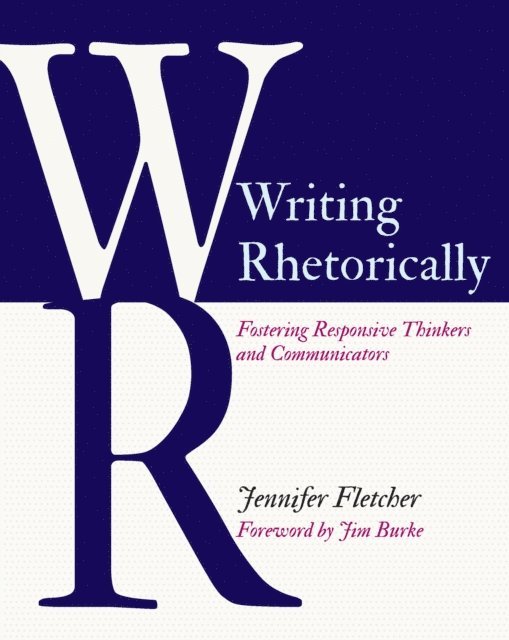
In Writing Rhetorically: Fostering Responsive Thinkers and Communicators, author Jennifer Fletcher aims to cultivate independent learners through rhetorical thinking. She provides teachers with strategies and frameworks for writing instruction that can be applied across multiple subjects and lesson plans. Students learn to discover their own questions, design their own inquiry process, develop their own positions and purposes, make their own choices about content and form, and contribute to conversations that matter to them.Inside this book, Fletcher helps remove some of the scaffolding and explains how to put in practice some methods which can successfully foster:Inquiry, Invention, and Rhetorical ThinkingWriting for TransferParaphrasing, Summary, Synthesis, and Citation SkillsResearch Skills and ProcessesEvidence-Based ReasoningRhetorical Decision MakingRhetorical decision making helps students develop the skills, knowledge, and mindsets needed for transfer of learning: the ability to adapt and apply learning in new settings. The more choices students make as writers, the better prepared they are to analyze and respond to diverse rhetorical situations. Writing Rhetorically shows teachers what it looks like to dig into real texts with students and novice writers and how it develops them for lifelong learning.