Jens-Uwe Wunderlich - Böcker
Visar alla böcker från författaren Jens-Uwe Wunderlich. Handla med fri frakt och snabb leverans.
8 produkter
8 produkter
European and East Asian Regionalism
Critical Junctures and Historical Turning Points
Häftad, Engelska, 2022
617 kr
Skickas inom 10-15 vardagar
Embedded in the evolving comparative regionalism literature, this book offers a systematic analysis of the factors positively and negatively influencing regional institution-building.The ruptures caused by the Eurozone crises, the coronavirus pandemic and by Brexit have renewed the interest in the impact of crises and critical junctures on regionalism here defined as regional institution-building. Drawing from critical juncture research and historical comparative analysis, this volume uses the cases of European and East Asian regional institution-building to systematically analyse institutional transformations during specific historical turning points and critical juncture moments. Wunderlich’s research offers an in-depth analysis of the interrelated drivers, spoilers and dissolvers of regional institution-building processes in Europe and East Asia, and addresses key questions including: Under what conditions does regionalism take hold? What is influencing the initial institutional design choices? What is the impact of historical experiences and well-entrenched norms and ideas? What are the roles of regional leaders? How do external factors influence regional institution-building? What turns a crisis into a critical juncture and are such junctures threats or opportunities? What accounts for variations in institutional responses to crisis events across different regional settings?This book will be a valuable resource for scholars of regionalism, region-building, regional governance and international relations of Europe and East Asia.
2 088 kr
Skickas inom 10-15 vardagar
New regionalism and globalization have been prominent themes in academic and political debates since the beginning of the 1990s. Despite the considerable amount of scholarly attention that the new regionalism has received in recent years, its full empirical and theoretical potential has yet to be fully investigated. This illuminating study provides an overview of new avenues in theorizing regionalism and proposes a consolidated framework for analysis and comparison. Offering a comparative historical perspective of European and Southeast Asian regionalism, it presents new and imaginative insights into the theory and practice of regionalism and the links between regional developments, globalization and international order.
European and East Asian Regionalism
Critical Junctures and Historical Turning Points
Inbunden, Engelska, 2020
2 088 kr
Skickas inom 10-15 vardagar
Embedded in the evolving comparative regionalism literature, this book offers a systematic analysis of the factors positively and negatively influencing regional institution-building.The ruptures caused by the Eurozone crises, the coronavirus pandemic and by Brexit have renewed the interest in the impact of crises and critical junctures on regionalism here defined as regional institution-building. Drawing from critical juncture research and historical comparative analysis, this volume uses the cases of European and East Asian regional institution-building to systematically analyse institutional transformations during specific historical turning points and critical juncture moments. Wunderlich’s research offers an in-depth analysis of the interrelated drivers, spoilers and dissolvers of regional institution-building processes in Europe and East Asia, and addresses key questions including: Under what conditions does regionalism take hold? What is influencing the initial institutional design choices? What is the impact of historical experiences and well-entrenched norms and ideas? What are the roles of regional leaders? How do external factors influence regional institution-building? What turns a crisis into a critical juncture and are such junctures threats or opportunities? What accounts for variations in institutional responses to crisis events across different regional settings?This book will be a valuable resource for scholars of regionalism, region-building, regional governance and international relations of Europe and East Asia.
3 397 kr
Skickas inom 10-15 vardagar
Globalization has become one of the most important topics within politics and economics. This new title explains some of the related terminology, summarizes the surrounding theories and examines the international organizations involved.With the proliferation of communications and the rise of the multi-national corporation, the concept of globalization is vitally important to the modern political environment. The structure of the modern economy, based on information production and diffusion, has made national boundaries largely irrelevant. A Dictionary of Globalization explains theories, philosophies and ideologies, and includes short biographies of leading activists, theorists and thinkers such as Noam Chomsky, Karl Marx and José Bové. Concepts, issues and terms key to the understanding of globalization also have clear and concise definitions, including democracy, civil society, non-governmental organizations and ethnicity.Cross-referenced for ease of use, this title aims to be of great benefit to anyone studying politics or sociology. It will prove essential to public and academic libraries, as well as to businesses, government departments, embassies and journalists.
3 397 kr
Skickas inom 10-15 vardagar
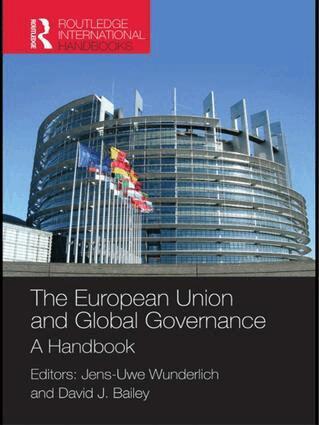
The role of the European Union in global politics has been of growing interest over the past decade. The EU is a key player in global institutions such as the World Trade Organization (WTO) and NATO. It continues to construct an emerging identity and project its values and interests throughout contemporary international relations. The capacity of the EU to both formulate and realise its goals, however, remains contested. Some scholars claim the EU’s `soft power’ attitude rivals that of the USA’s `hard power’ approach to international relations. Others view the EU as insufficiently able to produce a co-ordinated position to project upon global politics. Regardless of the position taken within this debate, the EU’s relationship with its external partners has an increasingly important impact upon economic, political and security concerns on an international level. Trade negotiations, military interventions, democracy promotion, international development and responses to the global economic crisis have all witnessed the EU playing a central role. This has seen the EU become both a major force in contemporary institutions of global governance and a template for supranational governance that might influence other attempts to construct regional and global institutions. This volume brings together a collection of leading EU scholars to provide a state-of-the-art overview covering these and other debates relating to the EU’s role in contemporary global governance. The Handbook is divided into four main sections:Part I: European studies and global governance – provides an overview and critical assessment of the leading theoretical approaches through which the EU’s role in global governance has been addressed within the literature.Part II: Institutions – examines the role played by the key EU institutions in pursuing a role for the EU in contemporary international relations.Part III: Policy and issue areas – explores developments within particular policy sectors, assessing the different impact that the EU has had in different issue areas, including foreign and security policy, environmental policy, common commercial policy, the Common Agricultural Policy, development policy, accession policy, the Neighbourhood Policy and conflict transformation.Part IV: The global multilevel governance complex and the EU – focuses on the relationship between the EU and the institutions, regions and countries with which it forms a global multilevel governance complex, including chapters on the EU’s relationship with the WTO, United Nations, East Asia, Africa and the USA.The editors are Jens-Uwe Wunderlich (Aston University) and David J. Bailey (University of Birmingham). Jens-Uwe Wunderlich’s research and teaching focuses on international relations theory, European integration and globalization and on comparative regionalism; he has recently published Regionalism, Globalisation and International Order–Europe and Southeast Asia (Ashgate) and A Dictionary of Globalization (Routledge, 2007). David Bailey has published on trends in European governance in the Journal of European Public Policy, Comparative European Politics, and Journal of European Social Policy.
576 kr
Skickas inom 10-15 vardagar
Globalization has become one of the most important topics within politics and economics. This new title explains some of the related terminology, summarizes the surrounding theories and examines the international organizations involved.With the proliferation of communications and the rise of the multi-national corporation, the concept of globalization is vitally important to the modern political environment. The structure of the modern economy, based on information production and diffusion, has made national boundaries largely irrelevant. A Dictionary of Globalization explains theories, philosophies and ideologies, and includes short biographies of leading activists, theorists and thinkers such as Noam Chomsky, Karl Marx and José Bové. Concepts, issues and terms key to the understanding of globalization also have clear and concise definitions, including democracy, civil society, non-governmental organizations and ethnicity.Cross-referenced for ease of use, this title aims to be of great benefit to anyone studying politics or sociology. It will prove essential to public and academic libraries, as well as to businesses, government departments, embassies and journalists.
861 kr
Skickas inom 10-15 vardagar
The role of the European Union in global politics has been of growing interest over the past decade. The EU is a key player in global institutions such as the World Trade Organization (WTO) and NATO. It continues to construct an emerging identity and project its values and interests throughout contemporary international relations. The capacity of the EU to both formulate and realise its goals, however, remains contested. Some scholars claim the EU’s `soft power’ attitude rivals that of the USA’s `hard power’ approach to international relations. Others view the EU as insufficiently able to produce a co-ordinated position to project upon global politics. Regardless of the position taken within this debate, the EU’s relationship with its external partners has an increasingly important impact upon economic, political and security concerns on an international level. Trade negotiations, military interventions, democracy promotion, international development and responses to the global economic crisis have all witnessed the EU playing a central role. This has seen the EU become both a major force in contemporary institutions of global governance and a template for supranational governance that might influence other attempts to construct regional and global institutions. This volume brings together a collection of leading EU scholars to provide a state-of-the-art overview covering these and other debates relating to the EU’s role in contemporary global governance. The Handbook is divided into four main sections:Part I: European studies and global governance – provides an overview and critical assessment of the leading theoretical approaches through which the EU’s role in global governance has been addressed within the literature.Part II: Institutions – examines the role played by the key EU institutions in pursuing a role for the EU in contemporary international relations.Part III: Policy and issue areas – explores developments within particular policy sectors, assessing the different impact that the EU has had in different issue areas, including foreign and security policy, environmental policy, common commercial policy, the Common Agricultural Policy, development policy, accession policy, the Neighbourhood Policy and conflict transformation.Part IV: The global multilevel governance complex and the EU – focuses on the relationship between the EU and the institutions, regions and countries with which it forms a global multilevel governance complex, including chapters on the EU’s relationship with the WTO, United Nations, East Asia, Africa and the USA.The editors are Jens-Uwe Wunderlich (Aston University) and David J. Bailey (University of Birmingham). Jens-Uwe Wunderlich’s research and teaching focuses on international relations theory, European integration and globalization and on comparative regionalism; he has recently published Regionalism, Globalisation and International Order–Europe and Southeast Asia (Ashgate) and A Dictionary of Globalization (Routledge, 2007). David Bailey has published on trends in European governance in the Journal of European Public Policy, Comparative European Politics, and Journal of European Social Policy.
Exiting Regional Organisations
Differentiated Disintegration in Comparative Perspective
Inbunden, Engelska, 2026
1 478 kr
Kommande
Why do states leave regional organisations – and what happens next? This book explores these timely questions through the analytical lens of comparative regionalism. While Brexit may be the most high-profile example of a state departure, this book shows that state withdrawals from regional organisations are neither unique nor isolated. From West Africa to the Andes, from the Pacific Islands to Eurasia, state exits have become a recurring albeit limited feature of the regional landscape challenging the future contours of the international order.This book offers a comparative analysis of voluntary withdrawals from regional organisations. Anchored in the conceptual framework of differentiated disintegration, the authors examine such exits not as abrupt ends, but as forms of institutional change within the broader tapestry of regionalism. The result is a multidimensional portrait of how regional cooperation evolves – and occasionally unravels.The volume begins with a robust conceptual and methodological foundation, situating withdrawals within broader debates on regionalism, integration, and institutional development. It draws on diverse integration theories and bridges the divide between European and Global South experiences. The authors take the reader across five continents with seven richly documented case studies – including the UK’s departure from the EU, Morocco’s exit from the Organisation of African Unity (OAU), Chile and the Andean Community, and Kiribati leaving the Pacific Islands Forum. Each chapter follows a common analytical structure, enabling comparative insight into drivers, consequences, and post-withdrawal re-engagements, that is differentiated disintegration.