Jeroen Warner - Böcker
Visar alla böcker från författaren Jeroen Warner. Handla med fri frakt och snabb leverans.
10 produkter
10 produkter
921 kr
Skickas inom 5-8 vardagar
Water Conflicts applies cutting-edge thinking to identify pathways that can transform complex water conflicts. It challenges existing power-blind and politics-lite analysis that is very deeply-held and recurring in debates that suggest causal links between scarcity and violence-or peace. This book presents a much needed revision of transboundary water analysis, leading to a rethink on the way water is used and contested, with a focus on harm experienced both by the most vulnerable water users and the environment. Recognizing that conflicts are never static, Mark Zeitoun, Naho Mirumachi, and Jeroen Warner's "transformative analysis" provides multi-disciplinary tools and perspectives to understand and address the complexities involved. The approach is stress-tested through dozens of examples around the globe, and it incorporates collective evidence and knowledge of the London Water Research Group. The insights on water diplomacy will be most welcome by analysts, activists, diplomats, and all others tackling water conflicts. Seeking to motivate improvement of transboundary water arrangements towards further equity and sustainability as a practical agenda, the book is a fresh antidote to the detached role that researchers and policymakers often play.
2 155 kr
Skickas inom 10-15 vardagar
As they provide a negotiating space for a diversity of interests, Multi-Stakeholder Platforms (MSPs) are an increasingly popular mode of involving civil society in resource management decisions. This book focuses on water management to take a positive, if critical, look at this phenomenon. Illustrated by a wide geographical range of case studies from both developed and developing worlds, it recognizes that MSPs will neither automatically break down divides nor bring actors to the table on an equal footing, and argues that MSPs may in some cases do more harm than good. The volume then examines how MSPs can make a difference and how they might successfully co-opt the public, private and civil-society sectors. The book highlights the particular difficulties of MSPs when dealing with integrated water management programmes, explaining how MSPs are most successful at a less complex and more local level. It finally questions whether MSPs are - or can be - sustainable, and puts forward suggestions for improving their durability.
1 895 kr
Skickas inom 10-15 vardagar
This edited volume examines the changes that arise from the entanglement of global interests and narratives with the local struggles that have always existed in the drylands of Africa, the Middle East, and Central Asia/Inner Asia.Changes in drylands are happening in an overwhelming manner. Climate change, growing political instability, and increasing enclosures of large expanses of often common land are some of the changes with far-reaching consequences for those who make their living in the drylands. At the same time, powerful narratives about the drylands as ‘wastelands’ and their ‘backward’ inhabitants continue to hold sway, legitimizing interventions for development, security, and conservation, informing re-emerging frontiers of investment (for agriculture, extraction, infrastructure), and shaping new dryland identities. The chapters in this volume discuss the politics of change triggered by forces as diverse as the global land and resource rush, the expansion of new Information and Communication Technologies, urbanization, the COVID-19 pandemic, and the spread of violent extremism. While recognizing that changes are co-produced by differently positioned actors from within and outside the drylands, this volume presents the dryland’s point of view. It therefore takes the views, experiences, and agencies of dryland dwellers as the point of departure to not only understand the changes that are transforming their lives, livelihoods, and future aspirations, but also to highlight the unexpected spaces of contestation and innovation that have hitherto remained understudied.This edited volume will be of much interest to students, researchers, and scholars of natural resource management, land and resource grabbing, political ecology, sustainable development, and drylands in general.The Open Access version of this book, available at www.taylorfrancis.com, has been made available under a Creative Commons Attribution-Non Commercial-No Derivatives 4.0 license.
579 kr
Skickas inom 10-15 vardagar
This edited volume examines the changes that arise from the entanglement of global interests and narratives with the local struggles that have always existed in the drylands of Africa, the Middle East, and Central Asia/Inner Asia.Changes in drylands are happening in an overwhelming manner. Climate change, growing political instability, and increasing enclosures of large expanses of often common land are some of the changes with far-reaching consequences for those who make their living in the drylands. At the same time, powerful narratives about the drylands as ‘wastelands’ and their ‘backward’ inhabitants continue to hold sway, legitimizing interventions for development, security, and conservation, informing re-emerging frontiers of investment (for agriculture, extraction, infrastructure), and shaping new dryland identities. The chapters in this volume discuss the politics of change triggered by forces as diverse as the global land and resource rush, the expansion of new Information and Communication Technologies, urbanization, the COVID-19 pandemic, and the spread of violent extremism. While recognizing that changes are co-produced by differently positioned actors from within and outside the drylands, this volume presents the dryland’s point of view. It therefore takes the views, experiences, and agencies of dryland dwellers as the point of departure to not only understand the changes that are transforming their lives, livelihoods, and future aspirations, but also to highlight the unexpected spaces of contestation and innovation that have hitherto remained understudied.This edited volume will be of much interest to students, researchers, and scholars of natural resource management, land and resource grabbing, political ecology, sustainable development, and drylands in general.The Open Access version of this book, available at www.taylorfrancis.com, has been made available under a Creative Commons Attribution-Non Commercial-No Derivatives 4.0 license.
810 kr
Skickas inom 10-15 vardagar
As they provide a negotiating space for a diversity of interests, Multi-Stakeholder Platforms (MSPs) are an increasingly popular mode of involving civil society in resource management decisions. This book focuses on water management to take a positive, if critical, look at this phenomenon. Illustrated by a wide geographical range of case studies from both developed and developing worlds, it recognizes that MSPs will neither automatically break down divides nor bring actors to the table on an equal footing, and argues that MSPs may in some cases do more harm than good. The volume then examines how MSPs can make a difference and how they might successfully co-opt the public, private and civil-society sectors. The book highlights the particular difficulties of MSPs when dealing with integrated water management programmes, explaining how MSPs are most successful at a less complex and more local level. It finally questions whether MSPs are - or can be - sustainable, and puts forward suggestions for improving their durability.
1 833 kr
Skickas inom 10-15 vardagar
Floods are amongst the most common and devastating natural disasters. In the wake of such an event, the pressure to initiate flood protection schemes that will provide security is enormous, and politicians promise quick solutions in the national interest. Jeroen Warner examines a number of such projects from around the world - the Middle East, South Asia and Western Europe - aimed at the prevention of serious flooding. Each provoked a level of controversy unforeseen by its initiators, with the result that schemes were shelved, were not completed, or simply failed. The author shows how such projects inevitably become politicized as different stakeholders seek to promote their interests.
3 265 kr
Skickas inom 10-15 vardagar
This authoritative reference work gives timely information on the global politics of water. Readers will find case studies on a variety of complex water situations, from the Okavango River that flows through Angola, Namibia and Botswana, to the Euphrates-Tigris of the Upper Persian Gulf. With the current threat of climate change and increasing demand on water resources, the book gives valuable insight into an increasingly politicized topic. Politics of Water is a welcome addition to Routledge’s extensive The Politics of … reference series.Readers will benefit from:essays on major topics in water politics from a variety of contributors (thirteen in all), including Is water politics? Towards international water relations and The politics of water and mining in South Africa sensitive debate on gender issues, reflecting the fact that in many cultures men are responsible for the supply of water, and women as cultivators and house keepers are the major usersan A-Z glossary of key terms, issues, organizations, etc. in water politicsinformation on selected major river basins of the world, including maps detailing water consumption and resources.The Politics of Water is a useful guide to the politics surrounding the availability and provision of water on a world-wide scale. It will prove to be a useful reference source for anyone interested in, or studying, the politics of water and climate change.
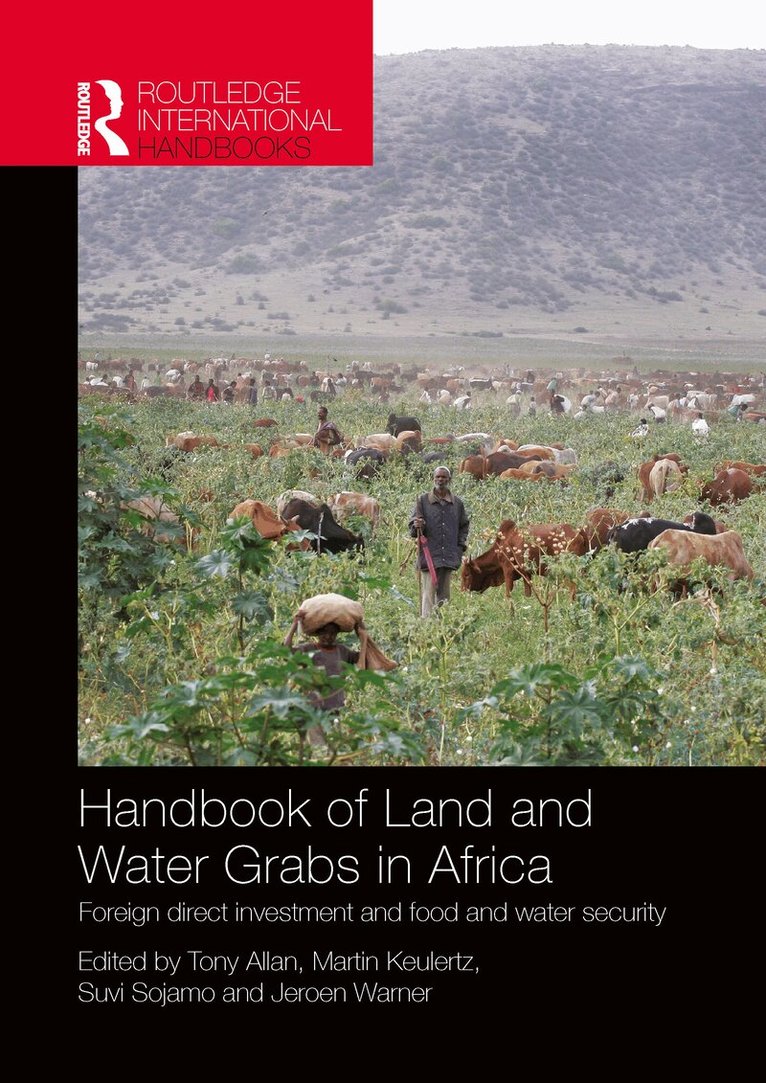
Handbook of Land and Water Grabs in Africa
Foreign direct investment and food and water security
Inbunden, Engelska, 2012
3 028 kr
Skickas inom 10-15 vardagar
According to estimates by the International Land Coalition based at the International Fund for Agricultural Development (IFAD), 57 million hectares of land have been leased to foreign investors since 2007. Current research has focused on human rights issues related to inward investment in land but has been ignorant of water resource issues and the challenges of managing scarce water. This handbook will be the first to address inward investment in land and its impact on water resources in Africa. The geographical scope of this book will be the African continent, where land has attracted the attention of risk-taking investors because much land is under-utilised marginalized land, with associated water resources and rapidly growing domestic food markets. The successful implementation of investment strategies in African agriculture could determine the future of more than one billion people. An important factor to note is that sub-Saharan Africa will, of all the continents, be hit hardest by climate change, population growth and food insecurity. Sensible investment in agriculture is therefore needed, however, at what costs and at whose expense? The book will also address the livelihoods theme and provide a holistic analysis of land and water grabbing in sub-Saharan Africa. Four other themes will addressed: politics, economics, the environment and the history of land investments in sub-Saharan Africa. The editors have involved a highly diverse group of expert researchers, who will review the pro- and anti-investment arguments, geopolitics, the role of capitalist investors, the environmental contexts and the political implications of, and reasons for, leasing millions of hectares in sub-Saharan Africa. To date, there has been no attempt to review land investments through a suite of different lenses, thus this handbook will differ significantly from existing research and publication. The editors are Tony Allan, (Professor Emeritus, Department of Geography, School of Oriental and African Studies and King’s College London); Jeroen Warner (Assistant Professor, Disaster Studies, University of Wageningen); Suvi Sojamo (PhD Researcher, Water and Development Research Group, Aalto University); and Martin Keulertz (PhD Researcher, Department of Geography, London Water Group, King’s College London).
Handbook of Land and Water Grabs in Africa
Foreign direct investment and food and water security
Häftad, Engelska, 2014
820 kr
Skickas inom 10-15 vardagar
According to estimates by the International Land Coalition based at the International Fund for Agricultural Development (IFAD), 57 million hectares of land have been leased to foreign investors since 2007. Current research has focused on human rights issues related to inward investment in land but has been ignorant of water resource issues and the challenges of managing scarce water. This handbook will be the first to address inward investment in land and its impact on water resources in Africa. The geographical scope of this book will be the African continent, where land has attracted the attention of risk-taking investors because much land is under-utilised marginalized land, with associated water resources and rapidly growing domestic food markets. The successful implementation of investment strategies in African agriculture could determine the future of more than one billion people. An important factor to note is that sub-Saharan Africa will, of all the continents, be hit hardest by climate change, population growth and food insecurity. Sensible investment in agriculture is therefore needed, however, at what costs and at whose expense? The book will also address the livelihoods theme and provide a holistic analysis of land and water grabbing in sub-Saharan Africa. Four other themes will addressed: politics, economics, the environment and the history of land investments in sub-Saharan Africa. The editors have involved a highly diverse group of expert researchers, who will review the pro- and anti-investment arguments, geopolitics, the role of capitalist investors, the environmental contexts and the political implications of, and reasons for, leasing millions of hectares in sub-Saharan Africa. To date, there has been no attempt to review land investments through a suite of different lenses, thus this handbook will differ significantly from existing research and publication. The editors are Tony Allan, (Professor Emeritus, Department of Geography, School of Oriental and African Studies and King’s College London); Jeroen Warner (Assistant Professor, Disaster Studies, University of Wageningen); Suvi Sojamo (PhD Researcher, Water and Development Research Group, Aalto University); and Martin Keulertz (PhD Researcher, Department of Geography, London Water Group, King’s College London).
753 kr
Skickas inom 10-15 vardagar
This authoritative reference work gives timely information on the global politics of water. Readers will find case studies on a variety of complex water situations, from the Okavango River that flows through Angola, Namibia and Botswana, to the Euphrates-Tigris of the Upper Persian Gulf. With the current threat of climate change and increasing demand on water resources, the book gives valuable insight into an increasingly politicized topic. Politics of Water is a welcome addition to Routledge’s extensive The Politics of … reference series.Readers will benefit from:essays on major topics in water politics from a variety of contributors (thirteen in all), including Is water politics? Towards international water relations and The politics of water and mining in South Africa sensitive debate on gender issues, reflecting the fact that in many cultures men are responsible for the supply of water, and women as cultivators and house keepers are the major usersan A-Z glossary of key terms, issues, organizations, etc. in water politicsinformation on selected major river basins of the world, including maps detailing water consumption and resources.The Politics of Water is a useful guide to the politics surrounding the availability and provision of water on a world-wide scale. It will prove to be a useful reference source for anyone interested in, or studying, the politics of water and climate change.