Jianmin Ma – författare
1 863 kr
Skickas inom 5-8 vardagar
397 kr
Skickas inom 5-8 vardagar
1 847 kr
Skickas inom 5-8 vardagar
397 kr
Skickas inom 5-8 vardagar
1 863 kr
Skickas inom 5-8 vardagar
397 kr
Skickas inom 5-8 vardagar
1 847 kr
Skickas inom 5-8 vardagar
400 kr
Skickas inom 5-8 vardagar
2 885 kr
Skickas inom 5-8 vardagar
3 038 kr
Läs direkt efter köp
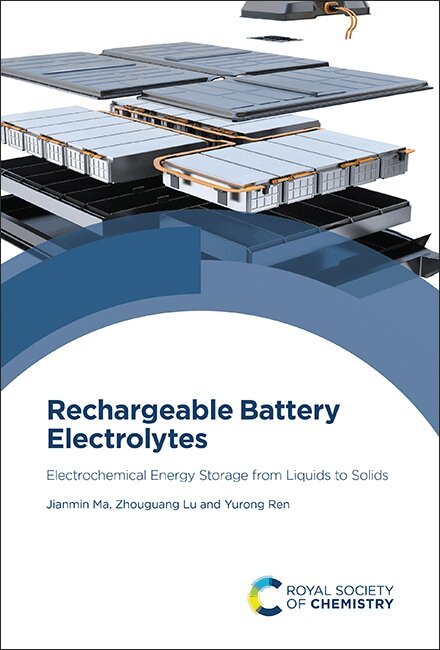
Rechargeable batteries are one of the crucial ways we are going to solve the sustainable energy crisis. Lithium-ion batteries have been commercialised and are heavily relied upon, however, the scarcity of lithium resources increases the production cost and hinders further application. Additionally, the toxic and flammable electrolyte brings many potential safety hazards including environmental pollution. Looking for low-cost, safe, and environmentally friendly alternatives to LIBs has become a valuable research direction.
The modification of batteries is focused on the anode, the cathode and electrolyte. Globally, researchers have moved onto new rechargeable batteries based on multivalent metal ions which have been extensively studied, including K+, Ca2+, Mg2+ and Al3+. However, the electrolyte is a very important component of a battery as its physical and chemical properties directly affect the electrochemical performance and energy storage mechanism.
Finding and selecting an appropriate electrolyte system is a crucial factor that must be taken into account to make these post-lithium-ion batteries commercially viable. Until now, it has been challenging to develop a suitable electrolyte with a wide electrochemical stability window and stable anode interface.
This book covers all the major ion-battery groups and their electrolytes, examining their performance and suitability in different solvents: aqueous, non-aqueous, solid gel and polymer.
It is suitable for all levels of students and researchers who want to understand the fundamentals and future challenges of developing electrolytes.
3 038 kr
Läs direkt efter köp
Rechargeable batteries are one of the crucial ways we are going to solve the sustainable energy crisis. Lithium-ion batteries have been commercialised and are heavily relied upon, however, the scarcity of lithium resources increases the production cost and hinders further application. Additionally, the toxic and flammable electrolyte brings many potential safety hazards including environmental pollution. Looking for low-cost, safe, and environmentally friendly alternatives to LIBs has become a valuable research direction.
The modification of batteries is focused on the anode, the cathode and electrolyte. Globally, researchers have moved onto new rechargeable batteries based on multivalent metal ions which have been extensively studied, including K+, Ca2+, Mg2+ and Al3+. However, the electrolyte is a very important component of a battery as its physical and chemical properties directly affect the electrochemical performance and energy storage mechanism.
Finding and selecting an appropriate electrolyte system is a crucial factor that must be taken into account to make these post-lithium-ion batteries commercially viable. Until now, it has been challenging to develop a suitable electrolyte with a wide electrochemical stability window and stable anode interface.
This book covers all the major ion-battery groups and their electrolytes, examining their performance and suitability in different solvents: aqueous, non-aqueous, solid gel and polymer.
It is suitable for all levels of students and researchers who want to understand the fundamentals and future challenges of developing electrolytes.
1 818 kr
Skickas inom 5-8 vardagar
1 612 kr
Skickas inom 3-6 vardagar
2 095 kr
Läs direkt efter köp
A state-of-the-art exploration of modern battery technology
In Battery Technologies: Materials and Components, distinguished researchers Dr. Jianmin Ma delivers a comprehensive and robust overview of battery technology and new and emerging technologies related to lithium, aluminum, dual-ion, flexible, and biodegradable batteries. The book offers practical information on electrode materials, electrolytes, and the construction of battery systems. It also considers potential approaches to some of the primary challenges facing battery designers and manufacturers today.
Battery Technologies: Materials and Components provides readers with:
A thorough introduction to the lithium-ion battery, including cathode and anode materials, electrolytes, and binders Comprehensive explorations of lithium-oxygen batteries, including battery systems, catalysts, and anodes Practical discussions of redox flow batteries, aqueous batteries, biodegradable batteries, and flexible batteries In-depth examinations of dual-ion batteries, aluminum ion batteries, and zinc-oxygen batteriesPerfect for inorganic chemists, materials scientists, and electrochemists, Battery Technologies: Materials and Components will also earn a place in the libraries of catalytic and polymer chemists seeking a one-stop resource on battery technology.
2 077 kr
Läs direkt efter köp
A state-of-the-art exploration of modern battery technology
In Battery Technologies: Materials and Components, distinguished researchers Dr. Jianmin Ma delivers a comprehensive and robust overview of battery technology and new and emerging technologies related to lithium, aluminum, dual-ion, flexible, and biodegradable batteries. The book offers practical information on electrode materials, electrolytes, and the construction of battery systems. It also considers potential approaches to some of the primary challenges facing battery designers and manufacturers today.
Battery Technologies: Materials and Components provides readers with:
A thorough introduction to the lithium-ion battery, including cathode and anode materials, electrolytes, and binders Comprehensive explorations of lithium-oxygen batteries, including battery systems, catalysts, and anodes Practical discussions of redox flow batteries, aqueous batteries, biodegradable batteries, and flexible batteries In-depth examinations of dual-ion batteries, aluminum ion batteries, and zinc-oxygen batteriesPerfect for inorganic chemists, materials scientists, and electrochemists, Battery Technologies: Materials and Components will also earn a place in the libraries of catalytic and polymer chemists seeking a one-stop resource on battery technology.
2 542 kr
Läs direkt efter köp
Explore green catalytic reactions with this reference from a renowned leader in the field
Green reactions—like photo-, photoelectro-, and electro-catalytic reactions—offer viable technologies to solve difficult problems without significant damage to the environment. In particular, some gas-involved reactions are especially useful in the creation of liquid fuels and cost-effective products.
In Photo- and Electro-Catalytic Processes: Water Splitting, N2 Fixing, CO2 Reduction, award-winning researcher Jianmin Ma delivers a comprehensive overview of photo-, electro-, and photoelectron-catalysts in a variety of processes, including O2 reduction, CO2 reduction, N2 reduction, H2 production, water oxidation, oxygen evolution, and hydrogen evolution. The book offers detailed information on the underlying mechanisms, costs, and synthetic methods of catalysts.
Filled with authoritative and critical information on green catalytic processes that promise to answer many of our most pressing energy and environmental questions, this book also includes:
Thorough introductions to electrocatalytic oxygen reduction and evolution reactions, as well as electrocatalytic hydrogen evolution reactions Comprehensive explorations of electrocatalytic water splitting, CO2 reduction, and N2 reduction Practical discussions of photoelectrocatalytic H2 production, water splitting, and CO2 reduction In-depth examinations of photoelectrochemical oxygen evolution and nitrogen reductionPerfect for catalytic chemists and photochemists, Photo- and Electro-Catalytic Processes: Water Splitting, N2 Fixing, CO2 Reduction also belongs in the libraries of materials scientists and inorganic chemists seeking a one-stop resource on the novel aspects of photo-, electro-, and photoelectro-catalytic reactions.
2 519 kr
Läs direkt efter köp
Explore green catalytic reactions with this reference from a renowned leader in the field
Green reactions—like photo-, photoelectro-, and electro-catalytic reactions—offer viable technologies to solve difficult problems without significant damage to the environment. In particular, some gas-involved reactions are especially useful in the creation of liquid fuels and cost-effective products.
In Photo- and Electro-Catalytic Processes: Water Splitting, N2 Fixing, CO2 Reduction, award-winning researcher Jianmin Ma delivers a comprehensive overview of photo-, electro-, and photoelectron-catalysts in a variety of processes, including O2 reduction, CO2 reduction, N2 reduction, H2 production, water oxidation, oxygen evolution, and hydrogen evolution. The book offers detailed information on the underlying mechanisms, costs, and synthetic methods of catalysts.
Filled with authoritative and critical information on green catalytic processes that promise to answer many of our most pressing energy and environmental questions, this book also includes:
Thorough introductions to electrocatalytic oxygen reduction and evolution reactions, as well as electrocatalytic hydrogen evolution reactions Comprehensive explorations of electrocatalytic water splitting, CO2 reduction, and N2 reduction Practical discussions of photoelectrocatalytic H2 production, water splitting, and CO2 reduction In-depth examinations of photoelectrochemical oxygen evolution and nitrogen reductionPerfect for catalytic chemists and photochemists, Photo- and Electro-Catalytic Processes: Water Splitting, N2 Fixing, CO2 Reduction also belongs in the libraries of materials scientists and inorganic chemists seeking a one-stop resource on the novel aspects of photo-, electro-, and photoelectro-catalytic reactions.
1 787 kr
Läs direkt efter köp
An of-the-moment treatment of liquid electrolytes used in lithium metal batteries
Considered by many as the most-promising next-generation batteries, lithium metal batteries have grown in popularity due to their low potential and high capacity. Crucial to the development of this technology, electrolytes can provide efficient electrode electrolyte interfaces, assuring the interconversion of chemical and electrical energy. The quality of electrode electrolyte interphase, in turn, directly governs the performance of batteries.
In Liquid Electrolyte Chemistry, provides a comprehensive look at the current understanding and status of research regarding liquid electrolytes for lithium metal batteries. Offering an introduction to lithium-based batteries from development history to their working mechanisms, the book further offers a glimpse at modification strategies of anode electrolyte interphases and cathode electrolytic interphases. More, by discussing the high-voltage electrolytes from their solvents—organic solvents and ionic liquids—to electrolyte additives, the text provides a thorough understanding on liquid electrolyte chemistry in the remit of lithium metal batteries.
Liquid Electrolyte Chemistry for Lithium Metal Batteries readers will also find:
A unique focus that reviews the development of liquid electrolytes for lithium metal batteries State-of-the-art progress and development of electrolytes for lithium metal batteries Consideration of safety, focusing the design principles of flame retardant and non-flammable electrolytes Principles and progress on low temperature and high temperature electrolytesLiquid Electrolyte Chemistry for Lithium Metal Batteries is a useful reference for electrochemists, solid state chemists, inorganic chemists, physical chemists, surface chemists, materials scientists, and the libraries that supply them.
1 787 kr
Läs direkt efter köp
An of-the-moment treatment of liquid electrolytes used in lithium metal batteries
Considered by many as the most-promising next-generation batteries, lithium metal batteries have grown in popularity due to their low potential and high capacity. Crucial to the development of this technology, electrolytes can provide efficient electrode electrolyte interfaces, assuring the interconversion of chemical and electrical energy. The quality of electrode electrolyte interphase, in turn, directly governs the performance of batteries.
In Liquid Electrolyte Chemistry, provides a comprehensive look at the current understanding and status of research regarding liquid electrolytes for lithium metal batteries. Offering an introduction to lithium-based batteries from development history to their working mechanisms, the book further offers a glimpse at modification strategies of anode electrolyte interphases and cathode electrolytic interphases. More, by discussing the high-voltage electrolytes from their solvents—organic solvents and ionic liquids—to electrolyte additives, the text provides a thorough understanding on liquid electrolyte chemistry in the remit of lithium metal batteries.
Liquid Electrolyte Chemistry for Lithium Metal Batteries readers will also find:
A unique focus that reviews the development of liquid electrolytes for lithium metal batteries State-of-the-art progress and development of electrolytes for lithium metal batteries Consideration of safety, focusing the design principles of flame retardant and non-flammable electrolytes Principles and progress on low temperature and high temperature electrolytesLiquid Electrolyte Chemistry for Lithium Metal Batteries is a useful reference for electrochemists, solid state chemists, inorganic chemists, physical chemists, surface chemists, materials scientists, and the libraries that supply them.
1 819 kr
Skickas inom 10-15 vardagar
2 283 kr
Läs direkt efter köp
The field of new energy batteries is a major national strategy and a hot spot for research and development. Particular attention is paid to battery technology and electrode materials. In recent years, the importance of electrolytes has become increasingly prominent, but there is still a long way to go for practitioners to train in this field, mainly due to their lack of knowledge and technology. It is in this context that the book was planned and designed. The main feature and advantage of the book is that the author combines academic and practical work according to his own industry and scientific research experience, which is also an important advantage of the book. It is expected that this book will have important guiding value for graduate students in the field of electrochemistry in universities and technicians in battery companies.
The translation was done with the help of artificial intelligence. A subsequent human revision was done primarily in terms of content.