Joel S. Miller – författare
Visar alla böcker från författaren Joel S. Miller. Handla med fri frakt och snabb leverans.
13 produkter
13 produkter
Del 198 - NATO Science Series E:
Magnetic Molecular Materials
Inbunden, Engelska, 1991
2 160 kr
Skickas inom 10-15 vardagar
One of the major challenges of science in the last few years of the second millennium is learning how to design materials which can fulfill specific tasks. Ambitious as it may be, the possibilities of success are not ne~li~ble provided that all the different expertises merge to overcome the limits of eXIsting disciplines and forming new paradigms science. The NATO Advanced Research Workshop on "Magnetic Molecular Materials" was organized with the above considerations in mind in order to determine which are the most appropriate synthetic strategies, experimental techniques of investigation, and theoretical models which are needed in order to develop new classes of magnetic materials which are based on molecules rather than on metallic or ionic lattices. Why molecules? The answer may be obvious: molecular chemistry in principle fine can tune the structures and the properties of complex aggregates, and nature already provides a large number of molecular aggregates which can perform the most disparate functions. The contributions collected in this book provide a rather complete view of the current research accomplishments of magnetic molecular materials. There are several different synthetic approaches which are followed ranging from purely organic to inorganic materials. Some encouraging successes have already been achieved, even if the critical temperatures below which magnetic order is observed still are in the range requiring liquid helium.
Del 321 - NATO Science Series E:
Molecular Magnetism: From Molecular Assemblies to the Devices
Inbunden, Engelska, 1996
5 390 kr
Skickas inom 10-15 vardagar
Molecular Magnetism: From Molecular Assemblies to the Devices reviews the state of the art in the area. It is organized in two parts, the first of which introduces the basic concepts, theories and physical techniques required for the investigation of the magnetic molecular materials, comparing them with those used in the study of classical magnetic materials. Here the reader will find: (i) a detailed discussion of the electronic processes involved in the magnetic interaction mechanisms of molecular systems, including electron delocalization and spin polarization effects; (ii) a presentation of the available theoretical models based on spin and Hubbard Hamiltonians; and (iii) a description of the specific physical investigative techniques used to characterize the materials. The second part presents the different classes of existing magnetic molecular materials, focusing on the possible synthetic strategies developed to date to assemble the molecular building blocks ranging from purely organic to inorganic materials, as well as on their physical properties and potential applications. These materials comprise inorganic and organic ferro- and ferrimagnets, high nuclearity organic molecules and magnetic and metallic clusters, spin crossover systems, charge transfer salts (including fulleride salts and organic conductors and superconductors), and organized soft media (magnetic liquid crystals and Langmuir-Blodgett films).
E-bok
PDF, Engelska, 2013687 kr
Läs direkt efter köp
Linear chain substances span a large cross section of contemporary chemistry ranging from covalent polymers, to organic charge transfer com plexes to nonstoichiometric transition metal coordination complexes. Their commonality, which coalesced intense interest in the theoretical and exper imental solid state physics/chemistry communities, was based on the obser vation that these inorganic and organic polymeric substrates exhibit striking metal-like electrical and optical properties. Exploitation and extension of these systems has led to the systematic study of both the chemistry and physics of highly and poorly conducting linear chain substances. To gain a salient understanding of these complex materials rich in anomalous aniso tropic electrical, optical, magnetic, and mechanical properties, the conver gence of diverse skills and talents was required. The constructive blending of traditionally segregated disciplines such as synthetic and physical organic, inorganic, and polymer chemistry, crystallography, and theoretical and ex perimental solid state physics has led to the timely development of a truly interdisciplinary science. This is evidenced in the contributions of this monograph series. Within the theme of Extended Linear Chain Compounds, experts in important, but varied, facets of the discipline have reflected upon the progress that has been made and have cogently summarized their field of specialty. Consequently, up-to-date reviews of numerous and varied aspects of "extended linear chain compounds" have developed. Within these vol umes, numerous incisive contributions covering all aspects of the diverse linear chain substances have been summarized.
Häftad, Engelska, 2011
545 kr
Skickas inom 10-15 vardagar
Linear chain substances span a large cross section of contemporary chemistry ranging from covalent polymers, to organic charge transfer com plexes to nonstoichiometric transition metal coordination complexes. Their commonality, which coalesced intense interest in the theoretical and exper imental solid state physics/chemistry communities, was based on the obser vation that these inorganic and organic polymeric substrates exhibit striking metal-like electrical and optical properties. Exploitation and extension of these systems has led to the systematic study of both the chemistry and physics of highly and poorly conducting linear chain substances. To gain a salient understanding of these complex materials rich in anomalous aniso tropic electrical, optical, magnetic, and mechanical properties, the conver gence of diverse skills and talents was required. The constructive blending of traditionally segregated disciplines such as synthetic and physical organic, inorganic, and polymer chemistry, crystallography, and theoretical and ex perimental solid state physics has led to the timely development of a truly interdisciplinary science. This is evidenced in the contributions of this monograph series. Within the theme of Extended Linear Chain Compounds, experts in important, but varied, facets of the discipline have reflected upon the progress that has been made and have cogently summarized their field of specialty. Consequently, up-to-date reviews of numerous and varied aspects of "extended linear chain compounds" have developed. Within these vol umes, numerous incisive contributions covering all aspects of the diverse linear chain substances have been summarized.
Häftad, Engelska, 2012
545 kr
Skickas inom 10-15 vardagar
Linear chain substances span a large cross section of contemporary chemistry ranging from covalent polymers, to organic charge transfer com plexes to nonstoichiometric transition metal coordination complexes. Their commonality, which coalesced intense interest in the theoretical and exper imental solid state physics/chemistry communities, was based on the obser vation that these inorganic and organic polymeric substrates exhibit striking metal-like elec,trical and optical properties. Exploitation and extension of these systems has led to the systematic study of both the chemistry and physics of highly and poorly conducting linear chain substances. To gain a salient understanding of these complex materials rich in anomalous aniso tropic electrical, optical, magnetic, and mechanical properties, the conver gence of diverse skills and talents was required. The constructive blending of traditionally segregated disciplines such as synthetic and physical organic, inorganic, and polymer chemistry, crystallography, and theoretical and ex perimental solid state physics has led to the timely development of a truly interdisciplinary science. This is evidenced in the contributions of this monograph series. Within the theme of Extended Linear Chain Compounds, experts in important, but varied, facets of the discipline have reflected upon the progress that has been made and have cogently summarized their field of speciality. Consequently, up-to-date reviews of numerous and varied aspects of "extended linear chain compounds" have developed. Within these vol umes, numerous incisive contributions covering all aspects of the diverse linear chain substances have been summarized.
E-bok
PDF, Engelska, 2012712 kr
Läs direkt efter köp
Linear chain substances span a large cross section of contemporary chemis try ranging from covalent polymers, organic charge transfer complexes to nonstoichiometric transition metal coordination complexes. Their common ality, which coalesced intense interest in the theoretical and experimental solid-state-physics/chemistry communities, was based on the observation that these inorganic and organic polymeric substrates exhibit striking metal-like electrical and optical properties. Exploitation and extension of these systems has led to the systematic study of both the chemistry and physics of highly and poorly conducting linear chain substances. To gain a salient understanding of these complex materials rich in anomalous anisotropic electrical, optical, magnetic, and mechanical properties, the convergence of diverse skills and talents was required. The constructive blending of traditionally segregated disciplines such as synthetic and physical organic, inorganic, and polymer chemistry, crystallography, and theoretical and experimental solid state physics has led to the timely devel opment of a truly interdisciplinary science. This is evidenced in the contri butions of this monograph series. Within the theme of Extended Linear Chain Compounds, experts in important, but varied, facets of the discipline have reflected upon the progress that has been made and have cogently summarized their field of specialty. Consequently, up-to-date reviews of numerous and varied aspects of "extended linear chain compounds" has developed. Within these volumes, numerous incisive contributions covering all aspects of the diverse linear chain substances have been summarized. I am confident that assimilation of the state-of-the-art and clairvoy ance will be rewarded with extraordinarydevelopments in the near future.
Häftad, Engelska, 2012
545 kr
Skickas inom 10-15 vardagar
Linear chain substances span a large cross section of contemporary chemis try ranging from covalent polymers, organic charge transfer complexes to nonstoichiometric transition metal coordination complexes. Their common ality, which coalesced intense interest in the theoretical and experimental solid-state-physics/chemistry communities, was based on the observation that these inorganic and organic polymeric substrates exhibit striking metal-like electrical and optical properties. Exploitation and extension of these systems has led to the systematic study of both the chemistry and physics of highly and poorly conducting linear chain substances. To gain a salient understanding of these complex materials rich in anomalous anisotropic electrical, optical, magnetic, and mechanical properties, the convergence of diverse skills and talents was required. The constructive blending of traditionally segregated disciplines such as synthetic and physical organic, inorganic, and polymer chemistry, crystallography, and theoretical and experimental solid state physics has led to the timely devel opment of a truly interdisciplinary science. This is evidenced in the contri butions of this monograph series. Within the theme of Extended Linear Chain Compounds, experts in important, but varied, facets of the discipline have reflected upon the progress that has been made and have cogently summarized their field of specialty. Consequently, up-to-date reviews of numerous and varied aspects of "extended linear chain compounds" has developed. Within these volumes, numerous incisive contributions covering all aspects of the diverse linear chain substances have been summarized. I am confident that assimilation of the state-of-the-art and clairvoy ance will be rewarded with extraordinarydevelopments in the near future.
E-bok
PDF, Engelska, 20062 784 kr
Läs direkt efter köp
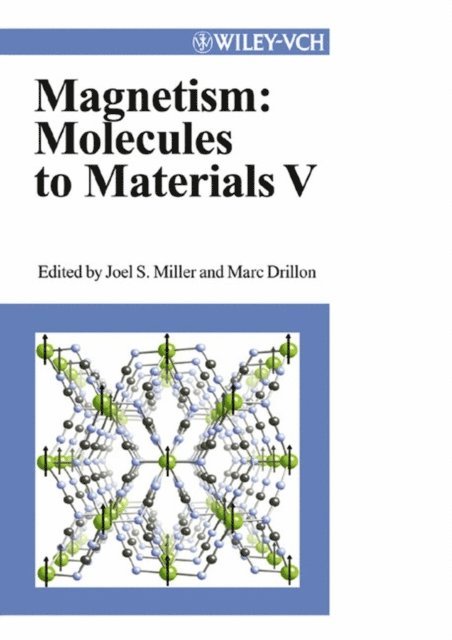
Combining the contemporary knowledge from widely scattered sources, this is a much-needed and comprehensive overview of the field. In maintaining a balance between theory and experiment, the book guides both advanced students and specialists to this research area. Topical reviews written by the foremost scientists explain recent trends and advances, focusing on the correlations between electronic structure and magnetic properties. The book spans recent trends in magnetism for molecules -- as well as inorganic-based materials, with an emphasis on new phenomena being explored from both experimental and theoretical viewpoints with the aim of understanding magnetism on the atomic scale. The volume helps readers evaluate their own experimental observations and serves as a basis for the design of new magnetic materials. Topics covered include: * Metallocenium Salts of Radical Anion Bis-(dichalcogenate) metalates * Chiral Molecule-Based Magnets * Cooperative Magnetic Behavior in Metal-Dicyanamide Complexes * Lanthanide Ions in Molecular Exchange Coupled Systems * Monte Carlo Simulation * Metallocene-Based Magnets * Magnetic Nanoporous Molecular Materials A unique reference work, indispensable for everyone concerned with the phenomena of magnetism.
E-bok
PDF, Engelska, 20062 990 kr
Läs direkt efter köp
Magnetic phenomena and materials are everywhere. Our understanding of magnetic behavior, once thought to be mature, has enjoyed new impetus from contributions ranging from molecular chemistry, materials chemistry and sciences to solid state physics. New phenomena are explored that open promising perspectives for commercial applications in future - carrying out chemical reactions in magnetic fields is just one of those. The spectrum spans molecule-based - organic, (bio)inorganic, and hybrid - compounds, metallic materials as well as their oxides forming thin films, nanoparticles, wires etc. Reflecting contemporary knowledge, this open series of volumes provides a much-needed comprehensive overview of this growing interdisciplinary field. Topical reviews written by foremost scientists explain the trends and latest advances in a clear and detailed way. By maintaining the balance between theory and experiment, the book provides a guide for both advanced students and specialists to this research area. It will help evaluate their own experimental observations and serve as a basis for the design of new magnetic materials. A unique reference work, indispensable for everyone concerned with the phenomena of magnetism!
Häftad, Engelska, 2010
5 384 kr
Skickas inom 10-15 vardagar
Molecular Magnetism: From Molecular Assemblies to the Devices reviews the state of the art in the area. It is organized in two parts, the first of which introduces the basic concepts, theories and physical techniques required for the investigation of the magnetic molecular materials, comparing them with those used in the study of classical magnetic materials. Here the reader will find: (i) a detailed discussion of the electronic processes involved in the magnetic interaction mechanisms of molecular systems, including electron delocalization and spin polarization effects; (ii) a presentation of the available theoretical models based on spin and Hubbard Hamiltonians; and (iii) a description of the specific physical investigative techniques used to characterize the materials. The second part presents the different classes of existing magnetic molecular materials, focusing on the possible synthetic strategies developed to date to assemble the molecular building blocks ranging from purely organic to inorganic materials, as well as on their physical properties and potential applications. These materials comprise inorganic and organic ferro- and ferrimagnets, high nuclearity organic molecules and magnetic and metallic clusters, spin crossover systems, charge transfer salts (including fulleride salts and organic conductors and superconductors), and organized soft media (magnetic liquid crystals and Langmuir-Blodgett films).
Häftad, Engelska, 2012
2 158 kr
Skickas inom 10-15 vardagar
One of the major challenges of science in the last few years of the second millennium is learning how to design materials which can fulfill specific tasks. Ambitious as it may be, the possibilities of success are not ne~li~ble provided that all the different expertises merge to overcome the limits of eXIsting disciplines and forming new paradigms science. The NATO Advanced Research Workshop on "Magnetic Molecular Materials" was organized with the above considerations in mind in order to determine which are the most appropriate synthetic strategies, experimental techniques of investigation, and theoretical models which are needed in order to develop new classes of magnetic materials which are based on molecules rather than on metallic or ionic lattices. Why molecules? The answer may be obvious: molecular chemistry in principle fine can tune the structures and the properties of complex aggregates, and nature already provides a large number of molecular aggregates which can perform the most disparate functions. The contributions collected in this book provide a rather complete view of the current research accomplishments of magnetic molecular materials. There are several different synthetic approaches which are followed ranging from purely organic to inorganic materials. Some encouraging successes have already been achieved, even if the critical temperatures below which magnetic order is observed still are in the range requiring liquid helium.
E-bok
PDF, Engelska, 20122 840 kr
Läs direkt efter köp
One of the major challenges of science in the last few years of the second millennium is learning how to design materials which can fulfill specific tasks. Ambitious as it may be, the possibilities of success are not ne~li~ble provided that all the different expertises merge to overcome the limits of eXIsting disciplines and forming new paradigms science. The NATO Advanced Research Workshop on "Magnetic Molecular Materials" was organized with the above considerations in mind in order to determine which are the most appropriate synthetic strategies, experimental techniques of investigation, and theoretical models which are needed in order to develop new classes of magnetic materials which are based on molecules rather than on metallic or ionic lattices. Why molecules? The answer may be obvious: molecular chemistry in principle fine can tune the structures and the properties of complex aggregates, and nature already provides a large number of molecular aggregates which can perform the most disparate functions. The contributions collected in this book provide a rather complete view of the current research accomplishments of magnetic molecular materials. There are several different synthetic approaches which are followed ranging from purely organic to inorganic materials. Some encouraging successes have already been achieved, even if the critical temperatures below which magnetic order is observed still are in the range requiring liquid helium.
E-bok
PDF, Engelska, 20136 923 kr
Läs direkt efter köp
Molecular Magnetism: From Molecular Assemblies to the Devices reviews the state of the art in the area. It is organized in two parts, the first of which introduces the basic concepts, theories and physical techniques required for the investigation of the magnetic molecular materials, comparing them with those used in the study of classical magnetic materials. Here the reader will find: (i) a detailed discussion of the electronic processes involved in the magnetic interaction mechanisms of molecular systems, including electron delocalization and spin polarization effects; (ii) a presentation of the available theoretical models based on spin and Hubbard Hamiltonians; and (iii) a description of the specific physical investigative techniques used to characterize the materials. The second part presents the different classes of existing magnetic molecular materials, focusing on the possible synthetic strategies developed to date to assemble the molecular building blocks ranging from purely organic to inorganic materials, as well as on their physical properties and potential applications. These materials comprise inorganic and organic ferro- and ferrimagnets, high nuclearity organic molecules and magnetic and metallic clusters, spin crossover systems, charge transfer salts (including fulleride salts and organic conductors and superconductors), and organized soft media (magnetic liquid crystals and Langmuir-Blodgett films).