O. Kahn - Böcker
Visar alla böcker från författaren O. Kahn. Handla med fri frakt och snabb leverans.
7 produkter
7 produkter
2 121 kr
Skickas inom 10-15 vardagar
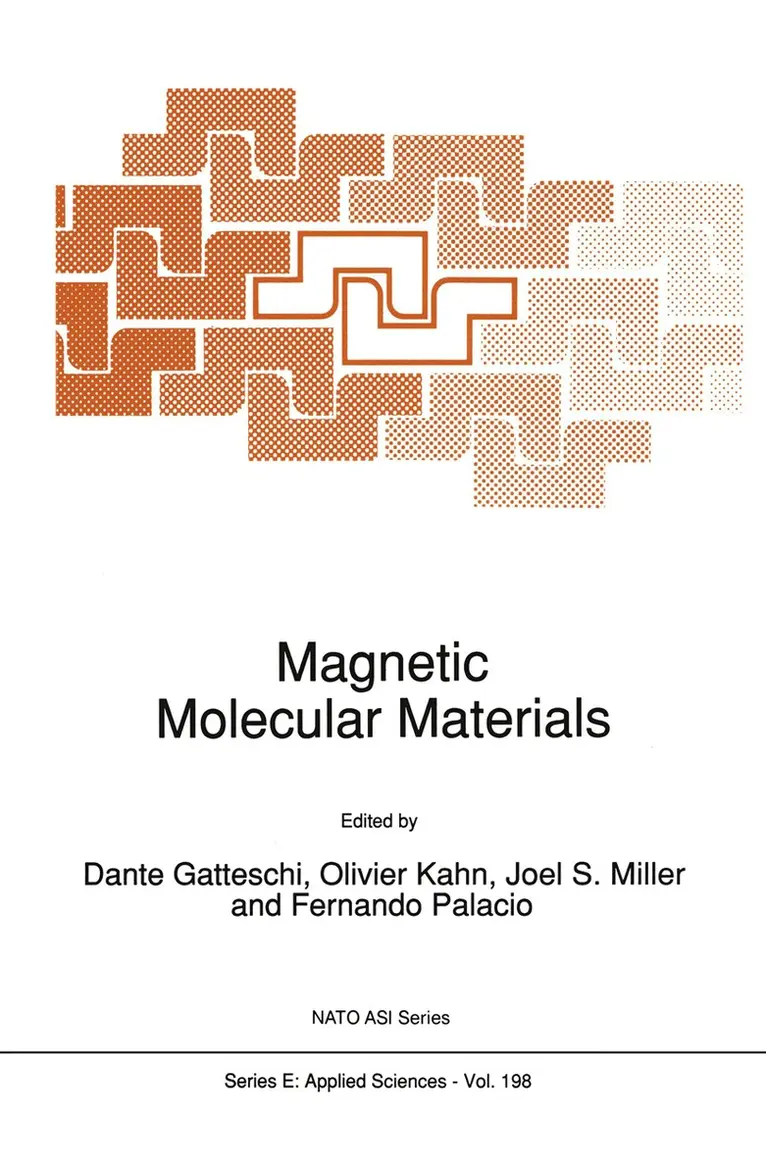
One of the major challenges of science in the last few years of the second millennium is learning how to design materials which can fulfill specific tasks. Ambitious as it may be, the possibilities of success are not ne~li~ble provided that all the different expertises merge to overcome the limits of eXIsting disciplines and forming new paradigms science. The NATO Advanced Research Workshop on "Magnetic Molecular Materials" was organized with the above considerations in mind in order to determine which are the most appropriate synthetic strategies, experimental techniques of investigation, and theoretical models which are needed in order to develop new classes of magnetic materials which are based on molecules rather than on metallic or ionic lattices. Why molecules? The answer may be obvious: molecular chemistry in principle fine can tune the structures and the properties of complex aggregates, and nature already provides a large number of molecular aggregates which can perform the most disparate functions. The contributions collected in this book provide a rather complete view of the current research accomplishments of magnetic molecular materials. There are several different synthetic approaches which are followed ranging from purely organic to inorganic materials. Some encouraging successes have already been achieved, even if the critical temperatures below which magnetic order is observed still are in the range requiring liquid helium.
3 178 kr
Skickas inom 10-15 vardagar
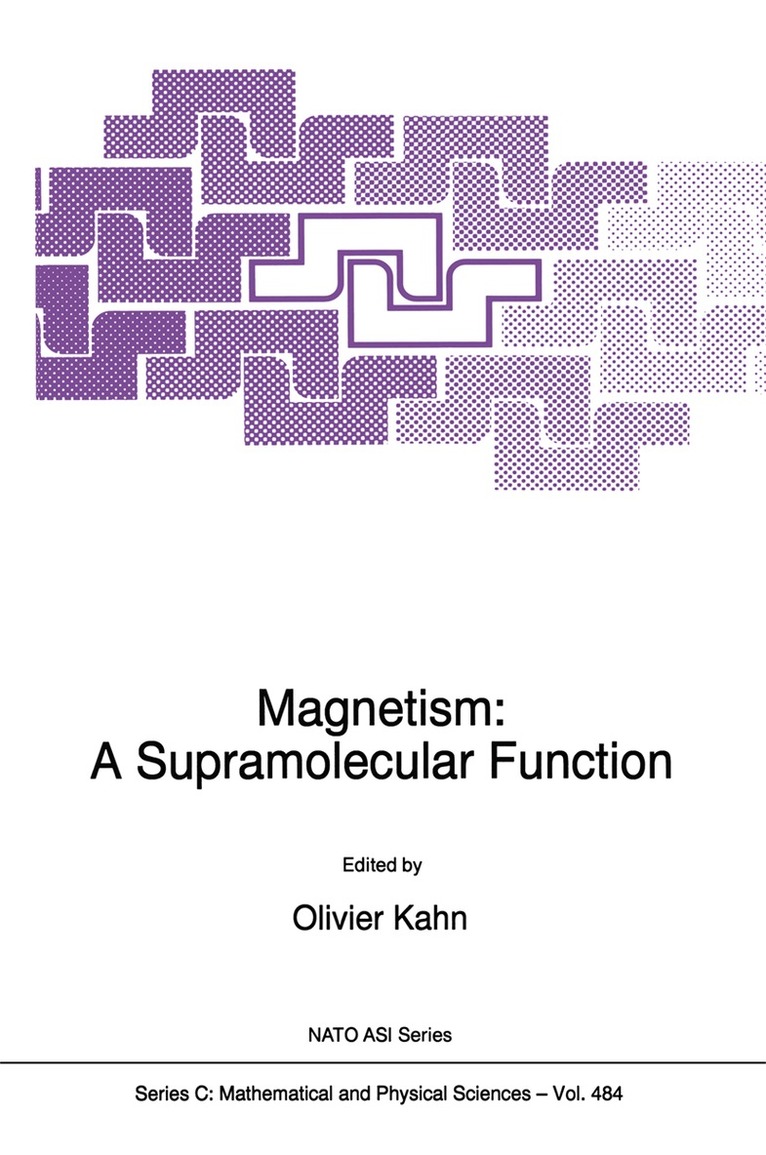
Molecular magnetism is a new field of research dealing with the synthesis and study of the physical properties of molecular assemblies involving open-shell units. It is essentially interdisciplinary, joining together organic, organometallic and inorganic chemists, as well as theoreticians, physicists and materials scientists.At the core of research into molecular magnetism lie design and synthesis of new molecular assemblies exhibiting bulk properties such as long-range magnetic ordering or bistability with an hysteresis effect, which confers a memory effect on the system. In such terms, magnetism may be considered a supramolecular function.The first eight contributions to this volume present the state of the art in organic supramolecular chemistry, emphasising interlocked systems and molecular trees. The following six articles are devoted to molecular materials constructed from organic radicals and transition metal units. Molecular bistability is then focused on, followed by metal-organic and coordination magnetic materials. A new approach to nano-sized particles closes the work.
1 746 kr
Skickas inom 7-10 vardagar
1 798 kr
Skickas inom 5-8 vardagar
2 121 kr
Kommande
3 168 kr
Skickas inom 10-15 vardagar
Molecular magnetism is a new field of research dealing with the synthesis and study of the physical properties of molecular assemblies involving open-shell units. It is essentially interdisciplinary, joining together organic, organometallic and inorganic chemists, as well as theoreticians, physicists and materials scientists.At the core of research into molecular magnetism lie design and synthesis of new molecular assemblies exhibiting bulk properties such as long-range magnetic ordering or bistability with an hysteresis effect, which confers a memory effect on the system. In such terms, magnetism may be considered a supramolecular function.The first eight contributions to this volume present the state of the art in organic supramolecular chemistry, emphasising interlocked systems and molecular trees. The following six articles are devoted to molecular materials constructed from organic radicals and transition metal units. Molecular bistability is then focused on, followed by metal-organic and coordination magnetic materials. A new approach to nano-sized particles closes the work.
2 121 kr
Skickas inom 10-15 vardagar
One of the major challenges of science in the last few years of the second millennium is learning how to design materials which can fulfill specific tasks. Ambitious as it may be, the possibilities of success are not ne~li~ble provided that all the different expertises merge to overcome the limits of eXIsting disciplines and forming new paradigms science. The NATO Advanced Research Workshop on "Magnetic Molecular Materials" was organized with the above considerations in mind in order to determine which are the most appropriate synthetic strategies, experimental techniques of investigation, and theoretical models which are needed in order to develop new classes of magnetic materials which are based on molecules rather than on metallic or ionic lattices. Why molecules? The answer may be obvious: molecular chemistry in principle fine can tune the structures and the properties of complex aggregates, and nature already provides a large number of molecular aggregates which can perform the most disparate functions. The contributions collected in this book provide a rather complete view of the current research accomplishments of magnetic molecular materials. There are several different synthetic approaches which are followed ranging from purely organic to inorganic materials. Some encouraging successes have already been achieved, even if the critical temperatures below which magnetic order is observed still are in the range requiring liquid helium.