Johannes Müller – författare
Visar alla böcker från författaren Johannes Müller. Handla med fri frakt och snabb leverans.
108 produkter
Trypillia Mega-Sites and European Prehistory
4100-3400 BCE
Av Johannes Müller, Knut Rassmann m. fl.
Häftad, 2019
831 kr
Lägg i varukorg
In European prehistory population agglomerations of more than 10,000 inhabitants per site are a seldom phenomenon. A big surprise to the archaeological community was the discovery of Trypillia mega-sites of more than 250 hectares and with remains of more than 2000 houses by a multidisciplinary …
Course in Mathematical Biology
Quantitative Modeling with Mathematical and Computational Methods
Av Gerda de Vries, Thomas Hillen m. fl.
Häftad, 2006
1100 kr
Lägg i varukorg
The field of mathematical biology is growing rapidly. Questions about infectious diseases, heart attacks, cell signaling, cell movement, ecology, environmental changes, and genomics are now being analyzed using mathematical and computational methods. A Course in Mathematical Biology teaches all …
Beyträge zur Nördlingischen Geschlechtshistorie.
Av Daniel Eberhardt Beyschlag, Johannes Müller
Inbunden, 2022
426 kr
Lägg i varukorg
Beyträge zur Nördlingischen Geschlechtshistorie.
Av Daniel Eberhardt Beyschlag, Johannes Müller
Häftad, 2022
302 kr
Lägg i varukorg
Handbuch der Physiologie des Menschen für Vorlesungen, Erster Band
Inbunden, 2022
569 kr
Lägg i varukorg
Zur Vergleichenden Physiologie des Gesichtssinnes des Menschen und der Thiere
Inbunden, 2022
484 kr
Lägg i varukorg
Zur Vergleichenden Physiologie des Gesichtssinnes des Menschen und der Thiere
Häftad, 2022
356 kr
Lägg i varukorg
Beyträge zur Nördlingischen Geschlechtshistorie. Zweyter Theil. Zweyte Abtheilung.
Av Daniel Eberhardt Beyschlag, Johannes Müller
Inbunden, 2022
398 kr
Lägg i varukorg
Beyträge zur Nördlingischen Geschlechtshistorie. Zweyter Theil. Zweyte Abtheilung.
Av Daniel Eberhardt Beyschlag, Johannes Müller
Häftad, 2022
294 kr
Lägg i varukorg
Handbuch der Physiologie des Menschen. Zweiten Bandes erste Abtheilung.
Inbunden, 2023
514 kr
Lägg i varukorg
Vor- Und Frühreformatorische Schulordnungen Und Schulverträge in Deutscher Und Niederländerischer Sprache
Av Johannes Müller, Austria m. fl.
Inbunden, 2023
407 kr
Lägg i varukorg
Quellenschriften Und Geschichte Des Deutschsprachlichen Unterrichtes
Bis Zur Mitte Des 16. Jahrhunderts
Inbunden, 2023
455 kr
Lägg i varukorg
Handbuch der Physiologie des Menschen. Zweiten Bandes erste Abtheilung.
Häftad, 2023
388 kr
Lägg i varukorg
Vor- Und Frühreformatorische Schulordnungen Und Schulverträge in Deutscher Und Niederländerischer Sprache
Av Johannes Müller, Austria m. fl.
Häftad, 2023
289 kr
Lägg i varukorg
Quellenschriften Und Geschichte Des Deutschsprachlichen Unterrichtes
Bis Zur Mitte Des 16. Jahrhunderts
Häftad, 2023
323 kr
Lägg i varukorg
Far From the Truth
Distance, Information, and Credibility in the Early Modern World
Av Michiel van Groesen, Johannes Müller
Inbunden, 2023
2590 kr
Lägg i varukorg
Information and knowledge were essential tools of early modern Europe’s global ambitions. This volume addresses a key concern that emerged as the competition for geopolitical influence increased: how could information from afar be trusted when there was no obvious strategy for verification? How did …
Far From the Truth
Distance, Information, and Credibility in the Early Modern World
Av Michiel van Groesen, Johannes Müller
Häftad, 2025
728 kr
Lägg i varukorg
Information and knowledge were essential tools of early modern Europe’s global ambitions. This volume addresses a key concern that emerged as the competition for geopolitical influence increased: how could information from afar be trusted when there was no obvious strategy for verification? How did …
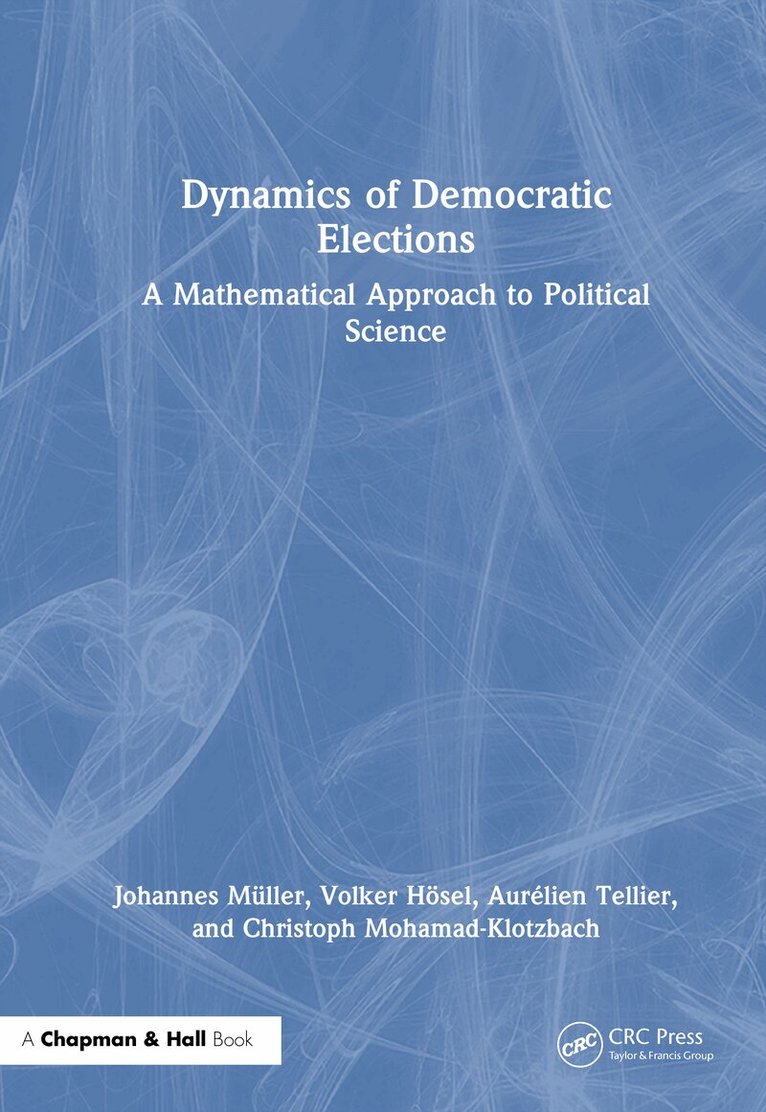
Dynamics of Democratic Elections
A Mathematical Approach to Political Science
Av Johannes Müller, Volker Hösel m. fl.
Inbunden, 2025
3070 kr
Lägg i varukorg
Dynamics of Democratic Elections explores modeling approaches to democratic elections and opinion dynamics at the intersection of mathematics, political science, and computational modeling. The book focuses on relatively simple models, their analysis, and how they perform in real-world …
Dynamics of Democratic Elections
A Mathematical Approach to Political Science
Av Johannes Müller, Volker Hösel m. fl.
Häftad, 2025
969 kr
Lägg i varukorg
Dynamics of Democratic Elections explores modeling approaches to democratic elections and opinion dynamics at the intersection of mathematics, political science, and computational modeling. The book focuses on relatively simple models, their analysis, and how they perform in real-world …
Dynamics of Democratic Elections
A Mathematical Approach to Political Science
Av Christoph Mohamad-Klotzbach, Aurelien Tellier m. fl.
E-bok, 2025
1022 kr
Lägg i varukorg
Dynamics of Democratic Elections explores modeling approaches to democratic elections and opinion dynamics at the intersection of mathematics, political science, and computational modeling. The book focuses on relatively simple models, their analysis, and how they perform in real-world …
Dynamics of Democratic Elections
A Mathematical Approach to Political Science
Av Christoph Mohamad-Klotzbach, Aurelien Tellier m. fl.
E-bok, 2025
1022 kr
Lägg i varukorg
Dynamics of Democratic Elections explores modeling approaches to democratic elections and opinion dynamics at the intersection of mathematics, political science, and computational modeling. The book focuses on relatively simple models, their analysis, and how they perform in real-world …
Trypillia Mega-Sites and European Prehistory
4100-3400 BCE
Av Mykhailo Videiko, Knut Rassmann m. fl.
E-bok, 2016
981 kr
Lägg i varukorg
In European prehistory population agglomerations of more than 10,000 inhabitants per site are a seldom phenomenon. A big surprise to the archaeological community was the discovery of Trypillia mega-sites of more than 250 hectares and with remains of more than 2000 houses by a multidisciplinary …
Trypillia Mega-Sites and European Prehistory
4100-3400 BCE
Av Mykhailo Videiko, Knut Rassmann m. fl.
E-bok, 2016
981 kr
Lägg i varukorg
In European prehistory population agglomerations of more than 10,000 inhabitants per site are a seldom phenomenon. A big surprise to the archaeological community was the discovery of Trypillia mega-sites of more than 250 hectares and with remains of more than 2000 houses by a multidisciplinary …