John Deely – författare
Visar alla böcker från författaren John Deely. Handla med fri frakt och snabb leverans.
23 produkter
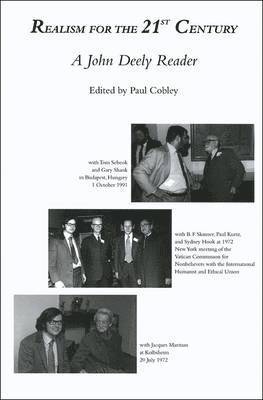
Realism for the 21st Century
A John Deely Reader
Häftad, 2010
366 kr
Lägg i varukorg
"Realism for the 21st Century" is a collection of thirty essays from John Deely - a major figure in contemporary semiotics and an authority on scholastic realism and the works of Charles Sanders Peirce. The volume tracks Deely's development as a pragmatic realist, featuring his early essays on our …
Introducing Semiotics
Its History and Doctrine
Av John Deely
Häftad, 1982
219 kr
Lägg i varukorg
The appeal of semiotics lies in its apparent ability to establish a common framework for all disciplines, a framework rooted in the understanding of the sign as the universal means of communication. Introducing Semiotic provides a synoptic view of semiotic development, covering for the first time …
Frontiers in Semiotics
Av John Deely, Brooke Williams m. fl.
Häftad, 1986
225 kr
Lägg i varukorg
Semiotics is rapidly establishing itself as one of the most fruitful and exciting fields of intellectual inquiry. Literary scholars, philosophers, social scientists, and students of linguistics and communication are all finding something of value in the various insights and approaches to knowledge …
Human Use of Signs
Or Elements of Anthroposemiosis
Av John Deely
Häftad, 1993
713 kr
Lägg i varukorg
'An impressive synthesis of semiotics and anthropology which puts human experience in a new light. Deely gives us the foundation for a new paradigm for anthropology.' -Nathan Houser, Peirce Edition Project
Four Ages of Understanding
The First Postmodern Survey of Philosophy from Ancient Times to the Turn of the Twenty-First Century
Av John Deely
Häftad, 2011
716 kr
Lägg i varukorg
This book redraws the intellectual map and sets the agenda in philosophy for the next fifty or so years. By making the theory of signs the dominant theme in Four Ages of Understanding, John Deely has produced a history of philosophy that is innovative, original, and complete. The first full-scale …
Four Ages of Understanding
The First Postmodern Survey of Philosophy from Ancient Times to the Turn of the Twenty-First Century
Av John Deely
E-bok, 2001
815 kr
Lägg i varukorg
This book redraws the intellectual map and sets the agenda in philosophy for the next fifty or so years. By making the theory of signs the dominant theme in Four Ages of Understanding, John Deely has produced a history of philosophy that is innovative, original, and complete. The first full-scale …
Four Ages of Understanding
The First Postmodern Survey of Philosophy from Ancient Times to the Turn of the Twenty-First Century
Av John Deely
E-bok, 2020
1009 kr
Lägg i varukorg
This book redraws the intellectual map and sets the agenda in philosophy for the next fifty or so years. By making the theory of signs the dominant theme in Four Ages of Understanding , John Deely has produced a history of philosophy that is innovative, original, and complete. The first full-scale …
How Science Enriches Theology
Av Benedict M. Ashley, John Deely
Inbunden, 2012
283 kr
Lägg i varukorg
In a time when the relation of theology to science is in question, due in part to the unwitting fideism of religious fundamentalists and, conversely, as a result of the equally fundamentalist diatribes of the so-called “New Atheists,” How Science Enriches Theology provides a much-needed …
Medieval Philosophy Redefined as the Latin Age
Av John Deely
Häftad, 2020
330 kr
Lägg i varukorg
In a statement published for Paul Cobley’s edition of Realism for the 21st Century. A John Deely Reader, Umberto Eco wrote that “John Deely has not only paid attention to the Second Scholasticism but also to the first one”. In the present book, Deely goes one step further, by establishing the …
Purely Objective Reality
Av John Deely
Inbunden, 2009
2438 kr
Lägg i varukorg
No detailed description available for "Purely Objective Reality".
Purely Objective Reality
Av John Deely
Häftad, 2011
792 kr
Lägg i varukorg
In his 'Letter on Humanism' of 1947, Heidegger declared that the subject/object opposition and the terminology that accrues to it had still not been properly addressed in the history of philosophy, and he awaited a proper disquisition that resolved the problem. To date, that has not been provided. …
Purely Objective Reality
Av John Deely
E-bok, 2009
2481 kr
Lägg i varukorg
In his ''Letter on Humanism'' of 1947, Heidegger declared that the subject/object opposition and the terminology that accrues to it had still not been properly addressed in the history of philosophy, and he awaited a proper disquisition that resolved the problem. To date, that has not been …
Semiotics Continues to Astonish
Thomas A. Sebeok and the Doctrine of Signs
Av Paul Cobley, John Deely m. fl.
Inbunden, 2011
2566 kr
Lägg i varukorg
Peirce's (1906) proposal that the universe as a whole, even if it does not consist exclusively of signs, is yet everywhere perfused with signs, is a thesis that better than any other sums up the life and work of Thomas A. Sebeok, "inventor" of semiotics as we know it today.Semiotics - the doctrine …
Semiotics Continues to Astonish
Thomas A. Sebeok and the Doctrine of Signs
Av Susan Petrilli, Kalevi Kull m. fl.
E-bok, 2011
2517 kr
Lägg i varukorg
Peirce''s (1906) proposal that the universe as a whole, even if it does not consist exclusively of signs, is yet everywhere perfused with signs, is a thesis that better than any other sums up the life and work of Thomas A. Sebeok, "inventor" of semiotics as we know it today. Semiotics - the …
Semiotics 1984
Proceedings of the Ninth Annual Meeting
Av John Deely
Inbunden, 1985
1456 kr
Tillfälligt slut
This volume, emanating from the 1984 meeting of the Semiotic Society of America, establishes a regular forum for interdisciplinary scholarly effort 'semioticizing' traditional perspectives and disciplines and a solid, constantly expanding core of references for semiotic research interests. …
Semiotics 1984
Proceedings of the Ninth Annual Meeting
Av John Deely
Häftad, 1985
771 kr
Tillfälligt slut
This volume, emanating from the 1984 meeting of the Semiotic Society of America, establishes a regular forum for interdisciplinary scholarly effort 'semioticizing' traditional perspectives and disciplines and a solid, constantly expanding core of references for semiotic research interests. …
Semiotics 1983
Inbunden, 1987
1358 kr
Tillfälligt slut
The proceedings of the 8th annual meeting of the Semiotic Society of America, held in Snowbird, Utah, on October 6-9, 1983, includes 52 contributions in 16 subject areas including: Art and Architecture; Signs Systems in Combination; Peircean Semiotics: Applications and Developments; Neglected …
Semiotics 1985
Av John Deely
Inbunden, 1986
1344 kr
Tillfälligt slut
This book represents the proceedings of the tenth annual meeting of the Semiotic Society of America held in October of 1985. Contents: Semiotic Approaches to Issues in Philosophy; Theater and Film Semiotics; Semiotics of Perception and the Visual; Empirical Semiotics and Popular Culture; History of …
Semiotics 1990 With Symbolicit
Proceedings of the 15th Annual Meeting of the Semiotic Society of America
Av Jeff Bernard, John Deely m. fl.
Inbunden, 1993
1263 kr
Tillfälligt slut
This is the collection of the 15th Annual Meeting of the Semiotic Society of America proceedings. The volume is dedicated to Dr. Thomas Albert Sebeok, principal founding figure of the Society and whose 70th birthday was the day of the meeting. Contributors to ^ISemiotics 1990: William P. Dougherty, …
Semiotics 1991
Proceedings of the 16th Annual Meeting of the Semiotic Society of America
Inbunden, 1993
1237 kr
Tillfälligt slut
This is the 12th volume of Annual Proceedings of the Semiotic Society of America. Contents: I. Language, Geometry and Logic; II. Semiotic Relevance of the Liberal Arts; III. Semiotics of Art and Poetry; IV. Semiotics and Critical Theory; V. Semiotic Analysis of Theater and Literature; VI. Learning …
Semiotics 1996
Inbunden, 1997
708 kr
Tillfälligt slut
Over the past twenty years, the annual meetings of the Semiotic Society of America have tracked the growth and development of modern sign theory in American scholarship. Since 1981, the published proceedings of SSA meetings have included representative semiotic work from a wide range of disciplines …