John M. S. Bartlett – författare
Visar alla böcker från författaren John M. S. Bartlett. Handla med fri frakt och snabb leverans.
8 produkter
8 produkter
Inbunden, Engelska, 2000
2 230 kr
Skickas inom 10-15 vardagar
Over one hundred well-respected scientists comprehensively review every aspect of the biology underlying ovarian cancer and present a remarkably detailed collection of easy-to-follow methods for illuminating basic mechanisms underlying all forms of cancer. Here today's investigators will find the broadest imaginable array of molecular biology techniques specially designed to determine not only tumor genetics, expression, and protein function, but also to elucidate the genetic mechanisms by which gene and immunotherapies may be perfected. Versatile and comprehensive, Ovarian Cancer Methods and Protocols constitutes a veritable treasury of well-proven expert methods that will help basic scientists and clinical researchers alike master the powerful technologies required for effective cancer research today.
2 866 kr
Skickas inom 7-10 vardagar
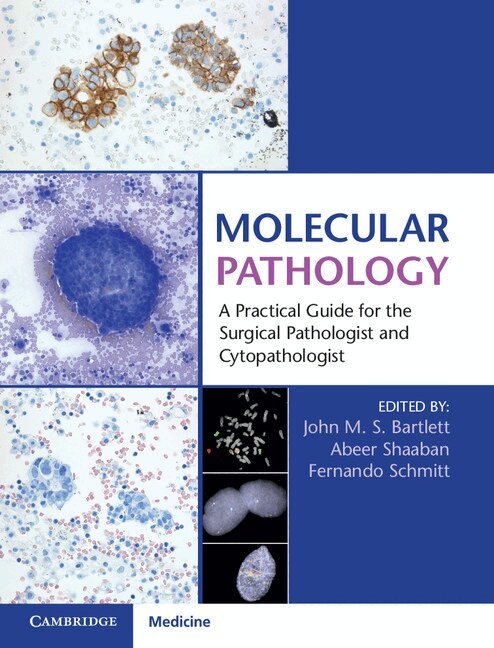
This practical manual provides a comprehensive yet concise guide to state-of-the-art molecular techniques and their applications. It starts with an overview of the essential principles of molecular techniques, followed by separate chapters detailing the use of these techniques in particular tissues and organs, and describing recommended treatment plans. Each chapter covers the tests available, their advantages, limitations, and use as diagnostic and prognostic tools, with key learning points at the end of each topic. Using both histologic and cytologic samples, it discusses how to interpret test results in a pathologic context and enables trainees and practising pathologists to gain an in-depth understanding of molecular diagnostic techniques and how to incorporate them into routine diagnostic practice. Aiding the daily practice of refining diagnosis, as well as offering a didactic approach, this book is an essential reference for practising pathologists and cytopathologists as well as trainees in pathology.
Häftad, Engelska, 2013
1 674 kr
Skickas inom 10-15 vardagar
If there is one aspect of current cancer research that represents a major ch- lenge in both novice and experienced researchers, it is the rapid advance in our understanding of the disease. Researchers can be required to switch from analysis of gene expression to kinetics of protein activation, from genetic studies to the analysis of protein funtion. Cancers are highly complex disease systems and researchers aiming to understand the functioning of cancer systems require access to a wide range of laboratory techiques from a broad range of research disciplines. Increasingly, however, published methods are incomplete or refer back to a series of previous publications each containing only a small part of the complete pro- col. The aim of Ovarian Cancer: Methods and Protocols is to provide for ovarian cancer researchers in the first instance, a laboratory handbook that will facilitate research into cancer systems by providing a series of expert protocols, with proven efficacy, across a broad range of technical expertise. Thus, there are sections on tumor genetics and cellular signal transduction, as well as sections on apoptosis and RNA analysis. The value of Ovarian Cancer: Methods and Protocols to the ovarian cancer researcher will, I trust, be considerably enhanced by (1) the provision of a series of overviews relating to the biology, diagnosis, and treatment of this important neoplasm, and (2) the provision of a series of technical overviews introducing each part that provides an expert review of the applications and pitfalls of the various techniques included.
Inbunden, Engelska, 2004
1 674 kr
Skickas inom 10-15 vardagar
A diverse collection of readily reproducible methods for use in cancer detection. Highlights include FISH-based methodologies currently used in the diagnosis of solid tumors, the molecular diagnosis of genetic abnormalities by DNA array technologies - including sequence-specific oligonucleotide arrays and CGH arrays - and methodologies directed at the detection of epigenetic events and at quantitative gene expression. The authors apply these novel diagnostic procedures to a broad range of cases taken from cytology, solid tumor pathology, hematology, and rare cell detection, paying special attention to potential future developments and the practical problems of dealing with quality control and accuracy.
E-bok
Engelska, 20082 036 kr
Läs direkt efter köp
If there is one aspect of current cancer research that represents a major ch- lenge in both novice and experienced researchers, it is the rapid advance in our understanding of the disease. Researchers can be required to switch from analysis of gene expression to kinetics of protein activation, from genetic studies to the analysis of protein funtion. Cancers are highly complex disease systems and researchers aiming to understand the functioning of cancer systems require access to a wide range of laboratory techiques from a broad range of research disciplines. Increasingly, however, published methods are incomplete or refer back to a series of previous publications each containing only a small part of the complete pro- col. The aim of Ovarian Cancer: Methods and Protocols is to provide for ovarian cancer researchers in the first instance, a laboratory handbook that will facilitate research into cancer systems by providing a series of expert protocols, with proven efficacy, across a broad range of technical expertise. Thus, there are sections on tumor genetics and cellular signal transduction, as well as sections on apoptosis and RNA analysis. The value of Ovarian Cancer: Methods and Protocols to the ovarian cancer researcher will, I trust, be considerably enhanced by (1) the provision of a series of overviews relating to the biology, diagnosis, and treatment of this important neoplasm, and (2) the provision of a series of technical overviews introducing each part that provides an expert review of the applications and pitfalls of the various techniques included.
E-bok
Engelska, 20081 100 kr
Läs direkt efter köp
In this new edition, the editors have thoroughly updated and dramatically expanded the number of protocols to take advantage of the newest technologies used in all branches of research and clinical medicine today. These proven methods include real time PCR, SNP analysis, nested PCR, direct PCR, and long range PCR. Among the highlights are chapters on genome profiling by SAGE, differential display and chip technologies, the amplification of whole genome DNA by random degenerate oligonucleotide PCR, and the refinement of PCR methods for the analysis of fragmented DNA from fixed tissues. Each fully tested protocol is described in step-by-step detail by an established expert in the field and includes a background introduction outlining the principle behind the technique, equipment and reagent lists, tips on trouble shooting and avoiding known pitfalls, and, where needed, a discussion of the interpretation and use of results.
1 845 kr
Skickas
A diverse collection of readily reproducible methods for use in cancer detection. Highlights include FISH-based methodologies currently used in the diagnosis of solid tumors, the molecular diagnosis of genetic abnormalities by DNA array technologies-including sequence-specific oligonucleotide arrays and CGH arrays-and methodologies directed at the detection of epigenetic events and at quantitative gene expression. The authors apply these novel diagnostic procedures to a broad range of cases taken from cytology, solid tumor pathology, hematology, and rare cell detection, paying special attention to potential future developments and the practical problems of dealing with quality control and accuracy.
Del 97 - Methods in Molecular Medicine
Molecular Diagnosis of Cancer
Methods and Protocols
Häftad, Engelska, 2010
1 230 kr
Skickas inom 10-15 vardagar
We are currently experiencing a fundamental shift in the way in which we approach the characterization of cancer. Never before has the make up of cancer tissues and individual cells been so exhaustively researched and char- terized. We are now capable of producing molecular “fingerprints” that ch- acterize the expression of all known and unknown genes within tumors and their surrounding tissues. More than 30,000 different genes may be measured in each patient’s tumor in a single experiment. Simultaneously, novel therapies that exploit the molecular roadmap have been developed and are now being offered to patients. These novel agents, such as Glivec, Herceptin, Iressa, and others, specifically target individual genes within tumors and can produce d- matic responses in some patients. These drugs are only the forerunners of a coming tidal wave of novel therapeutics that individually target specific m- ecules within cancer cells—more than 300 such agents are currently in phase I or II clinical trials. This is an exciting time for cancer specialists and patients alike. However, if we have learned anything from the past 50 or more years of research into cancer, it is that Lord Beaverbrook, in founding the British national health service in the 1950s, was frighteningly prescient when he defined the primary goal of health care to be “Diagnosis, Diagnosis, Diag- sis. ” Now, more than ever, it is essential that appropriate diagnostic methods and approaches are applied to the selection of patients for treatment.