John Ma – författare
Visar alla böcker från författaren John Ma. Handla med fri frakt och snabb leverans.
11 produkter
11 produkter
Inbunden, Engelska, 2000
2 934 kr
Skickas inom 5-8 vardagar
This work examines a test case for the relationship between the polis and the Hellenistic empire focusing specifically on the interaction between Antiochos III and the cities of Western Asia Minor (226-188 BC). Such a study is possible thanks to a rich epigraphical documentation which has been reproduced extensively and translated in an appendix to this book. Dr Ma approaches this material from a variety of angles: narrative history, structural analyses of imperial power, and analyses of the functions played by language and stereotype in the interaction between rulers and ruled. The result is to further a nuanced appreciation of the relation between the Hellenistic king and the Hellenistic polis by drawing attention to the power of the Hellenistic empires, to the capacity of political language to modify power relations, and to the efforts of the Hellenistic polis to preserve its sense of identity and civic pride, if not its political independence.
Häftad, Engelska, 2015
817 kr
Skickas inom 7-10 vardagar
Why say thank you with a portrait statue? This book combines two different and quite specialized fields, archaeology and epigraphy, to explore the phenomenon of portraits in ancient art within the historical and anthropological context of city-states honouring worthy individuals through erecting statues, and the development of families imitating this practice. This transaction tells us a lot about the history of these cities and how ancient art worked as a construction of relations during the Hellenistic period (c. 350 BC-c. AD 1), which is marked by a political culture of civic devotion, common decision making, and publicness. As honorific statues were considered public art, the volume also investigates the workings of images, representations, memory, and the monumental public form of permanent inscription, to see what stories the Hellenistic city-states can reveal about themselves.
Inbunden, Engelska, 2020
1 978 kr
Skickas inom 5-8 vardagar
During the Second World War the Bodleian Library in Oxford acquired a set of Aramaic letters, eight sealings, and the two leather bags in which the sealed letters were once stored. The letters concern the affairs of Aršāma, satrap of Egypt in the later fifth century. Taken with other material associated with him (mostly in Aramaic, Demotic Egyptian, and Akkadian), they illuminate the Achaemenid world of which Aršāma was a privileged member and evoke a wide range of social, economic, cultural, organizational, and political perspectives, from multi-lingual communication, storage and disbursement of resources, and satrapal remuneration, to cross-regional ethnic movement, long-distance travel, religious practice, and iconographic projection of ideological messages. Particular highlights include a travel authorization (the only example of something implicit in numerous Persepolis documents), texts about the religious life of the Judaean garrison at Elephantine, Aršāma's magnificent seal (a masterpiece of Achaemenid glyptic, inherited from a son of Darius I), and echoes of temporary disturbances to Persian management of Egypt. But what is also impressive is the underlying sense of systematic coherence founded on and expressed in the use of formal, even formalized, written communication as a means of control. The Aršāma dossier is not alone in evoking that sense, but its size, variety, and focus upon a single individual give it a unique quality. Though this material has not been hidden from view, it has been insufficiently explored: it is the purpose of the three volumes of Aršāma and his World: The Bodleian Letters in Context to provide the fullest presentation and historical contextualization of this extraordinary cache yet attempted. Volume I presents and translates the letters alongside a detailed line-by-line commentary, while Volume II reconstructs the two seals that made the clay bullae that sealed the letters, with special attention to Aršāma's magnificent heirloom seal. Volume III comprises a series of thematic essays which further explore the administrative, economic, military, ideological, religious, and artistic environment to which Aršāma and the letters belonged.
Inbunden, Engelska, 2020
2 680 kr
Skickas inom 7-10 vardagar
During the Second World War the Bodleian Library in Oxford acquired a set of Aramaic letters, eight sealings, and the two leather bags in which the sealed letters were once stored. The letters concern the affairs of Aršāma, satrap of Egypt in the later fifth century. Taken with other material associated with him (mostly in Aramaic, Demotic Egyptian, and Akkadian), they illuminate the Achaemenid world of which Aršāma was a privileged member and evoke a wide range of social, economic, cultural, organizational, and political perspectives, from multi-lingual communication, storage and disbursement of resources, and satrapal remuneration, to cross-regional ethnic movement, long-distance travel, religious practice, and iconographic projection of ideological messages. Particular highlights include a travel authorization (the only example of something implicit in numerous Persepolis documents), texts about the religious life of the Judaean garrison at Elephantine, Aršāma's magnificent seal (a masterpiece of Achaemenid glyptic, inherited from a son of Darius I), and echoes of temporary disturbances to Persian management of Egypt. But what is also impressive is the underlying sense of systematic coherence founded on and expressed in the use of formal, even formalized, written communication as a means of control. The Aršāma dossier is not alone in evoking that sense, but its size, variety, and focus upon a single individual give it a unique quality. Though this material has not been hidden from view, it has been insufficiently explored: it is the purpose of the three volumes of Aršāma and his World: The Bodleian Letters in Context to provide the fullest presentation and historical contextualization of this extraordinary cache yet attempted. Volume I presents and translates the letters alongside a detailed line-by-line commentary, while Volume II reconstructs the two seals that made the clay bullae that sealed the letters, with special attention to Aršāma's magnificent heirloom seal. Volume III comprises a series of thematic essays which further explore the administrative, economic, military, ideological, religious, and artistic environment to which Aršāma and the letters belonged.
6 510 kr
Skickas inom 3-6 vardagar
During the Second World War the Bodleian Library in Oxford acquired a set of Aramaic letters, eight sealings, and the two leather bags in which the sealed letters were once stored. The letters concern the affairs of Aršāma, satrap of Egypt in the later fifth century. Taken with other material associated with him (mostly in Aramaic, Demotic Egyptian, and Akkadian), they illuminate the Achaemenid world of which Aršāma was a privileged member and evoke a wide range of social, economic, cultural, organizational, and political perspectives, from multi-lingual communication, storage and disbursement of resources, and satrapal remuneration, to cross-regional ethnic movement, long-distance travel, religious practice, and iconographic projection of ideological messages. Particular highlights include a travel authorization (the only example of something implicit in numerous Persepolis documents), texts about the religious life of the Judaean garrison at Elephantine, Aršāma's magnificent seal (a masterpiece of Achaemenid glyptic, inherited from a son of Darius I), and echoes of temporary disturbances to Persian management of Egypt. But what is also impressive is the underlying sense of systematic coherence founded on and expressed in the use of formal, even formalized, written communication as a means of control. The Aršāma dossier is not alone in evoking that sense, but its size, variety, and focus upon a single individual give it a unique quality. Though this material has not been hidden from view, it has been insufficiently explored: it is the purpose of the three volumes of Aršāma and his World: The Bodleian Letters in Context to provide the fullest presentation and historical contextualization of this extraordinary cache yet attempted. Volume I presents and translates the letters alongside a detailed line-by-line commentary, while Volume II reconstructs the two seals that made the clay bullae that sealed the letters, with special attention to Aršāma's magnificent heirloom seal. Volume III comprises a series of thematic essays which further explore the administrative, economic, military, ideological, religious, and artistic environment to which Aršāma and the letters belonged.
Häftad, Engelska, 2002
1 163 kr
Skickas inom 7-10 vardagar
This important and wide-ranging work examines a test case for the relationship between the polis and the Hellenistic empire focusing specifically on the interaction between Antiochos III and the cities of Western Asia Minor (226-188 BC). Such a study is possible thanks to a rich epigraphical documentation which has been reproduced extensively and translated in an appendix to this book. Dr Ma approaches this material from a variety of angles: narrative history, structural analyses of imperial power, and analyses of the functions played by language and stereotype in the interaction between rulers and ruled. The result is to further a nuanced appreciation of the relation between the Hellenistic king and the Hellenistic polis by drawing attention to the power of the Hellenistic empires, to the capacity of political language to modify power relations, and to the efforts of the Hellenistic polis to preserve its sense of identity and civic pride, if not its political independence. This paperback edition includes a new preface and a section of addenda.
Inbunden, Engelska, 2013
2 226 kr
Skickas inom 5-8 vardagar
Why say thank you with a portrait statue? This book combines two different and quite specialized fields, archaeology and epigraphy, to explore the phenomenon of portraits in ancient art within the historical and anthropological context of city-states honouring worthy individuals through erecting statues, and the development of families imitating this practice. This transaction tells us a lot about the history of these cities and how ancient art worked as a construction of relations during the Hellenistic period (c. 350 BC- c. AD 1), which is marked by a political culture of civic devotion, common decision making, and publicness.As honorific statues were considered public art, the volume also investigates the workings of images, representations, memory, and the monumental public form of permanent inscription, to see what stories the Hellenistic city-states can reveal about themselves.
Inbunden, Engelska, 2020
1 961 kr
Skickas inom 5-8 vardagar
During the Second World War the Bodleian Library in Oxford acquired a set of Aramaic letters, eight sealings, and the two leather bags in which the sealed letters were once stored. The letters concern the affairs of Aršāma, satrap of Egypt in the later fifth century. Taken with other material associated with him (mostly in Aramaic, Demotic Egyptian, and Akkadian), they illuminate the Achaemenid world of which Aršāma was a privileged member and evoke a wide range of social, economic, cultural, organizational, and political perspectives, from multi-lingual communication, storage and disbursement of resources, and satrapal remuneration, to cross-regional ethnic movement, long-distance travel, religious practice, and iconographic projection of ideological messages. Particular highlights include a travel authorization (the only example of something implicit in numerous Persepolis documents), texts about the religious life of the Judaean garrison at Elephantine, Aršāma's magnificent seal (a masterpiece of Achaemenid glyptic, inherited from a son of Darius I), and echoes of temporary disturbances to Persian management of Egypt. But what is also impressive is the underlying sense of systematic coherence founded on and expressed in the use of formal, even formalized, written communication as a means of control. The Aršāma dossier is not alone in evoking that sense, but its size, variety, and focus upon a single individual give it a unique quality. Though this material has not been hidden from view, it has been insufficiently explored: it is the purpose of the three volumes of Aršāma and his World: The Bodleian Letters in Context to provide the fullest presentation and historical contextualization of this extraordinary cache yet attempted. Volume I presents and translates the letters alongside a detailed line-by-line commentary, while Volume II reconstructs the two seals that made the clay bullae that sealed the letters, with special attention to Aršāma's magnificent heirloom seal. Volume III comprises a series of thematic essays which further explore the administrative, economic, military, ideological, religious, and artistic environment to which Aršāma and the letters belonged.
Inbunden, Engelska, 2024
418 kr
Skickas inom 5-8 vardagar
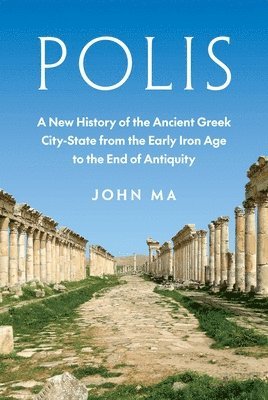
A definitive new history of the origins, evolution, and scope of the ancient Greek city-stateThe Greek polis, or city-state, was a resilient and adaptable political institution founded on the principles of citizenship, freedom, and equality. Emerging around 650 BCE and enduring to 350 CE, it offered a means for collaboration among fellow city-states and social bargaining between a community and its elites—but at what cost? Polis proposes a panoramic account of the ancient Greek city-state, its diverse forms, and enduring characteristics over the span of a millennium.In this landmark book, John Ma provides a new history of the polis, charting its spread and development into a common denominator for hundreds of communities from the Black Sea to North Africa and from the Near East to Italy. He explores its remarkable achievements as a political form offering community, autonomy, prosperity, public goods, and spaces of social justice for its members. He also reminds us that behind the successes of civic ideology and institutions lie entanglements with domination, empire, and enslavement. Ma’s sweeping and multifaceted narrative draws widely on a rich store of historical evidence while weighing in on lively scholarly debates and offering new readings of Aristotle as the great theoretician of the polis.A monumental work of scholarship, Polis transforms our understanding of antiquity while challenging us to grapple with the moral legacy of an idea whose very success centered on the inclusion of some and the exclusion of others.
Häftad, Engelska, 2026
248 kr
Skickas inom 5-8 vardagar
A definitive new history of the origins, evolution, and scope of the ancient Greek city-stateThe Greek polis, or city-state, was a resilient and adaptable political institution founded on the principles of citizenship, freedom, and equality. Emerging around 650 BCE and enduring to 350 CE, it offered a means for collaboration among fellow city-states and social bargaining between a community and its elites—but at what cost? Polis proposes a panoramic account of the ancient Greek city-state, its diverse forms, and enduring characteristics over the span of a millennium.In this landmark book, John Ma provides a new history of the polis, charting its spread and development into a common denominator for hundreds of communities from the Black Sea to North Africa and from the Near East to Italy. He explores its remarkable achievements as a political form offering community, autonomy, prosperity, public goods, and spaces of social justice for its members. He also reminds us that behind the successes of civic ideology and institutions lie entanglements with domination, empire, and enslavement. Ma’s sweeping and multifaceted narrative draws widely on a rich store of historical evidence while weighing in on lively scholarly debates and offering new readings of Aristotle as the great theoretician of the polis.A monumental work of scholarship, Polis transforms our understanding of antiquity while challenging us to grapple with the moral legacy of an idea whose very success centered on the inclusion of some and the exclusion of others.
Häftad, Engelska, 2009
550 kr
Skickas inom 10-15 vardagar
The empire that the Athenians established in the years after 478 BC was an entirely new phenomenon in the history of Greece, and the basis of much of the brilliant development of Athenian culture in the fifth century. Its growth and collapse was the key event in the history of the period, after the defeat of the Persian invasion. Yet this important historical phenomenon remains baffling to study. New developments in various fields have made urgent a revision of existing approaches, which largely originated in the first half of the last century. Advances in archaeology have hugely extended the possibilities of writing an archaeology of the empire. The accepted chronology of many key inscriptions has been powerfully challenged, so that new narrative reconstructions become possible. Relevant new documents in languages such as Lycian have become available. Understanding of the Persian empire which was the parallel, and in a sense the model, with which the Athenian empire interacted has been transformed in the last quarter century. Broader developments in historiography (microhistory; history from below; and, post-colonial theory) invite us to pose new questions.The aim of this collection is not to offer a final word on any of the problems, but to give a sense of the possibility of a new generation of studies of the empire.