Joseph Henrich – författare
Visar alla böcker från författaren Joseph Henrich. Handla med fri frakt och snabb leverans.
11 produkter
11 produkter
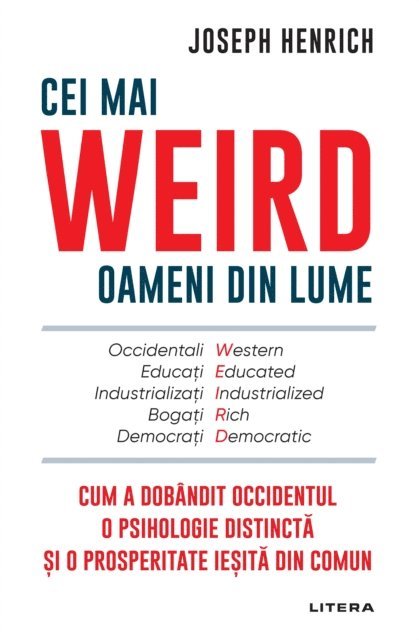
Weirdest People in the World
How the West Became Psychologically Peculiar and Particularly Prosperous
Häftad, Engelska, 2021
198 kr
Skickas
'A landmark in social thought. Henrich may go down as the most influential social scientist of the first half of the twenty-first century' MATTHEW SYEDDo you identify yourself by your profession or achievements, rather than your family network? Do you cultivate your unique attributes and goals? If so, perhaps you are WEIRD: raised in a society that is Western, Educated, Industrialized, Rich and Democratic. Unlike most who have ever lived, WEIRD people are highly individualistic, nonconformist, analytical and control-oriented. How did WEIRD populations become so psychologically peculiar? What part did these differences play in our history, and what do they mean for our collective identity? Joseph Henrich, who developed the game-changing concept of WEIRD, uses leading-edge research in anthropology, psychology, economics and evolutionary biology to explore how changing family structures, marriage practices and religious beliefs in the Middle Ages shaped the Western mind, laying the foundations for the world we know today. Brilliant, provocative, engaging and surprising, this landmark study will revolutionize your understanding of who - and how - we are now. 'Phenomenal ... The only theory I am aware of that attempts to explain broad patterns of human psychology on a global scale' Washington Post'You will never look again in the same way at your own seemingly universal values' Uta Frith, Professor of Cognitive Development, University College London
Häftad, Engelska, 2021
269 kr
Skickas inom 3-6 vardagar
Häftad, Engelska, 2007
725 kr
Skickas inom 5-8 vardagar
Cooperation among humans is one of the keys to our great evolutionary success. Natalie and Joseph Henrich examine this phenomena with a unique fusion of theoretical work on the evolution of cooperation, ethnographic descriptions of social behavior, and a range of other experimental results. Their experimental and ethnographic data come from a small, insular group of middle-class Iraqi Christians called Chaldeans, living in metro Detroit, whom the Henrichs use as an example to show how kinship relations, ethnicity, and culturally transmitted traditions provide the key to explaining the evolution of cooperation over multiple generations.
Inbunden, Engelska, 2004
2 333 kr
Skickas inom 5-8 vardagar
What motives underlie the ways humans interact socially? Are these the same for all societies? Are these part of our nature, or influenced by our environments? Over the last decade, research in experimental economics has emphatically falsified the textbook representation of Homo economicus. Hundreds of experiments suggest that people care not only about their own material payoffs, but also about such things as fairness, equity, and reciprocity. However, this research left fundamental questions unanswered: Are such social preferences stable components of human nature, or are they modulated by economic, social, and cultural environments? Until now, experimental research could not address this question because virtually all subjects had been university students. Combining ethnographic and experimental approaches to fill this gap, this book breaks new ground in reporting the results of a large cross-cultural study aimed at determining the sources of social (non-selfish) preferences that underlie the diversity of human sociality. In this study, the same experiments carried out with university students were performed in fifteen small-scale societies exhibiting a wide variety of social, economic, and cultural conditions. The results show that the variation in behaviour is far greater than previously thought, and that the differences between societies in market integration and the importance of cooperation explain a substantial portion of this variation, which individual-level economic and demographic variables could not. The results also trace the extent to which experimental play mirrors patterns of interaction found in everyday life. The book includes a succinct but substantive introduction to the use of game theory as an analytical tool, and to its use in the social sciences for the rigorous testing of hypotheses about fundamental aspects of social behaviour outside artificially constructed laboratories. The editors also summarize the results of the fifteen case studies in a suggestive chapter about the scope of the project.
Häftad, Engelska, 2004
684 kr
Skickas inom 5-8 vardagar
What motives underlie the ways humans interact socially? Are these the same for all societies? Are these part of our nature, or influenced by our environments?Over the last decade, research in experimental economics has emphatically falsified the textbook representation of Homo economicus. Literally hundreds of experiments suggest that people care not only about their own material payoffs, but also about such things as fairness, equity and reciprocity. However, this research left fundamental questions unanswered: Are such social preferences stable components of human nature; or, are they modulated by economic, social and cultural environments? Until now, experimental research could not address this question because virtually all subjects had been university students, and while there are cultural differences among student populations throughout the world, these differences are small compared to the full range of human social and cultural environments. A vast amount of ethnographic and historical research suggests that people's motives are influenced by economic, social, and cultural environments, yet such methods can only yield circumstantial evidence about human motives. Combining ethnographic and experimental approaches to fill this gap, this book breaks new ground in reporting the results of a large cross-cultural study aimed at determining the sources of social (non-selfish) preferences that underlie the diversity of human sociality. The same experiments which provided evidence for social preferences among university students were performed in fifteen small-scale societies exhibiting a wide variety of social, economic and cultural conditions by experienced field researchers who had also done long-term ethnographic field work in these societies. The findings of these experiments demonstrated that no society in which experimental behaviour is consistent with the canonical model of self-interest. Indeed, results showed that the variation in behaviour is far greater than previously thought, and that the differences between societies in market integration and the importance of cooperation explain a substantial portion of this variation, which individual-level economic and demographic variables could not. Finally, the extent to which experimental play mirrors patterns of interaction found in everyday life is traced.The book starts with a succinct but substantive introduction to the use of game theory as an analytical tool and its use in the social sciences for the rigorous testing of hypotheses about fundamental aspects of social behaviour outside artificially constructed laboratories. The results of the fifteen case studies are summarized in a suggestive chapter about the scope of the project.
Häftad, Engelska, 2017
225 kr
Skickas inom 5-8 vardagar
Humans are a puzzling species. On the one hand, we struggle to survive on our own in the wild, often failing to overcome even basic challenges, like obtaining food, building shelters, or avoiding predators. On the other hand, human groups have produced ingenious technologies, sophisticated languages, and complex institutions that have permitted us to successfully expand into a vast range of diverse environments. What has enabled us to dominate the globe, more than any other species, while remaining virtually helpless as lone individuals? This book shows that the secret of our success lies not in our innate intelligence, but in our collective brains--on the ability of human groups to socially interconnect and learn from one another over generations. Drawing insights from lost European explorers, clever chimpanzees, mobile hunter-gatherers, neuroscientific findings, ancient bones, and the human genome, Joseph Henrich demonstrates how our collective brains have propelled our species' genetic evolution and shaped our biology.Our early capacities for learning from others produced many cultural innovations, such as fire, cooking, water containers, plant knowledge, and projectile weapons, which in turn drove the expansion of our brains and altered our physiology, anatomy, and psychology in crucial ways. Later on, some collective brains generated and recombined powerful concepts, such as the lever, wheel, screw, and writing, while also creating the institutions that continue to alter our motivations and perceptions. Henrich shows how our genetics and biology are inextricably interwoven with cultural evolution, and how culture-gene interactions launched our species on an extraordinary evolutionary trajectory. Tracking clues from our ancient past to the present, The Secret of Our Success explores how the evolution of both our cultural and social natures produce a collective intelligence that explains both our species' immense success and the origins of human uniqueness.
Inbunden, Engelska, 2023
2 160 kr
Skickas inom 10-15 vardagar
This volume assesses the role of religion in cooperation and prosocial behaviour using ethnographic and experimental methods across eight different field sites. The first of two volumes presents results from the first phase of the Evolution of Religion and Morality (ERM) Project.Using a unique combination of both experimental and ethnographic methods, the ERM project addresses pressing questions from the burgeoning cultural evolutionary sciences of religion:What is the relationship between religious beliefs and cooperation?When people are committed to punitive, knowledgeable, and morally concerned gods, are they more inclined to behave prosocially towards others?How far does this prosociality extend?Do important individual and contextual factors mediate this relationship?In addition to an omnibus report, this book offers seven site-specific reports that contextualize experimental and ethnographic data collected around the world. Collecting data from communities as diverse as the Hadza of Tanzania, villagers from two communities on Tanna Island, Vanuatu, residents of Marajó, Brazil, Fijians from Yasawa and Lovu, Tyvans from southern Siberia, and Mauritians, this ground-breaking work sets a new standard in the scientific study of religion.The Evolution of Religion and Morality: Volume I will be a key resource for scholars and researchers of religious studies, human evolutionary biology, psychology, anthropology, the cultural evolution of religion and the sociology of religion. This book was originally published as a special issue of Religion, Brain & Behavior.
Häftad, Engelska, 2025
646 kr
Skickas inom 10-15 vardagar
This volume assesses the role of religion in cooperation and prosocial behaviour using ethnographic and experimental methods across eight different field sites. The first of two volumes presents results from the first phase of the Evolution of Religion and Morality (ERM) Project.Using a unique combination of both experimental and ethnographic methods, the ERM project addresses pressing questions from the burgeoning cultural evolutionary sciences of religion:What is the relationship between religious beliefs and cooperation?When people are committed to punitive, knowledgeable, and morally concerned gods, are they more inclined to behave prosocially towards others?How far does this prosociality extend?Do important individual and contextual factors mediate this relationship?In addition to an omnibus report, this book offers seven site-specific reports that contextualize experimental and ethnographic data collected around the world. Collecting data from communities as diverse as the Hadza of Tanzania, villagers from two communities on Tanna Island, Vanuatu, residents of Marajó, Brazil, Fijians from Yasawa and Lovu, Tyvans from southern Siberia, and Mauritians, this ground-breaking work sets a new standard in the scientific study of religion.The Evolution of Religion and Morality: Volume I will be a key resource for scholars and researchers of religious studies, human evolutionary biology, psychology, anthropology, the cultural evolution of religion and the sociology of religion. This book was originally published as a special issue of Religion, Brain & Behavior.
Inbunden, Engelska, 2023
2 160 kr
Skickas inom 10-15 vardagar
This volume draws on a unique dataset to answer pressing questions about human religiosity. Building upon the first volume in this series, it presents results from the second phase of the Evolution of Religion and Morality (ERM) project.The second volume investigates key questions in the evolutionary and cognitive sciences of religion and highlights cultural variability and context specificity of diverse religious systems. Chapters draw on a dataset comprising 2,228 participants from 15 ethnographically diverse societies that stretch from Africa and India through Oceania to South America, and include hunter-gatherers, pastoralists, horticulturalists, subsistence farmers and wage laborers. Four chapters using the full dataset answer the following questions:What are the general predictors of commitment to supernatural agents?Is there a gender gap in religiosity?Does belief in punitive gods facilitates cooperation?Are supernatural agents implicitly associated with moral concerns?Chapters from individual field sites further explore the distinction between moralizing and local gods, the potentially disruptive role of belief in local gods on cooperation with anonymous co-religionists, and the relationship between belief in moralizing gods, cooperation, and differential access to material resources. Above these empirical studies, the book also includes an informed discussion with specialists on the challenges of running such a large cross-cultural project and gives concrete recommendations for future projects.The Evolution of Religion and Morality: Volume II will be a key resource for scholars and researchers of religious studies, human evolutionary biology, psychology, anthropology, the cultural evolution of religion and the sociology of religion. This book was originally published as a special issue of Religion, Brain & Behavior.
Häftad, Engelska, 2025
646 kr
Skickas inom 10-15 vardagar
This volume draws on a unique dataset to answer pressing questions about human religiosity. Building upon the first volume in this series, it presents results from the second phase of the Evolution of Religion and Morality (ERM) project.The second volume investigates key questions in the evolutionary and cognitive sciences of religion and highlights cultural variability and context specificity of diverse religious systems. Chapters draw on a dataset comprising 2,228 participants from 15 ethnographically diverse societies that stretch from Africa and India through Oceania to South America, and include hunter-gatherers, pastoralists, horticulturalists, subsistence farmers and wage laborers. Four chapters using the full dataset answer the following questions:What are the general predictors of commitment to supernatural agents?Is there a gender gap in religiosity?Does belief in punitive gods facilitates cooperation?Are supernatural agents implicitly associated with moral concerns?Chapters from individual field sites further explore the distinction between moralizing and local gods, the potentially disruptive role of belief in local gods on cooperation with anonymous co-religionists, and the relationship between belief in moralizing gods, cooperation, and differential access to material resources. Above these empirical studies, the book also includes an informed discussion with specialists on the challenges of running such a large cross-cultural project and gives concrete recommendations for future projects.The Evolution of Religion and Morality: Volume II will be a key resource for scholars and researchers of religious studies, human evolutionary biology, psychology, anthropology, the cultural evolution of religion and the sociology of religion. This book was originally published as a special issue of Religion, Brain & Behavior.
Del 2471 - suhrkamp taschenbücher wissenschaft
Die seltsamsten Menschen der Welt
Häftad, Tyska, 2025
292 kr
Skickas inom 3-6 vardagar