József Bokor – författare
544 kr
Skickas inom 10-15 vardagar
693 kr
Läs direkt efter köp
Although nonlinear control is traditionally an area of interest in process systems engineering which is of great practical importance, many process engineers have difficulty with the paradigms and results of modern nonlinear control theory because they lack the mathematical background usually associated with such methods or because of their computational difficulty and small-scale applicability in the general case. This textbook overcomes these barriers.
Features:
• Mathematical preliminaries for readers from a process engineering background.
• Constant reference to the finite-dimensional linear time-invariant continuous case as a basis for extension to the nonlinear situation.
• Theories and analytical methods laid out clearly and straightforwardly with exercises to reaffirm the techniques as they are taught.
• Emphasis on process knowledge and first-principles-based models in obtaining feasible and effective solutions in particular circumstances from general cases.
• Simple examples and case studies.
1 619 kr
Skickas inom 10-15 vardagar
1 519 kr
Läs direkt efter köp
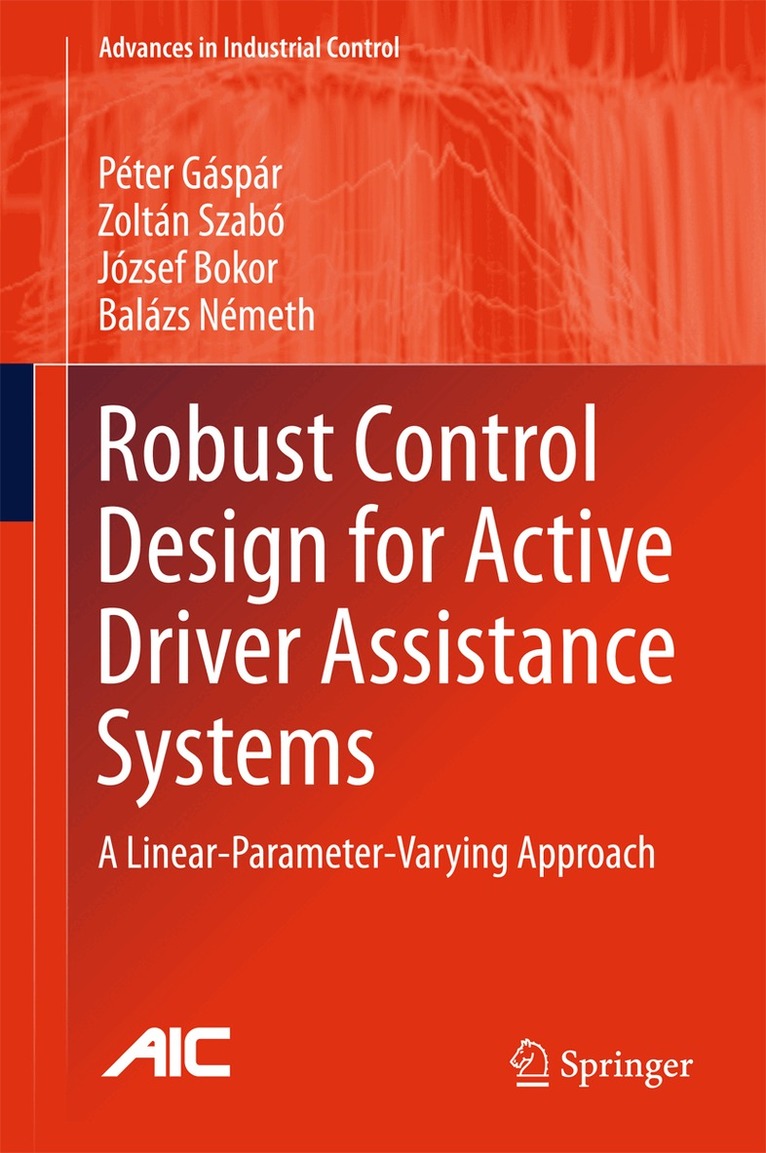
This monograph focuses on control methods that influence vehicle dynamics to assist the driver in enhancing passenger comfort, road holding, efficiency and safety of transport, etc., while maintaining the driver’s ability to override that assistance. On individual-vehicle-component level the control problem is formulated and solved by a unified modelling and design method provided by the linear parameter varying (LPV) framework. The global behaviour desired is achieved by a judicious interplay between the individual components, guaranteed by an integrated control mechanism. The integrated control problem is also formalized and solved in the LPV framework. Most important among the ideas expounded in the book are:
application of the LPV paradigm in the modelling and control design methodology;application of the robust LPV design as a unified framework for setting control tasks related to active driver assistance;formulation and solution proposals for the integrated vehicle control problem;proposal for a reconfigurable and fault-tolerant control architecture;formulation and solution proposals for the plug-and-play concept;detailed case studies.Robust Control Design for Active Vehicle Assistance Systems will be of interest to academic researchers and graduate students interested in automotive control and to control and mechanical engineers working in the automotive industry.
Advances in Industrial Control aims to report and encourage the transfer of technology in control engineering. The rapid development of control technology has an impact on all areas of the control discipline. The series offers an opportunity for researchers to present an extended exposition of new work in all aspects of industrial control.1 189 kr
Skickas inom 10-15 vardagar
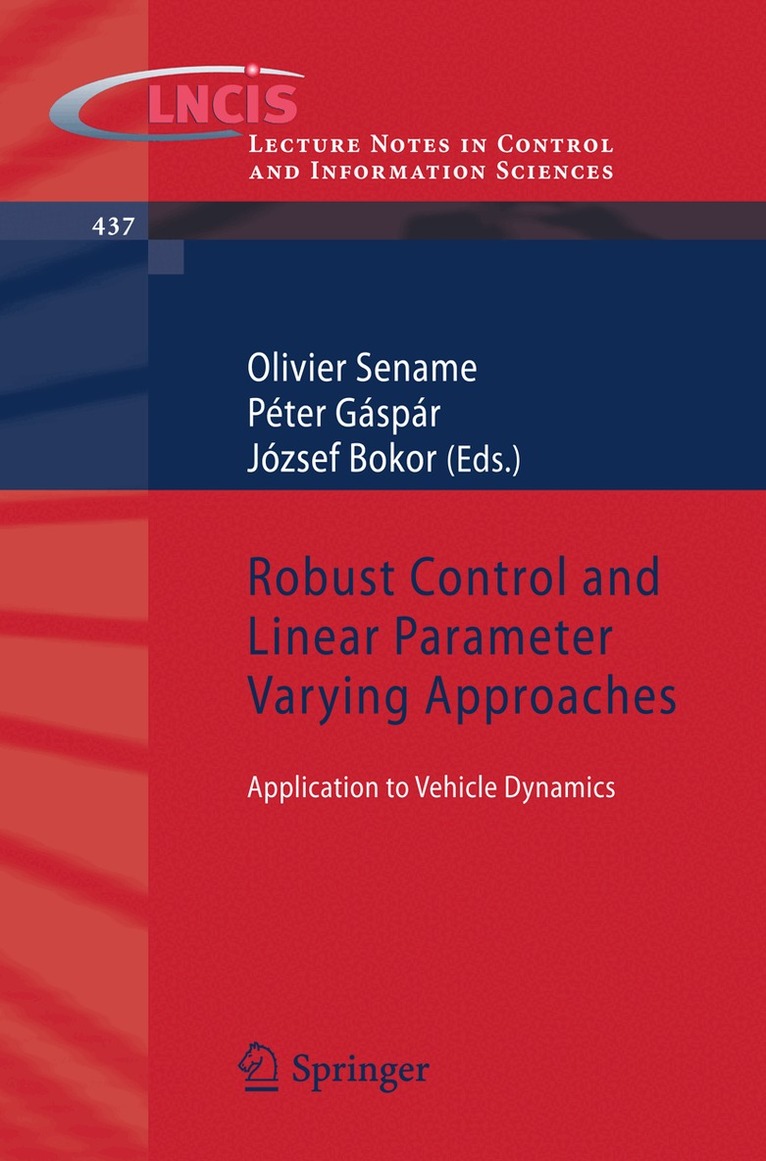
Robust Control and Linear Parameter Varying Approaches
Application to Vehicle Dynamics
1 082 kr
Skickas inom 10-15 vardagar
1 379 kr
Läs direkt efter köp
Vehicles are complex systems (non-linear, multi-variable) where the abundance of embedded controllers should ensure better security. This book aims at emphasizing the interest and potential of Linear Parameter Varying methods within the framework of vehicle dynamics, e.g. proposed control-oriented model, complex enough to handle some system non linearities but still simple for control or observer design, take into account the adaptability of the vehicle''s response to driving situations, to the driver request and/or to the road sollicitations, manage interactions between various actuators to optimize the dynamic behavior of vehicles.
This book results from the 32th International Summer School in Automatic that held in Grenoble, France, in September 2011, where recent methods (based on robust control and LPV technics), then applied to the control of vehicle dynamics, have been presented. After some theoretical background and a view on some recent works on LPV approaches (for modelling, analysis, control, observation and diagnosis), the main emphasis is put on road vehicles but some illustrations are concerned with railway, aerospace and underwater vehicles. The main objective of the book is to demonstrate the value of this approach for controlling the dynamic behavior of vehicles.
It presents, in a rm way, background and new results on LPV methods and their application to vehicle dynamics.