Karl-Göran Mäler - Böcker
Visar alla böcker från författaren Karl-Göran Mäler. Handla med fri frakt och snabb leverans.
17 produkter
17 produkter
2 214 kr
Skickas inom 7-10 vardagar
Two and a half billion people are affected directly on a day to day basis by the allocation and use of primary local resources. Yet `official' development economics has concentrated on headline international issues and only recently begun to take account of the dependence of poor countries on their natural resources, the link between acute poverty and environmental degradation, and the problems associated with the management of local common property such as soil and soil cover, water, forests and their products, animals and fisheries. In these volumes, which are part of the WIDER programme on the Economics for the Environment, expert contributors provide a set of authoritative studies of emerging development issues, ranging from foundational matters to case studies, original research (in areas where there has been a paucity of work) to survey papers. They address both analytic and empirical issues on the role of environmental resources in the development process, presenting explanations of existing situations and policies for the future. A wealth of interests and backgrounds is represented, and reflected in the cross-fertilization between papers.
1 231 kr
Skickas inom 7-10 vardagar
Two and a half billion people are affected directly on a day to day basis by the allocation and use of purely local resources. Yet `official' development economics has concentrated on headline international issues and only recently begun to take account of the dependence of poor countries on their natural resources, the link between acute poverty and environmental degredation, and the problems associated with the management of local common property such as soil and soil cover, water, forests and their products, animals and fisheries. In these volumes, which are part of the WIDER programme on the Economics of the Environment, expert contributors provide a set of authoritative studies of emerging development issues, ranging from foundational matters to case studies, original research (in areas where there has been a paucity of work) to survey papers. They address both analytic and empirical issues on the role of environmental resources in the development process, presenting explanations of existing situations and policies for the future. A wealth of interests and backgrounds is represented and reflected in the cross-fertilization between papers.
2 629 kr
Skickas inom 5-8 vardagar
Transnational commons, cross-border areas without well-defined property rights, have long been ignored in 'official' development economics. This volume redresses the balance by adopting an environmental approach which stresses the importance of shared natural resources and the links between acute poverty and environmental degradation. The Economics of Transnational Commons draws together eminent contributors from fields as diverse as law, population studies, social anthropology, biological sciences, and economics, to present authoritative accounts that combine empirical case-studies with rigorous theoretical foundations. Despite the milti-disciplinary approach, the main focus of the articles is the same: that the reciprocal externalities and problems of free-riding created by any common resource are complicated in the case of transnational commons by difficulties in monitoring, enforcement, and unequal access to information. Often using theories of negotiation taken from game theory, the studies then suggest possible solutions, both at an institutional and educational level. In order to make these materials suitable for teaching purposes, the authors have been encouraged to survey their topics rather than present their most recent findings. A companion publication, The Environment and Emerging Development Issues Volumes 1-11 (edited by Dasgupta and Mahler), deals with national environmental issues.
984 kr
Skickas inom 5-8 vardagar
Two and a half billion people are affected directly on a day-to-day basis by the allocation and use of purely local resources. Yet 'official' development economics has concentrated on headline international issues and only recently begun to take account of the dependence of poor countries on their natural resources, the link between acute poverty and environmental degradation, and the problems associated with the management of local common property such as soil and soil cover, water, forests and their products, animals and fisheries. In these two volumes, expert contributors provide a set of authoritative studies of emerging development issues, ranging from foundational matters to case studies. They address both analytic and empirical issues on the role of environmental resources in the development process, presenting explanations of existing situations and policies for the future. A wealth of interests and backgrounds is represented, beyond the confines of environmental economics proper; and this is reflected in the cross-fertilization between papers. In order to make these materials suitable for teaching purposes, authors have been encouraged to survey their topics rather than present their most recent findings.
419 kr
Skickas inom 7-10 vardagar
Two and a half billion people are affected directly on a day-to-day basis by the allocation and use of purely local resources. Yet 'official' development economics has concentrated on headline international issues and only recently begun to take account of the dependence of poor countries on their natural resources, the link between acute poverty and environmental degradation, and the problems associated with the management of local common property such as soil and soil cover, water, forests and their products, animals and fisheries. In these two volumes, expert contributors provide a set of authoritative studies of emerging development issues, ranging from foundational matters to case studies. They address both analytic and empirical issues on the role of environmental resources in the development process, presenting explanations of existing situations and policies for the future. A wealth of interests and backgrounds is represented beyond the confines of environmental economics proper, and broader theoretical issues fundamental to our understanding of environmental policy are covered.In order to make these materials suitable for teaching purposes, authors have been encouraged to survey their topics rather than present their most recent findings.
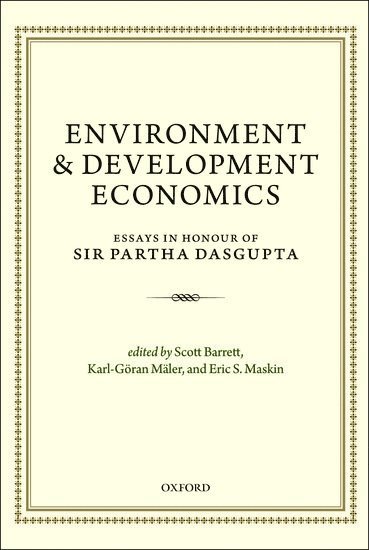
Environment and Development Economics
Essays in Honour of Sir Partha Dasgupta
Inbunden, Engelska, 2014
1 717 kr
Skickas inom 7-10 vardagar
This book honours Partha Dasgupta, and the field he helped establish; environment and development economics. It concerns the relationship between social systems (to include families, local communities, national economies, and the world as a whole) and natural systems (critical ecosystems, forests, water resources, mineral deposits, pollution, fisheries, and the Earth's climate). Above all, it concerns the poverty-environment nexus: the complex pathways by which people become or remain poor, and resources become or remain overexploited. With contributions by some of the world's leading economists, including five recipients of the Nobel Prize in Economics, in addition to scholars based in developing countries, this volume offers a unique perspective on the environmental issues that matter most to developing countries.
1 096 kr
Skickas inom 10-15 vardagar
This is the second, revised edition of a text based on a report commissioned by the Swedish International Development Agency (SIDA). The main purposes of the book are: to discuss the causes of environmental degradation from an economic perspective; to provide a conceptual framework for the organization of information in order to enhance environmental decision making; to provide an overview of economic mehtods that can assist in the evaluation of environmental costs and benefits; and to give examples of applications of the theoretical methods described. Policy failures are often overlooked as an obstacle to efficient environmental management. Although the main emphasis in this book is on project level analysis, it is essential that such analyses be linked to an understanding of the (dis)incentives for environmental improvements that general economic and particular environmental policies provide. Another key feature of the book is formed by the links provided between theory and empirical illustrations. It is hoped that these will illustrate the practical usefulness as well as the difficulties of applying economics to environmental problems.This new edition has been extended to include a chapter on management of environmental resources and environmental policy instruments. The chapter also includes a discussion on common property resources, a subject which was only briefly dealt with in the first edition. Two case studies concerning policy failures have been added to the last chapter of the book.
1 593 kr
Skickas inom 10-15 vardagar
This volume IS one of a number of pubhcatlOns to carry the results of the flfSt research programme of the Royal Swedish Academy of SCience's BelJer Institute The Instltute was formed m 1991 m order to promote mterdlsclplmary research between natural and social sClentlsts on the mterdependency between economic and ecological systems In Its first research programme, the BlOdlverslty Programme, the Instltute brought together a number of leadmg economists and ecologists to address the theoretlcal and pohcy Issues associated with the current high rates of blOdlVefSlty loss m such systems - whether the result of direct depletlOn, the destructlOn of habitat, or speclahsatlOn m agnculture, forestry and flshenes ThiS volume reports some of the more pohcy-onented work carned out under the programme 1 The broad aim of the programme IS to further our understandmg of the causes and consequences of blOdlverslty loss, and to Identlfy the optlOns for addressmg the problem The results have turned out to be surpnsmg to those who see blOdlverslty loss pnmarlly III terms of the eroslOn of the genetlc hbrary In vanous ways the work carned out under the programme has already begun to alter our perceptlOn of where the problem m blOdlverslty loss hes and what pohcy optlOns are aVailable to deal with It Indeed, the programme has provided a powerful set of arguments for reappraISIng not Just the econormc and ecologlcallmplicatlOns of blOdlverslty loss, but the whole case for development based on speCIalisatlOn of resource use
1 096 kr
Skickas inom 10-15 vardagar
Economists all too often assume that ecosystem and population dynamics are subject to convex (even linear) processes. However, research by ecosystem and population ecologists has shown that the processes in question are very often non-convex. This has important implications for environmental and resource economics. Typically, a system under study or being managed would contain multiple basins of attraction. So the system would flip from one basin to another if a "threshold" (mathematically, a bifurcation) were crossed. Furthermore, the flip could be irreversible. But even if it were reversible, the system could well display hysteresis. The latter eventuality means that in order to entice the system to return to its original basin of attraction, a different and possibly costly path has to be traced. A mistake in management may then be a lot more costly than envisaged. An example would be a possible flip of the Gulf Stream owing to fresh water intrusion from melting glaciers during global warming. These conclusions offer a sharper interpretation of the so-called precautionary principle. Moreover, the structure of optimum taxes and subsidies that Nature calls for is likely to be far m
1 096 kr
Skickas inom 7-10 vardagar
Economists all too often assume that ecosystem and population dynamics are subject to convex (even linear) processes. However, research by ecosystem and population ecologists has shown that the processes in question are very often non-convex. This has important implications for environmental and resource economics. Typically, a system under study or being managed would contain multiple basins of attraction. So the system would flip from one basin to another if a "threshold" (mathematically, a bifurcation) were crossed. Furthermore, the flip could be irreversible. But even if it were reversible, the system could well display hysteresis. The latter eventuality means that in order to entice the system to return to its original basin of attraction, a different and possibly costly path has to be traced. A mistake in management may then be a lot more costly than envisaged. An example would be a possible flip of the Gulf Stream owing to fresh water intrusion from melting glaciers during global warming. These conclusions offer a sharper interpretation of the so-called precautionary principle. Moreover, the structure of optimum taxes and subsidies that Nature calls for is likely to be far m
1 064 kr
Skickas inom 10-15 vardagar
Is knowledge an economic good? Which are the characteristics of the institutions regulating the production and diffusion of knowledge? Cumulation of knowledge is a key determinant of economic growth, but only recently knowledge has moved to the core of economic analysis. Recent literature also gives profound insights into events like scientific progress, artistic and craft development which have been rarely addressed as socio-economic institutions, being the domain of sociologists and historians rather than economists. This volume adopts a multidisciplinary approach to bring knowledge in the focus of attention, as a key economic issue.
1 064 kr
Skickas inom 10-15 vardagar
Is knowledge an economic good? Which are the characteristics of the institutions regulating the production and diffusion of knowledge? Cumulation of knowledge is a key determinant of economic growth, but only recently knowledge has moved to the core of economic analysis. Recent literature also gives profound insights into events like scientific progress, artistic and craft development which have been rarely addressed as socio-economic institutions, being the domain of sociologists and historians rather than economists. This volume adopts a multidisciplinary approach to bring knowledge in the focus of attention, as a key economic issue.
1 096 kr
Skickas inom 10-15 vardagar
This book is the second, revised, edition of a text based on a report commissioned by the Swedish International Development Agency (SIDA). The main purposes of this book are: to discuss the causes of environmental degradation from an economic perspective; to provide a conceptual framework for the organization of information in order to enhance environmental decision making; to provide an overview of economic methods that can assist in the evaluation of environmental costs and benefits; to give examples of applications of the theoretical methods described. Policy failures are often overlooked as an obstacle to efficient environmental management. Although the main emphasis in this book is on project level analysis, it is essential that such analyses be linked to an understanding of the (dis)incentives for environmental improvements that general economic and particular environmental policies provide. Another essential feature of the book is formed by the links provided between theory and empirical illustrations. It is hoped that these will illustrate the practical usefulness, as well as the difficulties, of applying economics to environmental problems.This new edition has been extended to include a chapter on management of environmental resources and environmental policy instruments. The chapter also includes a discussion on common property resources, a subject which was only briefly dealt with in the first edition of the book. Two case studies concerning policy failures have been added to the last chapter of the book.
1 593 kr
Skickas inom 10-15 vardagar
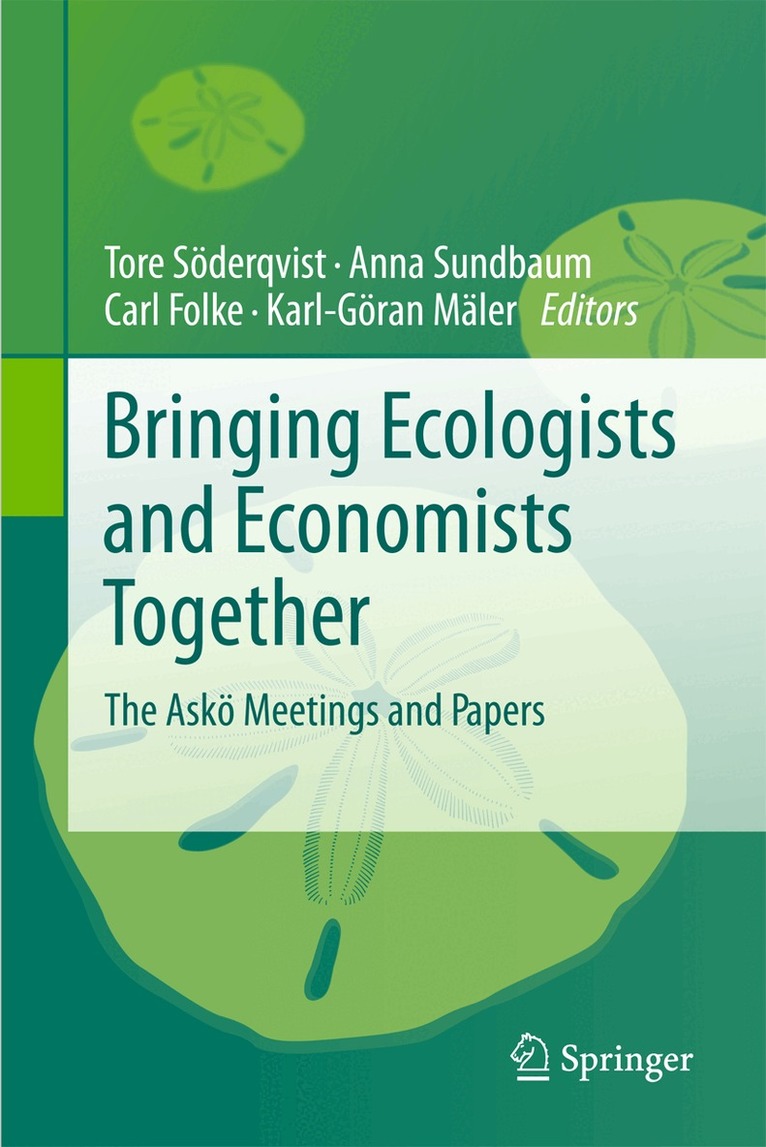
The Askö meetings were an annual forum where leading economists and ecologists came together to discuss the myriad issues and challenges surrounding sustainable development. Organized by the Beijer Institute of Ecological Economics and held on the Island of Askö in the Stockholm Archipelago, Sweden, the meetings facilitated a dialogue in which various players with differing perspectives could arrive at common conclusions and solutions that benefit us all.
1 593 kr
Skickas inom 10-15 vardagar
The Askö meetings were an annual forum where leading economists and ecologists came together to discuss the myriad issues and challenges surrounding sustainable development. Organized by the Beijer Institute of Ecological Economics and held on the Island of Askö in the Stockholm Archipelago, Sweden, the meetings facilitated a dialogue in which various players with differing perspectives could arrive at common conclusions and solutions that benefit us all.
1 593 kr
Skickas inom 10-15 vardagar
This volume IS one of a number of pubhcatlOns to carry the results of the flfSt research programme of the Royal Swedish Academy of SCience's BelJer Institute The Instltute was formed m 1991 m order to promote mterdlsclplmary research between natural and social sClentlsts on the mterdependency between economic and ecological systems In Its first research programme, the BlOdlverslty Programme, the Instltute brought together a number of leadmg economists and ecologists to address the theoretlcal and pohcy Issues associated with the current high rates of blOdlVefSlty loss m such systems - whether the result of direct depletlOn, the destructlOn of habitat, or speclahsatlOn m agnculture, forestry and flshenes ThiS volume reports some of the more pohcy-onented work carned out under the programme 1 The broad aim of the programme IS to further our understandmg of the causes and consequences of blOdlverslty loss, and to Identlfy the optlOns for addressmg the problem The results have turned out to be surpnsmg to those who see blOdlverslty loss pnmarlly III terms of the eroslOn of the genetlc hbrary In vanous ways the work carned out under the programme has already begun to alter our perceptlOn of where the problem m blOdlverslty loss hes and what pohcy optlOns are aVailable to deal with It Indeed, the programme has provided a powerful set of arguments for reappraISIng not Just the econormc and ecologlcallmplicatlOns of blOdlverslty loss, but the whole case for development based on speCIalisatlOn of resource use
Del 2 - Economy & Environment
Environment and Development: An Economic Approach
Häftad, Engelska, 2011
552 kr
Skickas inom 10-15 vardagar
This book is a thoroughly revised text based on a report commissioned by the Swedish International Development Authority (SIDA). The financial grant from SIDA which made the work possible is hereby gratefully acknowledged. We gratefully accepted the offer from Kluwer Academic Publishers to revise the text. Hopefully, the text can be of interest to decision-makers, development programme personnel, teachers and the general public interested in how economics can contribute to better environmental decision-making. There are already many books on the market about environmental economics, some of them very good. What is special about this one? We do not claim to have obtained new results, but we have our own way of presenting the subject matter. In particular, we are of the opinion that policy failures are often overlooked as an obstacle to efficient environmental management. Although the main emphasis in this book is on project level analysis, it is essential that such analyses be linked to an understanding of the (dis)incentives for environmental improvements that general economic and particular environmental policies provide. Another essential feature of the book, although this is not unique, is the links provided between theory and empirical illustrations. We hope that this will illustrate to our readers the practical usefulness, but also the difficulties, of applying economics to environmental problems. In principle, this book can be read by anyone interested in the subject matter, without any formal education in economics. However, some background in microeconomic theory makes the reading easier.