Karst T. Geurs - Böcker
Visar alla böcker från författaren Karst T. Geurs. Handla med fri frakt och snabb leverans.
4 produkter
4 produkter
1 382 kr
Skickas inom 7-10 vardagar
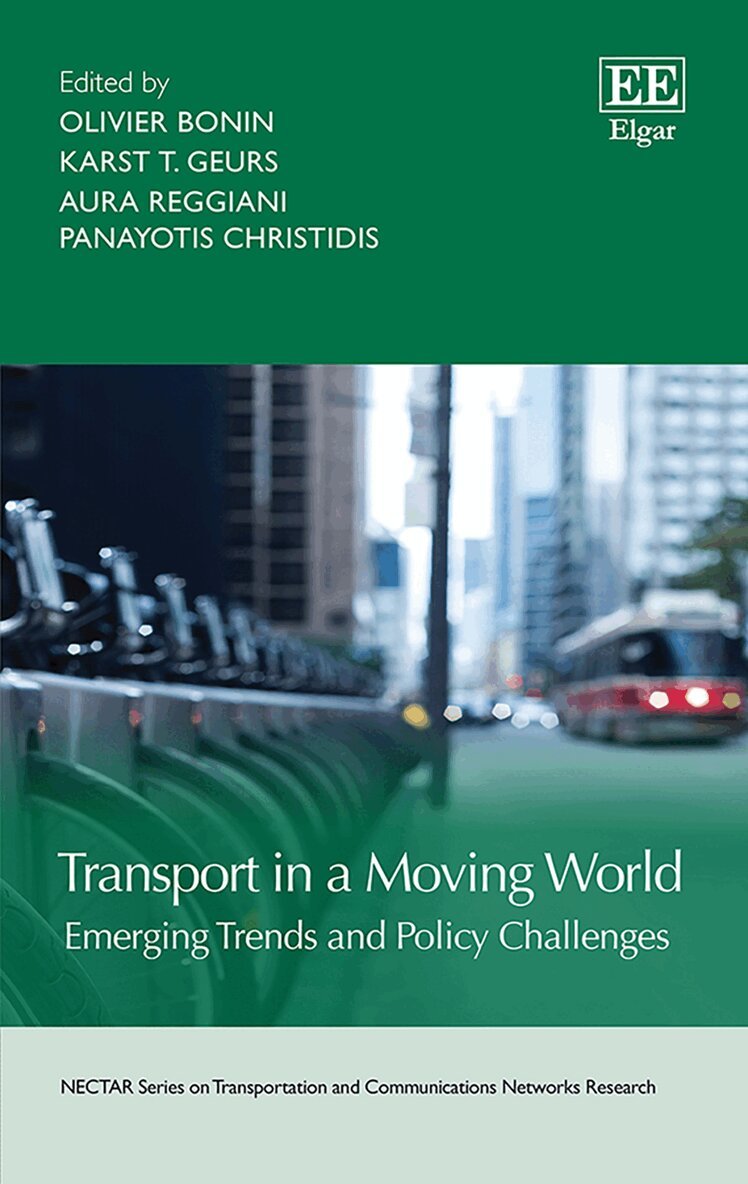
Recent changes in travel practices, triggered by the COVID-19 pandemic, raise the question of how cities and mobility systems are changing. Moreover, many local governments are accelerating their plans to reduce car traffic. This book comprises expert contributions taking multidisciplinary perspectives on transport in a moving world. It examines the joint transformations of mobility practices, urban planning, transport public policies and rapid technological development, within the context of an increasingly uncertain world.With state-of-the-art research and knowledge on the impact of digitalization in urban transport, the chapters examine the evolution of mobility practices, accessibility and urban planning and explore the evolution of planning and public policy practices. New paths and directions of urban and regional transport from both the research and policy viewpoints are covered in different scales and different geographical contexts.Transport in a Moving World grasps the important trends and challenges of soft mobility, tactical urbanism, accessibility planning and transport planning for students, scholars, policymakers and practitioners, and offers a portal to understanding ever-changing mobility practices.
Accessibility Analysis and Transport Planning
Challenges for Europe and North America
Inbunden, Engelska, 2012
1 978 kr
Skickas inom 7-10 vardagar
Accessibility is a concept central to integrated transport and land use planning. The goal of improving accessibility for all modes, for all people, has made its way into mainstream transport policy and planning in communities worldwide. This unique and fascinating book introduces new accessibility approaches to transport planning across Europe and the United States.The expert contributors present a wide variety of perspectives on transport and communication issues and explore their impacts on society at an international level. Best practice in both accessibility analysis and modelling are highlighted via widely interdisciplinary approaches. Moreover, future objectives and areas for research are clearly addressed. This book will prove an absorbing read for scholars, researchers and students working on accessibility issues across various academic fields including civil engineering, economics, geography, and the social sciences. Transport and urban planners will also find the book to be an invaluable reference tool. Contributors: K.W. Axhausen, X. Cao, C. Chorus, P. Christidis, Y. Crozet, M. de Bok, T. de Graaff, G. Debrezion, A. El-Geneidy, K.T. Geurs, A. Gjestland, A. Golub, D. Halden, J. Horning, N. Ibanez Rivas, K.J. Krizek, K. Lucas, K. Manaugh, K. Martens, D. McArthur, A. Mercier, P.L. Mokhtarian, T. Neutens, L. Osland, N. Ovtracht, A. Reggiani, P. Rietveld, I. Thorsen, B. van Wee, C. Zollig, B. Zondag
Accessibility, Equity and Efficiency
Challenges for Transport and Public Services
Inbunden, Engelska, 2016
1 786 kr
Skickas inom 7-10 vardagar
Leading researchers from around the world show, in this volume, the importance of accessibility in contemporary issues such as rural depopulation, investments in public services and public transport, and transport infrastructure investments in Europe. The trade-offs between accessibility, economic development and equity are comprehensively examined, and a variety of approaches to measuring accessibility and equality presented. The book's interdisciplinary contributions also provide different geographical contexts, from the US to various European and developing countries, and cover ex ante and ex post evaluation of transport investment.Improving transport accessibility is a main objective in transport policy and planning in developed and developing countries all over the world. Investment is motivated by the need to develop and/or reduce spatial or social inequalities. However, the economic and equity implications of investments in transport are not straightforward. The concepts of accessibility and equity can be defined and operationalized in many different ways, influencing outcomes and conclusions. Moreover, equity and efficiency goals are often conflicting. Accessibility models not only help to explain spatial and transport patterns in developed and developing countries but are also powerful tools to explain the equity and efficiency impacts of urban and transport policies and projects.This state-of-the-art overview of the accessibility-economic efficiency-equity relationship will appeal to researchers as well as transport and urban planners interested in accessibility issues and transport/regional developments.Contributors: P.R. Anciães, B. Büttner, K. Button, Z. Chen, P. Christidis, H. Demirel, T.P. Dentinho, J. Evans, K.T. Geurs, M. Kompil, K.J. Krizek, L. La Paix, D. Levinson, E. López, D.P. McArthur, P. Mogush, A. Monzón, R. Neiva, E. Ortega, L. Osland, C. Pakissi, R. Patuelli, B.A. Portnov, I. Thorsen, J. Ubøe, G. Wulfhorst
1 786 kr
Skickas inom 7-10 vardagar
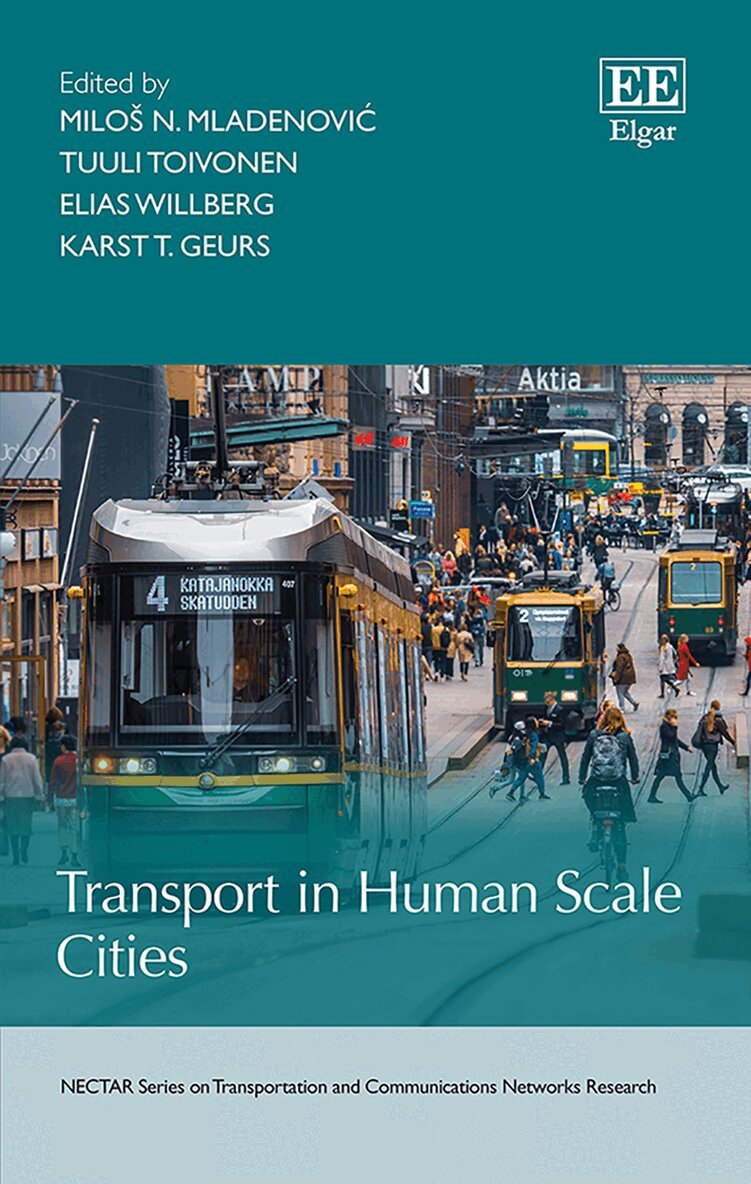
This timely book calls for a paradigm shift in urban transport, which remains one of the critically uncertain aspects of the sustainability transformation of our societies. It argues that the potential of human scale thinking needs to be recognised, both in understanding people on the move in the city and within various organisations responsible for cities. Taking a multidisciplinary approach with a focus on the human scale, expert contributors offer lessons for responsible innovation practices to advance the human scale urban mobility technologies. Chapters also offer new insights into the development of urban and transport planning processes, considering new data, methods and approaches. Drawing on specific examples, the book presents a critical analysis of key topics, including the relationship between transport and wellbeing, the relationship between accessibility and income, the mobility of the elderly and various transport planning and policy questions. Transport in Human Scale Cities will be a critical reading for scholars and students of transport studies, urban economics, and urban and human geography. Its arguments for broadening the discussion on humans in urban mobility systems and necessary actions for the transition out of the current car-dependent mobility regime will also benefit policy-makers and practitioners in these fields.