Kenichi Morita - Böcker
Visar alla böcker från författaren Kenichi Morita. Handla med fri frakt och snabb leverans.
4 produkter
4 produkter
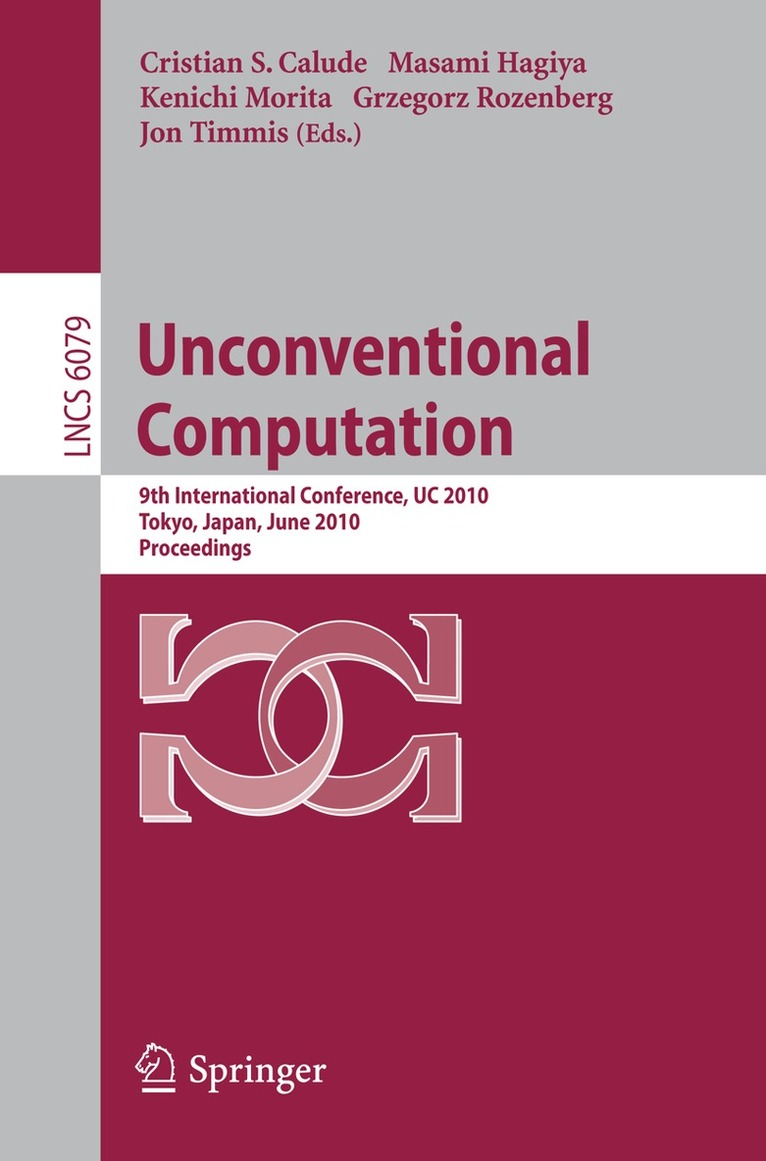
Unconventional Computation
9th International Conference, UC 2010, Tokyo, Japan, June 21-25, 2010, Proceedings
Häftad, Engelska, 2010
533 kr
Skickas inom 10-15 vardagar
The 9th International Conference on Unconventional Computation, UC 2010, was organized under the auspices of EATCS and Academia Europaea, by the University of Tokyo (Tokyo, Japan), and the Center for Discrete Mathematics and Theoretical Computer Science (Auckland, New Zealand). It was held in Tokyoduring June 21–25,2010(seehttp://arn.local.frs.riken.jp/UC10/). The venue was the Sanjo (Hilltop) Conference Hall at Hongo Campus of the University of Tokyo. Hongo Campus was formerly the residence of the Maeda family, one of the richest feudal lords in the Edo period of Japan. The Japanese garden in the residence is partially preserved, including the pond and the hill on which the conference hall is located. Within walking distance from Hongo Campus are Ueno park with many museums, the Akihabara area, which is now the center of Japanesepop culture, and the Korakuenamusement park/baseball stadium. The International Conference on Unconventional Computation (UC) series (seehttp://www.cs.auckland.ac.nz/CDMTCS/conferences/uc/)isdevotedto all aspects of unconventional computation — theory as well as experiments and applications. Typical, but not exclusive, topics are: natural computing including quantum, cellular, molecular, membrane, neural, and evolutionary computing, as well as chaos and dynamical system-based computing, and various proposals for computational mechanisms that go beyond the Turing model.
1 957 kr
Skickas inom 10-15 vardagar
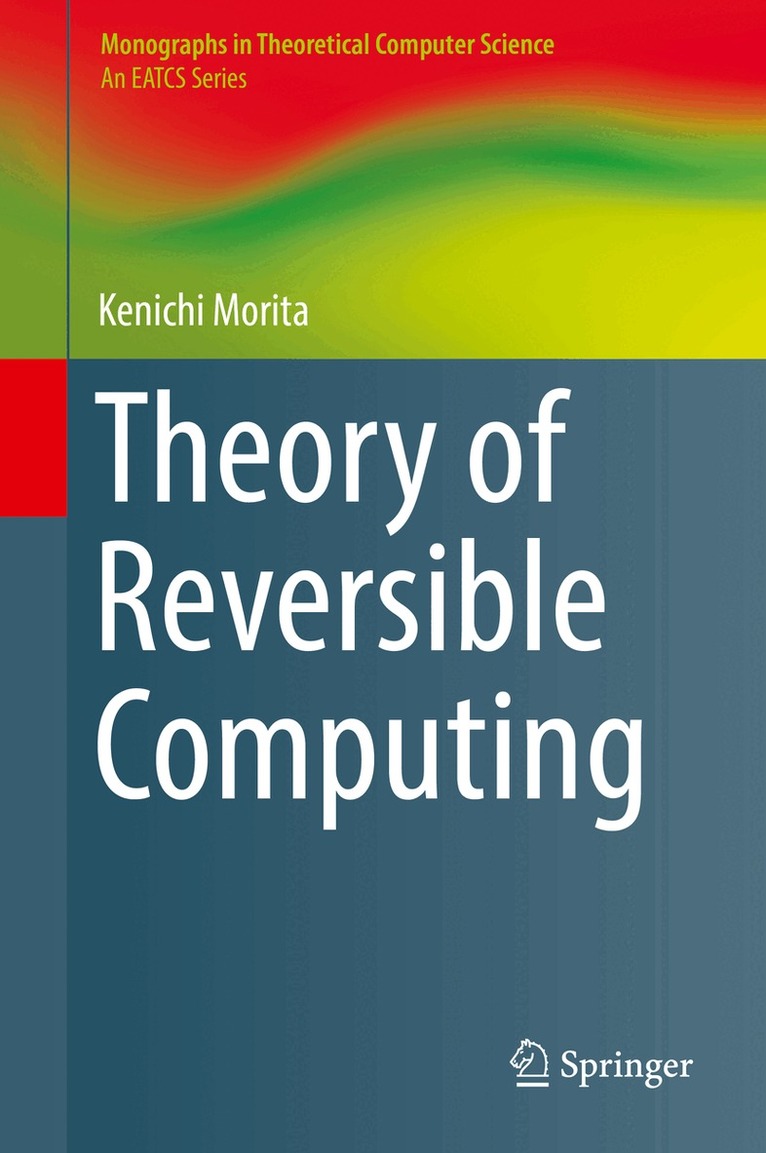
This book describes reversible computing from the standpoint of the theory of automata and computing. It investigates how reversibility can be effectively utilized in computing. A reversible computing system is a “backward deterministic” system such that every state of the system has at most one predecessor. Although its definition is very simple, it is closely related to physical reversibility, one of the fundamental microscopic laws of Nature. Authored by the leading scientist on the subject, this book serves as a valuable reference work for anyone working in reversible computation or in automata theory in general.This work deals with various reversible computing models at several different levels, which range from the microscopic to the macroscopic, and aims to clarify how computation can be carried out efficiently and elegantly in these reversible computing models. Because the construction methods are often unique and different from those in the traditional methods, these computing models as well as the design methods provide new insights for future computing systems. Organized bottom-up, the book starts with the lowest scale of reversible logic elements and circuits made from them. This is followed by reversible Turing machines, the most basic computationally universal machines, and some other types of reversible automata such as reversible multi-head automata and reversible counter machines. The text concludes with reversible cellular automata for massively parallel spatiotemporal computation. In order to help the reader have a clear understanding of each model, the presentations of all different models follow a similar pattern: the model is given in full detail, a short informal discussion is held on the role of different elements of the model, and an example with illustrations follows each model.
1 901 kr
Skickas inom 10-15 vardagar
This book describes reversible computing from the standpoint of the theory of automata and computing. It investigates how reversibility can be effectively utilized in computing. A reversible computing system is a “backward deterministic” system such that every state of the system has at most one predecessor. Although its definition is very simple, it is closely related to physical reversibility, one of the fundamental microscopic laws of Nature. Authored by the leading scientist on the subject, this book serves as a valuable reference work for anyone working in reversible computation or in automata theory in general.This work deals with various reversible computing models at several different levels, which range from the microscopic to the macroscopic, and aims to clarify how computation can be carried out efficiently and elegantly in these reversible computing models. Because the construction methods are often unique and different from those in the traditional methods, these computing models as well as the design methods provide new insights for future computing systems. Organized bottom-up, the book starts with the lowest scale of reversible logic elements and circuits made from them. This is followed by reversible Turing machines, the most basic computationally universal machines, and some other types of reversible automata such as reversible multi-head automata and reversible counter machines. The text concludes with reversible cellular automata for massively parallel spatiotemporal computation. In order to help the reader have a clear understanding of each model, the presentations of all different models follow a similar pattern: the model is given in full detail, a short informal discussion is held on the role of different elements of the model, and an example with illustrations follows each model.
Del 4 - Wspc Book Series In Unconventional Computing
Reversible World Of Cellular Automata: Fantastic Phenomena And Computing In Artificial Reversible Universe
Inbunden, Engelska, 2024
1 817 kr
Skickas inom 3-6 vardagar
This unique comprehensive compendium provides extensive studies on reversible cellular automata (RCAs), exhibiting a wide range of interesting phenomena similar to the Game-of-Life, a well-known irreversible CA.The useful reference text also introduces innovative approaches to constructing universal computers in a reversible cellular space. Numerous figures are included to illustrate the evolution of RCA configurations, and to elucidate theoretical results on RCAs. Additionally, readers can observe evolution processes of various RCAs on the free CA simulator Golly using supplementary files.