Klaus Armingeon – författare
Visar alla böcker från författaren Klaus Armingeon. Handla med fri frakt och snabb leverans.
11 produkter
Politics of Post-Industrial Welfare States
Adapting Post-War Social Policies to New Social Risks
Av Klaus Armingeon, Giuliano Bonoli
Inbunden, 2006
2512 kr
Lägg i varukorg
This new study assesses the welfare state to ask key questions and draw new conclusions about its place in modern society.It shows how the welfare states that we have inherited from the early post-war years had one main objective: to protect the income of the male breadwinner. Today, however, …
Politics of Post-Industrial Welfare States
Adapting Post-War Social Policies to New Social Risks
Av Klaus Armingeon, Giuliano Bonoli
Häftad, 2007
910 kr
Lägg i varukorg
This new study assesses the welfare state to ask key questions and draw new conclusions about its place in modern society.It shows how the welfare states that we have inherited from the early post-war years had one main objective: to protect the income of the male breadwinner. Today, however, …
Politics of Post-Industrial Welfare States
Adapting Post-War Social Policies to New Social Risks
Av Giuliano Bonoli, Klaus Armingeon
E-bok, 2007
1074 kr
Lägg i varukorg
This new study assesses the welfare state to ask key questions and draw new conclusions about its place in modern society. It shows how the welfare states that we have inherited from the early post-war years had one main objective: to protect the income of the male breadwinner. Today, however, …
Politics of Post-Industrial Welfare States
Adapting Post-War Social Policies to New Social Risks
Av Giuliano Bonoli, Klaus Armingeon
E-bok, 2007
1051 kr
Lägg i varukorg
This new study assesses the welfare state to ask key questions and draw new conclusions about its place in modern society. It shows how the welfare states that we have inherited from the early post-war years had one main objective: to protect the income of the male breadwinner. Today, however, …
OECD and European Welfare States
Av Klaus Armingeon, Michelle Beyeler
Inbunden, 2004
2058 kr
Lägg i varukorg
The OECD includes the richest nations in the world. It issues recommendations on economic and social policies. Is its counsel on welfare state policies coherent? And is it followed by member states in Western Europe? These are the guiding questions of this book, which is a first to deal with such …
Staat und Arbeitsbeziehungen
Ein internationaler Vergleich
E-bok, 2013
554 kr
Lägg i varukorg
Diese Arbeit ist die leicht überarbeitete Fassung meiner Heidelberger Habilita tionsschrift. In ihr geht es um die Regeln, die die Beziehungen zwischen staatli chen Stellen, Arbeitgebern und Gewerkschaften normieren und um die Be dingungen, unter denen eine Veränderung dieser Regeln stattfindet. …
Deutschland, Österreich und die Schweiz. Die politischen Systeme im Vergleich
Ein sozialwissenschaftliches Datenhandbuch
Av Markus Freitag, Klaus Armingeon
E-bok, 2013
574 kr
Lägg i varukorg
Deutschland, Österreich und die Schweiz. Die politischen Systeme im Vergleich
Ein sozialwissenschaftliches Datenhandbuch
Av Klaus Armingeon, Markus Freitag
Häftad, 2012
568 kr
Lägg i varukorg
Staat und Arbeitsbeziehungen
Ein internationaler Vergleich
Häftad, 1994
517 kr
Lägg i varukorg
Diese Arbeit ist die leicht überarbeitete Fassung meiner Heidelberger Habilita tionsschrift. In ihr geht es um die Regeln, die die Beziehungen zwischen staatli chen Stellen, Arbeitgebern und Gewerkschaften normieren und um die Be dingungen, unter denen eine Veränderung dieser Regeln stattfindet. …
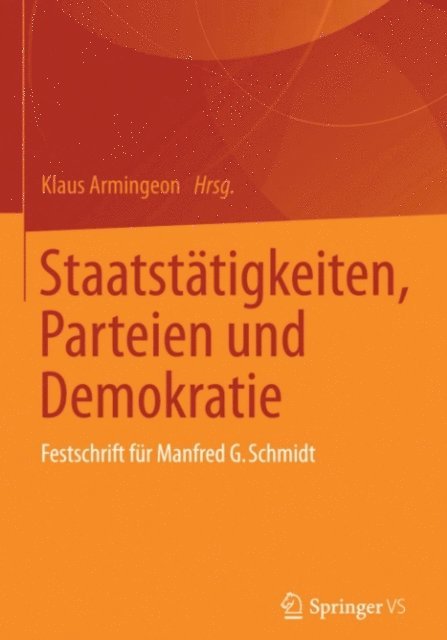
Staatstätigkeiten, Parteien und Demokratie
Festschrift für Manfred G. Schmidt
Av Klaus Armingeon, Klaus Armingeon
Inbunden, 2013
670 kr
Lägg i varukorg
Manfred G. Schmidt ist einer der führenden Politikwissenschaftler Europas. Drei Themen bilden Schwerpunkte in seinem reichhaltigen Werk. Machen Parteien einen Unterschied für das staatliche Handeln? Diese Frage bildet den ersten Schwerpunkt seines Schaffens: In welchen Politikbereichen und unter …
Staatstätigkeiten, Parteien und Demokratie
Festschrift für Manfred G. Schmidt
E-bok, 2013
910 kr
Lägg i varukorg
Manfred G. Schmidt ist einer der führenden Politikwissenschaftler Europas. Drei Themen bilden Schwerpunkte in seinem reichhaltigen Werk. Machen Parteien einen Unterschied für das staatliche Handeln? Diese Frage bildet den ersten Schwerpunkt seines Schaffens: In welchen Politikbereichen und unter …